
“Just find an open field and add a safety waiver” is popular advice for hamster ball for humans rentals. It misses the booking problems that can stop the activity before anyone climbs inside: the unit may not fit the site, the anchors may not work on its surface, or the provider may not have the paperwork the venue requires.
Treat the rental as an approval decision, not just an entertainment choice. Get the exact unit specifications, written rider limits, an anchoring plan, and insurance documents before you commit. If any of those details are missing, the booking isn't ready to sign off.
What a Human Hamster Ball Rental Is
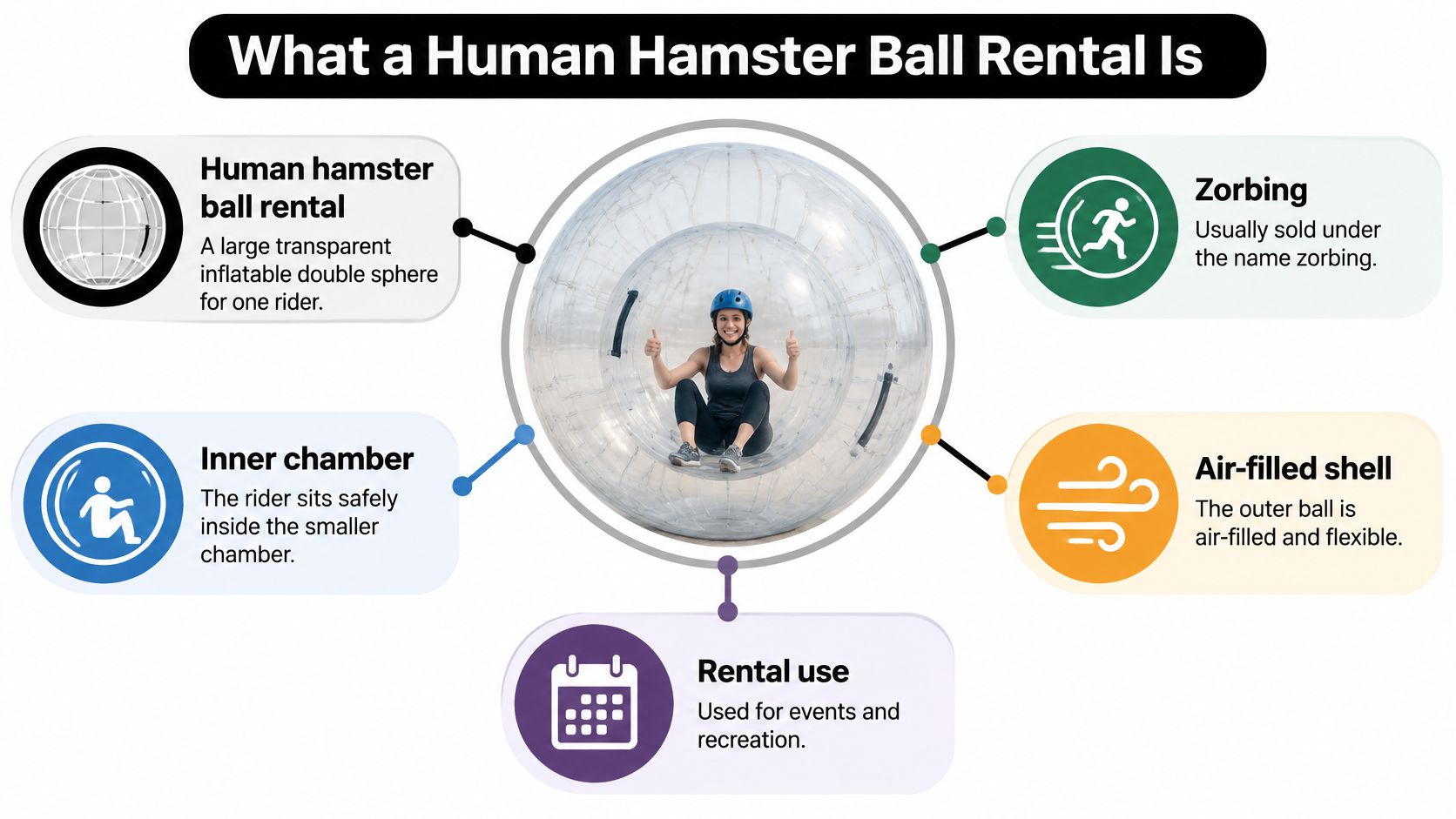
A human hamster ball rental is a large, transparent inflatable double sphere with a smaller inner chamber for the rider. It is usually sold under the name zorbing. The informal phrase hamster ball refers to this inflatable attraction, not the rigid ball designed for a small animal.
The air-filled space between the two layers cushions impacts and steadies the roll. Vano Inflatables' product listing gives diameters of 2.3 to 3 meters and a unit weight of approximately 60 kilograms for this type of unit. At that scale, delivery, inflation, handling, and teardown take crew time and floor space. Ask in writing who moves it, who inflates it, and what equipment they bring.
You will see two formats. One runs on flat ground such as open grass or a gym floor. The other uses a downhill slope or short track for a larger festival layout. The format changes the footprint, the anchoring plan, and the staffing you must approve. “We have a hamster ball” does not define what will arrive.
Planners promoting across neighborhoods sometimes review ZIP code targeting examples when scheduling outreach, but outreach never settles the venue question. Only the exact unit size and run format do.
Approval test: If the provider can't state the diameter, weight, and format of the exact unit they'll deliver, the booking isn't specified enough to approve.
Rider, Operator and Session Limits to Request
Limits belong to the specific model, not to the rental company in general. A generic “adults only” sign or a vague statement about weight doesn't tell event staff who may enter, how many people can ride, or who has authority to stop a session.
Ask for the following details in writing. Numeric limits should come from the manufacturer's documentation for the unit being rented, not from a universal rule.
| Limit | What the provider must state | How staff check it on the day |
|---|---|---|
| Rider weight | Maximum weight per rider for the exact model | Staff check against the posted limit at entry |
| Rider age | Minimum and maximum age, including rules for supervised younger riders | Check wristband or roster at the queue |
| Riders at once | Maximum simultaneous occupants per unit | Count riders at the run area before each start |
| Attendants per unit | Operator-to-rider ratio written into the plan | Assign a named, trained staff member to the run area |
| Run time and rest gap | Maximum session length and cool-down between riders | Attendant keeps a timer for each run |
| Weather shutdown | Written thresholds for wind, rain, heat, and cold | Check the reading before every session |
| Footwear and loose items | Whether closed shoes are required, and which items must be removed | Post the rules and check quickly at entry |
The CPSC safety bulletin for commercial inflatable amusement devices directs operators to follow the manufacturer's requirements for maximum rider load, occupancy, operating temperature, inspections, and emergency procedures. That's why each answer needs to match the actual model and operating plan.
Make limits enforceable at the queue
Staff need a clear way to refuse entry when someone doesn't meet a rule. Don't leave the attendant to negotiate with a disappointed guest or improvise an exception under pressure. Put the eligibility rules and the attendant's authority to stop a run in the event plan and rental contract.
Send the provider the seven questions in the table as written questions. Ask for written answers and the supporting model documentation where applicable. Treat any unanswered item as a no until the provider supplies the information.
Safety Controls That Stop Riders Getting Hurt
Control of movement decides the outcome. A sealed ball that rolls off line, tips into a barrier, or strikes another rider creates bruises, grazes, and falls even when the shell holds pressure. Published accounts of zorbing also cite harness failure, breathing difficulty in sealed units, and water hazards. Those reports do not set an injury rate. They show why the operating area and the stop procedure matter more than the product photo.
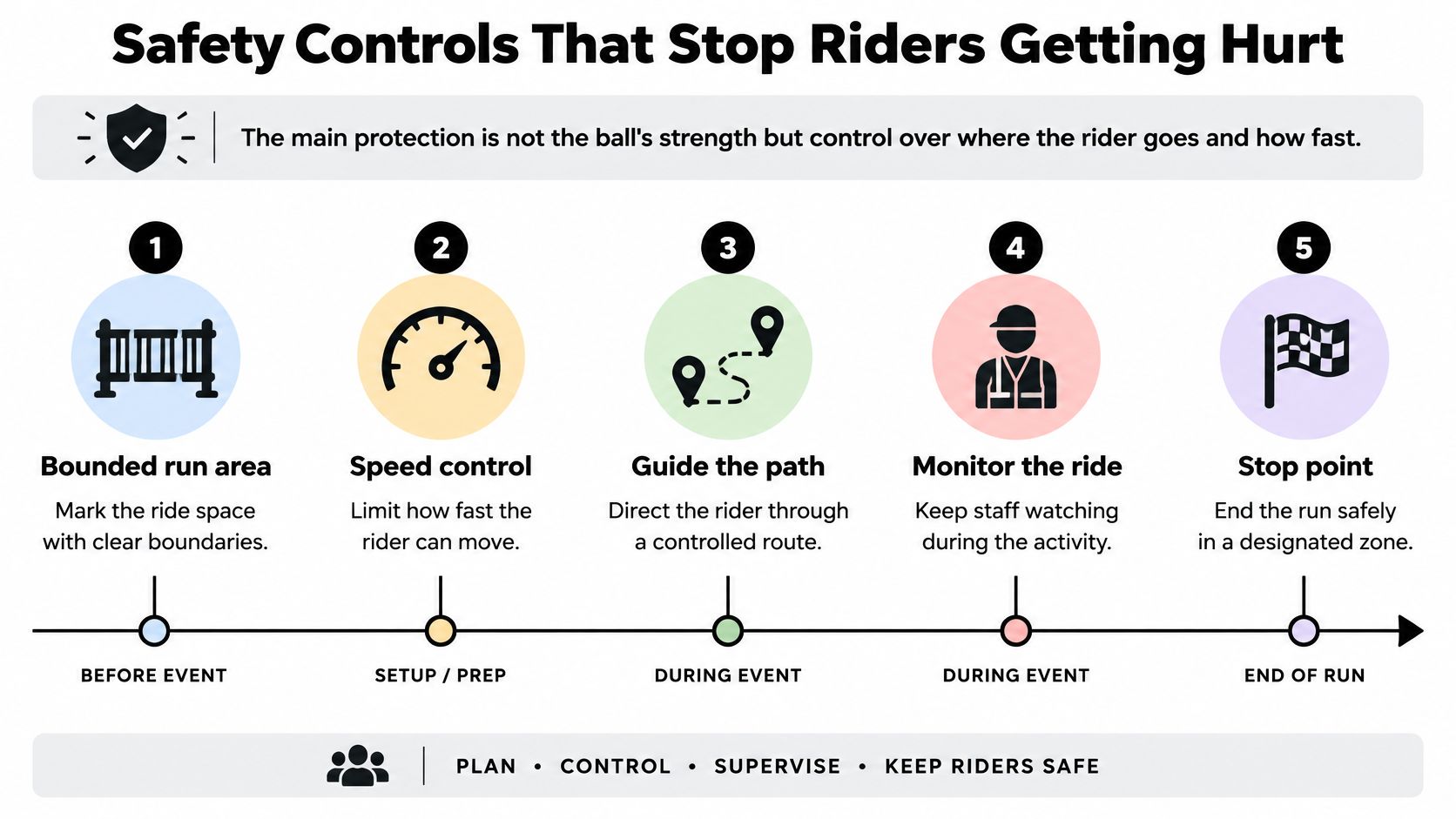
Set the area in event-day order. Mark a bounded run lane with cones or barriers. Keep entry and exit apart so waiting riders never stand in the roll path. Station the attendant where the full lane stays visible and the activity can be stopped at once if riders collide, lose orientation, or approach the edge. Name in writing who calls the stop and who contacts event response staff.
Run the pre-session check
Work the same routine before the first rider enters:
- Confirm the rated rider load and maximum occupancy on the product sheet.
- Walk the outer surface and seams for tears, damage, or faulty valves.
- Check any harness or restraint, including fittings.
- Brief riders on entry, exit, and the stop signal.
- Run one empty test cycle.
- Confirm the written weather shutdown thresholds.
The CPSC guidance on commercial inflatable devices calls for anchors at every designated point and prohibits attachment to vehicles or other nonstationary objects. The TSSA inflatable training material identifies ASTM F2374 as the relevant commercial practice where an inflatable enclosure or obstacle component forms part of the attraction.
Keep sessions short. Give anyone who feels dizzy or overheated a clear, direct route out instead of asking them to wait until the run ends.
I recommend a separate written plan for each moving-rider attraction on the program. Phantom Entertainment, for example, lists Human Foosball, Hungry Human Hippos, and Human Whack A Mole alongside other inflatables, and each needs its own staffing and shutdown rules. Use the format in this mechanical bull safety checklist to shape that separate zorbing plan, instead of borrowing procedures from another ride.
Venue Space, Anchoring and Surface Specifications
A human hamster ball rental can fit a site and still be unbookable there. It may fit on a grass athletic field but fail under a low gym ceiling. It may fit a parking lot physically but be unsuitable if the surface cannot accept stakes and the provider has not approved another anchoring method. The bookings that fail at this stage usually fail on measured clear space, approved anchoring or surface conditions, not on whether riders want a turn.
Start with measured clear space, not an estimate of the whole venue. Treat the figures below as planning values for a tracked unit and have the provider confirm the actual dimensions and anchoring plan for the unit you are booking.
| Item | Planning value | Planning note |
|---|---|---|
| Track length | 73 ft (about 22 m) | Measure the full run-out; a long unit needs a straight approach and exit. |
| Track width | 12 ft | Measure clear width, not the width of the lawn. |
| Overhead clearance | At least 12 ft | Check trees, lighting, gym ceilings and banners. |
| Recommended operating footprint | About 75 by 14 ft | Add entry, exit and spectator buffers outside this. |
| Anchor points | At least four | Confirm against the manufacturer's anchoring diagram. |
| Anchor component breaking strength | 3 times the calculated working load | Ask for the calculation sheet. |
| Tie-down rope where the manufacturer gives none | 1/2-inch solid-braided polypropylene, 3,700 lb minimum tensile strength, 370 lb safe working load | Fallback only; ask for the manufacturer's written rope specification. |
| Surface | Flat, open ground where stakes can be installed | If stakes cannot be installed, get written approval for engineered ballast. |
The anchoring plan should prove how the equipment resists displacement and list every connection. Training material addressing ASTM F2374-22 calls for an engineered anchorage system with at least four anchor points, and says anchor components' minimum breaking strength should be three times their calculated working load. Ask for the manufacturer's anchoring calculation or approved ballast schedule, then check each connection before operation. The TSSA inflatable training material also notes that where the manufacturer doesn't specify the rope, staff recommends 1/2-inch solid-braided polypropylene rope with a 3,700-pound minimum tensile strength or a 370-pound safe working load. The manufacturer's higher requirement takes precedence.
Approve the site, not just the footprint
Stakes won't work in asphalt or concrete. In those locations, use ballast only when the manufacturer explicitly approves an engineered option and supplies the required plan. A verbal assurance isn't an anchoring specification. Wind, uneven ground and overhead hazards such as trees, light fixtures and banners can also make a spacious site unsuitable. No provider can approve an asphalt site from a photo and a rough footprint. I would reject a site approval that arrives as a text message without a drawing or calculation.
Send the provider the venue's measured clear width, length, height and surface. Include the locations of hard surfaces and overhead obstructions, and ask the provider to confirm that the unit and anchoring plan are approved for that specific site. If a required measurement or surface condition doesn't meet the plan, choose a different site or unit. For weather-related planning, use the same discipline with wind and inflatable safety.
Who Can Ride, Waivers and Insurance Paperwork
Eligibility decides who may enter; inclusion determines how everyone else can still take part. A waiver doesn't settle either question. Use the provider's posted age, weight, and footwear rules, and schedule separate sessions when mixed-age groups have different eligibility requirements.
Before the event, give guests a short, private screening checklist that asks whether they have a mobility limitation, balance or dizziness concern, sensory sensitivity, heat or breathing concern, or motion sickness. Staff shouldn't give medical advice. They should explain the activity plainly, let guests decide for themselves, and make opting out easy and free of embarrassment.
Offer meaningful roles for guests who don't ride. A person can serve as a timer or referee, take a seated role with a clear job, or join an equivalent non-rolling activity. “Everyone can ride” marketing can create pressure and confusion when the unit's actual rules exclude some guests. A clear alternative lets people stay involved without asking staff to bend the rules.
Brief riders and check the documents
Before entry, provide the safety briefing and have riders sign the provider's waiver. A waiver is paperwork, not a substitute for trained supervision, a controlled entry and exit, or a workable emergency plan.
Request the provider's certificate of insurance and check the venue's requirements before the event. Some venues may require the organiser to be named as an additional insured, so confirm the exact wording with the venue and provider rather than assuming a standard certificate will satisfy it.
Staff can use a short, consistent briefing such as this:
“Follow the attendant's directions, use the marked entry and exit, and stop when staff signal. Tell us if you feel unwell or want to leave. You can opt out at any time.”
Pricing and the Factors That Change the Quote
The headline rental fee is rarely the number that decides whether a human hamster-ball booking works. A quote can look low because it assumes a flat, vehicle-accessible surface, one attendant, and a certificate your venue has already accepted. Add the missing labor, ballast, delivery time and paperwork back in before you compare two prices.
| Cost driver | How it changes the quote | What to ask the provider |
|---|---|---|
| Unit type and size | Larger or track-based formats need more crew and equipment | Which exact unit, with its diameter and weight? |
| Delivery distance | Transport and setup time rise with distance | Are delivery and setup included in the price? |
| Event length | Hourly, session, or day rates change the total | Is the price per session, per hour, or per day? |
| Operators on site | Attendant ratio adds staff hours | How many trained attendants are included? |
| Site preparation | Flat ground, anchoring, or ballast adds time | Does the quote assume a surface you've confirmed? |
| Insurance and paperwork | Certificates and additional insured wording may carry a fee | Is the certificate included in the quote? |
| Weather backup | Rain or heat may require an indoor site or a rescheduling term | What happens to the fee if weather stops use? |
Ask for an itemised written quote instead of a single total. Match offers line by line: exact unit and size, number of sessions or hours, attendant ratio, delivery and setup, surface and anchoring requirements, and whether insurance documentation is included. Phantom Entertainment's quote request page is one route to request pricing, but make the quote name the attraction and terms you need. A provider that cannot break out those lines is hard to compare fairly.
Published market rates for human hamster-ball rentals are thin, so do not anchor a school or community budget to a single advertised figure. Check the deposit, cancellation window, and weather terms before paying. Find out whether a weather shutdown means a refund, a rescheduled event, or a fee that remains payable.
I'd budget staff hours, delivery, and site preparation before the rental fee, because those lines are easy for schools and community groups to overlook when they compare headline prices.
Sign-Off Gate Before You Book
Don't sign until three sets of details match in writing: the rider and session limits, the venue measurements and anchoring approval, and the insurance certificate with any additional-insured wording the venue requires. Keep the provider email focused on those items, then add the emergency and weather terms below.
Ask the provider to confirm the emergency procedure and name the person responsible for holding and following it on event day. Get the written weather shutdown criteria and the fee, refund, or rescheduling terms that apply if use stops. If an answer is incomplete, ask for the missing document or wording before you approve the booking.
Phantom Entertainment's public listings show inflatables and mechanical bulls in Allentown, Carlisle, Hanover, and Harrisburg, as well as inflatables in Maryland, New York, and Pennsylvania. Those listings don't name a human hamster ball, so ask directly whether one is available for your date; if it isn't, compare the company's listed inflatable options for a different fit.
Book only when the venue measurements, rider limits, and insurance certificate all match in writing.
If a human hamster ball isn't available for your event, Phantom Entertainment offers inflatables and other event attractions that can be considered for school, company, and community gatherings. Visit Phantom Entertainment to discuss your event and identify options that fit your venue and paperwork requirements.
Ready to Book Your Event?
PA state-inspected, fully insured since 1979. Call us or get a free quote today.