
Among 49 pediatric patients treated for inflatable-amusement-device injuries from January 2014 through June 2024, 35 required surgery, according to a peer-reviewed study published in 2025. That's a hospital patient group, not a measure of every child's risk, but it makes the stakes clear: bounce house safety rules need an operator who enforces them, not just a sign beside the entrance.
The practical approach is an event-specific sign-off. Each rule needs an operating limit, someone responsible for enforcing it, and a place to record the decision. Inspection, staffing, and weather must all pass together before guests enter.
Bounce House Safety Rules at a Glance
A rental reservation doesn't establish that an inflatable is ready to operate. Neither does a current inspection document by itself. The lead operator must connect the equipment's condition with today's location, expected users, staffing, and weather.
Use the following as an opening-control sheet, not a substitute for the manufacturer's manual or applicable regulations. Pennsylvania's affidavit requirements are jurisdiction-specific, while the staffing and wind controls must also be checked against any stricter manufacturer or venue requirements.
Core Bounce House Safety Rules and Thresholds
| Rule | Requirement or threshold | Enforcement or documentation |
|---|---|---|
| Pre-use inspection | Affidavit required before operation in Pennsylvania | Signed inspection affidavit kept on site |
| Re-inspection | In Pennsylvania, every 30 days or after relocation, whichever comes first | Dated log entry and affidavit at each new site |
| Operators on tall slides | At least two for slides taller than 15 feet | Staffing roster for the event |
| Wind stop | Stop admission when gusts exceed 25 mph, or earlier under a stricter applicable limit | Weather log entry at each stop |
| Age and size separation | Per manufacturer label | Posted rules and attendant briefing |
| Capacity limit | Per manufacturer label | Headcount at the entrance |
| Supervision | Continuous adult supervision throughout use | Named attendant on the operator sheet |
| Shoes and hard objects | Removed before entry | Entrance check and posted sign |
The requirement column states what you enforce on the day. The documentation column identifies where the paperwork, enforcement responsibility, and sign-off belong.
Assign names, not departments. “School staff” or “event volunteers” isn't a usable supervision assignment. Write down the attendant's name, the relief arrangement, and who can authorize closure.
Prepare for injuries without confusing first aid with prevention. Adventure Medical Kits' guide to packing a summer first aid kit can help the event team organize supplies, but it doesn't replace trained supervision or an emergency-response plan.
Opening rule: If any row can't be signed off, the attraction isn't ready to open.
A failed item needs a correction, not a promise to watch it closely. Keep admission closed while the responsible person resolves the problem and records what changed.
How to Inspect and Set Up a Bounce House Safely
Treat setup as a controlled installation, not just unloading and switching on a blower. ASTM F2374's operating framework addresses installation, inspection, training, operation, and maintenance as connected responsibilities.
Keep the manufacturer's instructions available at the unit. An experienced installer still needs the model-specific anchoring layout, blower requirements, clearances, and user restrictions.
Work Through the Setup in Order
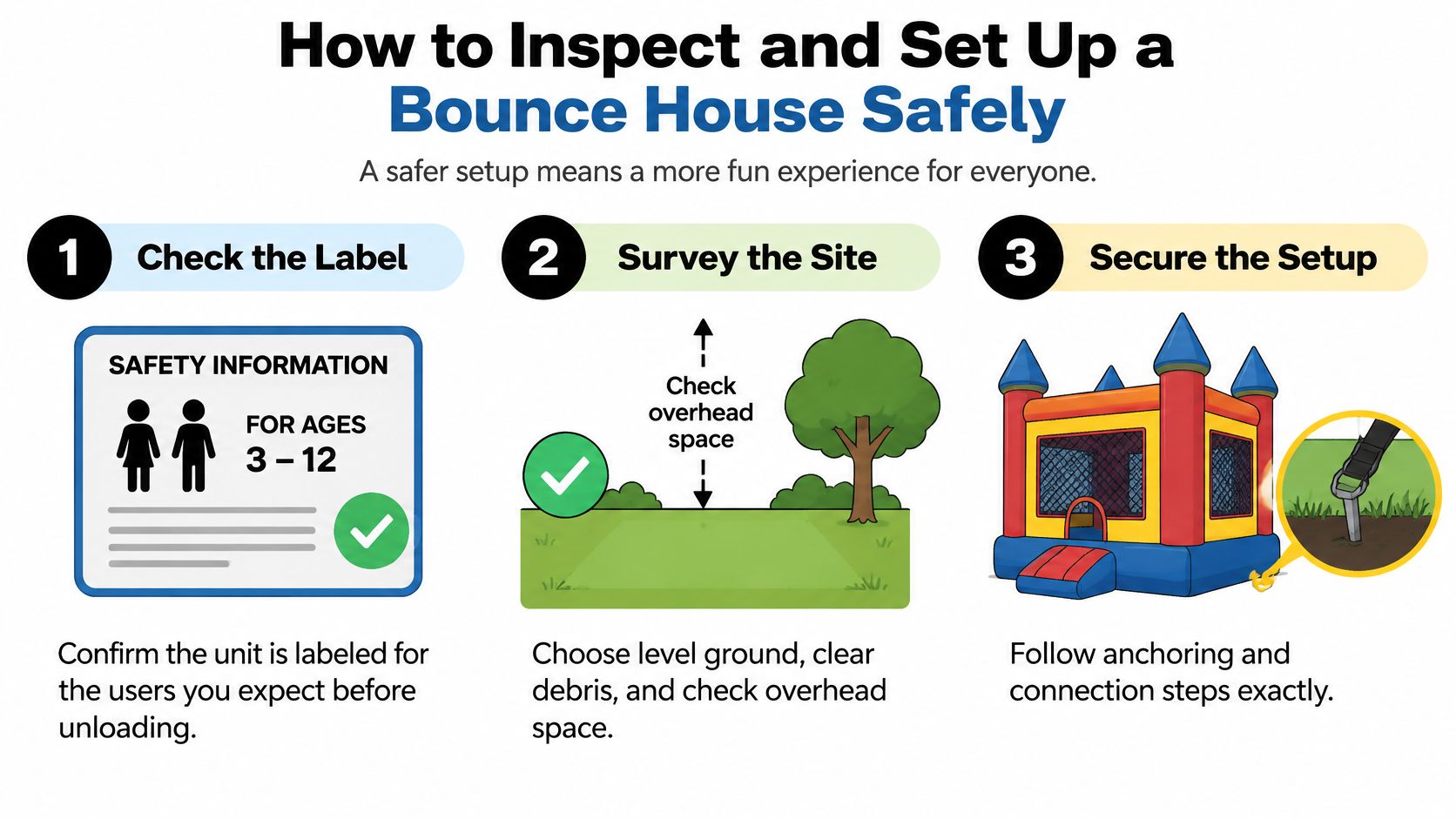
Check the label before unloading. Confirm that the unit is intended for the users and activities on the event schedule, because a toddler attraction isn't an interchangeable substitute for a school field-day unit. The easy mistake is choosing by appearance or footprint without reading the restrictions.
Survey the ground and overhead space before laying out the fabric. Choose a level location clear of debris, overhead lines, branches, and nearby structures, then measure the manufacturer's required clearances; eyeballing an apparently open lawn can miss an obstruction beside the exit.
Install the specified anchoring and blower protection. Follow the manufacturer's installation sequence, fit every required restraint and guard, and check blower positioning before operation. Leaving a guard aside because it complicates access creates an avoidable exposure to moving equipment.
Inflate the unit and inspect both surfaces. Walk the interior and exterior, checking fabric, stitching, seams, netting, safety buckles, debris, and entry and exit points; inspecting only the folded exterior can miss damage that becomes apparent under inflation.
Check the air and electrical connections. Inspect blower attachment, cords, plugs, and connections, and route cables away from walking paths with suitable protection. A running blower doesn't prove its connection is secure or its cable route is safe.
Brief attendants at their actual working positions. Have them identify their sightlines, admission controls, stop signal, and shutdown authority, because a general volunteer briefing can leave nobody certain who acts first.
Record defects and sign the completed check. Identify the unit, location, inspector, inspection time, corrective action, and opening authorization. Don't sign an incomplete checklist in anticipation of someone finishing the repair.
Use this visual as a setup reminder, not as a replacement for the model's instructions.
Separate Equipment Checks From Venue Checks
For venue teams, Facility Management Insights' OSHA compliance inspection checklist offers a separate framework for organizing workplace checks. It shouldn't be treated as an inflatable inspection standard or evidence that an attraction complies with amusement-device requirements.
When reviewing inflatable options for the event, settle the intended audience and installation space before finalizing the layout. Substituting equipment late can change clearances, electrical routing, and staffing needs.
Ready means more than inflated: the unit holds its intended shape, the installation matches its manual, unresolved defects are absent, and the lead operator has signed the checklist. The attendant should also be able to explain when admission must stop without searching for the paperwork.
Anchoring and Ground Checks That Prevent Tip-Overs
Inadequate inflatable anchoring was among the common problems identified when WorkSafe Victoria completed 380 inspections at 44 events and theme parks in 2024. Anchoring deserves its own inspection because an inflated unit can look ready while its restraints remain unsuitable for the site.
Check the attachment, strap, and ground connection as a complete assembly.
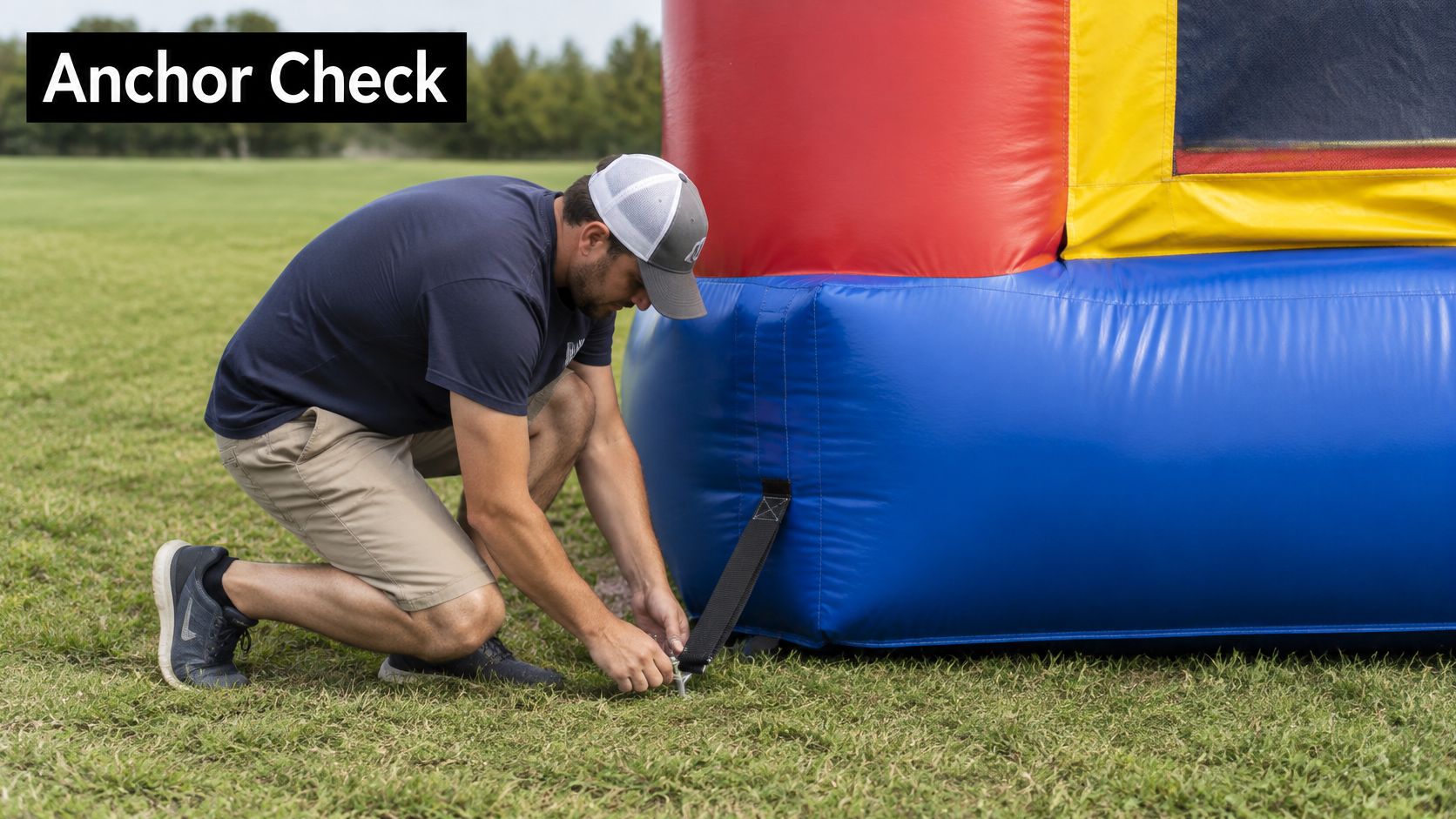
Start with flat, firm ground. Reject slopes, pooled water, soft patches, and broken pavement that prevent the specified anchoring arrangement from working. Confirm permission and underground-service clearance before driving stakes.
Use every anchor point shown in the manufacturer's layout. The manual determines anchor type, count, installation method, and any permitted ballast arrangement; convenient weights aren't automatically suitable ballast. Check straps and hardware, then apply a firm manual pull check after inflation without treating it as a substitute for the specified installation.
Anchoring Problems, Causes and Fixes
| Sign | Likely cause | Fix before reopening |
|---|---|---|
| Unit lifts or walks in light wind | Loose or missing stakes | Re-anchor every point and pull-test again |
| Tie-down straps frayed or stretched | Worn strap or damaged hardware | Replace the strap; don't reuse damaged parts |
| Unit tilts or the blower shifts | Uneven or soft ground | Relocate to suitable level ground and reset the anchors |
| Unit drifts toward one edge | Anchors set only on one side | Anchor all sides to the manufacturer layout |
These signs prompt closure and investigation, not a diagnosis made from a distance. A shifting blower, for example, also warrants checking its attachment and air tube.
Use the video as a discussion aid during the setup briefing, with the equipment manual controlling the actual installation.
Include the weather and wind planning guidance in the event review so the anchoring decision isn't separated from the forecast.
A unit that moves in light wind stays closed until the cause is corrected and every anchoring point is checked again.
Record the correction and the person authorizing reopening. Adding restraints doesn't authorize operation beyond the equipment's weather limits.
Supervision, Staffing and Stop Conditions
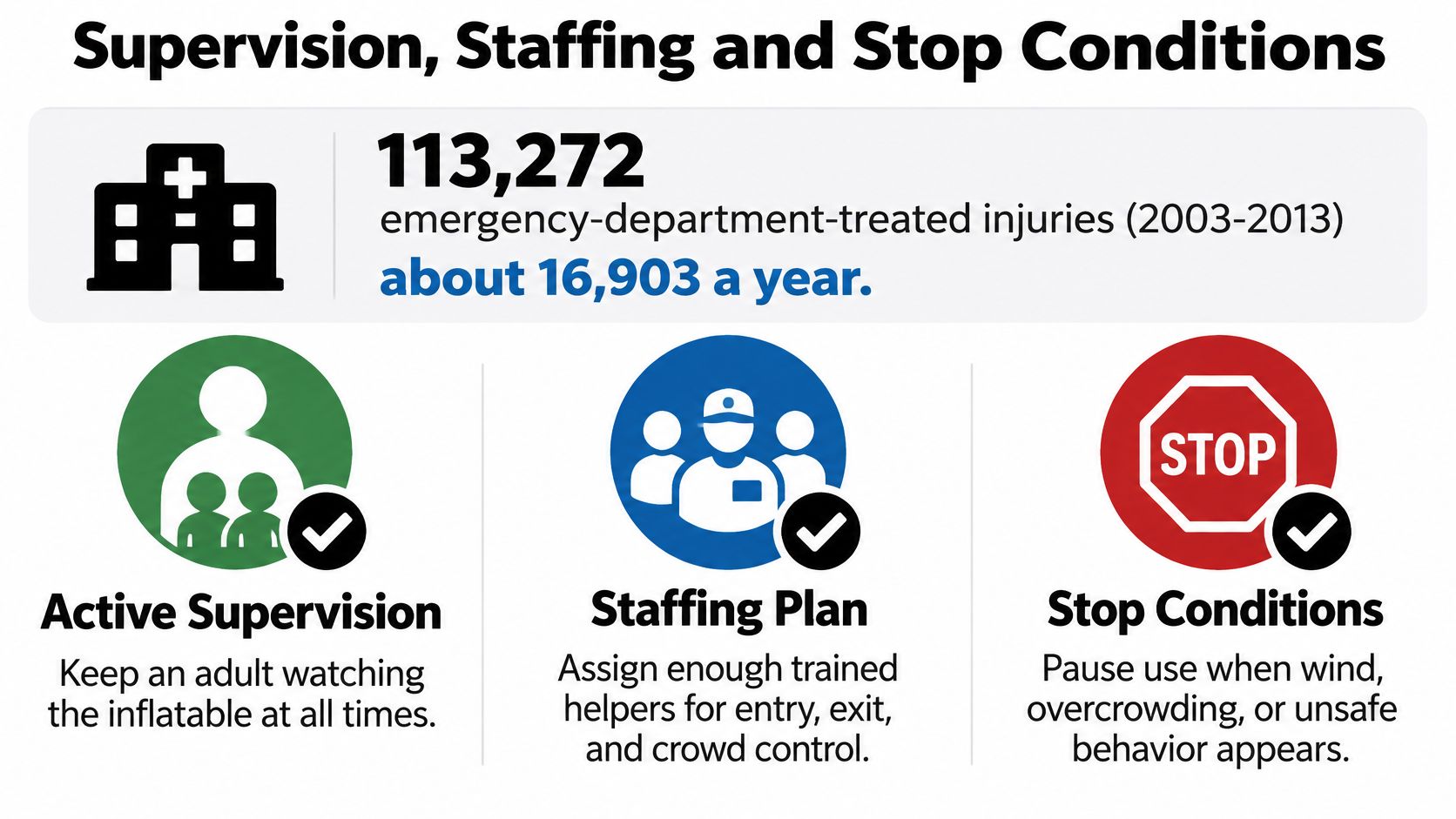
The U.S. Consumer Product Safety Commission estimated 113,272 emergency-department-treated injuries associated with inflatable amusements from 2003 through 2013, covering residential and commercial equipment. Its incident review identified improper operation, inadequate supervision, and unsafe setup as primary problems.
Supervision is an operating task, and like every other rule in this plan it needs three things on the day of the event: a threshold, an enforcement step, and a written record. The attendant needs a clear view, a defined responsibility, and permission to interrupt play even when guests or organizers object.
Give Operators Clear Instructions
Staff for the attraction and its sightlines. Position an adult attendant to watch the entrance and interior continuously, adding coverage where the layout blocks observation. As working limits, this plan assigns at least two operators to slides taller than 15 feet and stops admission when gusts exceed 25 mph. The manufacturer's label and applicable regulations control wherever they set stricter requirements, and the stricter figure is the one that goes on the sign-off sheet.
Control admission by the actual label. Match users to the permitted age and size group, and count occupancy at the entrance rather than estimating from outside. When guests don't form a compatible group, organize separate turns instead of expecting smaller users to protect themselves.
Give the weather monitor an explicit job. Review the forecast, measure on-site wind with an anemometer, and record conditions where the lead operator can check them. A weather app is useful for planning, but it doesn't replace observing gusts at the installation, and the log entry is what makes the stop decision auditable.
Close before conditions become unmanageable. At the applicable wind limit, stop admission, unload users, deflate according to the manufacturer's procedure, and secure the equipment against movement. Treat lightning and heavy rain as stop conditions under the venue's emergency plan, including moving guests to appropriate shelter.
Don't mistake a threshold for a target. If the unit becomes unstable, visibility deteriorates, or the operator can't maintain control, close it without waiting for a particular reading.
Use the checklist below to reinforce the briefing at the operator station.
Handle an Incident Without Creating Another Hazard
Rehearse the emergency sequence before opening. Stopping use doesn't always mean immediately switching off the blower while people remain inside. Keep the structure supported where safe while users exit, unless the emergency or manufacturer's instructions require a different response.
- Close admission and stop play. Direct unaffected users to a controlled exit and keep spectators away from the response area.
- Assist the injured person within the responder's training. Call emergency services when needed, give the exact site location, and send someone to guide responders.
- Record the facts promptly. Enter the time, observed conditions, occupancy, equipment identification, witness details, and actions taken in the incident log.
- Keep the attraction closed pending assessment. Record corrective action and reopening authorization, and complete any required reporting before returning it to service.
Use ASTM F2374 as the voluntary operating benchmark, alongside applicable state requirements, venue rules, and manufacturer instructions. A standard provides an operating framework, not blanket approval for every location or condition.
The recurring failures are an unattended supervision post, incompatible age or size groups, shoes or hard objects inside, excess occupancy, and continued operation as weather worsens. Address those directly in the briefing rather than relying on "use common sense."
For events with several attractions, the same named-operator and stop-authority approach is useful when reviewing mechanical bull safety planning, although equipment-specific procedures remain separate.
Keep the Attendant Effective
- Count both directions. Track entries and exits so the working headcount stays accurate.
- Interrupt dangerous behavior. Stop rough play, flips, and pile-ups immediately.
- Protect the entrance position. Keep an adult there rather than borrowing that person for unrelated event work.
- Arrange relief. Rotate attendants during long events, with an explicit handover before the outgoing operator leaves.
Sign Off Your Bounce House Plan Before Guests Arrive
Assemble an event-specific sign-off packet before the queue forms. Put the unit identifier, location, event date, and lead operator's name on the cover so nobody confuses a document from another attraction or installation with today's approval.
Keep the packet accessible to operators and the venue manager. A document stored in an office isn't much help when the entrance attendant needs to verify a restriction.
Build a Packet Someone Can Audit
- Inspection affidavit. Include the applicable signed affidavit and the next inspection trigger, including relocation where required.
- Pre-opening checklist. Keep the lead operator's signed checks with recorded defects and completed corrective actions.
- Staffing roster. Name attendants, relief personnel, the weather monitor, and the person authorized to reopen.
- Weather and incident forms. Prepare fields for time, observations, closure decisions, actions, and signatures before anything happens.
- Manufacturer restrictions. Include a readable copy of the label and accessible operating instructions.
- Venue documents. Have requested insurance certificates and safety documentation ready for handover.
Treat insurance and inspection paperwork as different documents. An insurance certificate doesn't demonstrate that today's installation passed inspection, and an inspection doesn't establish insurance coverage.
Make the Entrance Rules Usable
Post the permitted user group, capacity, shoes-off rule, prohibition on hard objects and flips, and the weather closure rule in plain language. Put the sign where waiting guests can read it before reaching the attendant, not behind the inflated entrance.
Give the attendant a short explanation for refusals: the equipment's limits determine admission, not a parent's permission. If a guest challenges a decision, the lead operator should support the attendant rather than negotiate a safety exception.
Final release: No unresolved defect, staffing gap, or unsafe weather condition gets carried into opening.
Walk the entrance, operator positions, and document station together before admitting guests. Confirm that every row of the rules table has a named owner and a completed sign-off, then record the opening authorization.
Phantom Entertainment offers inflatable attractions, including Jungle Bounce, Ladybug Bounce, and Megabounce, and lists inflatables for Maryland, New York, and Pennsylvania. Visit Phantom Entertainment to review the options and discuss your event's users, setup space, staffing needs, and safety documentation before booking.
Ready to Book Your Event?
PA state-inspected, fully insured since 1979. Call us or get a free quote today.