
The event opens in a few hours. The ride is assembled, the staff is on site, and the venue manager asks for the inspection certificate. The rental company sends a certificate of insurance, the inspector has a report, and someone mentions an affidavit and a decal. Each document may be legitimate, yet the event can still have a compliance gap because the paperwork doesn't describe the same approval.
That's the operational reality behind state inspection requirements for mobile amusements. An inspector checks the ride. A state or local authority may issue permission to operate. The venue may require insurance, setup records, emergency procedures, and proof that the attraction matches the approved itinerary. Treating those items as one interchangeable “safety document” is what creates last-minute problems.
The Morning a Compliance Gap Almost Shut Down the Event
At the edge of a school field, the planner is moving between three conversations. The venue wants a certificate of insurance, the ride operator is looking for the inspection paperwork, and the inspector is asking whether the attraction has been modified since its last review. The documents exist, but nobody has confirmed that the ride name, serial number, location, permit status, and setup configuration line up.
That distinction matters. A certificate of insurance, often called a COI, demonstrates insurance coverage and may identify the venue or organization as an additional insured. It doesn't prove that the ride passed its state inspection. An inspection certificate or report records the technical review, but it may not be the operating permit or decal that authorizes public use.
The word affidavit creates another common trap. In states that require an owner to file one before operation, the affidavit is part of the compliance process, not a substitute for the inspection itself. An itinerary can also matter for traveling operators because the state or venue may need to know where the ride is being erected and when it will operate.
Practical rule: Keep the inspection certificate, operating permit, COI, affidavit, itinerary, and operator records together, but never assume one document replaces another.
The morning schedule should therefore run in a defined order. First, confirm that the correct attraction arrived. Next, verify the setup, inspection status, and required state filings. Then make sure the venue has the insurance and emergency information it requested. Only after those pieces agree should guest access begin.
California's 2024 portable amusement ride activity report illustrates the scale of the system. The state recorded 915 rides inspected, 891 annual permits issued, 77 temporary permits issued, 29 inspections with no permit issued, 1 accident investigated, and 998 total inspections during the operating year (California's 2024 portable amusement ride inspection report). The figures show that permitting, inspection, compliance decisions, and incident review function as connected parts of enforcement.
That's why a planner shouldn't ask only, “Has this ride been inspected?” The better question is, “What must be current, filed, posted, and approved before this specific setup can open?”
What State Inspection Requirements Actually Cover
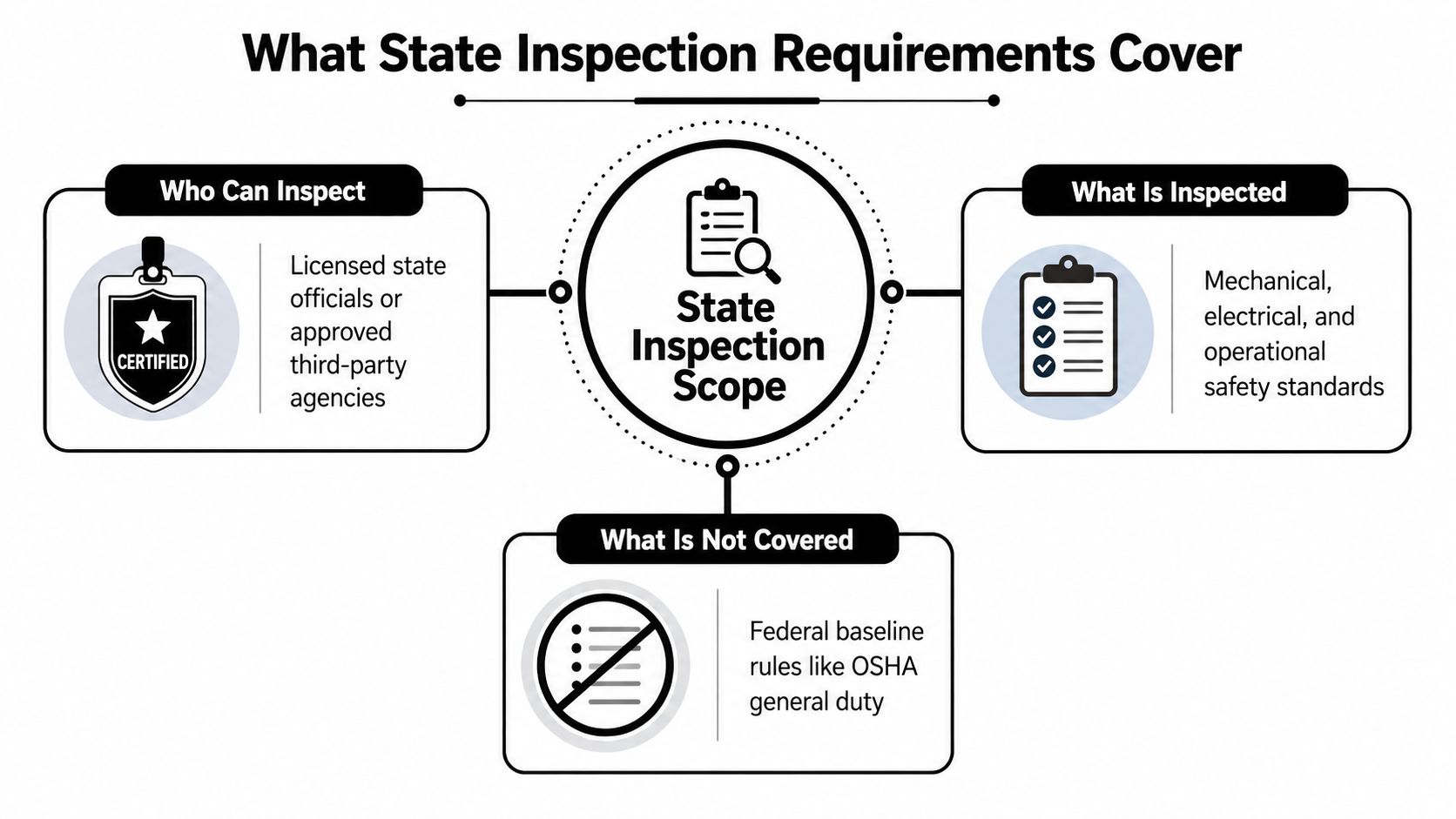
A state inspection is a formal safety review performed by an authorized state inspector or an approved third-party inspector, depending on the jurisdiction. The inspector evaluates the ride as it exists at the inspection site, not merely as it appears in a brochure or manufacturer file.
The scope commonly includes structural members, fasteners, anchor points, restraint systems, mechanical components, electrical equipment, guarding, controls, emergency stops, and operating procedures. The inspector may also observe an operating cycle, review maintenance records, and ask how operators are trained to manage loading, unloading, weather, stoppages, and emergencies.
Documents that serve different purposes
An inspection certificate or report answers whether the attraction met the applicable technical requirements at the time of inspection. An operating permit answers whether the authority has granted permission to place that attraction into service. A COI answers whether the required insurance coverage is in place.
Manufacturer testing remains important, but it doesn't automatically satisfy a state inspection. The manufacturer establishes design, operating, maintenance, and assembly requirements. The state or authorized inspector determines whether the deployed attraction complies with the applicable rules and documentation. Insurance underwriting evaluates risk for coverage purposes, while a venue walkthrough focuses on site logistics and immediate hazards. Those reviews can overlap, but they aren't interchangeable.
Pennsylvania demonstrates why timing must be tied to setup, not just a calendar. The state requires portable rides to be inspected every time they're erected, with owners filing inspection affidavits before operation and then every 30 days or on each new setup, whichever comes first (Pennsylvania amusement ride requirements). A transport move, reassembly, anchor-point error, or configuration change can create a new compliance question even when the ride passed a prior review.
For planners who also manage fleet or transport compliance, a 2026 compliance inspection guide can help separate recurring vehicle inspection duties from attraction-specific requirements. The practical lesson is simple: ask which authority accepts the inspection, what standard applies, and what document proves the result. A vendor's attraction inventory and operating details can be reviewed through its amusement ride offerings, but the responsible party still needs to verify the requirements for the event location.
Federal Floor Versus State Authority in Mobile Amusements
There isn't one nationwide amusement-ride permit that clears a mobile attraction for every event location. Federal agencies can establish broad workplace, product, and consumer-safety expectations, but states generally control ride permitting, inspection administration, inspector qualifications, operating conditions, and enforcement for attractions used within their borders.
That division creates a practical boundary. Federal workplace rules may affect the employer and employees who assemble or operate equipment. Consumer-product requirements may affect design, manufacturing, labeling, or hazards. State authorities decide whether the ride can operate at a particular event, under a particular inspection and permit process.
A ride can therefore have sound manufacturer documentation and appropriate insurance while still lacking the approval required in the state where it has just been erected. The rental company's home-state paperwork may be useful evidence, but it may not satisfy the destination state's inspection frequency, affidavit, permit, or inspector rules.
This is why a generic corporate safety policy can't replace state inspection requirements. A policy can require vendors to provide documentation, but it doesn't issue a permit or establish that the correct inspection occurred. The venue, school, municipality, and operator should each know who owns the final approval decision.
The New York framework makes the state-level difference clear. The labor department inspects stationary amusement-park rides at least annually, while traveling fair and carnival rides are inspected every time they're set up in a new location. A state audit recorded more than 4,800 site visits by 42 staff over a three-year period, along with more than 9,000 individual inspections in 2013 on about 1,700 rides, and 24 ride-related accidents or incidents, including 2 fatalities, during the reviewed period (New York ride safety information). That structure treats mobility and repeated setup as central compliance factors.
For a planner crossing a state line, the right assumption is that the destination jurisdiction controls the event. Confirm its accepted inspector, inspection interval, permit process, insurance wording, and post-incident obligations before the truck leaves the yard.
How PA, MD, NY, VA, and WV Handle Inspection Requirements
The Mid-Atlantic states do not use one uniform event-day process. Pennsylvania ties review directly to setup, New York changes the inspection trigger for traveling rides, and Maryland, Virginia, and West Virginia require planners to verify which state or local authority controls the event. A certificate from a neighboring state may not satisfy the destination jurisdiction.
| State | Who Inspects | Inspection Frequency | Required Documents | Enforcement Notes |
|---|---|---|---|---|
| Pennsylvania | State-authorized inspection process and accepted inspectors under the state framework | Portable rides are inspected every time they're erected. Permanent rides are inspected at least monthly. | Inspection records, owner affidavits before operation and at the required refresh point, operating approval, insurance records | A ride cannot reopen until approved in writing after a required inspection. |
| Maryland | Confirm the accepted state or local authority and any approved third-party pathway before booking | Frequency depends on the attraction and governing requirement. Verify whether setup, annual, or event-specific review applies. | Current inspection documentation, permit or approval, COI, operator and setup records | Venue and local authority requests can add documentation beyond the state file. |
| New York | Labor department inspectors and the state's applicable inspection process | Stationary park rides are inspected at least annually. Traveling rides are inspected at every new location. | Inspection record, operating documentation, itinerary or location information where requested, COI | Traveling status changes the inspection trigger, so prior-location approval isn't enough. |
| Virginia | Confirm the responsible state and local authority, plus any venue-specific review | Verify the required interval and whether a new setup or event requires additional approval. | Inspection certificate, operating approval where applicable, COI, setup and operator records | Local fire, building, or venue officials may review site conditions separately. |
| West Virginia | Confirm the authority and accepted inspector for the attraction and event | Verify the attraction-specific and event-location requirements before transport. | Inspection certificate, permit or approval where applicable, COI, emergency and operator records | Don't assume neighboring-state documentation transfers automatically. |
Pennsylvania offers the clearest setup-based workflow among these five states. Its portable-ride rule connects inspection to each erection, so the operator needs the inspection record and owner affidavit ready before guests are admitted. Permanent rides follow a separate schedule and must be inspected at least monthly. Those different requirements affect what should be in the truck binder and what the venue may request before opening (Pennsylvania's amusement ride requirements).
New York creates a separate deployment decision. A stationary ride follows an annual inspection model, while a traveling ride is inspected whenever it is erected at a new location. An approval from the prior venue therefore may not cover the current event. Confirm the location-specific inspection status before transport, then keep the resulting record with the current event documents (New York's ride safety guidance).
For Maryland, Virginia, and West Virginia, verification must happen before booking is finalized. Ask the state agency, local authority, venue, and rental company who accepts the inspection, whether a permit or decal must be displayed, and whether a fire or building official reviews the setup. Request the answer in writing. Store it with the inspection certificate, approval, insurance certificate, operator records, and any emergency procedures in the event file.
At the event, the practical test is simple. Can the operator produce the document that matches this attraction, this configuration, and this location without searching through an email thread? If not, the paperwork may fail the venue's review even when the ride passed an earlier inspection.
The document that matters is the one the authority for this event recognizes, not the one that looks most official in a vendor's email.
Your Pre-Event Compliance Checklist
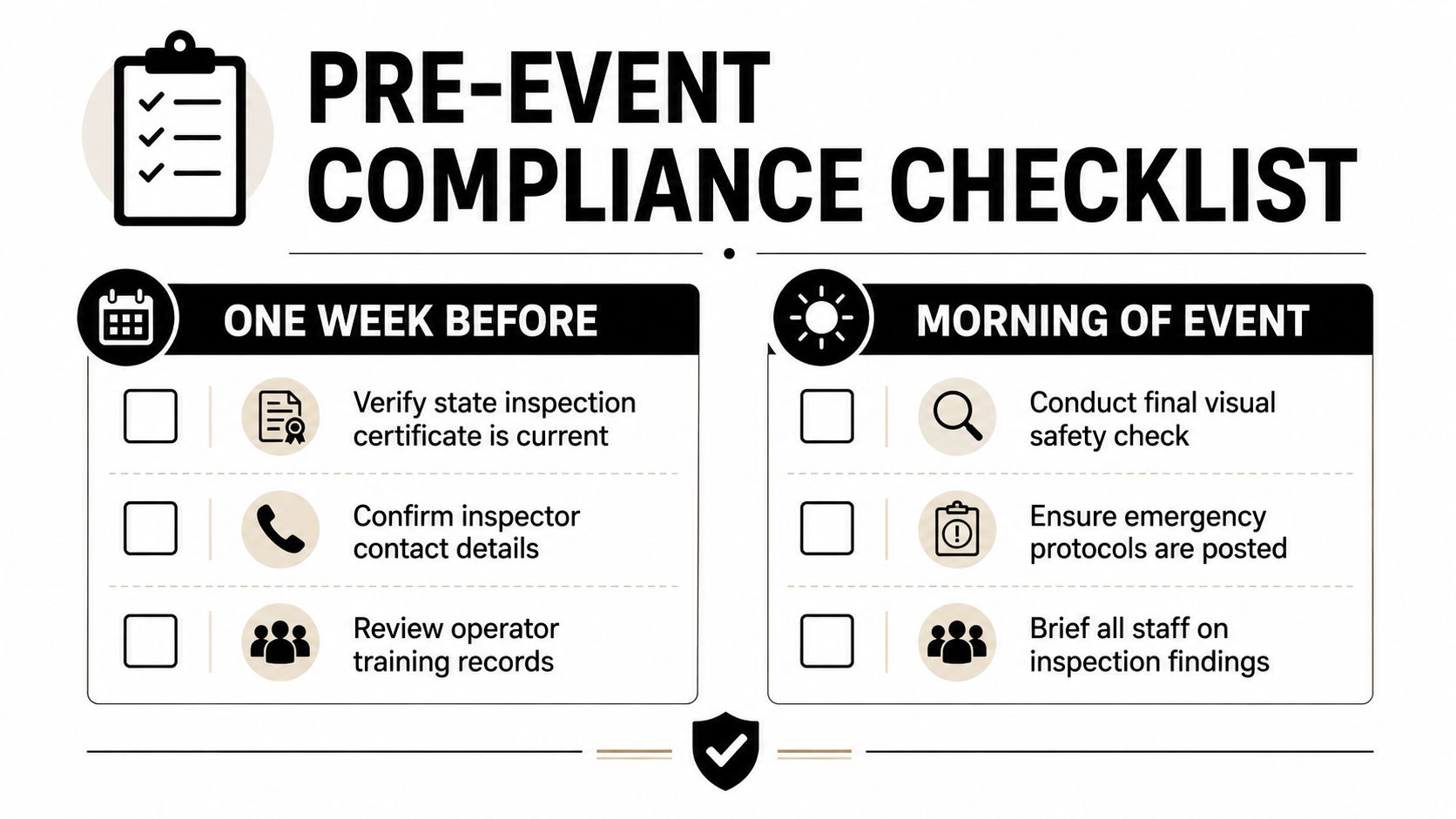
Run the compliance review before the truck arrives. A planner should be able to request the complete file without waiting for an operator to search through a cab, email thread, or storage office.
One week before the event
- Match the attraction: Confirm the ride name, serial number, manufacturer, and configuration on the inspection certificate match the attraction booked.
- Confirm the inspector: Ask who performed the inspection, whether that person or agency is accepted in the event state, and how the credential can be verified.
- Check operating permission: Request the current operating permit, approval letter, decal information, or other state-required authorization. An inspection report alone may not authorize public operation.
- Review insurance wording: Confirm the COI identifies the correct event, venue, dates, limits, and additional insureds requested by the contract.
- Ask about modifications: Find out whether the ride has been renovated, reconfigured, repaired, or fitted with different controls since its last inspection.
- Review operator records: Confirm that the assigned operators have the required training and can explain loading limits, emergency stops, shutdown criteria, and guest-control procedures.
The site file should also include the setup plan. Confirm level ground, anchoring conditions, clearance from obstacles, power requirements, access routes, emergency access, and weather procedures. For inflatables and other wind-sensitive equipment, the planner should review the vendor's documented operating limits and shutdown process, not rely on a casual forecast discussion. A practical reference on weather and wind planning for inflatables can support that conversation.
Morning of the event
Walk the setup before opening. Verify that anchors, guards, restraints, electrical connections, access paths, signage, emergency equipment, and operator stations match the approved arrangement. If the inspector identifies a correction, record it, confirm who owns the fix, and don't open the attraction until the required approval is complete.
The same discipline used for a facility review applies here. Teams responsible for venues and event spaces can use resources on how to prepare your team for compliance audits to improve document control, staff briefing, and evidence retention.
Passing the Inspection Is Not the Same as Approval to Operate
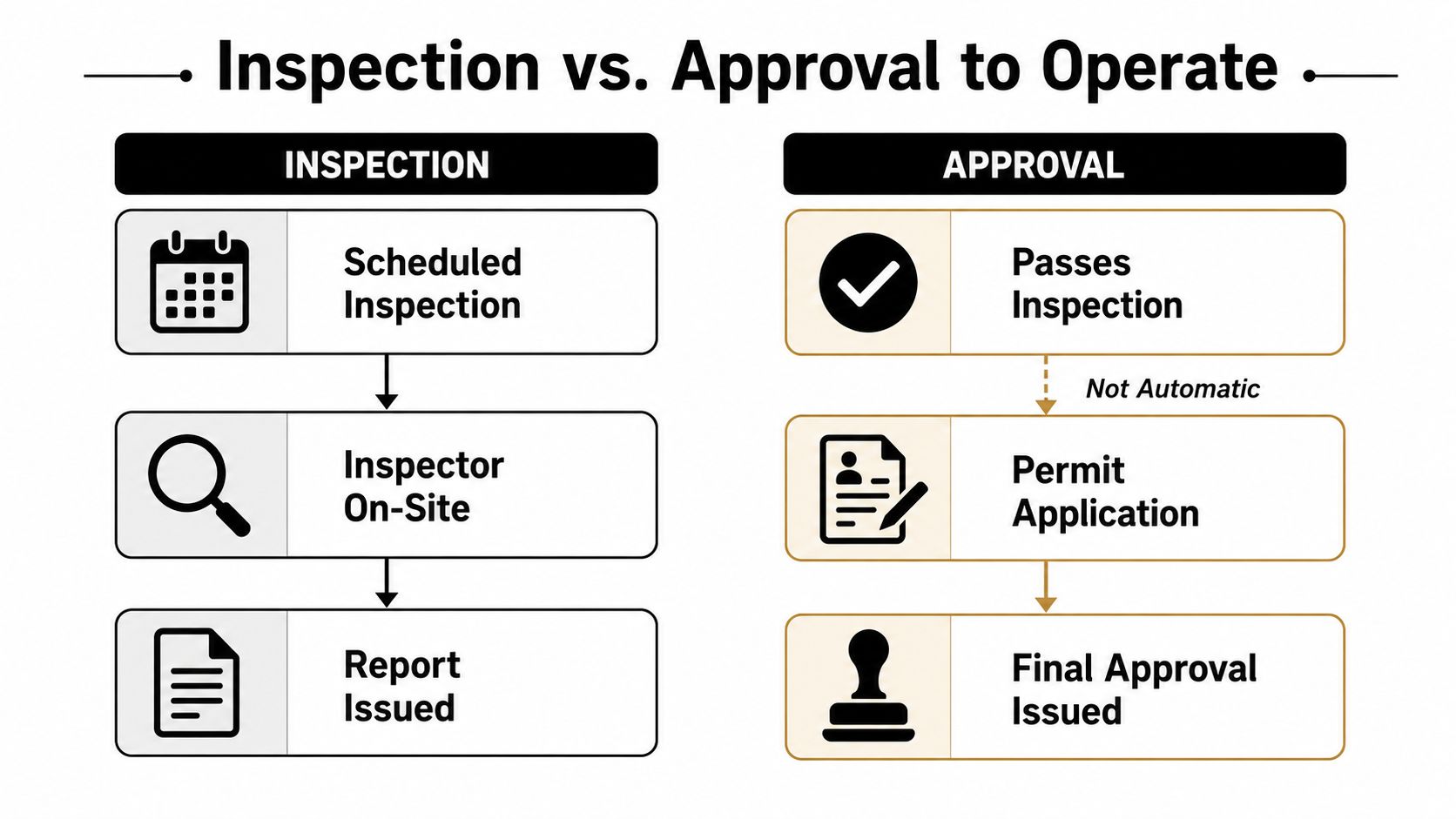
A passed inspection records the equipment's technical condition. Approval to operate is an authorization decision. These steps may happen close together, but they answer different questions and can produce separate documents. The binder on the truck should show both, not just an old inspection sticker or report.
Missouri makes the sequence clear. Its rules require a current operating permit valid for 12 months from the completed inspection report, state that permits are not transferable, and require reinspection after renovations that change ride dynamics or controls (Missouri's amusement ride operating permit rule). A completed report therefore does not prove that the operator has the current permit tied to that ride and owner.
Pennsylvania applies the same distinction through its reopening process. After a required inspection, a ride cannot reopen until written approval is issued. A correction, failed inspection, or additional review can stop operation even when an older inspection record remains in the file. Confirm the current state release before the first rider boards.
The paperwork chain
Use this sequence for each mobile attraction:
- Identify the ride. Match the serial number, manufacturer, ride name, and deployed configuration.
- Review the inspection. Confirm that the report is current and covers the equipment as set up for the event.
- Check modifications. Ask whether repairs or renovations changed dynamics, controls, structure, or operating conditions.
- Confirm the permit. Verify that the operating authorization is current, belongs to the correct owner where required, and applies to the event.
- Confirm written release. If the state requires written approval after inspection, keep that approval with the event file.
- Verify venue conditions. Make sure the approved ride is operating at the approved location and site arrangement.
Other jurisdictions also show why planners should request a complete file before opening day. Verified guidance identifies Abu Dhabi event approval requiring valid inspection certificates and Colorado tying annual registration to third-party inspections and insurance. Those examples do not replace Mid-Atlantic requirements, but they reflect the document trail venue and regulatory reviewers increasingly expect.
Ask for two separate items: the inspection certificate and the current approval to operate. Then ask what changed since the inspection.
Finding and Verifying a Certified Inspector Near You
Start with the authority that governs the event location, not a general internet search. Ask the Pennsylvania Department of Agriculture, the New York Department of Labor, or the relevant Maryland, Virginia, or West Virginia agency which inspector types and third-party agencies it accepts for the attraction involved.
Request the inspector's full name, agency, credential or license number, inspection date, scope, and standard used. Check the number through the issuing agency's official verification channel when one is available. A trade-association logo, website badge, or polished inspection form doesn't by itself establish state acceptance.
For mobile attractions, verify that the inspector can evaluate the equipment in its operating configuration. Texas provides a useful technical benchmark. Its inspection certificate must identify the ride name, serial number, manufacturer, and inspector, include an operable-state photograph taken at inspection, show evidence of at least one complete operating cycle, apply the most stringent applicable manufacturer, ASTM, or insurer standard, and include stress-and-wear testing for critical parts reasonably subject to failure (Texas amusement ride inspection certificate requirements).
That level of documentation is a good screening question even outside Texas. If an inspector can't explain what was tested, which standard governed, and how the report identifies the exact ride, the file may not satisfy the state or venue.
When the booking involves a new state, a tight deadline, or a disputed document, ask the rental company to coordinate the accepted inspection pathway. For general planning questions and documentation requests, use the vendor's event contact team, but still confirm the final acceptance decision with the governing authority.
Staying Ahead of Changing State Inspection Requirements
State inspection requirements are becoming a continuing records-management task, not a one-time annual appointment. The verified material identifies movement toward digital documentation, spot checks, unannounced enforcement, pre-event certificate uploads, and closer alignment between inspection, insurance, engineering, and manufacturer standards. The central question is shifting from “Was it inspected?” to “Does this complete file satisfy the state, venue, and insurer today?”
The most useful operating habits are straightforward:
- Confirm credentials early: Verify the inspector and accepted inspection pathway before booking the attraction.
- Build a reusable folder: Keep inspection reports, permits, affidavits, COIs, itineraries, operator records, modification history, and emergency procedures together.
- Set a renewal checkpoint: Review permits and certificates well before each event so missing approvals don't surface at load-in.
- Record every change: Treat renovations, control changes, reassembly issues, and new locations as potential triggers for additional review.
A clean binder on the truck still matters, but a current digital copy helps the venue, school, municipality, and insurer review the same evidence before opening day. The operator who can produce the right document quickly is easier to approve and less likely to face a preventable shutdown.
Phantom Entertainment supplies state-inspected, insured mobile attractions and venue-ready safety documentation, with delivery, setup, and professional operation handled as part of the event service. Visit Phantom Entertainment to plan a compliant attraction package for your school, corporate event, festival, or community gathering.
Ready to Book Your Event?
PA state-inspected, fully insured since 1979. Call us or get a free quote today.