
Students arrive at orientation carrying more than a course schedule. They're managing first-day nerves, unfamiliar buildings, new social expectations, accessibility needs, cultural differences, and a constant stream of digital notifications. A welcome speech alone can't handle that load.
The strongest orientation week activities create several ways to belong. High-energy attractions draw students into the shared experience, while quieter stations, peer-led conversations, and practical campus touchpoints give less social or physical students an equally legitimate path in. A documented university orientation program used five full days of structured programming, including registration, curriculum sessions, mentoring, faculty luncheons, technology and financial-aid presentations, tours, and evaluations, with at least nine distinct activity types across the week. The program's published account makes the central planning lesson clear: orientation works as a system, not a single party.
That's why I plan around energy, access, throughput, liability, and staffing from the start. Phantom Entertainment is the kind of turnkey partner that can turn a sprawling rental and operations spreadsheet into one planning conversation, with delivery, setup, professional operation, insurance documentation, and venue-ready safety support handled together.
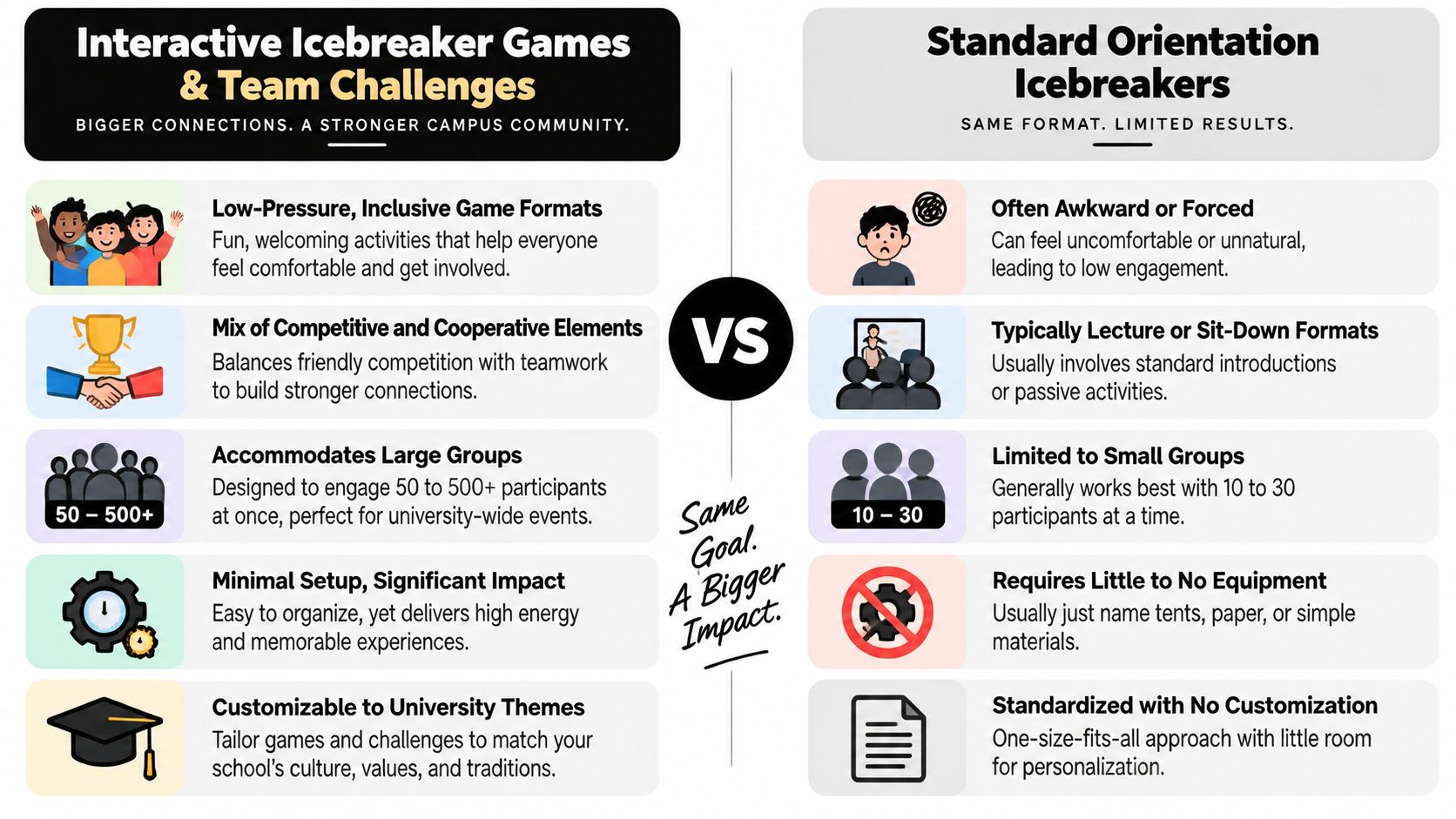
1. Interactive Icebreaker Games and Team Challenges
Interactive team challenges work when they give students something specific to do together. A relay race, campus scavenger hunt, trivia sprint, or collaborative puzzle creates an immediate reason to speak to someone who would otherwise remain a stranger. Orientation leaders can use the activity to mix residence halls, majors, or student groups without forcing a long round of personal introductions.
The trade-off is participation pressure. A physically demanding race may energize athletic students while excluding students with mobility limitations, injuries, anxiety about competition, or cultural discomfort with public performance. Build every challenge with parallel roles, such as clue reader, navigator, scorekeeper, photographer, strategist, or timekeeper. Offer competitive and noncompetitive versions, and recognize teamwork, creativity, encouragement, and problem-solving rather than rewarding only speed.
Practical rule: If a student can contribute meaningfully without running, climbing, shouting, or winning, the activity is more likely to build connection instead of sorting students into spectators and participants.
Design for flow, not chaos
Use a short demonstration before the first round, then run a practice version with no score. Keep instructions visible at the starting point and assign facilitators who can reset groups quickly. University examples often include field-day formats, trivia, and facilitated small-group activities. Harvard Kennedy School orientation leaders described field challenges, school trivia, and deeper guided conversations as effective ways to help students bond and move beyond surface-level networking. Their orientation reflections offer a useful reminder that the conversation after the game matters as much as the game itself.
Schedule more than one session so commuters, student employees, and students attending required meetings aren't locked out. A professional facilitator can maintain momentum, explain rules consistently, and keep the event welcoming when energy levels vary.
2. Carnival Game Stations and Midway Experiences
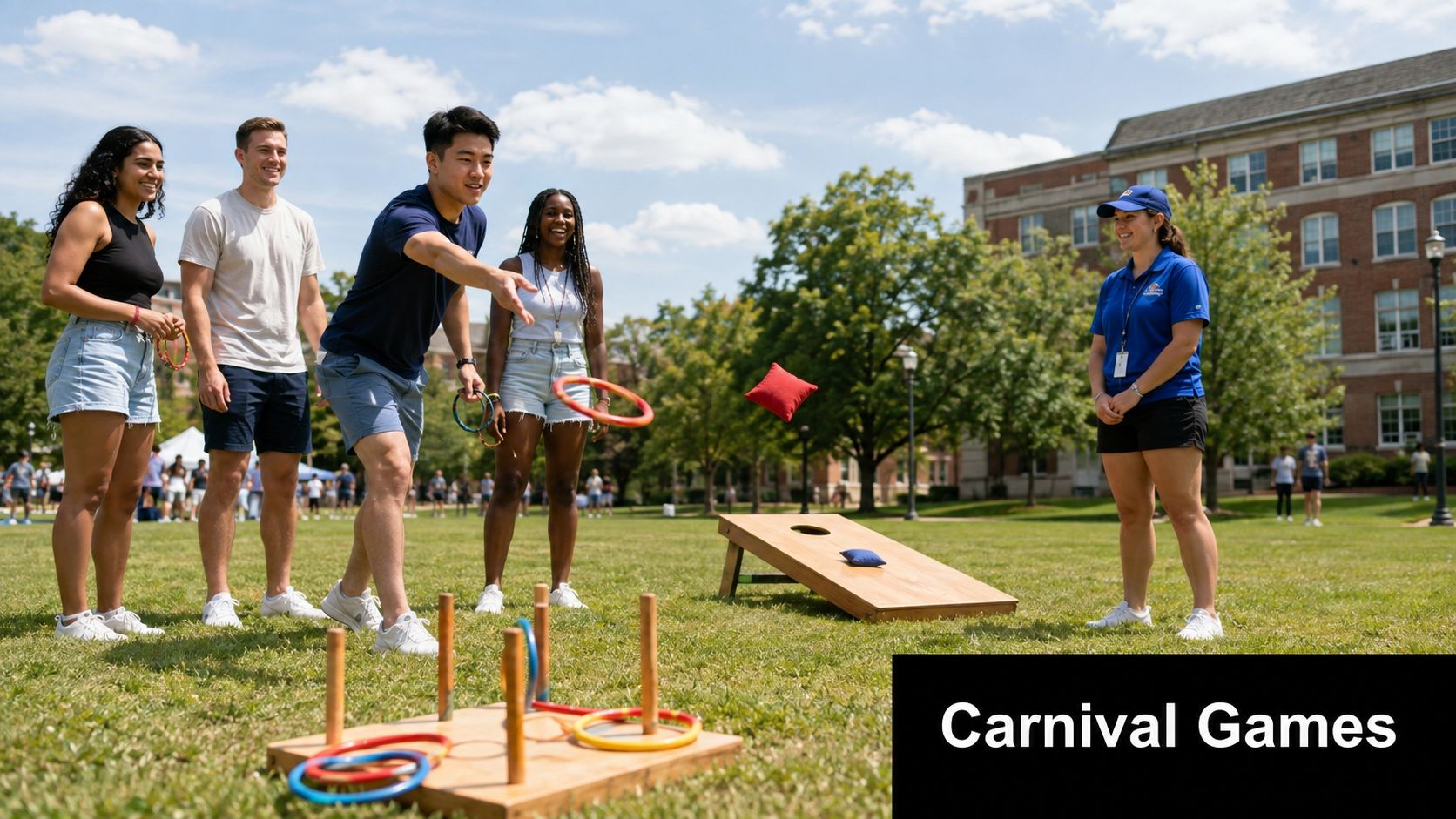
Carnival stations solve a problem that large welcome events often create: students can participate without committing to a long, intense session. Ring toss, beanbag targets, basketball challenges, prize wheels, and other short-format games give students a natural reason to linger, watch, and start conversations. They also work well around food, information booths, and shaded seating.
The planning risk is congestion. A few popular stations create lines while less familiar games sit empty, so spread attractions across the venue and use clear signage to make the entire footprint feel active. Give each station a distinct visual identity and a simple instruction panel. Students should understand how to play before they reach the front of a queue.
Use stations to encourage exploration
A passport system can encourage students to visit several areas without making participation feel mandatory. Keep rewards frequent and modest, and offer recognition for completing the circuit, encouraging another player, or trying a new activity. Don't build the event around a single expensive prize that makes every other station feel irrelevant.
Staffing matters more than the equipment. Operators should greet students, explain the game, reset materials, monitor safe use, and invite hesitant students to try. Rotate assignments during a long event so staff remain attentive and upbeat. For a broader range of options, review mobile game rentals for campus events and match the station mix to your venue, audience, and available staffing.
Keep accessible paths open between stations, place some games at usable heights, and provide seating near the action. The best midway feels casual, not like an obligation to compete.
3. Inflatable Obstacle Courses and Bounce House Challenges
Large inflatables create an instant visual anchor. Students can see the obstacle course or interactive game from across the quad, and that visibility helps a welcome event feel intentional rather than like a collection of disconnected tables. Bounce houses and obstacle attractions also provide a clear activity cycle, participants enter, play, exit, and make room for the next group.
Their cost is operational complexity. You need a suitable surface, reliable power, weather monitoring, controlled entrances and exits, trained operators, and a queue plan. Secure the attraction according to the vendor's requirements, inspect the surrounding area, and remove objects that could cause injury. Don't assume a large lawn automatically makes a safe site.
Protect throughput and choice
Brief every group before entry and use timed sessions so one enthusiastic group doesn't consume the entire event. A central location helps visibility, but it can also create noise and crowding near registration or academic information areas. Place the attraction where spectators can watch without blocking circulation.
Provide an equally visible alternative for students who can't or don't want to participate. Carnival games, arcade stations, seated trivia, photo experiences, and peer-hosted conversations can occupy the same social space without presenting participation as a test of confidence or fitness. A nearby quiet area also gives students somewhere to decompress.
Weather is the other major constraint. Decide in advance what conditions trigger a pause, where equipment or students will move, and whether you have a backup date or indoor plan. Ask the rental partner for inspection records, insurance documents, anchoring requirements, and a written operating plan before advertising the attraction.
4. Mobile Escape Rooms and Problem-Solving Activities
Escape rooms give orientation planners something many loud attractions don't: concentrated collaboration. Small groups must communicate, notice details, share partial information, and decide what to try next. That makes the format especially useful for students who prefer structured interaction over open-ended mingling.
Don't make the puzzles so difficult that the first group leaves frustrated. Start with a clear win, then increase complexity. Mix logic, observation, word, and physical mechanisms so one narrow skill doesn't determine who contributes. Facilitators should be able to offer hints without taking over, and they should watch for groups where one confident player is solving everything while others disengage.
Make the debrief part of the experience
After each session, ask what helped the group progress, where communication broke down, and how the team handled uncertainty. That short conversation turns entertainment into a practical introduction to collaboration. It also gives orientation leaders a natural way to connect the activity to project teams, residence-life expectations, and academic group work.
Mobile units are attractive because they can operate in parking areas, courtyards, or other spaces without requiring a permanent installation. The trade-off is capacity. Sessions are usually small, and demand can outpace the number of available runs. Publish a reservation process, hold a few walk-up places, and offer a parallel activity so students without a slot aren't left watching a queue.
Use different themes where possible, including a lighter introductory room and a more challenging option. Train facilitators to reset quickly, explain safety rules clearly, and intervene when a group needs a nudge. For international, commuter, and transitioning students, consider dedicated sessions with peer leaders who can make the activity feel less intimidating.
5. Mechanical Bull and Interactive Riding Experiences
A mechanical bull is a centerpiece, not background entertainment. It creates a visible challenge, a cheering audience, and a natural photo moment. That spectator value matters because students who don't ride can still participate by encouraging friends, tracking rides, or joining a themed team.
The liability profile is also obvious. Treat the attraction as a managed ride, not a casual novelty. Use trained operators, appropriate padding, a controlled waiting area, and a clear participant screening process. Explain that riders can choose a gentle setting and that stepping off early is a successful decision, not a failure.
Build a safe-fail culture
An experienced operator adjusts the ride to the participant and watches the dismount closely. Staff should celebrate every attempt, not only the longest ride, and they should stop teasing before it turns into public embarrassment. A bracket can add structure, but offer awards for spirit, technique, or encouragement so the event doesn't become an athletic ranking exercise.
The crowd should make participation feel safer, not more humiliating.
Set the attraction away from tight pedestrian routes and provide enough space for spectators to stand clear. Keep water available, account for heat, and coordinate with campus medical and emergency procedures. Confirm the vendor's inspection process and insurance requirements before the event is announced.
For the operational details planners often overlook, review mechanical bull safety guidance while you build your site plan. Then brief student volunteers on queue control, privacy around photos, and how to direct a participant who needs assistance. The strongest version feels exciting because the boundaries are clear.
6. Laser Tag and Paintball Competitions
Team-based combat games can build strong connections, but the framing must be deliberate. Laser tag is usually easier to position for a broad orientation audience because it avoids projectiles and paint cleanup. Paintball can work in a controlled setting, but it demands stricter equipment rules, protective gear, site management, and communication about physical contact and visibility.
Start with an explanation, not a countdown. Demonstrate equipment, define boundaries, explain what ends a round, and state which behaviors are prohibited. Use objective-based scenarios such as capture, defense, or retrieval rather than relying only on elimination. Those formats give students different ways to contribute and create more useful teamwork than a simple free-for-all.
Keep competition welcoming
Balance teams by experience and activity level. Let students try a low-pressure introductory round before running a bracket, and offer observer or referee roles for students who don't want to play. Water, shaded recovery space, and clear breaks are essential for outdoor events. Staff should enforce rules consistently, especially around equipment handling, physical contact, and boundary violations.
A short post-game conversation can ask teams how they communicated, adapted, and shared decisions. That discussion gives orientation leaders a constructive way to connect a noisy activity to residence hall cooperation and academic teamwork.
Don't hide the practical requirements. Confirm the venue's surface, noise limits, emergency access, cleaning plan, and weather policy. A professional operator should manage equipment checks, field boundaries, refereeing, and participant briefings. Your campus team should focus on scheduling, messaging, and making sure the activity sits within a wider program rather than becoming the only social option.
7. Mobile Zip Lines and Rock Climbing Challenges
Adventure attractions create memorable moments because students must make a personal decision. Some will climb immediately, some will need time, and some will opt out. That range is useful when planners treat participation as voluntary and provide meaningful support roles, such as belay communication practice where appropriate, cheering, photography, timing, or route observation.
Safety begins before the first student arrives. Use qualified operators, inspect the site, maintain exclusion zones, and provide a briefing that covers equipment, movement, stopping procedures, and what happens if a participant changes their mind. Progression matters. Let students begin with an easier route or lower challenge before inviting them toward more difficult options.
Give fear and access equal respect
Never use peer pressure as the motivation. A student who declines should be directed toward an equally social alternative, not asked to justify the decision. Offer accessibility information in advance and ask the vendor what adaptive equipment, transfer support, or alternative participation formats are available. Don't promise access features until the operator and venue confirm them.
A debrief can turn the experience into more than a thrill. Ask students how they handled uncertainty, what support helped, and how they can offer that support to classmates. That conversation works especially well with orientation leaders who want to establish a culture of encouragement early.
Before booking, verify anchoring, clearance, weather triggers, rescue procedures, insurance, and emergency access. Keep spectators outside the operating zone and design the queue so students aren't standing in direct sun for long periods.
Watch the equipment and operating process before committing the event to a promotional campaign. A short demonstration video can help students understand the experience and reduce uncertainty, but the written safety briefing remains the authority.
8. DJ, Karaoke, and Performance Experiences
Music changes the shape of a welcome event. A skilled DJ can fill dead air, announce schedule changes, invite students toward quieter areas, and create a shared atmosphere without asking everyone to perform. Karaoke and talent showcases add a different layer, students can participate from the stage, from a small group, or from the audience.
The main trade-off is control. A playlist that works at a private party may not suit a campus event with international students, religious considerations, age ranges, accessibility needs, and institutional conduct standards. Send the DJ a written brief covering prohibited content, pronunciation of campus names, announcement priorities, volume limits, and the tone you want.
Give performers a safe route in
Offer song choices in advance, a practice microphone, and an MC who can protect performers from ridicule. Celebrate participation rather than vocal quality. For students who don't want to sing or dance, add photo stations, seating near the performance area, and nearby activities that don't require loud interaction.
DJ party planning support from Phantom Entertainment can be useful when you need music, hosting, and event flow coordinated rather than booked as unrelated services. Confirm power, stage placement, weather protection, cable management, sight lines, and a safe distance between equipment and the crowd.
Foam parties require their own site plan. Protect flooring, manage drainage, control slip risks, and provide a clear cleanup process. Colored lighting and effects can create a strong peak moment, but don't let spectacle compromise accessible circulation or make it impossible for students with sensory sensitivities to find a calmer route.
9. Mini Golf and Arcade Games
Mini golf and arcade games are reliable low-pressure options. Students can play side by side without needing to disclose personal information, perform in front of a crowd, or sustain intense physical effort. That makes them useful near food, lounges, student organization tables, and other places where casual conversation happens naturally.
They also expose a common planning mistake: confusing an attractive setup with usable access. Check lane widths, turning space, surface transitions, control height, seating, glare, sound, and queue placement. Ask the vendor to identify which games can be adapted or replaced for students with mobility, sensory, or dexterity needs.
Create reasons to stay
A live leaderboard can add energy, but don't make score the only social currency. Recognize most creative play, best team name, longest visit, or strongest encouragement. Use short rotations for popular games and explain rules at each station so newcomers can join without waiting for a full group.
Place the arcade and mini golf near seating rather than in an isolated corner. A student may not want to play immediately, but they might watch a friend, share a snack, or join after a conversation. Student staff can keep the area clean, answer questions, reset games, and direct visitors toward other activities.
Theme selected holes around campus traditions, landmarks, or academic life, but avoid designs that require insider knowledge to enjoy. A small amount of campus identity makes the activity feel intentional. Too much institutional branding makes it feel like a marketing display.
Plan for power, noise, lighting, sanitation, and equipment faults. Have a manual backup activity ready so a failed game doesn't create a dead zone. This category is strongest when it acts as a social bridge between the big attractions and the quieter parts of orientation.
10. Virtual Reality and Immersive Experience Stations
VR offers instant curiosity. A student puts on a headset and enters a completely different environment, which gives nearby students an easy conversation starter. It can also support a university innovation theme through simulations, creative tools, games, or experiences connected to research and campus identity.
The risks are less visible than those of an inflatable or climbing wall. Motion sensitivity, hygiene, disorientation, cable hazards, and equipment failure can undermine the experience quickly. Provide a seated option where appropriate, explain that students can stop at any time, and keep a clear area around each user. Never treat opting out as a lack of enthusiasm.
Operate technology like an attraction
Test every headset, controller, cable, network connection, and content selection before doors open. Keep backup content available and train operators to fit equipment, explain controls, sanitize shared surfaces, and recognize when a participant needs a break. A spectator screen helps friends engage without taking the headset away from the participant.
Choose experiences with short, understandable onboarding. A complicated menu wastes the student's turn and creates queues that feel longer than they are. Offer beginner content first, then more demanding options for students who want a deeper challenge. Place VR near a seated recovery area, not beside a high-speed attraction or loud speaker stack.
Use permission-based photography only. If you capture screenshots or video, explain where the material will appear and give students a straightforward way to decline. The technology should support connection, not turn participation into an unrequested publicity moment.
Connect the experience to the institution's mission when that feels authentic. A research-focused campus might feature scientific visualization, while a creative program could highlight immersive storytelling. The strongest setup has both the wow factor and a clear reason to be on the orientation schedule.
10 Orientation Week Activities Comparison
| Activity | 🔄 Implementation Complexity | ⚡ Resource Requirements | 📊 Expected Outcomes | ⭐ Ideal Use Cases | 💡 Key Advantages / Tips |
|---|---|---|---|---|---|
| Interactive Icebreaker Games & Team Challenges | Low–Moderate; simple props but needs trained facilitators for large groups | Low cost; minimal equipment; moderate staffing; flexible spaces | ⭐⭐⭐ High, rapid peer bonding, reduced anxiety, broad inclusion when designed well | First-week mixers, mass orientations, large-group icebreakers | Cost-effective and scalable; mix competitive and cooperative formats; ensure accessibility |
| Carnival Game Stations & Midway Experiences | Moderate, multiple stations require coordination and flow management | Moderate space and staffing; multiple game units; prize budget | ⭐⭐ Good, festival atmosphere, high social interaction, strong photo opportunities | Fair-style events, open-house orientation hubs, casual social hours | Nostalgic, high-throughput entertainment; use passports and enthusiastic operators to avoid bottlenecks |
| Inflatable Obstacle Course & Bounce House Challenges | Moderate–High, rigging, safety checks, queue management | Significant space, delivery/setup crew, certified operators, insurance | ⭐⭐⭐ Very High, visible centerpiece, energy boost, strong social media content | Main-stage attractions, peak-energy orientation days, photo-centric events | Eye-catching and memorable; plan entry/exit flow, safety briefings, weather contingencies |
| Mobile Escape Rooms & Problem-Solving Activities | High, themed setup, game masters, timed sessions | Higher per-participant cost; small-room capacity; dedicated operators and space | ⭐⭐⭐ High, deep teamwork, communication skills, memorable bonding | Small-group bonding, leadership training, cohort team-building | Delivers skill development and intensity; offer multiple themes and debriefs to maximize learning |
| Mechanical Bull & Interactive Riding Experiences | Moderate, requires trained operator and strict safety procedures | Arena space, operator, padding, insurance; moderate equipment cost | ⭐⭐ Good, strong spectacle and social media buzz; crowd-drawing | Evening socials, spectacle attractions, challenge-themed events | Unique memorable draw; screen participants, prioritize safety and inclusive handling |
| Laser Tag & Paintball Competitions | High, field design, referees, safety briefings, game management | Specialized equipment, dedicated field/props, higher staffing and cleanup | ⭐⭐ Strong, intense teamwork and competitive bonding; tournament-friendly | Team tournaments, outdoor activity days, competitive cohorts | High-energy and strategic engagement; balance teams and enforce safety rules |
| Mobile Zip Line & Rock Climbing Challenges | Very High, technical installation, certified operators, intensive safety | High cost, substantial space, specialized staff, insurance | ⭐⭐⭐ Very High, peak experiences, confidence building, lasting impact | Leadership retreats, adventure days, resilience-building programs | Powerful personal-growth outcomes; provide opt-outs, psychological support, and clear progressions |
| DJ, Karaoke & Performance Experiences | Moderate, pro AV setup, MC coordination, sound management | Professional sound/lighting, DJ/MC, stage space; medium cost | ⭐⭐⭐ High, energizes crowd, inclusive social space, high shareability | Evening concerts, talent showcases, high-energy social events | Versatile centerpiece for transitions; curate playlists, manage noise, and provide performer support |
| Mini Golf & Arcade Games | Low–Moderate, straightforward setup but needs layout planning | Moderate space for mini golf or arcade units; maintenance staff; moderate cost | ⭐⭐ Good, casual socializing, accessible to many, steady throughput | Low-energy engagement, introvert-friendly areas, family-style socials | Accessible and low-intensity; use leaderboards and tournaments to drive engagement |
| Virtual Reality (VR) & Immersive Experience Stations | High, technical setup, content selection, operator training | High equipment cost, sanitation measures, trained operators, backups | ⭐⭐ Novel, strong wow-factor and shareable moments but limited throughput | Tech showcases, innovation-themed events, small-group highlight attractions | Positions event as cutting-edge; enforce hygiene, provide beginner/advanced tracks and backups |
Building an Orientation Week That Actually Lands
A successful week doesn't need every attraction on this list. It needs a deliberate mix. Choose two or three spectacle anchors that give the campus a shared visual and emotional center, then surround them with low-barrier activities that students can enter and leave without pressure. Carnival games, mini golf, arcade stations, karaoke, trivia, and facilitated conversations keep the program open to students who won't climb, ride, race, or wear a headset.
The evidence supports that approach. A large student survey recorded 2,802 of 3,000 respondents attending new-student orientation, while 73% rated the experience good or excellent. In the same survey set, satisfaction for the Class of 2026 reached 81%, compared with 71% for the Class of 2023, 66% for the Class of 2024, and 73% for the Class of 2025. The published survey points toward orientation as a major engagement window, but reach alone doesn't prove that a program improves persistence.
That outcome question deserves its own attention. A 2025 university study explicitly examined relationships between orientation program types and first-year fall-to-fall persistence, addressing a gap in guides that often describe fun activities without connecting them to student outcomes. The study record is a useful prompt for administrators: track more than attendance. Record participation by activity, repeat engagement, student feedback, and later connection to advising, peer networks, or campus services.
Build inclusion into the operating plan
Don't publish accessibility as a sentence on the event page and leave the rest to chance. Give students clear information about surfaces, noise, physical requirements, seating, sensory conditions, weather, transfers, and alternative participation. International and transitioning students need more than a generic welcome. Recent welcome-program research reported 91% of respondents rating a tour excellent or very good and 95% saying the experience was very well organized, while also identifying the need for clearer practical guidance on cultural inclusion, accessibility, and participation by commuter and nontraditional students. The research on international student welcome experiences supports a blended design with tours, social events, and practical support.
Staffing and compliance belong in the first planning meeting, not the final week. Confirm site access, power, weather contingencies, emergency routes, equipment inspections, participant rules, trained operators, and certificates of insurance. Review broader event risk considerations through party safety guidance from GM Group Services, then align those principles with your campus policies and local requirements.
Use one accountable delivery partner
Multiple vendors can create multiple arrival windows, contracts, insurance packets, setup standards, and points of failure. A turnkey provider can consolidate delivery, installation, professional operation, teardown, and safety documentation, leaving the campus team to handle student communication, peer leadership, programming goals, and the personal welcome that no rental company can replace.
Phantom Entertainment offers attractions relevant to orientation programs, including inflatables, mobile escape rooms, mechanical bulls, laser tag, mobile zip lines, rock walls, carnival games, arcade games, mini golf, VR, DJs, karaoke, and foam dance parties. Its publisher information states that the Carlisle-based company serves Pennsylvania and the Mid-Atlantic, provides delivery and setup, and supplies certificates of insurance and venue-ready safety documentation. Treat those materials as part of your procurement review, and confirm the exact attraction, site requirements, staffing, and documentation for your campus before signing.
The best orientation week feels energetic without becoming exhausting, inclusive without becoming bland, and memorable without making students accept unnecessary risk. Start with the student journey, select attractions that serve different comfort levels, and make every operational detail support that welcome.
Phantom Entertainment provides turnkey orientation attractions, including inflatables, escape rooms, mechanical bulls, carnival games, DJs, karaoke, VR, and more, with delivery, setup, operation, and safety documentation coordinated for campus events. Visit Phantom Entertainment to review options for your orientation week and start planning a package that fits your venue, schedule, and student community.
Ready to Book Your Event?
PA state-inspected, fully insured since 1979. Call us or get a free quote today.