
You're looking at a field, a guest list and a rental photo that makes the inflatable look easy to fit. Then the practical questions arrive: Will adults and children use it together? Where will the line go? Who stops play if the wind picks up while everyone's waiting?
Choosing obstacle course jumpers starts with those questions, not the tallest slide. A smaller course with controlled entry can be a better rental than a larger attraction squeezed into the available space. The right choice gives the crew room to operate, riders an appropriate challenge and your event a workable shutdown plan.
Obstacle Course Jumper Types and Sizes Compared
An inflatable obstacle course jumper is a bounce-style structure with features such as climbing walls, tunnels and jump pads that riders move through in sequence or race through in separate lanes.
Obstacle course jumper formats and typical sizes
| Format | Typical footprint | Obstacles |
|---|---|---|
| Toddler mini course | Compact layout, confirm length, width and height on the unit's specification sheet | Low-entry features and simple barriers; count and simultaneous riders set by the manufacturer |
| Single-lane obstacle course | Elongated layout with separate approach and exit space | Sequential tunnels, barriers or climbs; entry spacing and rider limit set by the manufacturer |
| Dual-lane race course | Parallel lanes requiring enough width for the unit and attendant access | Matched racing features; occupancy and lane-release rules set by the manufacturer |
| Combo course with slide or climb | Layout must accommodate the slide landing, climb and any connected bounce area | Combined activity zones; obstacle count and zone-specific capacity require written confirmation |
Read the specification sheet before comparing rentals
There isn't a reliable universal size or rider count for each format. Product names describe the experience, not a standardized footprint. Use the table to narrow the format, then get the exact dimensions and operating limits for the actual unit being delivered.
The footprint describes the inflatable itself. Your site plan also needs the manufacturer's anchoring clearance, blower position, protected electrical route, entry approach, exit landing and spectator separation. Don't treat unused space beside a blower as somewhere to put the queue.
Measure overhead clearance as well as ground space. Branches, lighting strings, roof edges and utility lines can rule out a location that looks generous on a lawn plan. Delivery access matters too, including gates, turns and any route across sensitive landscaping.
The inflatable rental selection is a useful starting point for identifying options, but a photograph isn't a substitute for a dimensioned placement plan.
Compare movement, not just obstacle count
More obstacles don't automatically mean a better event. A challenging climb can hold up everyone behind it, while a straightforward course may be easier to supervise and more comfortable for hesitant riders.
Likewise, simultaneous occupancy isn't hourly throughput. Completion time, rider spacing, unloading and the crew's checks all affect how quickly the line moves. Don't turn a maximum occupancy label into a target the attendants must maintain.
A dual-lane course suits a race-focused event, but a single-lane layout may make more sense when participants want to move without competition. A combo offers variety, although its changing activity zones can demand more attention than a simple start-to-finish course.
Practical rule: Write down the largest usable installation area and the intended rider age range before choosing a format. Eliminate anything that fails either test.
Matching a Jumper to Your Event and Crowd
The same attraction can work well at a controlled school rotation and poorly at an open-entry festival. Match the course to how guests arrive, who manages them and whether participation happens in organized groups.
Recommended jumper format by event
| Event | Recommended format | Age mix | Main concern |
|---|---|---|---|
| School field day | Dual-lane race course | Grouped by grade band and compatible size | Line control and clear starts |
| Corporate family picnic | Single-lane course | Adults and children in separate, staggered heats | Assigned supervision |
| Community festival | Combo course with slide | Broad audience separated by approved age and size bands | Queue flow and weather monitoring |
| Birthday party | Toddler mini course | Young children within the unit's approved range | Keeping older children on a separate activity |
| University orientation | Dual-lane race course | Adults within the equipment's limits | Controlled release and reliable completion flow |
A race format works best when attendants can see and control the start.
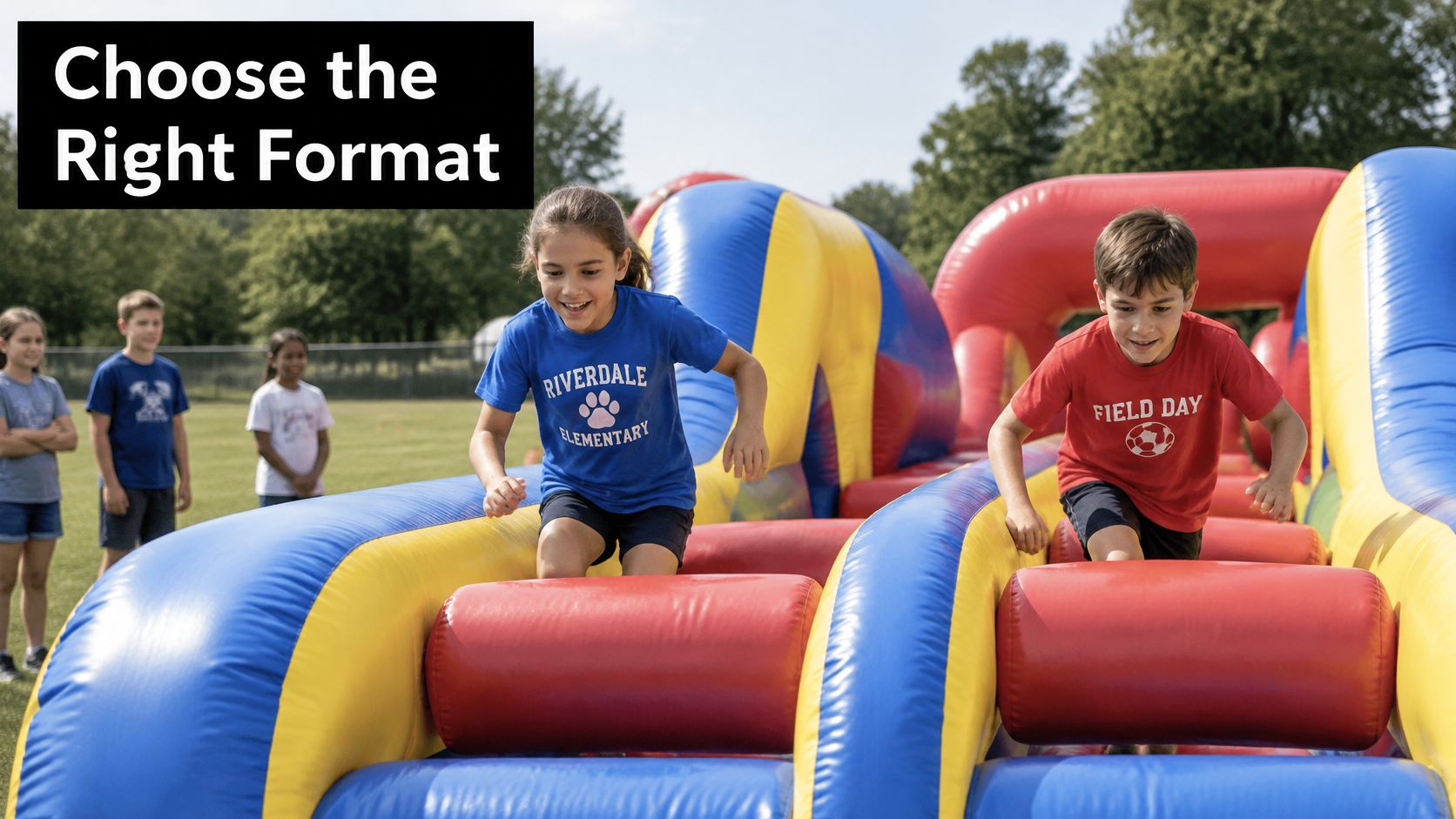
Match the format to the way guests participate
School field day. A dual-lane course gives teachers a clear activity rotation and students a recognizable start and finish. Keep classes organized before they reach the entrance rather than sorting riders on the ramp. The school inflatable planning guide can support the broader activity layout.
Corporate family picnic. A single-lane course can accommodate different scheduled groups without making every turn a race. Put the heat schedule where families can see it, and assign supervision rather than assuming parents standing nearby will manage admission.
Community festival. A combo can provide an appealing centerpiece, but its entrance needs protection from spectators stopping to watch the slide. Keep the queue outside the operating perimeter and appoint someone other than the entrance attendant to manage overflow.
Birthday party. A mini course is the sensible starting point for young children when its approved rider range matches the guest list. Don't invite older siblings onto it because it has spare room. Give them a separate activity or an appropriate scheduled option.
University orientation. An adult-approved dual-lane course supports friendly competition without requiring complicated tournament rules. Confirm adult suitability explicitly, including individual rider limits, rather than assuming a large inflatable is suitable for every adult.
Before choosing, resolve rider eligibility, usable space and expected demand during the busiest period. If the audience includes markedly different ages or body sizes, schedule separate runs instead of asking attendants to manage an unsuitable mix once everyone is inside.
Pre-Rental Checks and Live-Run Control
Agree on responsibilities before delivery. The rental crew, venue representative and event lead should know who accepts the installation, who controls admission and who has authority to stop operation. A checklist helps only when someone has the authority to act on a failed item.
Keep the setup checklist available at the attraction rather than buried in an event office.
Walk the installation in order
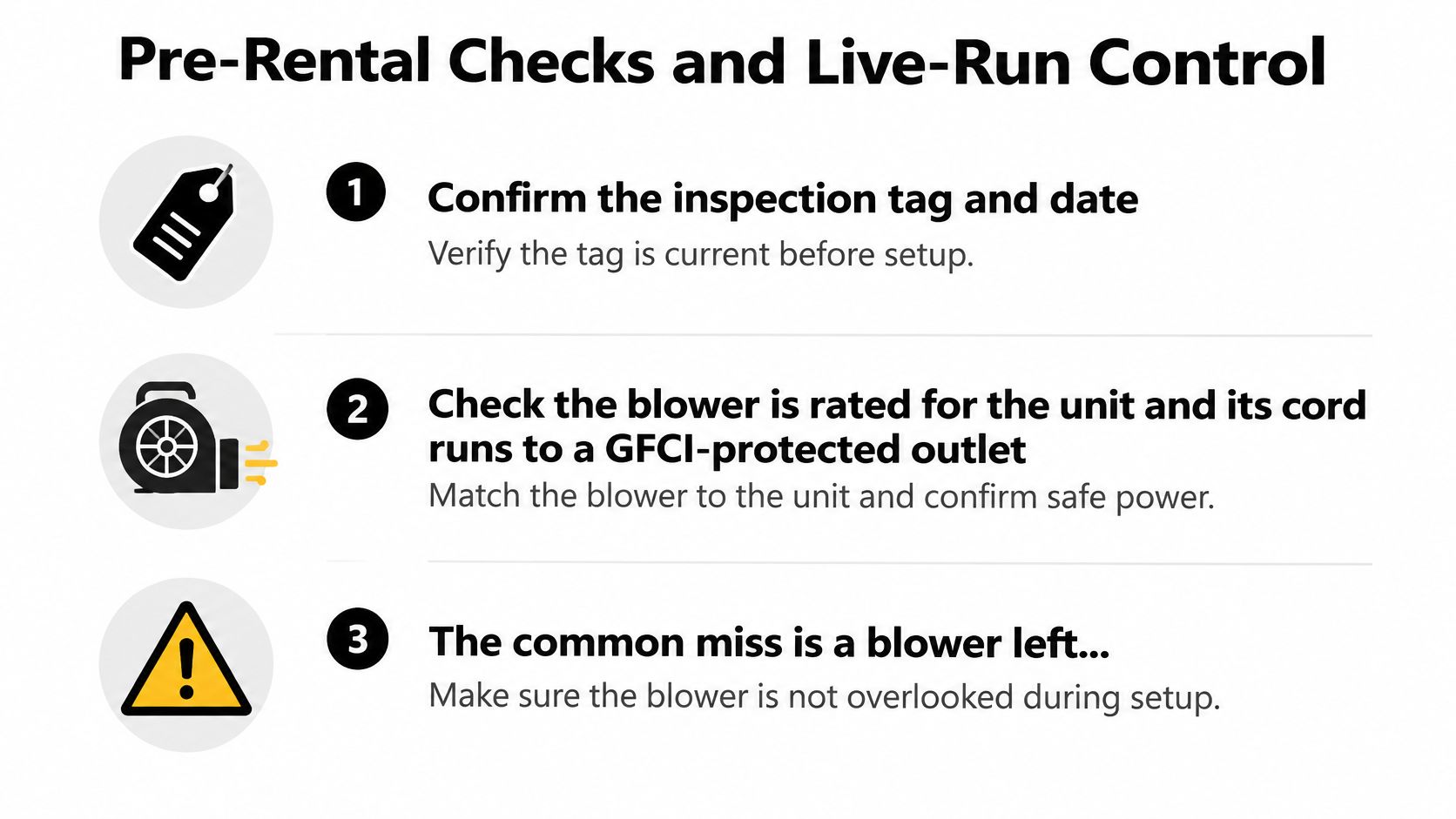
- Confirm the inspection record. Check the tag, date and equipment identity against the unit being installed. Resolve missing or inconsistent documentation before admitting riders.
- Verify the blower and power supply. Match the blower to the manufacturer's requirements and connect through the required GFCI protection. Protect connections from water and route cords away from foot traffic. Never assume the attraction is ready after a power interruption just because the blower has restarted.
- Check every anchoring position. Compare the installation with the manufacturer's anchoring plan, including the prescribed stakes or engineered ballast arrangement. Look for movement, loose attachments and ground that won't hold securely. Don't improvise substitute weights.
- Inspect the structure. Examine seams, netting, padding, climbing grips and slide surfaces for damage. Loose stitching, exposed edges or a compromised barrier need resolution, not a reminder to riders to be careful.
- Prepare the base and perimeter. Remove rocks and sharp debris, identify sprinkler heads and confirm that the surface and slope are acceptable. Keep anchoring hardware, blower equipment and public circulation separated.
- Test the travel route. The authorized crew should check entry, obstacles, landings and exits using the manufacturer's procedure. Confirm that attendants can reach the positions needed to supervise the full course.
Buried utilities and venue restrictions must be resolved before stakes go into the ground. A paved site isn't automatically unusable, but it requires an approved anchoring solution established before delivery, not improvised at setup.
Control each heat from entry to exit
Post the unit-specific rider limit and eligibility rules at the admission point. Use a clicker, admission tokens or a simple release-and-clear procedure so the entrance attendant knows who remains inside. Never raise occupancy because the line is getting longer.
Assign entrance control, exit control and observation of concealed or higher-risk features. The staffing arrangement must cover the actual layout and manufacturer's requirements. If a tunnel or climb blocks visibility, an attendant standing at the front can't supervise it by listening.
Give riders a short briefing before release. Require shoes off where specified, empty pockets and removal of unsuitable loose items. Prohibit piggybacking, flips, rough play, climbing on external walls and stopping in landing areas.
For a race, release riders only when their lanes and landing areas are clear. Don't let a faster participant chase a slower rider into a confined obstacle. Stop the next start if someone becomes stuck, frightened or unwilling to continue.
A reset ends when the course is clear and ready, not when a stopwatch says the next group should enter.
During the reset, confirm that everyone has exited, check for dropped items and inspect any feature that drew concern during the run. After a power loss or noticeable softening, stop admission and follow the emergency procedure, including controlled evacuation when necessary. Keep riders out until the authorized operator has checked the cause and confirmed readiness.
Finish the acceptance check with names, signatures and the date. File it with the insurance certificate and inspection documentation, and record later interruptions or corrective actions so the event lead has a usable operating record.
Wind and Weather Limits for Stopping a Jumper
Published wind limits for inflatable operation
| Guidance | Wind limit | Required action | Measurement |
|---|---|---|---|
| Oklahoma guidance | Maximum operating range of 15 to 25 mph | Shut down during storms or high winds | Confirm the applicable equipment and jurisdictional monitoring requirements |
| UK Health and Safety Executive | Do not operate above 24 mph | Stop when the applicable limit is exceeded | Regular anemometer readings |
| 2026 ASTM proposal, U.S. | Proposed reduction of minimum design operational wind speed from 25 mph to 15 mph | A design proposal, not a universal shutdown rule | Not a field measurement schedule |
These thresholds describe different guidance and a proposed design change, not interchangeable permission to operate; the wind-related inflatable incident review and associated guidance also identify 132 wind-related bounce-house incidents from 2000 to 2021, resulting in at least 479 injuries and 28 deaths.
A clear forecast isn't a site safety plan. The operator needs the applicable legal requirements, the equipment's operating instructions and a written stop-use procedure. A proposal must not be presented as an enacted operating requirement.
Give someone authority to stop the attraction
Build the procedure around decisions the crew can make without seeking permission from a committee.
- Assign the wind monitor. Name the person carrying the anemometer and a replacement for breaks. Position measurements according to the operating instructions rather than choosing a sheltered spot that produces reassuring readings.
- Set the logging schedule. Write the required measurement interval into the operating sheet before opening, using applicable guidance and equipment instructions. Record readings and conditions, with additional checks when weather changes.
- Treat gusts as actionable. A sudden gust, anchor movement or instability calls for immediate intervention. Don't average away a concerning reading or wait for the next scheduled check.
- Plan rain and lightning responses. Identify the triggers for stopping, the evacuation route and suitable shelter. Have an announcement ready, and make reopening a deliberate authorization rather than an automatic response when rain eases.
The inflatable weather and wind planning guide can help event leads organize those responsibilities before guests arrive.
Make the backup usable
When reviewing venues, Texas Old Town's resource on choosing an indoor outdoor event space offers useful context for considering a sheltered alternative. Confirm that the backup accommodates guests and accessible circulation. An indoor gathering area doesn't mean an outdoor inflatable can be moved inside.
Tell guests where to go, whether their turn is postponed or canceled and who will announce any restart. Include evacuation time in the decision, rather than waiting until conditions make moving people harder.
Stop-use principle: Log wind during the event, not only before opening. A favorable forecast never replaces live monitoring.
Making the Course Fair for Every Participant
Maximum capacity isn't the same as safe or equitable capacity. A clinical review of pediatric inflatable injuries identifies excessive participant numbers and mixing children of different ages or weights as important risk factors. Soft surfaces don't remove the need to control collisions, falls and rider compatibility.
Fair participation also means recognizing that an approved attraction may still be unsuitable for a particular guest. Don't make entering the inflatable the condition for joining the group or receiving a team reward.
Offer choices without requiring disclosure
- Provide a no-penalty alternative. A lawn game, cooperative challenge or quiet station should be available to anyone who prefers it, not labeled as the activity for children who can't participate.
- Schedule a quieter period. Reduce nearby announcements and competitive pressure where practical. Explain what participants should expect before they approach the entrance.
- Offer lower-density runs. Allow additional room and unhurried completion when the equipment's operating rules permit it. Don't send someone faster behind a participant who needs time.
- Check the complete access route. Assess the journey from parking or drop-off through check-in, viewing areas and the attraction entrance. A clear lawn route alone doesn't establish that mobility equipment can safely enter the inflatable.
- Train attendants to offer help respectfully. Ask what support would be useful, without requesting a diagnosis. Never lift someone or bring mobility equipment onto the unit without an approved procedure.
Post a general check-in notice stating that alternate activities and quieter participation options are available to everyone. That makes the choice ordinary rather than forcing a private explanation in front of the queue.
Check the layout and equipment together
For the surrounding waiting area, ABCO Security Services Australia's guidance to improve crowd flow at events provides useful context for managing approaches and circulation. Keep resting spaces and accessible paths outside the queue's likely overflow.
Before booking, request written answers about lower-height entry options, permitted assistance, mobility-equipment compatibility and any restrictions affecting adapted participation. Where the course can't provide an appropriate experience, put equal planning effort into the alternative rather than promising access the equipment cannot support.
Confirm Your Jumper Plan Before You Book
Book the operating plan, not just the inflatable. The reservation should identify the actual unit, approved placement, supervision arrangement and conditions under which it won't operate.
Review the paperwork with the people responsible for the event and installation.
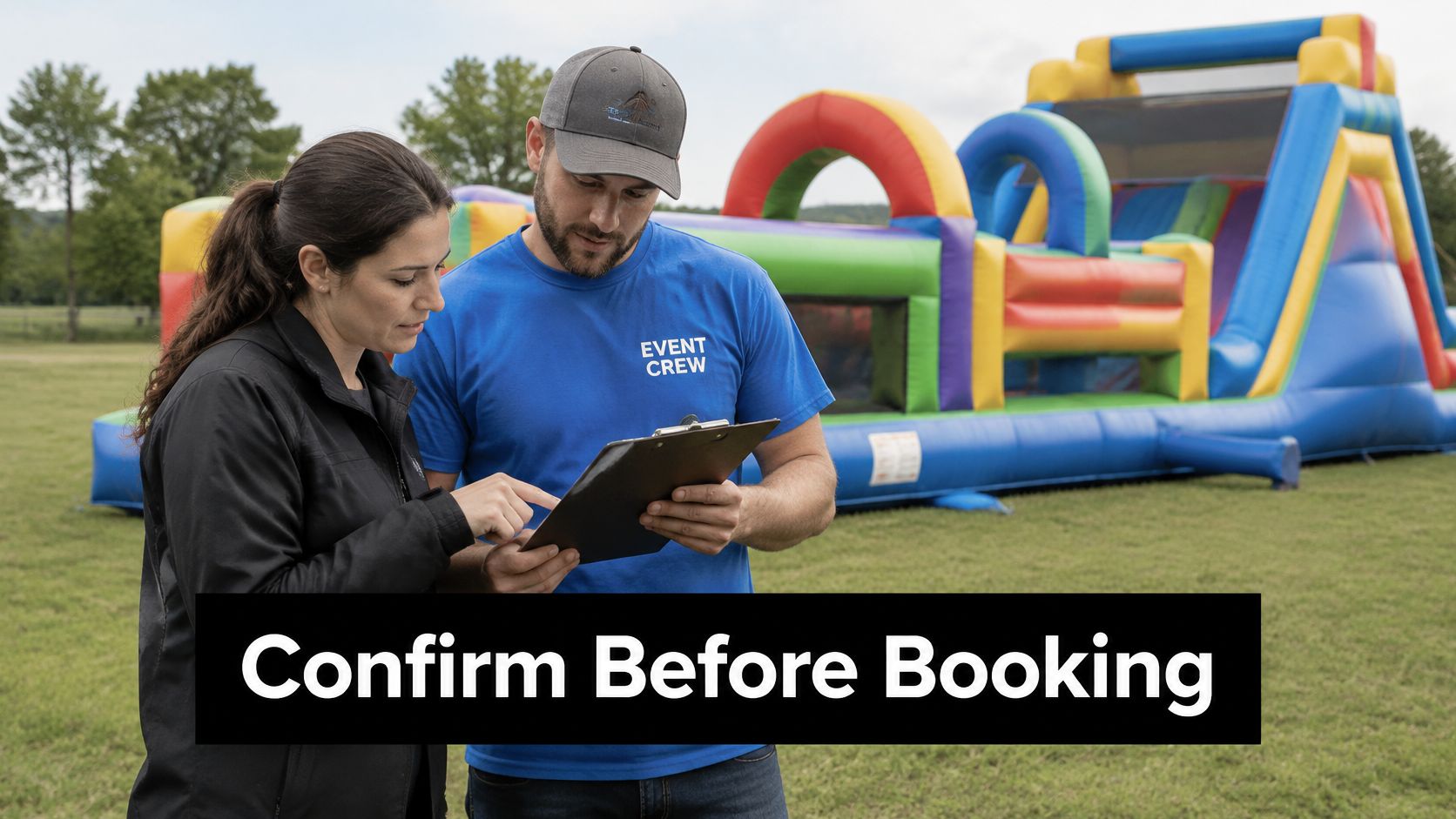
Get the commitment in writing
- Equipment documents. Obtain the unit's specification sheet, inspection record and insurance certificate. Confirm the dimensions, rider eligibility and any separate limits for connected activity zones.
- Site acceptance. Record the approved surface, access route, anchoring arrangement, power provision and required clearance.
- Operating responsibility. Identify who supplies attendants, who briefs them and who authorizes reopening after an interruption.
- Weather procedure. Attach the wind-stop instructions, monitoring responsibilities, evacuation arrangements and cancellation communication.
- Participation schedule. Include compatible rider groups, quieter periods, alternatives and any approved lower-height entry option.
Compare the written answers with the event requirements before signing. Hold the booking if a safety-critical item remains unresolved; a verbal promise to work it out on arrival isn't enough.
We list inflatables for Maryland, New York and Pennsylvania. Our listed bounce options include Megabounce, Jungle Bounce, Ladybug Bounce and Jungle Side And Splash. Treat those as named options to evaluate, not evidence that every unit provides an obstacle-course layout or suits the same riders.
Use this video as an additional planning reference, while keeping the selected unit's written instructions authoritative.
Before opening, have the event lead and operating crew confirm the maximum simultaneous rider count and the wind speed at which operation stops. Put both on the operating sheet, with any stricter conditions that require an earlier shutdown.
Phantom Entertainment offers inflatable rentals and obstacle-course activities for school events, company picnics and community celebrations. Visit Phantom Entertainment with your usable site dimensions, rider age range and event schedule to discuss an appropriate attraction and the documentation needed before booking.
Ready to Book Your Event?
PA state-inspected, fully insured since 1979. Call us or get a free quote today.