
You've booked the venue, selected the date, and told everyone a mechanical bull is coming. Then the venue manager asks for a certificate of insurance, an additional insured endorsement, and proof that the attraction is covered under the provider's policy. The event is only days away, and the rental company's standard party-equipment paperwork doesn't seem to answer those questions.
That situation is common because a mechanical bull isn't treated like an ordinary table, tent, or speaker system. It's a moving amusement attraction that places a rider, spectators, staff, the venue, and the rental operator in the same risk environment. Mechanical bull rental insurance is often the document that determines whether the venue approves the attraction at all.
The practical goal isn't to become an insurance specialist. It's to confirm that the policy covers the actual activity, that the limits satisfy the venue, and that the certificate uses the wording the venue requested. A broader overview of business liability coverage, including how it protects organizations from third-party claims, is available through PTL Insurance Associates liability coverage.
By the time you finish, you'll know what liability insurance does, why venues inspect the certificate closely, which safety records help underwriting, and how to submit a complete approval package without creating a last-minute scramble.
Introduction Why Insurance Decides If Your Bull Gets In
A venue manager sees a mechanical bull differently from an event planner. You may see an exciting activity that fits a company picnic, school celebration, festival, or private party. The venue sees a powered attraction with a rider who can fall, a crowd standing nearby, and a business that must respond if someone alleges an injury.
That distinction explains why a venue can approve your food vendor, DJ, and tables without asking for the same documentation. Mechanical attractions create a more direct bodily-injury exposure. The venue wants evidence that the operator has insurance in force, that the policy applies to the mechanical bull, and that the venue receives the status it requires under the contract.
The concern isn't theoretical. A 2022 analysis of United States emergency department data estimated 27,903 mechanical bull-riding injuries from 2000 through 2020, based on a sample of 801 treated cases. The analysis found that 61.6% of estimated injuries involved a rider falling or being thrown from the bull, while 31.1% were strains or sprains and 23.6% were fractures. 96.3% of patients were treated and released, which indicates that many incidents aren't catastrophic, but frequent claims can still create meaningful exposure for operators, hosts, and venues. The published injury analysis is available through PubMed.
Practical rule: A venue doesn't approve a certificate because it looks official. It approves the attraction when the policy, wording, limits, and operating arrangements match its requirements.
If the certificate arrives with the wrong event dates, omits the mechanical bull from the description, or lists the venue only as a certificate holder when an additional insured endorsement is required, the venue may reject it. A missing endorsement can delay approval even when the rental company carries a legitimate policy.
That's why insurance should be handled at the same time as the venue contract, not after the entertainment is booked. Ask what the venue requires, give those requirements to the rental provider or broker, and request the complete documentation package before invitations, announcements, or final event production decisions depend on the bull.
How Mechanical Bull Liability Really Works
Think about a mechanical bull the way you'd think about a trampoline park. A participant chooses to take part, but the business still controls the equipment, the staff, the operating conditions, and the surrounding environment. A waiver can explain the activity's inherent risks, but it doesn't replace the operator's responsibility to run the attraction properly.
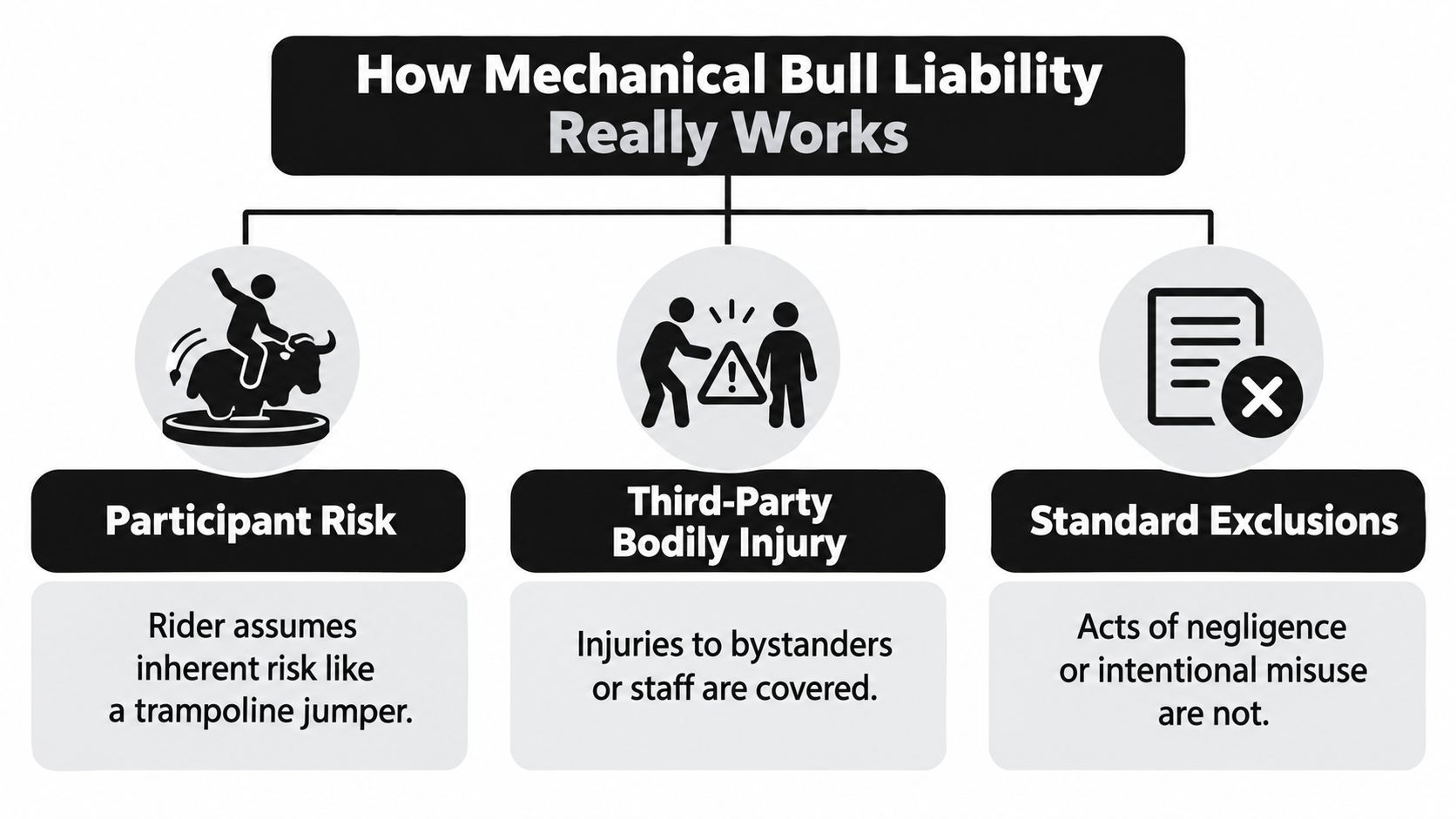
Three layers help clarify the exposure.
Participant risk begins with the rider. The rider can lose balance, fall, or be thrown as the bull changes movement. The soft landing area and automatic stop controls can reduce the consequences, but they don't eliminate the possibility of injury. The operator must set an appropriate intensity, explain the rules, monitor the rider, and stop the attraction when conditions become unsafe.
Third-party bodily injury involves someone other than the rider. A spectator could enter the operating area, a staff member could be struck during setup, or a guest could allege an injury caused by unsafe crowd control. Commercial general liability is designed to address claims alleging bodily injury or property damage arising from the business's operations, subject to the policy terms and exclusions.
Standard exclusions create the point that surprises many first-time planners. A general party-rental policy may not automatically cover a mechanical amusement device. Industry guidance warns that standard party-rental liability forms can exclude mechanical amusement equipment unless the policy specifically names or endorses it. An industry discussion of mechanical amusement coverage and underwriting documentation is available from G Inflatable News.
The safety net has several owners
Responsibility can involve more than one party. The rental operator controls the bull, its setup, and its attendant. The event host controls decisions such as where the attraction is placed and whether the event follows venue rules. The venue controls the property and may impose its own operating conditions.
Insurance doesn't automatically make every party responsible for every incident. Instead, the contracts and policy endorsements determine who receives protection, under what circumstances, and subject to which exclusions. That's why a venue may request additional insured status rather than accepting a certificate that merely identifies the venue by name.
A waiver helps communicate inherent risk to participants, but it shouldn't be treated as a guarantee that a claim can't be made. Stronger protection comes from combining appropriate coverage with trained operation, controlled access, documented inspections, and clear participant rules.
Coverage Types and Limits You Will Be Asked For
Most mechanical bull programs use more than one insurance layer because different coverages solve different problems.
Commercial general liability, or CGL, is the primary protection for third-party claims alleging bodily injury or property damage connected with the operation. It can respond to defense costs and covered settlements or judgments, subject to the policy language, limits, deductible, and exclusions. For a mechanical bull, the policy should specifically address the amusement device rather than assuming every rental activity is included.
Participant accident coverage addresses certain injuries suffered by riders, depending on the policy design. It's not a substitute for CGL. Instead, it can provide a separate route for eligible medical expenses and may help address participant injuries without relying only on a negligence claim.
Umbrella or excess liability adds another layer above the primary policy. Market guidance for mechanical bull businesses recommends total liability limits of about $5 million to $10 million for venue-based operators and $2 million to $5 million for mobile operators, with primary CGL often beginning at $1 million or $2 million per occurrence before the umbrella responds to higher-severity losses. The insurance structure and limit guidance are discussed by Professional Insurance Group.
Per occurrence and aggregate limits
A per-occurrence limit is the maximum the policy may pay for one covered incident. The aggregate limit is the maximum the policy may pay for covered claims during the policy period, subject to the policy terms. A venue may ask for both because one serious incident can consume part of the available protection, while several separate claims can affect the annual total.
Pennsylvania provides a useful regulatory benchmark. State amusement-ride rules require liability insurance to be in force before an amusement ride or attraction operates. The minimum limits are $100,000 per occurrence and $300,000 aggregate for Class I rides, or $250,000 per occurrence and $500,000 aggregate for Class II rides. Mechanical bulls may be treated as higher-risk amusement attractions rather than ordinary party equipment, so venue and municipal requirements can be more demanding than a general private-party expectation. Pennsylvania mechanical bull insurance guidance and regulatory benchmarks are summarized by Kelly Insurance Group.
| Coverage Layer | Mobile Operator Typical Range | Venue-Based Operator Typical Range |
|---|---|---|
| Primary CGL | $1 million to $2 million per occurrence | $1 million to $2 million per occurrence |
| Umbrella or excess | Total liability commonly reaches $2 million to $5 million | Total liability commonly reaches $5 million to $10 million |
| Participant accident | Often added where rider exposure requires it | Often added where recurring venue operations require broader protection |
The table describes market guidance, not a universal legal requirement. Your venue contract, municipality, insurer, and state rules control the final answer. A one-time renter usually doesn't buy a standalone policy independently. The practical route is to select a provider whose policy already covers the bull and request a certificate for the event.
Understanding Your Certificate of Insurance
A certificate of insurance, commonly called a COI, is a summary document. It shows that a policy exists and displays important information, but it isn't the insurance contract itself. The venue manager uses it as a screening tool, then relies on the policy and endorsements for the actual rights and obligations.
Start with the named insured. This should identify the company carrying the policy, not merely the person who placed the event order. If the rental is being supplied by a subcontractor, ask which business owns the coverage and which entity will operate the attraction.
Read the COI field by field
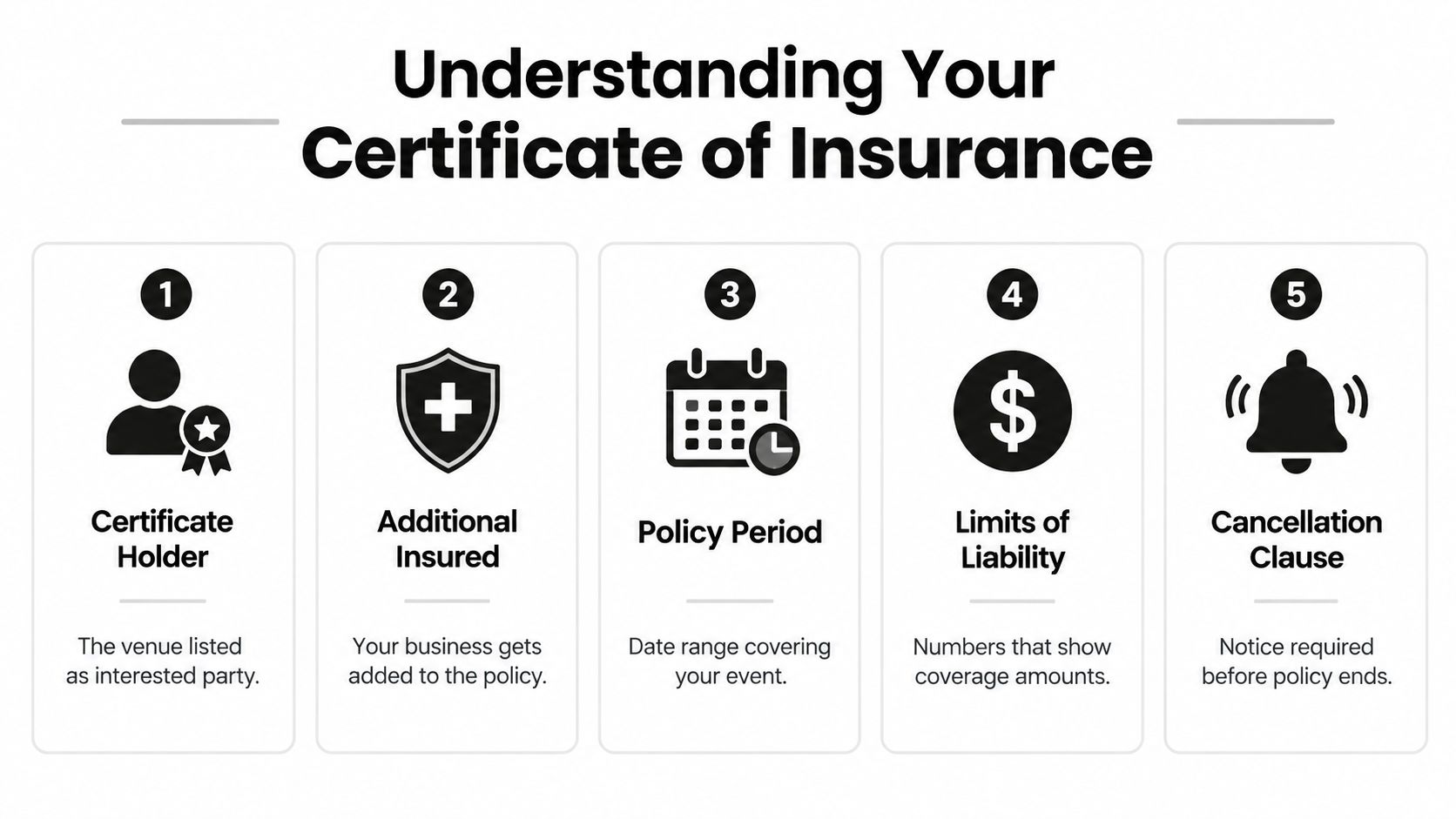
The certificate holder is the party receiving the certificate. A venue may want its legal name and address listed there. That status alone usually doesn't provide the same protection as being an additional insured.
An additional insured endorsement adds the venue, municipality, school, or other requested organization to the policy for qualifying claims. The endorsement itself matters. A venue may reject a COI that lists it in the certificate-holder box but doesn't include the endorsement it requested.
The policy period must include the event date, including setup or teardown if the venue requires those activities to be covered. Check the liability boxes for the per-occurrence and aggregate limits, then compare them with the venue's written requirements.
Most important, inspect the description of operations. It should identify the mechanical bull rental or mechanical amusement attraction clearly enough for the venue to understand what is insured. If the policy excludes mechanical devices, the certificate's general wording won't fix that exclusion.
A venue might also request a waiver of subrogation, primary and noncontributory wording, or notice provisions. Those requests are contract-specific, so send them to the broker rather than trying to edit the COI yourself. A certificate can't expand coverage or override policy language.
Document check: The bull should be specifically included, the event dates should be correct, the limits should match the venue's request, and every endorsement should be supplied separately when the venue asks for it.
If you're comparing broader business coverage while reviewing vendor requirements, a practical guide to find contractor insurance policy types can help you understand how commercial policies differ across operations. For event-specific planning questions, review the DJ Phantom event FAQ, then ask the provider for a venue-ready package containing the COI, endorsements, operating description, and safety documentation.
Risk Mitigation That Makes Insurance Work Better
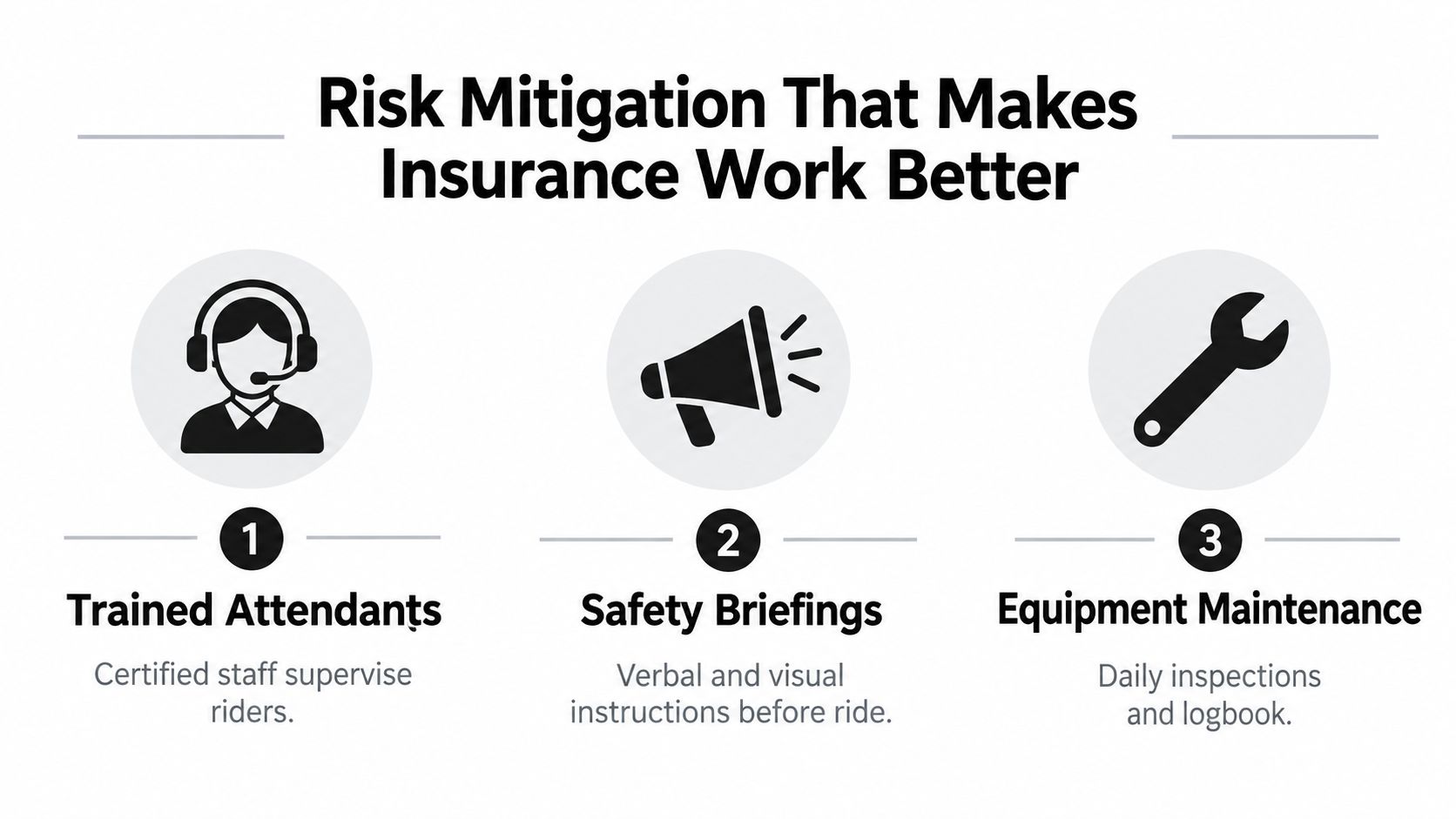
Insurance works best when it supports a controlled operation. Underwriters and venue managers want to know who will supervise the ride, how the equipment will be inspected, what riders will be told, and what happens after an incident. Those details show that the operator manages risk before a claim occurs.
The first control is a trained attendant who stays focused on the attraction. The attendant manages the controls, watches the rider and landing area, keeps unauthorized people away from the operating zone, and stops the bull when a rider loses position. A provider should be able to explain the operator's experience and training rather than promising that someone will be present.
Build safety into the event schedule
Before guests arrive, the crew should inspect the bull, power connections, controls, inflatable landing area, surrounding surface, and clearance around the attraction. The operator should record the inspection through a checklist or logbook. If weather or ground conditions make outdoor operation unsuitable, the team needs a clear decision process for pausing or relocating the activity.
Riders should receive verbal and visual instructions before participating. Rules commonly address one rider at a time, proper seating and hand placement, behavior during the ride, and conditions that prohibit participation. Waivers can document that participants received risk information, but they should sit alongside supervision and operating controls, not replace them.
Document the quiet days too
An accident report matters after an injury, but a no-loss report can also help document that an event concluded without a known incident. Brokers and insurers may request waivers, accident or no-loss reports, operator experience, and written safety procedures before quoting. They're evaluating how the business controls falls, supervises participants, and preserves information if a claim develops.
Venues also respond to visible professionalism. An operator who can provide inspection credentials, maintenance records, staffing details, and safety procedures gives the venue something concrete to review. Phantom Entertainment's mechanical bull safety information is an example of the type of operational material planners can review when assessing a provider.
Operational insight: A clean file of inspections, briefings, waivers, and incident records helps the insurer evaluate the risk and helps the venue trust the person running the attraction.
How to Get Compliant Insurance for Your Event
Start with the venue, not the rental company. Ask for the insurance clause in the contract and request the venue's exact legal name, address, required limits, additional insured wording, waiver requirements, and certificate deadline. A municipality, school, corporate campus, and private venue may each use different language.
Then give those requirements to the mechanical bull provider or broker. Ask one direct question: Does the policy specifically cover the mechanical bull or mechanical amusement device being rented? A general statement that the company is insured isn't enough if the underlying policy excludes the attraction.
Use this sequence to avoid avoidable delays:
- Confirm the operating location. Determine whether the event is on private property, at a public facility, or at a venue with its own risk department.
- Request the insurance requirements in writing. Include limits, additional insured status, certificate-holder details, and any requested endorsements.
- Verify the mechanical bull endorsement. Ask the provider or broker to confirm that the insured activity matches the equipment and service.
- Provide event details. Share the date, venue name, address, operating hours, setup window, expected audience, and whether the event is indoors or outdoors.
- Request the complete document set. Obtain the COI, applicable endorsements, waiver materials, safety procedures, and inspection documentation.
- Submit everything for approval. Send the package to the venue's designated contact and keep written confirmation that the attraction is accepted.
Don't wait until the week of the event. Underwriting questions can arise when the broker needs details about operator experience, prior losses, equipment maintenance, or safety controls. Early submission leaves time to correct an excluded activity or replace wording the venue won't accept.
A turnkey provider can reduce the number of moving parts by coordinating delivery, setup, staffing, operation, teardown, and insurance certificates. That arrangement doesn't eliminate your responsibility to verify venue requirements, but it gives you one operational contact instead of coordinating separate equipment, staffing, and compliance vendors.
Booking With Confidence and Keeping Venues Happy
A mechanical bull gets through venue approval when three pieces line up: adequate limits, correct COI wording, and professional operation. The insurance certificate should identify the right parties and dates, the policy should cover the actual mechanical attraction, and the provider should be prepared to show how staff control the ride and document safety procedures.
Before signing, confirm that the venue has approved the certificate and any endorsements. Ask who will operate the bull, what safety documentation is available, how the landing area and controls are inspected, and who your event contact will be on setup day.
For planners in Pennsylvania and the Mid-Atlantic, an insured, state-inspected provider can make the process more predictable from delivery through teardown. Review the available mechanical bull rental service, compare the documentation with your venue's requirements, and resolve gaps before you commit to the event schedule.
Phantom Entertainment provides mechanical bull rentals with delivery, setup, professional operation, certificates of insurance, and venue-ready safety documentation for events across Pennsylvania and the Mid-Atlantic. Visit Phantom Entertainment to discuss your venue requirements and request an attraction package that's ready for approval.
Ready to Book Your Event?
PA state-inspected, fully insured since 1979. Call us or get a free quote today.