
You're filling the last open space on a school field-day plan or company-picnic layout, and an inflatable soccer darts board looks like a straightforward choice. Guests kick at a giant target, staff record the scores, and the next player steps forward. The harder questions sit behind the attraction: whether it fits the site, who operates it, what happens when the wind rises, and what the quote includes.
Treat it as commercial inflatable equipment, not a large lawn game. A workable booking starts with the exact unit's specifications, a realistic operating plan, and clear responsibility for setup and shutdown.
What an Inflatable Soccer Darts Board Is and How a Round Plays
An inflatable soccer darts board gives players a large vertical target with scored zones. Players kick balls from a marked line, aiming for the zones as they would on a conventional dartboard. A blower keeps the fabric target inflated during play.
The game tests kicking accuracy and is straightforward to demonstrate. Show the scoring zones, the kicking line and where the next player waits. The Soccer Challenge information can help planners understand the format.
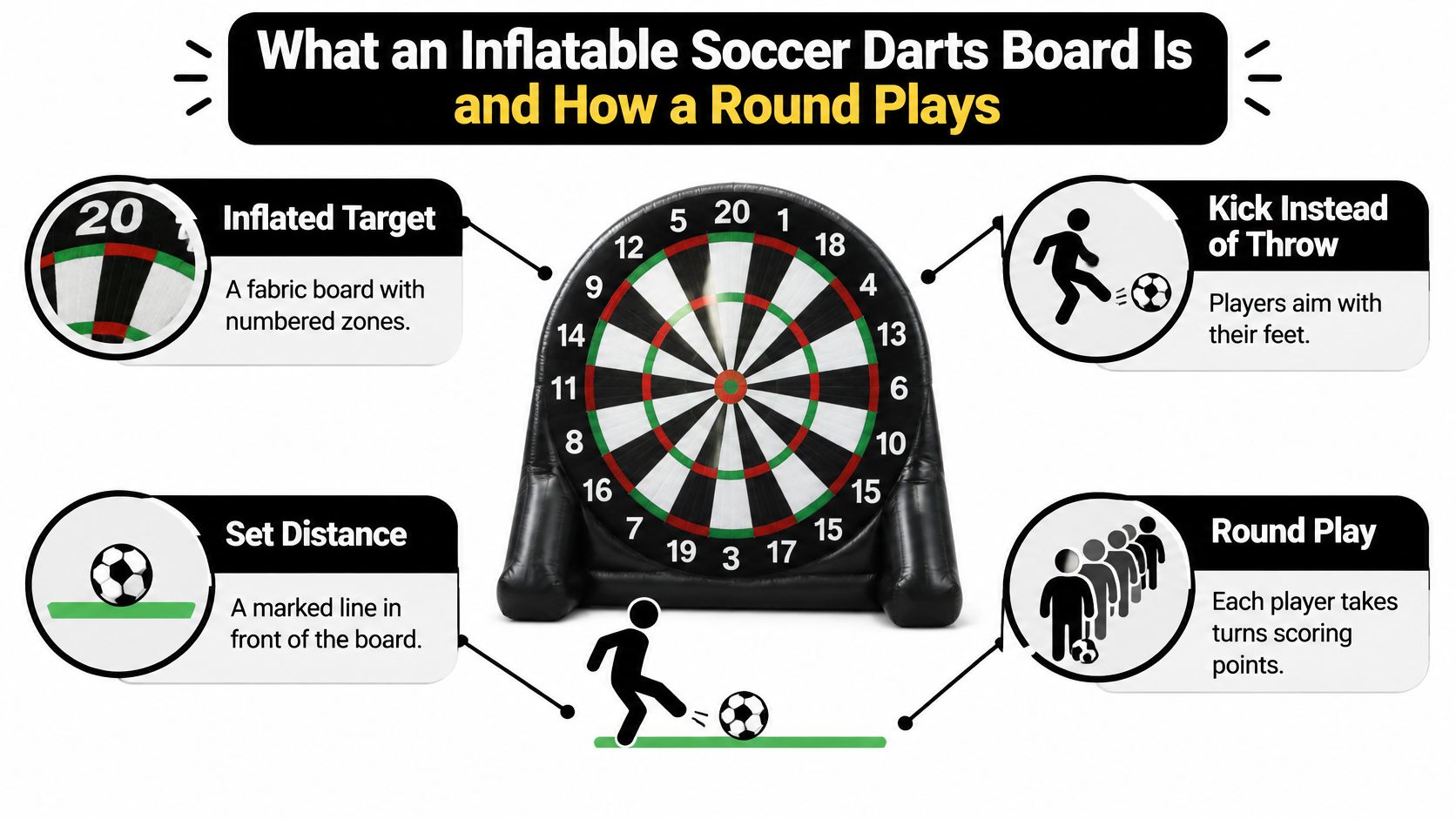
A round staff can repeat consistently
For a school challenge, give each participant the same number of attempts and explain the rules before play:
- Take turns: The attendant calls a player forward and checks that the lane is clear.
- Record the result: Score the zone reached according to the unit's rules.
- Reset safely: Retrieve or release the ball using the specified procedure before the next kick.
- Compare totals: Once everyone has finished, compare individual or team scores.
Confirm how the target handles the ball. It may stick to the face or rebound, and some setups may require a retrieval tool. Tell staff how to score boundary hits and misses.
Choose the format before guests arrive
Individual scores suit a leaderboard. Team totals give colleagues or classmates a shared goal without putting every attempt in the spotlight.
Keep the rules visible by the queue. Sudden-death ties and complicated bonus zones can slow play when participants need repeated explanations. If a guest can explain the round after a demonstration, the format is working.
Specs and Setup Requirements to Compare Before Booking
Use this comparison sheet to separate a suitable unit from an attractive photograph.
| Spec | What to Confirm | Why It Matters |
|---|---|---|
| Dimensions and target layout | Height, width and zone count from the manufacturer's spec sheet | Sets the footprint and kicking distance |
| Safety standard | Commercial-use documentation, rather than home-use product documentation | Determines the safety record you can show a venue |
| Anchoring | Every manufacturer-specified anchor point used at every setup | Helps resist movement and overturning |
| Wind limit | Written manufacturer operating limit and shutdown procedure | Sets when play must stop |
| Blower and power | Specified blower, stable pressure and electrical check before opening | Loss of pressure can make the board sag or collapse |
| Staffing | Trained attendant with authority to stop play immediately | Controls the queue, climbing and rebound area |
| Inspection records | Pre-opening inspection and maintenance intervals in writing | Supports venue and insurance review |
There's no single standard board size. Height, width, target layout and permitted kicking distance must come from the documentation for the exact model being delivered. Don't use dimensions from a similar-looking unit to approve a site.
Measure the operating area, not just the inflatable
A board's footprint isn't its complete activity area. Add room for the kicking lane, ball retrieval, the queue, spectators, blower access and the manufacturer's required clearances.
A larger face can be easier to see across a festival, but it also needs more site space and an anchoring arrangement approved for that unit. Don't infer the number or strength of anchors from appearance.
A longer kicking distance changes the experience, too. It can make scoring harder and increase time spent retrieving missed balls. A shorter approved distance may suit a casual family event better than a tournament-style layout.
Booking rule: Approve the equipment against a marked site plan, not a product photograph.
Resolve the site constraints early
Tell the operator whether the surface is grass, asphalt or an indoor floor. A setup that relies on ground stakes cannot move onto paving without an approved alternative.
Check ceiling clearance indoors, including lights and other suspended fittings. Outdoors, identify access restrictions, underground-service concerns and pedestrian routes before agreeing on the position.
Power deserves its own place on the plan. Confirm the electrical supply, cable routing and who prevents other equipment from being connected to the same supply without approval.
Before booking, get clear answers to these questions: Does the spec sheet identify the dimensions? Which safety standard applies? Is the operating wind limit written down? Missing answers should delay approval, not become arrival-day decisions.
Safety Standards, Injury Risks and Age Limits
CPSC staff estimated approximately 113,272 emergency-department-treated injuries associated with inflatable amusements in the United States from 2003 through 2013, according to the CPSC guidance on constant-air inflatable play devices. Those figures cover inflatable amusements generally, not soccer darts boards specifically. They establish why a soft-looking attraction still needs a serious operating plan.
A child approaching the kicking line illustrates the difference between a simple game and the supervision needed to run it.
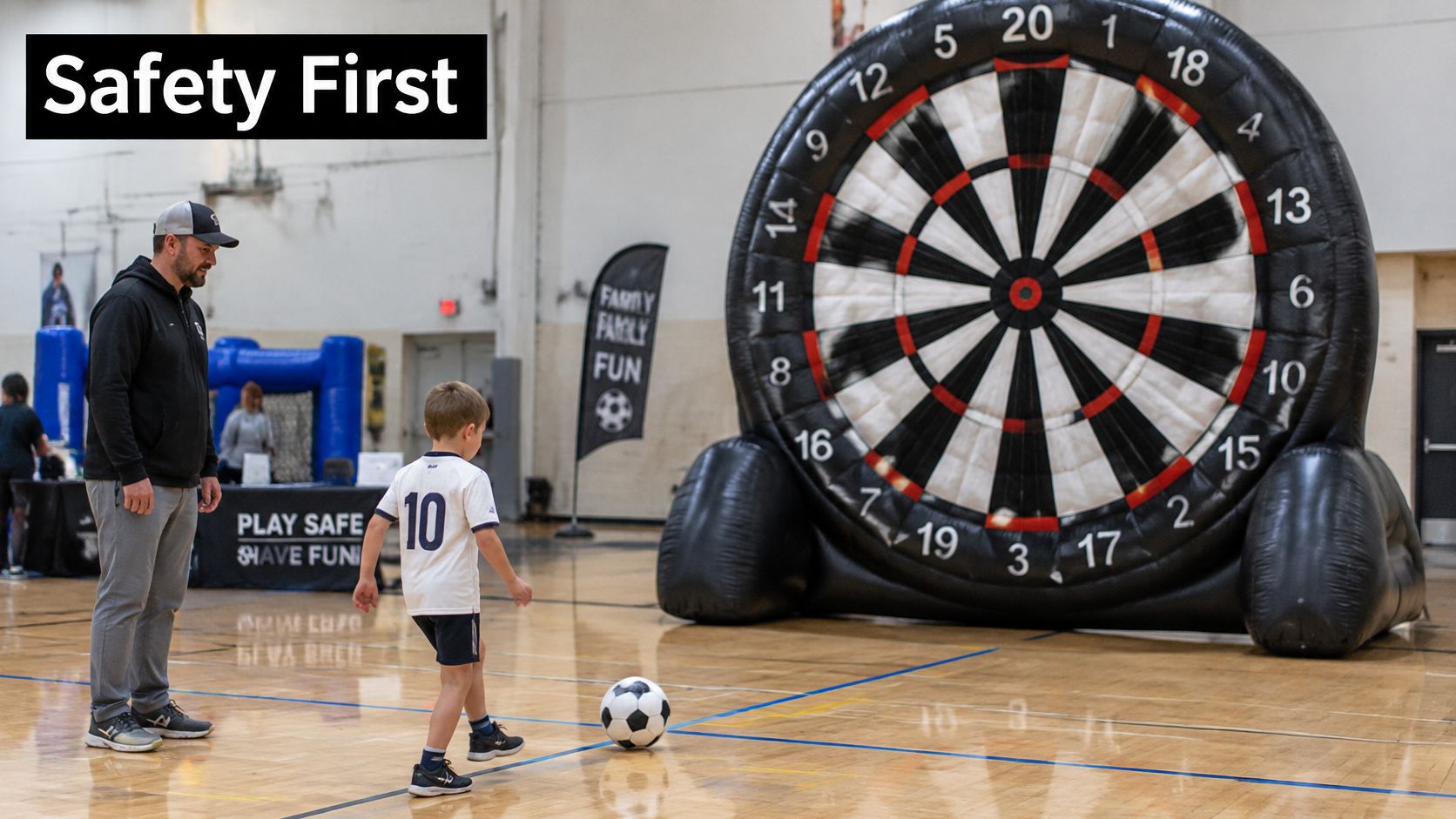
Soft construction doesn't remove operational risk
An inflatable structure doesn't prevent a spectator from walking into a kicking lane. It doesn't stop someone hanging from the target, recognize a loose attachment, or decide that changing weather requires closure.
The CPSC distinguishes ASTM F2374, the voluntary benchmark for commercial inflatable amusement devices, from ASTM F2729, which applies to home-use constant-air inflatables. A product advertised for backyard use isn't automatically an appropriate substitute for a commercially operated attraction.
Ask for evidence relevant to the actual unit, its condition and its intended use. A general statement that equipment meets safety standards doesn't establish which standard was applied or whether the current setup follows the manufacturer's instructions.
The attendant's job must also be realistic. Someone answering registration questions across the field can't simultaneously monitor kicks, approaching spectators and the condition of the board.
Supervision means watching the activity and being able to intervene, not merely being somewhere nearby.
Set limits from the equipment documentation
There's no universal age range for soccer darts. Get permitted user limits from the manufacturer, reconcile them with venue requirements, and include them in the staff briefing.
Height, balance, mobility, vision and kicking confidence can matter as much as age. Don't assume that a large target and a soft ball make the activity accessible to everyone.
For mixed groups, separate participants by size or experience where appropriate and permitted. Never improvise a modification that conflicts with the operating instructions.
Use the video as a gameplay reference, not as proof of an approved setup or a replacement for operator training.
Before opening, make the limits visible to guests and staff. If a participant can't use the attraction within those limits, offer another role or activity rather than encouraging them to push through an unsuitable challenge.
Setup, Wind and Shutdown Steps
Use the manufacturer's lower wind limit, and monitor gusts rather than relying only on an average forecast. CPSC inflatable-amusement guidance advises deflating inflatables when wind exceeds 25 mph, while many manufacturers set limits between 15 and 25 mph. That upper figure isn't permission to keep a unit running beyond its own instructions.
Commercial setup is a complete operating task. The ASTM F2374 standard addresses inflatable-amusement design, installation, operation, inspection, maintenance and training, rather than treating the fabric target as an isolated product.
Follow a controlled opening sequence
Check the blower and electrical supply. Inspect the casing, intake, plug and cable, and verify compatibility with the unit. Don't discover an unsuitable power connection after the inflatable is positioned and the queue has formed.
Confirm the surface and pressure. Place the unit on the approved level area, following the manufacturer's installation sequence. Check that inflation stabilizes and investigate soft sections rather than dismissing them as cosmetic.
Complete the approved anchoring arrangement. Use every specified anchor point and approved attachment method. Non-load-bearing loops aren't substitutes, and improvised ballast isn't an acceptable answer to a surface that won't take stakes.
Examine the fabric and target face. Look for damaged seams, tears, loose attachments and anything that could affect play or stability. Secure the scoring face as instructed; don't conceal damage behind it.
Mark the playing lane. Put the kicking line at the approved distance and establish a clear retrieval area. Avoid locating the lane across a route guests will naturally use between attractions.
Brief the attendant. Give the operator the written operating limits, emergency contacts and authority to close the activity. A common planning mistake is assigning responsibility without making shutdown authority equally clear.
Position the queue and spectators. Keep them outside the likely ball-return area and away from anchors, tie-downs and blower equipment. Agree on the turn format before opening so staff aren't negotiating extra attempts with each participant.
Record the checks. Log the inspection, weather assessment and any defects or corrective work. A completed form should reflect an actual inspection, not become a signature added after guests arrive.
Keep the weather and wind planning guidance available to the event lead alongside the unit-specific instructions. Use an anemometer as part of monitoring, with placement and interpretation directed by the operator's procedure.
Stop before conditions become unsafe
Stop admitting players when gusts approach the applicable limit, and begin the manufacturer's shutdown procedure with enough time to clear the area. Don't wait for visible movement as confirmation that the wind is too strong.
Pause immediately if the board shifts, pressure falls or an anchor loosens. Clear participants and spectators before investigating, and don't resume until the operator has corrected the issue and repeated the relevant checks.
Prevent climbing and hanging throughout operation. If power fails, keep people away from the deflating structure and let the trained operator manage isolation and recovery.
Adapt participation without improvising equipment
HSE inflatable safety guidance emphasizes trained supervision and enforcement of user limits. Within the manufacturer's permitted use, build flexibility into the game rather than altering the structure.
Offer a low-pressure practice turn, age- or experience-based scoring groups, or a noncompetitive target challenge. Rolling, seated or assisted attempts should be agreed with the operator only where compatible with the equipment and safe lane arrangement.
Team roles can include scorekeeping and announcing results, so participation doesn't depend entirely on kicking. Keep adaptations consistent and published, rather than changing the scoring whenever a confident player asks for a harder challenge.
Rental vs Purchase Trade-Offs
Compare responsibility as well as price when deciding whether to rent or own.
| Factor | Rental | Purchase |
|---|---|---|
| Upfront cost | Per-event fee set by the provider | Full unit price plus blower and anchors |
| Delivery and setup | Often packaged in the quote, but confirm explicitly | Owner needs transport, labor and trained staff |
| Inspection and records | Require the provider's inspection documentation | Owner schedules inspections and keeps records |
| Insurance | Request a certificate of insurance from the provider | Owner must arrange appropriate liability coverage |
| Best fit | Occasional events without equipment-management capacity | Frequent use with storage and a trained operator |
Don't assume the rental headline includes an attendant, delivery, collection or every site requirement. Get an itemized scope that distinguishes supplied services from organizer responsibilities.
For an initial budget conversation, use our pricing information, then request a written quote for the actual date, location and operating requirements. A general price page can't establish the complete cost of a particular setup.
Calculate ownership from the full cost
Let P represent the purchase outlay, including the unit and required initial equipment. Let E represent the events you realistically expect to run during the year.
P ÷ E gives the purchase-cost allocation per event if you charge the entire outlay to that year. Add per-event operating labor, transport, cleaning, inspection, repair and storage allocations before comparing it with rental.
For a longer ownership horizon, spread the purchase outlay across the events realistically expected over that period instead. Label the chosen period clearly so nobody mistakes a first-year calculation for a lifetime cost.
Ownership only saves money when the complete operating cost is lower, not when the purchase price divided by optimistic bookings looks attractive.
Find the actual break-even point
Let R be the complete rental cost per event and V the ownership operating cost per event. Where R exceeds V, divide the ownership outlay plus fixed costs for the chosen period by R − V to estimate the event count needed to break even.
If the denominator isn't positive, buying doesn't create a cost advantage under those assumptions. Also test a quieter schedule and an unexpected repair before approving the purchase.
Use a comparison sheet for competing written quotes. To keep signatures and agreed responsibilities together, Closer Innovation Labs Corp. provides a resource to manage event equipment rental agreements; contract organization still doesn't replace checking the operating scope.
Confirm the Booking Before You Sign
Send the supplier a document request before seeking final venue approval. Commercial inflatable requirements aren't identical everywhere: the Oklahoma Department of Labor inflatable amusement device guide illustrates jurisdiction-specific expectations around registration, supervision and standards compliance.
The organizer must confirm the rules that apply at the event location. Don't assume another venue's acceptance establishes compliance at yours.
Put these questions in writing
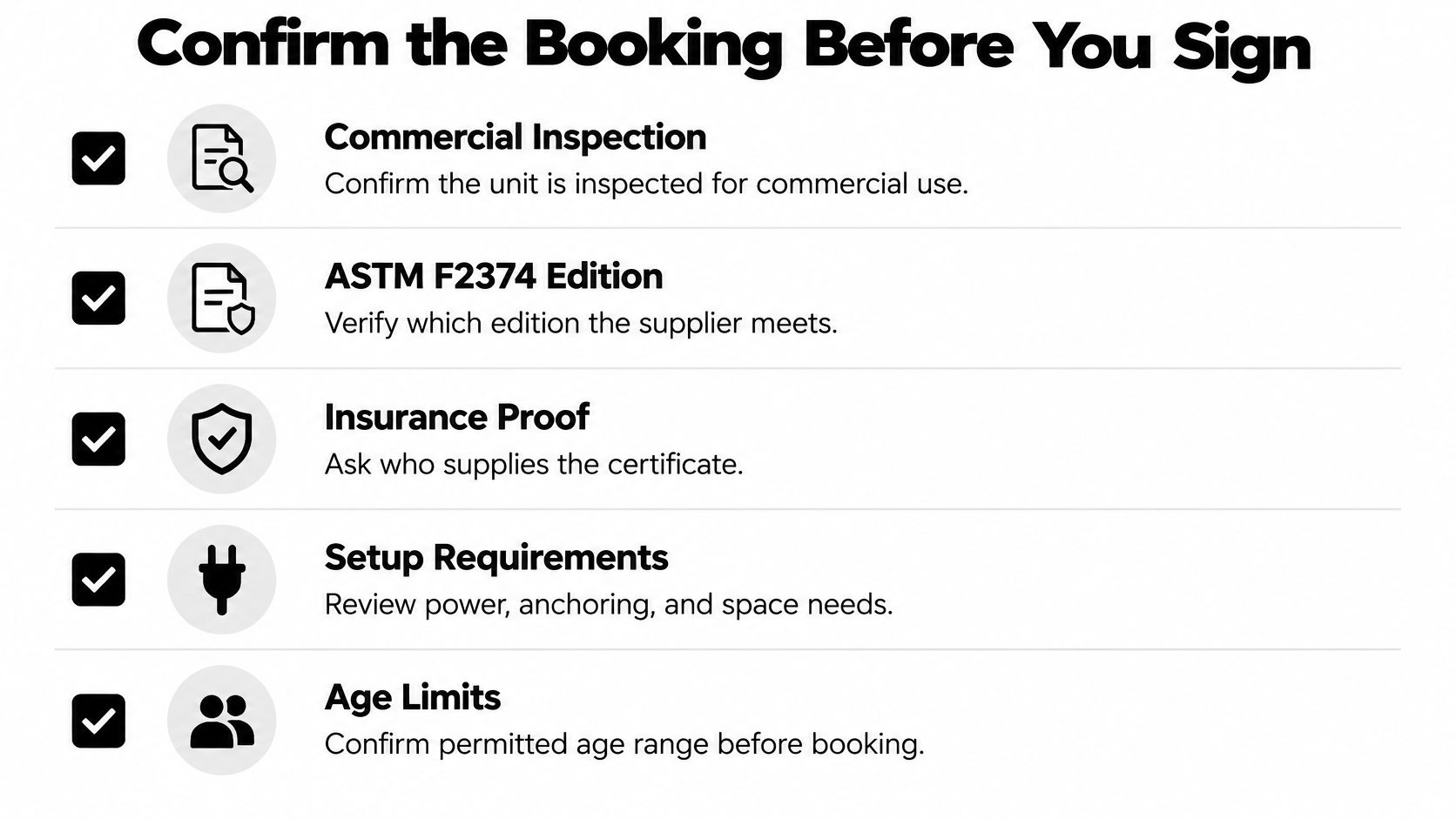
- ✓ Commercial inspection: Is this exact unit inspected for commercial use, and can the relevant record be supplied?
- ✓ Standard documentation: Which ASTM edition does the supplier identify, and what evidence supports that statement?
- ✓ Insurance: Who supplies the certificate, and does the venue need additional documentation?
- ✓ Weather responsibility: What operating limit applies, who monitors conditions, and who decides to shut down?
- ✓ Staffing allocation: What is the operator-to-unit arrangement, including breaks and relief coverage?
- ✓ Power failure: Who clears the area, isolates the equipment and authorizes reopening?
- ✓ Record custody: Who holds inspection and maintenance records, and who receives the event-day checklist?
- ✓ Site and user approval: Are the surface, power supply, available space and participant restrictions accepted in writing?
Use the checklist graphic to keep the approval conversation focused.
Match the contract to the operating plan
Review cancellation, weather closure, site access and responsibility for delays before signing. Smartpicsuk®’s conditions for photo booth bookings offer a separate event-service example of terms to review, but they aren't inflatable safety guidance or the terms governing your booking.
We list inflatable service areas in Maryland, New York and Pennsylvania, including Carlisle, Harrisburg, Lancaster and York. Send us the event address rather than assuming a service-area listing guarantees availability for a particular date or attraction.
Keep the accepted quote, site plan, insurance documentation and operating responsibilities together. If the supplier changes the unit, surface arrangement or staffing scope, get the replacement details approved before treating the booking as complete.
Phantom Entertainment offers inflatable attractions and interactive event rentals for schools, workplaces and community events. Visit Phantom Entertainment to ask about soccer darts availability for your location, share your site plan, and request a written quote with setup, staffing and safety documentation clearly identified.
Ready to Book Your Event?
PA state-inspected, fully insured since 1979. Call us or get a free quote today.