
A birthday is on the calendar, the guest list is growing, and the backyard looks smaller now that you're thinking about a bounce house. Before you choose a theme or pay a deposit, check two things together: how much clear ground the unit needs and how many children can jump at once. Then confirm the operating limit and setup plan with the rental company. A unit's printed rating matters, but it doesn't replace careful placement, anchoring, supervision, or weather checks.
For an inflatable bounce house for kids, the right fit is the one that works for your yard and your group, not just the biggest unit available. Use the tables below to narrow the options, then verify every limit against the specific unit's label and manual.
Bounce House Sizes and Capacity at a Glance
| Unit size (ft) | Clear space needed (ft) | Kids jumping at once | Best fit |
|---|---|---|---|
| 10 x 10 | About 14 x 14 | 3 to 5 | Small yards and toddler groups |
| 13 x 13 | About 17 x 17 | 5 to 7 | Backyard birthdays with mixed ages |
| 15 x 15 | About 19 x 19 | 8 to 10 | Large parties and church events |
| 20 x 20 | About 24 x 24 | 10 or more, check label | School and community festivals |
These clear-space figures use a practical allowance of about 2 feet on each side beyond the unit's dimensions. That room helps accommodate the blower, anchor lines, and entrance, but it doesn't guarantee that every site is suitable. Keep the entrance path open, and ask the rental company whether the specific model needs more clearance.
The 10 x 10 unit works for a smaller yard and a younger group, provided there's room around it to set up safely. A 13 x 13 is a common backyard birthday choice because it balances a manageable footprint with space for several children to jump. The larger 15 x 15 can suit a bigger gathering, while a 20 x 20 may fit a school or community event if the site, setup requirements, and unit label all support it.
Plan for simultaneous jumpers
Capacity means the number of children inside the inflatable at one time, not the total number of party guests. A party with many children can still use a smaller unit if adults organize turns and keep admission within the manufacturer's limit. Don't estimate capacity from the floor area: use the unit's label or the rental company's manual.
Measure the usable space, not just the lawn. A tree canopy, fence, slope, or walkway can make an otherwise large yard unsuitable.
Before booking, measure the flat ground, look above the setup area for trees and power lines, and check that the blower cord can reach a suitable outlet or generator without crossing the entrance. If any part of the setup is uncertain, share the measurements and a site photo with the rental company before choosing a unit.
Matching Bounce House Style to Your Kids' Ages
| Style | Typical ages | Supervision level | Best use |
|---|---|---|---|
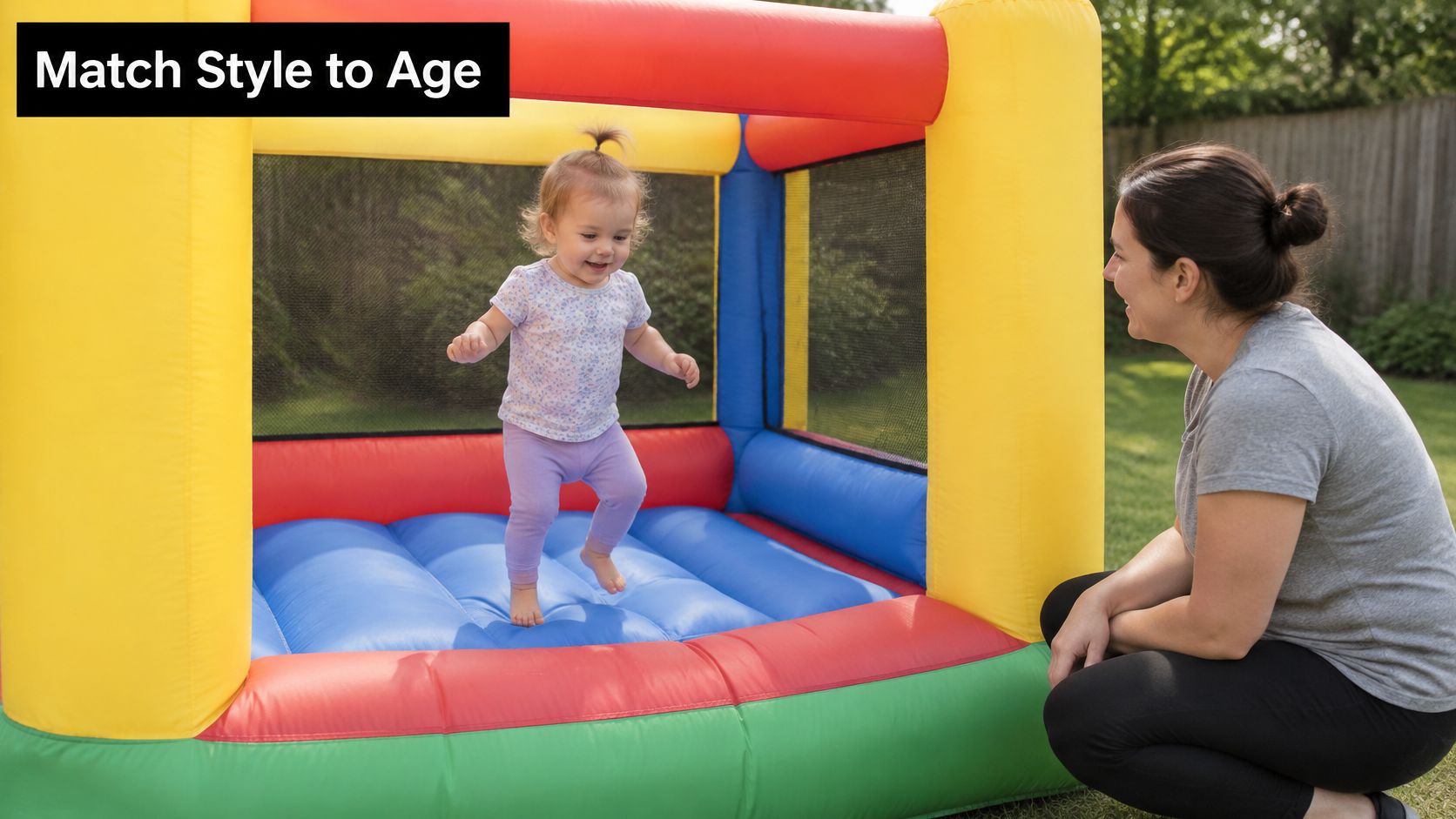
| Toddler bounce | 2 to 5 | High, one attendant | Preschool parties and daycare events |
| Castle or open bounce | 4 to 12 | Moderate | Mixed-age birthdays and backyard parties |
| Combo with slide | 5 to 12 | High, second adult at slide exit | Party groups and field days |
| Obstacle course | 6 to 14 | High, collision risk | School field days and team events |
The age ranges are starting points, not permission to mix every child in that range. Follow the unit's posted rules, and consider children's size and activity level alongside age. A toddler unit calls for close attention from an assigned attendant; a combo needs an adult watching the slide exit as well as the main play area. Obstacle courses have children moving through a longer shared route, so collisions need particular attention.
The U.S. Consumer Product Safety Commission (CPSC) estimated that children ages 4 to 15 accounted for 61% of inflatable-amusement injuries in its 2011–2013 analysis, and arm and leg injuries represented 66% of cases. The agency's findings cover inflatable amusements broadly, including bounce houses, slides, and obstacle courses, and point to falls, collisions, and awkward landings as practical concerns for event organizers. CPSC injury estimates for inflatable amusements
That's why toddlers and tweens shouldn't jump together. Older or larger children can move with more force, while younger children may not be able to anticipate an unexpected landing. At a school field day with children from kindergarten through fifth grade, for example, organizers can use separate toddler and older-kid units and rotate groups through timed sessions.
For a family event, review the available children's party options and choose a style that fits the ages attending, rather than assuming one inflatable will suit everyone. If a landing by the tallest child could knock over the shortest child, split the group.
Wind, Weather and Anchoring Limits
A unit can start the day within its wind limit and become unsafe as gusts rise. Size up the conditions using live gust readings, not the morning forecast alone, and check the manufacturer's limit before opening.
| Gust reading | Action |
|---|---|
| Under 10 mph | Operate if the unit's printed limit allows; check gusts every hour |
| 10 to 14 mph | Confirm the printed limit; check gusts every 15 minutes |
| 15 to 20 mph | Stop at or below 20 mph, or at the lower printed limit |
| Above 20 mph | Unload and deflate the unit |
ASTM F2374 calls for at least four anchor points and anchorage that resists wind and patron loads. It assumes a design wind speed of at least 25 mph, measured by the highest sustained three-second gust, and sets the operating limit at least 5 mph below that design speed. That makes about 20 mph an upper operating ceiling under this assumption, not permission to keep running until a unit's limit is reached. The manufacturer's lower printed limit takes precedence. ASTM F2374 anchoring and operating requirements
Sandbags don't automatically make a bounce house safe, and an indoor room isn't automatically a safe setup. Use the anchoring method approved by the manufacturer for the venue's surface. Keep wind checks active throughout the rental, and treat the table as a monitoring guide, not a replacement for the unit's instructions.
Use gust readings as the stop rule
At a Saturday park event, a forecast might show 8 mph at 9 a.m., while gusts reach 19 mph by 2 p.m. The morning reading does not determine whether the unit can stay open that afternoon. Check a reliable weather source before setup, record the site, anchor type, and wind limit, then monitor gusts while the unit is in use.
Set the stop point before children enter. If gusts reach the lower of the printed limit or about 20 mph, unload and deflate. Review weather and wind planning for inflatables before event day, and agree in advance who will stop operation if conditions worsen. Install every required anchor at its approved location, check connections for tension and trip or abrasion hazards, and inspect the inflated unit for movement before opening.
How to Set Up and Run a Safe Bounce House
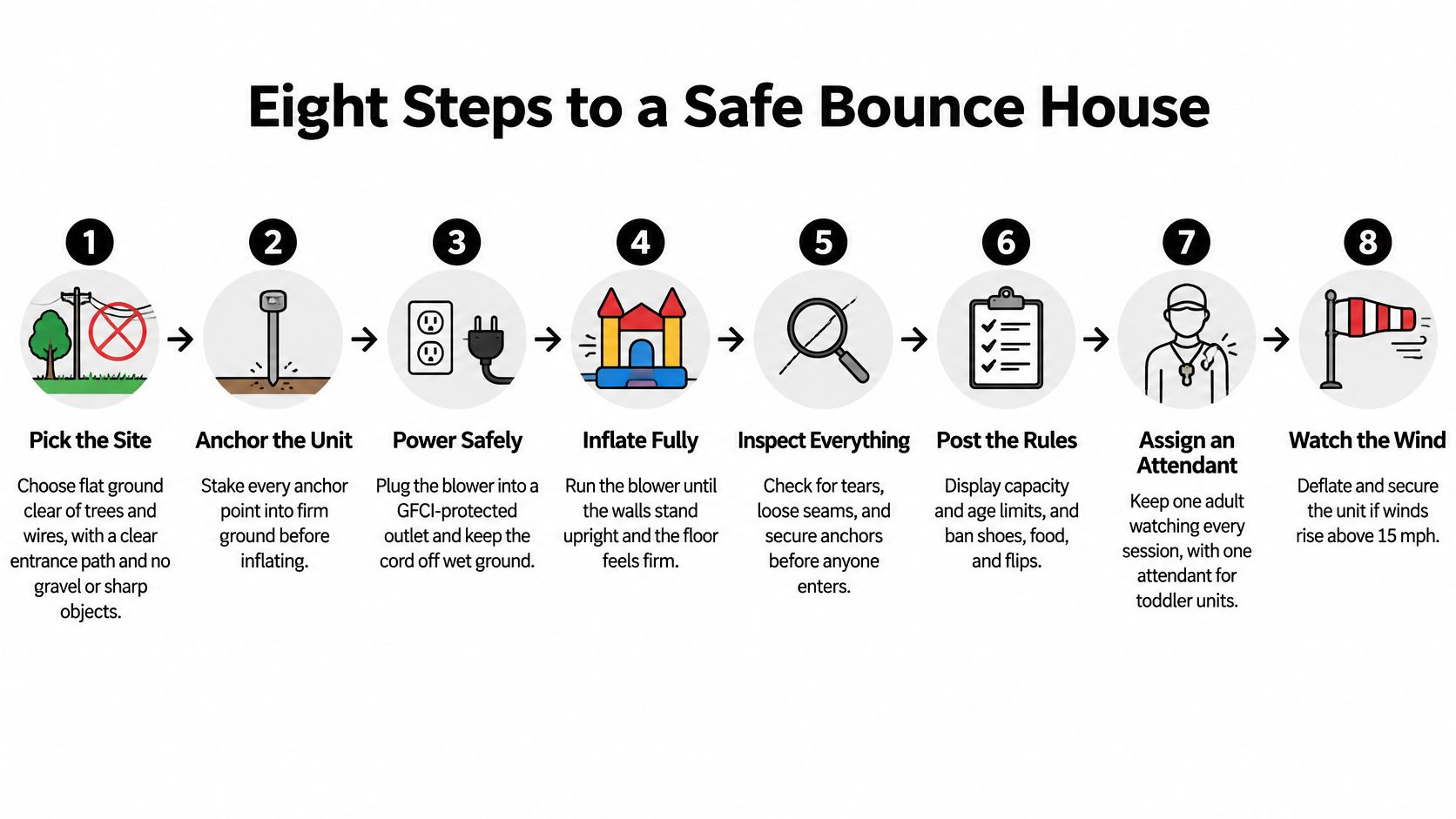
A safe setup follows a sequence. Don't admit children while the unit is still being positioned, inflated, or checked.
- Pick the site. Choose flat ground clear of trees and wires, with an open entrance path and no gravel or sharp edges underneath.
- Place and anchor the unit. Find the manufacturer's anchor points and install every required anchor before inflation, keeping lines and cords out of walkways.
- Connect the blower. Use a protected outlet or generator, and route the cord away from the entrance to reduce trip hazards.
- Inflate fully. Wait until the unit has reached operating pressure, then push on each side to check that it doesn't shift.
- Inspect the equipment. Check the vinyl, seams, netting, entrance, blower, electrical connections, and pressure stability before opening.
- Clear the play area and post the limit. Remove shoes, sharp objects, food, and incompatible toys, then set admission from the unit's label or manual.
- Assign attendants and manage turns. Put an adult at the entrance and a second adult at the slide exit when needed; admit children in controlled groups.
- Stop and recheck when conditions change. Unload for pressure loss, anchor movement, torn material, unsafe behavior, or worsening weather; document the inspection before restarting.
Keep the entrance and exit area clear, and have the attendant prevent rough collisions, climbing on walls or nets, flips, and overcrowding. The CPSC estimated 113,272 emergency-department-treated injuries associated with inflatable amusements in the United States between 2003 and 2013, averaging roughly 10,300 cases per year. These are population-level estimates, not a prediction of what will happen at a specific event; they underline why inspection, admission control, supervision, and clear shutdown criteria matter. CPSC safety bulletin for residential and commercial inflatables
A blower that's running doesn't compensate for torn fabric, blocked airflow, inadequate supervision, or shifting anchors. If something changes, clear the unit and inspect it before anyone goes back in.
Rental Checklist, Costs and Written Quote
A useful quote identifies the exact unit, its operating limits, the services included, and who makes decisions if conditions change. Before paying a deposit, compare the available ground with the unit's footprint and the planned number of jumpers. A model that fits the guest list may still be a poor choice if the site cannot accommodate its anchors, blower, and clear entry and exit areas.
Check the documents
Ask for a certificate of insurance naming your venue or organization, a current state inspection record where applicable, and written information about the unit's construction and operation. Request a clear photo of the manufacturer's label. Check its stated capacity and wind limit against the specific unit you booked, then confirm those limits work for your site and event.
ASTM F2374 standard information describes a consensus-based practice covering areas such as design, manufacture, installation, operation, maintenance, inspection, and training. It is not a single nationwide law. State and local rules may add requirements, so check which records apply at your location.
Confirm the equipment and service
Ask which blower comes with the unit, how long its power cord is, what the anchor kit includes, and how many anchor points the model requires. Confirm the surface is suitable for those anchors. If reliable power is a concern, ask what backup is available and who decides whether to use it.
Put service responsibilities in writing. Confirm whether delivery, setup, and tear-down are included, whether an attendant stays throughout the event, and what the company will do if rain or wind makes operation unsafe. Ask for a recent photo of the unit so you can check that it matches your booking.
Ask these questions before paying a deposit: Which anchor points and surface does this unit require? What wind limit is printed on its label? Who stays with the unit and makes the stop decision if gusts rise?
Compare the full price, not just the base rate
The figures below are Phantom Entertainment planning examples, not market-wide averages. Treat them as a starting point for comparing written quotes, then check what delivery, setup, and staffing add to the total.
| Unit type | Phantom Entertainment planning range | Common add-on | Notes |
|---|---|---|---|
| 10 x 10 toddler unit | $60 to $110 | Delivery $25 to $90 | Lowest cost for ages 2 to 5 |
| 13 x 13 bounce house | $90 to $160 | Delivery $25 to $90 | Often considered for mixed ages |
| 13 x 20 combo with slide | $130 to $230 | Delivery $25 to $90 | Adds a slide; confirm exit supervision |
| 15 x 15 large unit | $120 to $200 | Delivery $25 to $90 | Fits 8 to 10 jumpers at once |
| Obstacle course | $200 to $350 | Setup crew fee where required | Longer footprint and may require more attendants |
Check the Phantom Entertainment rental price examples against your written quote. Rates and add-on charges can vary with region, season, and weekend demand. Delivery or setup may be included in the base price or listed separately, so compare the total and the service provided, not only the headline rate.
Weekend availability can tighten around school and community events. Contact rental companies several weeks ahead for those dates; backyard parties may need less lead time. Have the quote list the rental date and delivery window, exact unit size, setup, insurance paperwork, wind plan, deposit, and cancellation terms before you commit.
When comparing providers, choose a unit that fits both the measured clear ground and the planned jumper count. The written quote should name the equipment, state its operating limits, and identify who will manage it on site. Phantom Entertainment offers bounce houses and obstacle courses, with delivery, setup, and event support across Pennsylvania and the Mid-Atlantic. Share your date, site measurements, and age mix with Phantom Entertainment to discuss a suitable unit and written setup, supervision, and weather arrangements.
Ready to Book Your Event?
PA state-inspected, fully insured since 1979. Call us or get a free quote today.