
The most popular advice about an inflatable bounce house for adults is to book the biggest one you can fit. That often gets the decision backward. For adults, a lower open floor with controlled heats can be easier to supervise and safer to manage than a tall, enclosed unit where climbing, crowding, and drop-in play complicate traffic.
Choose by the unit's commercial rating, participant mix, and staffing plan, not by the most dramatic photo. Then confirm the site, power, anchoring, wind limits, and access arrangements before you commit to a date.
Adult Bounce House Formats and Capacities
| Format | Best adult event | Traffic pattern | Capacity rule | Main watch-out |
|---|---|---|---|---|
| Open bounce floor | Company picnic, mixed fitness | Short heats of similar-size adults | Manufacturer occupant and combined-weight rating, not floor area | Collision energy if several large adults jump at once |
| Obstacle course | University field day or orientation | One-direction timed runs | One or two adults per lane, within the unit's rating | Two-way racing and shoes |
| Enclosed slide or combo | Festival that wants a tall visual | Single-file climb and slide | Height and weight printed on the unit | Exit-mat pileups and transfer height |
| Interactive game unit | Small corporate team activity | Supervised small groups | Posted maximum occupants | Sharp objects and drinks in the queue |
| Residential backyard unit | Not for public or commercial adult use | Home play only | ASTM F2729 is for children ages 2–12 | Treating a home toy as an adult rental |
For a company picnic, an open bounce floor is usually the practical starting point. Similar-size adults can take short heats, while an attendant controls entry and clears the floor between groups. Obstacle courses work well for university field days when the design supports one-direction runs. Enclosed slides and combos offer a tall visual for festivals, but participants need to climb and exit in an orderly, single-file flow. Interactive games suit small teams when an attendant can keep the group and queue under control.
The floor's dimensions don't set a safe headcount. A large-looking floor can still be overloaded if several heavier adults jump at once, because adult mass increases the force and energy involved in collisions. The unit's manufacturer-stated commercial occupant count and combined-weight limit set the boundary. Don't estimate capacity by counting how many people can stand on the vinyl.
The tallest inflatable is often the wrong adult choice when alcohol, uneven fitness, or spontaneous drop-in play is likely. A lower open floor with planned heats gives the attendant a clearer view and simpler entry control.
Set heats at about 60 to 90 seconds as an operating plan, then adjust the schedule to the unit's instructions and your event flow. Keep the waiting line outside the inflatable, separate mixed ages or sizes into different blocks, and don't let a crowd press the attendant to exceed the posted limit. Adult suitability is about load management, user mixing, and active supervision, not a product name or oversized footprint. The UK Health and Safety Executive's operator guidance emphasizes manufacturer limits, separating users, monitoring inflation, and trained supervision.
Before you accept a quote, ask for the unit's documented commercial capacity, combined-weight limit, and participant height range. If the vendor can't provide those details for the specific inflatable, choose another unit.
Commercial Grade Versus a Backyard Unit
Commercial grade is an operating category, not a synonym for “large.” ASTM F2374 covers commercial inflatable amusement devices, including bounce houses, slides, obstacle courses, and interactive play units. The standard addresses the equipment's design and manufacture, but also its installation, operation, maintenance, inspection, operator training, auditing, and major modifications. These structures use flexible fabric held in shape by blower air pressure.
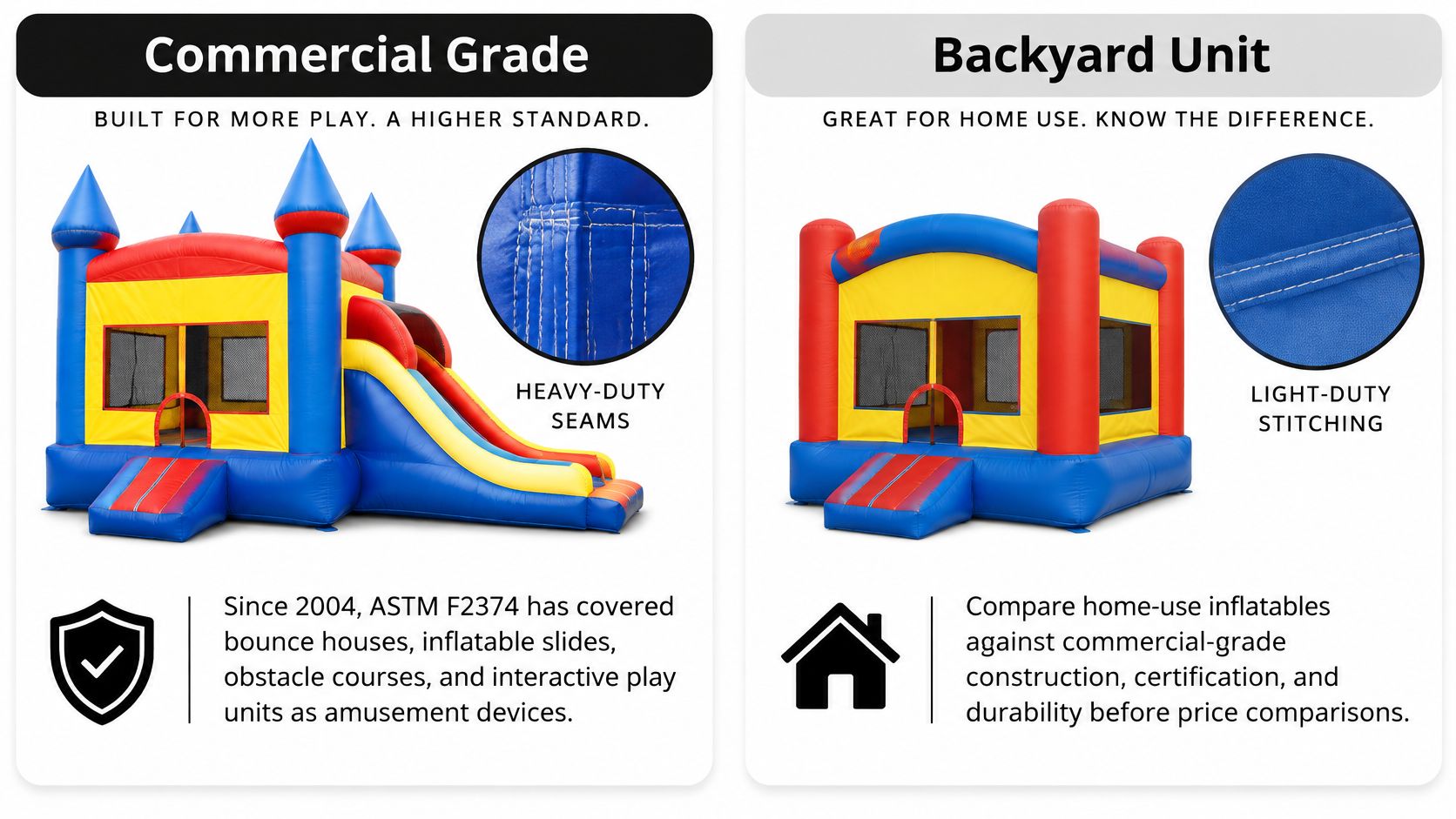
ASTM distinguishes commercial equipment from constant-air inflatable play equipment intended for private home use by children ages 2–12. A backyard unit doesn't become suitable for adult guests or public rental because it looks spacious. The ASTM International overview of its inflatable amusement standard explains the commercial framework and its distinction from the home-use standard.
What the injury baseline tells planners
The Consumer Product Safety Commission's analysis of U.S. emergency-department data estimated 113,272 injuries associated with inflatable amusements from 2003 through 2013, an average of approximately 10,297 a year. Moon bounces accounted for an estimated 104,875 cases, or 93% of that total, according to the CPSC injury and death analysis.
Those figures establish a broad safety context, not an adult-only risk rate. Children ages 4–15 represented 61% of estimated injuries during 2011–2013, so planners shouldn't treat the overall estimates as a prediction for adult participants. The same analysis found that 96% of estimated cases were treated and released, while 3% resulted in hospitalization. Fractures represented 28% of injuries, and leg and arm injuries together accounted for 66%. CPSC recorded 12 deaths involving inflatable amusements from January 2003 through December 2013.
The practical conclusion is not that every rental is unsafe. It's that adult use needs defined operating controls and paperwork rather than assumptions based on appearance or price.
Separate participants by size or age, cap the count, provide active supervision, anchor the unit, and keep a written operating procedure.
Ask the rental operator for commercial-use documentation, the inspection record, the operating manual, and a certificate of insurance. Before opening, the inspection log should show zero unresolved defects. A low quote without the documents and operating support is a different product, not a comparable bargain.
How to Book Site Power and Staffing
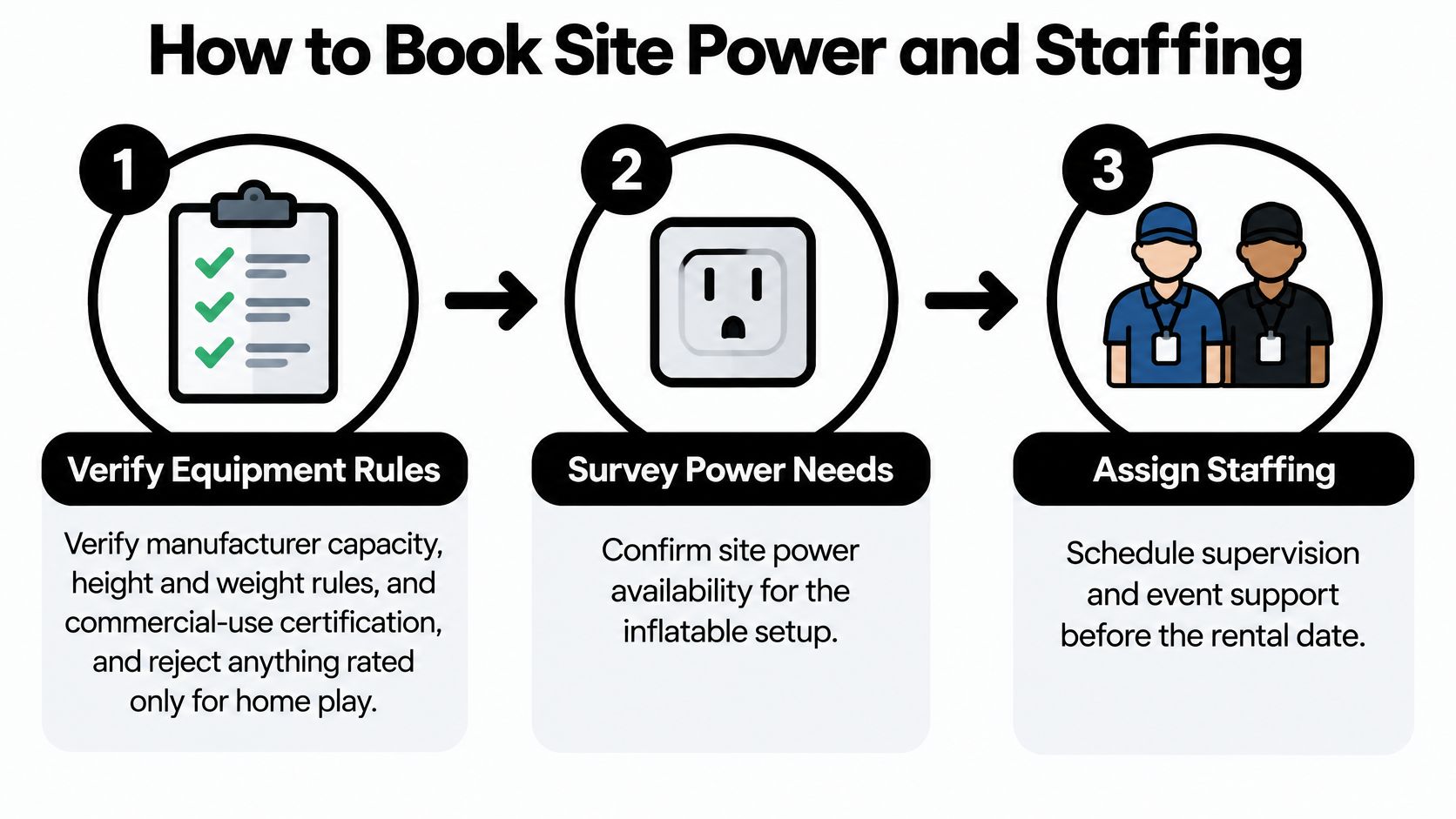
A facilities contact can keep booking orderly by handling equipment, site, power, documents, setup, and staffing in that order. ASTM F2374-21 covers commercial inflatable design, installation, operation, maintenance, inspection, training, auditing, and major modifications. Its scope is reflected in the ASTM F2374-21 standard.
Verify the unit and its rules. Get the manufacturer's capacity, height and weight limits, commercial-use certification, and operating manual for the specific unit. Reject equipment rated only for home play. The common slip is accepting a general “adult-friendly” description without checking the actual unit's rating.
Survey the site. Check overhead lines and trees, slope, underground utilities, vehicle access, and a clear emergency exit route. Mark the full footprint, including room for anchors, blower placement, and hose clearance. A frequent miss is measuring only the inflatable's base and leaving no safe route around it.
Plan power before delivery. Confirm that the outdoor circuit and receptacle match the blower's requirements; keep cords out of walkways and protect the route from trip hazards. If you need a generator, verify that its output matches the blower and place its exhaust away from guests. Don't wait until the crew arrives to discover there's no suitable circuit.
Collect documents before scheduling the truck. Get the certificate of insurance, inspection documentation, operating manual, and any permit required by the city or campus. Confirm which party will obtain the permit instead of assuming the rental operator or venue has handled it.
Inspect and anchor on site. Install every anchor specified by the manufacturer, then check inflation pressure, seams, blower power, and anchor integrity. Keep the entrance closed until the written inspection log shows zero unresolved defects. The common mistake is opening as soon as the unit looks inflated.
Assign a trained attendant. Give one person responsibility for one-direction traffic, separating incompatible users, removing shoes and sharp objects, and stopping play for unsafe behavior or weather. Mixed-size users, overcrowding, and an unattended entrance are preventable operating failures, not scheduling details.
Adult dynamic loading means the unit's posted rating controls even when the floor looks empty. Send facilities a short brief before the event:
- Headcount: expected attendance and scheduled user blocks.
- Surface: setup location and ground type.
- Circuit: outlet or generator plan.
- Permit holder: named person responsible for approvals.
- Shutdown authority: the person authorized to stop the unit.
Wind Limits Anchors and Shutdown Rules
A taller inflatable is not automatically the safer adult choice. Use the lowest applicable wind limit, because a broad, lower unit may be easier to anchor and supervise than a taller format. Check the manufacturer's limit, local rules, the UK Health and Safety Executive's guidance, and CPSC consumer guidance before opening.
| Control | Spec to use | Required action |
|---|---|---|
| Sustained wind | Lowest of the manufacturer's limit, local rule, 24 mph HSE guidance, and 15–25 mph CPSC guidance | Stop before the lowest limit |
| Gusts | Same lowest limit | Clear occupants when gusts reach it |
| On-site reading | Anemometer at the unit, with readings logged at regular intervals | Use a forecast for planning, not as an on-site reading |
| Stakes | At least 380 mm long and 16 mm wide at every anchor point | Install every required anchor |
| Ballast or bolts | At least 163 kg per anchor point, or anchor bolts rated at 1,600 N | Use when suitable stakes cannot hold |
| Shutdown record | Wind reading, limit used, time occupants cleared, and securing action | Record before the crew leaves |
The HSE inflatable guidance advises against operating above 24 mph (38 km/h). CPSC consumer guidance gives a range of 15–25 mph. Apply the lowest relevant threshold, including the manufacturer's limit and any local rule.
Measure wind at the inflatable with an anemometer and log readings at regular intervals. Outdoor units need every manufacturer-approved anchor point. Where the ground accepts stakes, HSE specifies metal stakes at least 380 mm long and 16 mm wide. Where stakes will not hold, its guidance identifies ballast of at least 163 kg per anchor point or properly installed anchor bolts rated at 1,600 N.
Use the same shutdown sequence each time:
- Take a wind reading at the unit.
- Compare sustained wind and gusts with the lowest applicable limit.
- Clear occupants when either reaches that limit.
- Deflate or secure the unit according to its operating procedure.
- Record the reading, limit, clearance time, and securing action.
A phone forecast cannot replace an on-site reading. Anchoring only the front or using undersized water barrels leaves the unit without the specified restraint. Give the attendant clear authority to close the attraction, even if the host wants one more heat. The wind and inflatable safety overview provides further guidance on weather-related operating decisions.
Tips for Corporate Campus and Private Events
For a corporate picnic, crowd flow matters more than adding the tallest inflatable. Schedule department heats to prevent a post-lunch rush, put the venue name on the certificate of insurance, and keep drinks outside the queue. A lawn game beside the unit gives employees and family members who skip bouncing another way to join in. For planners adding activities for a birthday or other private gathering, these birthday activities for adults in 2026 offer ideas for guests with different interests.
At a university orientation or homecoming, assign student volunteers clear roles before gates open. Brief them on entry control and who can stop play, wristband the group permitted to use the unit, and place any generator where campus exhaust and residence-hall rules allow. A volunteer who doesn't know the operating limits can't manage the crowd reliably.
For a private party, start with the ground, not the décor. Check whether the soil can hold the manufacturer's anchors. For a patio or asphalt setup, arrange approved ballast before paying a deposit. Confirm power with the homeowner, separate adults and children into different user blocks, and keep a clear route around the blower and cords.
Accessible event planning needs more than a path to the inflatable. The U.S. Access Board's amusement ride guidance covers accessible routes and ride features, including transfer surfaces, gripping areas, padding, and transfer paths. Ask whether a participant can enter and exit safely, and plan a companion activity if the inflatable can't be adapted. A label alone can't establish that an attraction and site meet a person's needs.
Phantom Entertainment offers rentals for corporate gatherings and other events. Compare its corporate party options when choosing attractions and staffing packages.
Assign one person to each decision: the event owner confirms the heat schedule, the attendant controls who may use the unit, and the host confirms the wind plan.
Accessibility Promises for Adult Participants
Accessibility is three separate promises: a participant can arrive, can transfer onto and off the attraction if it's suitable for them, and can take part meaningfully if the inflatable itself isn't accessible. Ask about all three before booking, not after the equipment reaches the site.
| Promise | What to verify | What to request from the vendor |
|---|---|---|
| Accessible arrival | Route connects to the unit; width and firm ground | Site plan showing route and surface |
| Accessible transfer | Entrance and transfer height; mat transitions; grip areas; padding | Unit dimensions and transfer surface details |
| Equivalent participation | Staffed non-inflatable companion activity; restrooms nearby | Written accommodation procedure and staffing plan |
For accessible arrival, confirm that the route connects to the attraction and that its width and surface work for the participant's mobility needs. A route that reaches the entrance but ends at soft, uneven ground doesn't solve the practical access problem. Get the route and surface shown on the site plan.
For accessible transfer, request the entrance and transfer dimensions, mat transitions, gripping areas, and padding details. Ask whether staff assistance or a transfer device is available, and how a participant can exit safely. The U.S. Access Board distinguishes rides designed for children from attractions intended for broader users, so ask the vendor which category the unit is designed for.
For equivalent participation, plan a staffed companion activity and confirm that accessible restrooms are nearby. That gives someone who can't use the inflatable a way to share the event, rather than leaving them to watch from the side. Put the accommodation procedure and staffing plan in writing before signing; access depends on the unit, the ground, and the support available, not on an “ADA-friendly” label.
Rent for the Event Instead of Buying
For a single event date, renting is usually the cleaner choice. Owning commercial equipment brings recurring responsibilities: storage, a blower matched to the unit, insurance, inspection, anchors, maintenance, transport, and a trained operator each time it's set up. Buying starts to make sense when the same commercial unit will serve many dates and your team can handle the operating duties.
A rental quote should itemize delivery, setup, attendant, blower and power needs, and insurance documentation. Compare those line by line, not by headline price. If the vendor offers delivery, anchoring, and a trained attendant as part of the booking, that can reduce the number of event-day tasks your staff must coordinate. Review the rental pricing information and ask what the quote includes before comparing vendors.
Before reserving, email five facts:
- Headcount: expected attendance and how you'll schedule the user blocks.
- Age and size mix: who will use the unit and how you'll separate groups.
- Surface: lawn, turf, pavement, or another setup area.
- Power: available circuit or generator plan.
- Shutdown authority: the person who can close the attraction for wind or unsafe conditions.
In the same message, request the unit's commercial rating and a certificate of insurance, along with its capacity and operating documents. Send those details to Phantom Entertainment through its rental site, and hold the date only after the paperwork and equipment match the crowd you expect, not the crowd in a marketing photo.
Phantom Entertainment offers inflatable rentals and other event attractions, with delivery, setup, and professional operation for gatherings across Pennsylvania and the Mid-Atlantic. Visit Phantom Entertainment with your date, venue, headcount, and site details to discuss a unit and operating plan suited to your adult event.
Ready to Book Your Event?
PA state-inspected, fully insured since 1979. Call us or get a free quote today.