
Mechanical bull rentals typically run from about $450 to $1,600 for a few hours, while outright purchase prices start around $1,750 for basic units and climb past $23,000 for premium commercial packages. The number that matters, though, is the all-in delivered cost after you add the operator, transport, power, insurance, and any after-hours charges.
You may be looking at a vendor's attractive base rate while building a company picnic, school field day, fundraiser, or backyard party. Then the revised quote arrives, and the total bears little resemblance to the headline price. That happens because a mechanical bull isn't just equipment. It's a staffed attraction with delivery, setup, safety controls, venue requirements, and operating limits.
The practical question isn't just, “How much does a mechanical bull cost?” Ask instead: What will the complete attraction cost at my venue, for my event window, under my operating conditions?
What Planners Pay for a Mechanical Bull
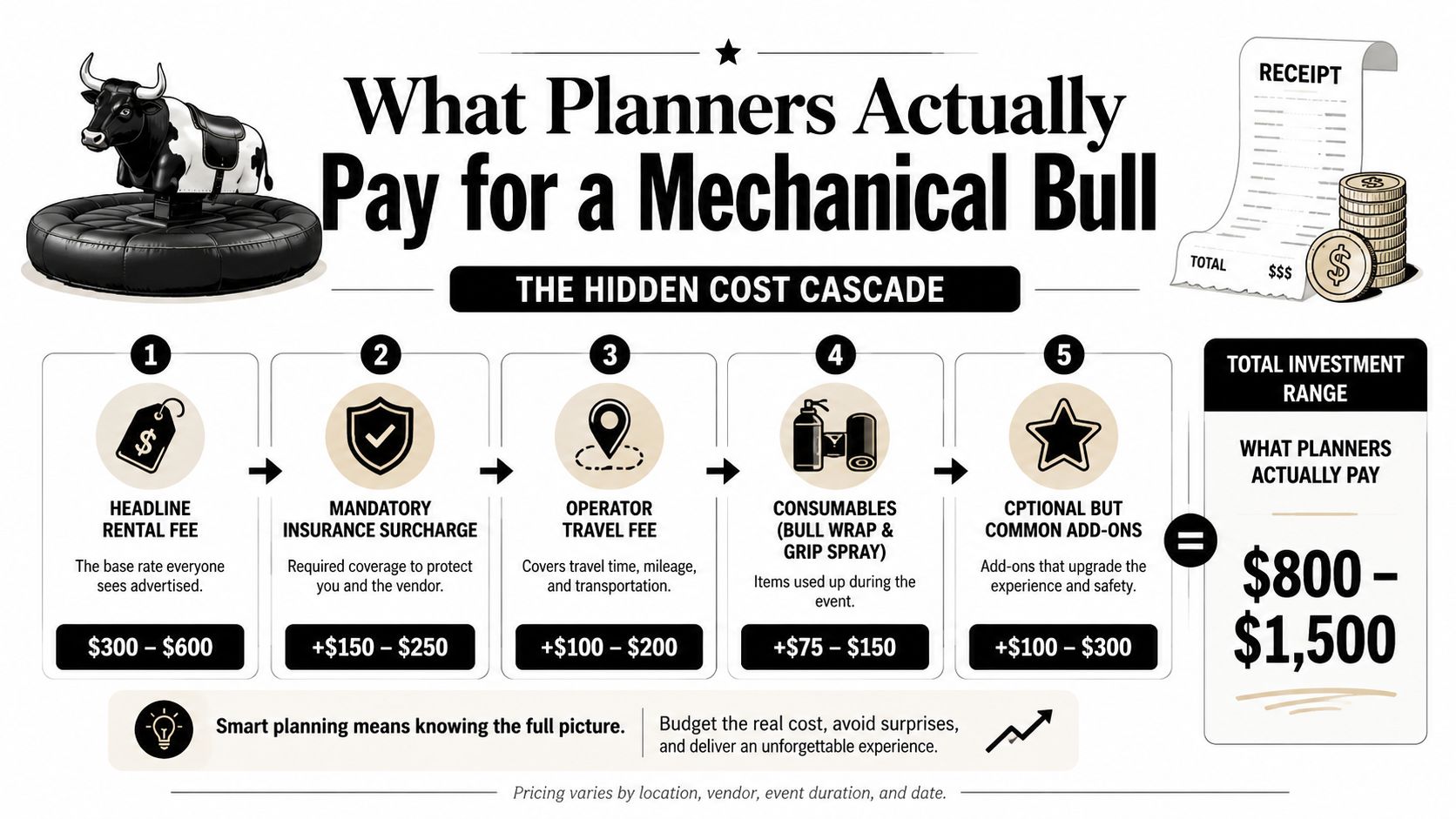
A planner may see a short rental advertised near $450, then receive a much higher invoice after travel, staffing, power, and event requirements are added. Published market examples range from a $650 three-hour rental to $1,249 for three hours, so the headline rate alone tells you very little. Other listings place shorter bookings at roughly $450 for three hours to $1,599 for two to four hours.
That spread does not make every higher quote unreasonable. It shows that the advertised rental rate covers only part of the service. The all-in figure must separate the bull, operator, delivery, power, insurance, and after-hours surcharges.
The four buckets in a real quote
Equipment covers the bull, landing system, controls, mats, and themed or branded components. A basic unit with a short operating window costs less than a premium attraction supplied for a long public event.
Operator labor pays the trained person who controls the ride, manages rider flow, applies operating rules, and stops the bull when conditions become unsafe. If the included operating window ends before the event does, overtime or additional labor raises the bill.
Logistics includes delivery, mileage, loading, setup, teardown, and difficult access. A venue with a loading dock and nearby parking is easier to service than an outdoor field with no convenient vehicle access. Ask whether stairs, long carry distances, or special unloading are priced separately.
Compliance includes insurance documentation, waivers, safety equipment, venue rules, and power planning. Some vendors bundle these items. Others list them separately, making two similar-looking quotes difficult to compare.
Budgeting rule: Price the total delivered attraction, not the advertised rental rate.
Ownership has a much wider range. Basic imported units appear around $1,750 to $3,000, while commercial packages and premium systems are listed around $7,000 to $23,100 before shipping, customs, and setup (mechanical bull purchase cost breakdown). For comparison with other event entertainment, review this party and event pricing guide and identify what is included, what is optional, and what gets charged after confirmation.
Request an all-in event total before approving the booking. The quote should state rental duration, operator hours, delivery area, power arrangement, insurance documents, setup, teardown, taxes, and overtime terms. That checklist exposes the true number and prevents the base rate from distorting your budget.
Rental Pricing Tiers and What Each Package Includes
Mechanical bull rentals usually fit three practical tiers. Vendors label them differently, but the price differences come down to booking length, staffing, presentation, and logistics.
| Tier | Typical Duration | What's Included | Price Range (USD) |
|---|---|---|---|
| Basic drop-off | 2 hours | Bull unit, landing area, basic setup and teardown, limited service radius | Around $450 to $899 |
| Standard staffed package | 3 to 4 hours | Bull, padded or inflatable landing zone, operator, setup, teardown, and applicable liability coverage | Around $650 to $1,599 |
| Premium event experience | Extended or full event window | Extended operator coverage, branded presentation, crowd management, upgraded décor, and expanded logistics | Around $1,249 to $1,600 for short premium bookings, with longer rentals priced separately |
These ranges are published market examples, not a universal rate card. A detailed pricing breakdown from Pepes Party Rental lists $899 for two hours and $1,249 for three hours, then rises to $4,538 for a full event-length rental and $7,229 for 24 hours. Longer bookings cost more because the bull, operator, and service crew remain committed throughout the reserved window.
Match the tier to the event
A backyard birthday can use a basic package when the vendor provides safe setup and the property offers suitable access. A school field day or company picnic should use the standard staffed option. Riders arrive in waves, so an operator needs to explain the rules, manage the line, and control the attraction continuously.
Choose the premium tier for a corporate activation or any event where the bull serves as a visual centerpiece. The package may include themed covers, LED accents, a sound system, branded signage, or a cowboy-style attendant. Those details support the event's presentation. They add less value when the bull is just one activity among several.
Book the event window around actual demand. A short rental works for a private party with a concentrated riding period. A public event needs longer coverage because guests arrive gradually. Paying for idle hours wastes money, while cutting the operator window too tightly creates queues and makes the attraction feel unavailable.
Ask vendors to quote the package scope, not only the headline rental rate. Compare the bull, operator coverage, setup period, presentation elements, and event duration in the same request. The same comparison method applies when you budget for a marquee event. Review available mechanical bull rental options for different event formats, then request an all-in total that shows what is included and what remains conditional.
The Hidden Line Items That Change Your Final Bill
A bull rental quote can look affordable until the final invoice adds labor, delivery, power, insurance, and timing charges. Treat the advertised rental rate as the equipment starting point, not the event total. Ask the vendor to separate every charge before comparing proposals.
Labor and time charges
Operator coverage usually applies to a defined service window. If guests keep riding after that period, the vendor may charge overtime or require a longer minimum booking. After-hours pricing can apply too. Published examples include $50 per hour after 8 p.m. and $100 for each extra hour, as shown in the add-on charges listed by Epic Events Party.
Weekend pricing may differ from weekday pricing because staffing and delivery schedules change. Confirm whether setup and teardown count as paid time. Get the overtime trigger, minimum booking, and after-hours rate in writing.
Delivery, power, and paperwork
Delivery often sits outside the headline rental price. A published listing shows a $99 transport fee, while other vendors price travel by distance or service radius. Review the transport and overtime examples from Epic Events Party when checking how those charges can be structured. Remote venues, difficult access routes, stairs, or a long carry from parking can add labor even when the mileage looks reasonable.
Power needs its own line on the quote. Published equipment information lists models requiring a 2×20-amp circuit, while some models use a standard outlet. Check the power requirements from ACP Entertainment against the venue's actual electrical plan. If the required circuit is unavailable, the vendor may need to supply additional power equipment. Do not assume a normal wall outlet will handle the bull.
Insurance certificates, damage waivers, sales tax, gratuity, and consumables may appear separately. Some vendors include liability coverage and safety materials. Others charge for a certificate of insurance or add a waiver fee. A damage waiver can change your exposure to certain equipment claims, but its exclusions and limits matter more than the label.
Use this checklist when requesting an all-in quote:
- Equipment: Identify the bull, landing system, controls, mats, and included accessories.
- Staffing: Confirm operators, paid hours, overtime, and arrival time.
- Logistics: Ask about delivery, mileage, stairs, setup, teardown, and pickup.
- Compliance: Confirm insurance documents, waivers, venue paperwork, and safety requirements.
- Extras: List generators, themed covers, sound, lighting, consumables, taxes, and gratuity.
Ask for one final number: “What amount should I expect to pay if the event runs exactly as described?”
Renting Versus Buying a Mechanical Bull
A one-time company event and a busy entertainment venue should not use the same ownership calculation. Buying looks attractive after several rental invoices, but the purchase price is only the starting point. Storage, transport, maintenance, insurance, and operator labor determine whether ownership saves money.
Basic imported units appear around $1,750 to $3,000. Commercial and premium systems are listed around $7,000 to $23,100 before shipping, customs, and setup, according to a cost breakdown from USA Mechanical Bulls. Complete packages listed at $7,000 and $8,500 show that a usable ownership setup generally requires several thousand dollars before operating costs, as shown in package listings from USA Mechanical Bulls.
The comparison that matters
| Cost Factor | Renting | Buying |
|---|---|---|
| Upfront cash | Low, limited to the booking | High equipment purchase |
| Equipment access | Vendor supplies the bull and related gear | Buyer owns the unit and accessories |
| Operator | Usually supplied by the vendor | Owner must hire or train operators |
| Delivery | Usually quoted per event or service area | Owner handles transport or pays for it |
| Storage | Vendor responsibility between events | Buyer needs secure storage |
| Maintenance | Usually handled by the vendor | Buyer pays for inspection, repairs, and upkeep |
| Insurance | Often included or added to the booking | Owner carries ongoing operational exposure |
| Best fit | Occasional private, school, nonprofit, or corporate events | Frequent commercial bookings with reliable demand |
Renting keeps a specialized asset off your balance sheet and puts event-day responsibility with the vendor. Published hourly listings range from about $499 to $1,499, depending on region and package, based on rental package pricing from USA Mechanical Bulls. That spread reflects location, duration, staffing, and included service, not a universal industry rate.
Buying fits bars, rodeo schools, entertainment companies, and venues that can keep the equipment booked regularly. Price the full operating plan first. Include secure storage, transport, inspections, repairs, insurance, trained operators, and downtime. An unused bull still occupies space and still needs care.
For a wedding, fundraiser, birthday, or one-time company event, rent. For a business with recurring bookings and staff already equipped to handle attractions, investigate buying. Count the events you realistically expect over the next 24 months, then compare rental invoices with the complete ownership plan. Do not use an optimistic booking schedule to justify a purchase.
Why Two Quotes for the Same Event Can Differ by Hundreds
Two vendors can price the same bull for the same four-hour event and still reach sharply different totals. The gap usually comes from scope, staffing, travel, and add-on charges, not arithmetic.
For a fictional Friday booking in a mid-sized Texas city, Vendor A quotes $950 with one operator. Vendor B, located 40 miles away, quotes $1,600 for a service that appears identical. That difference may reflect fleet costs, subcontracted labor, travel rules, insurance handling, minimum-hour requirements, or after-hours charges. Compare the all-in bill, not the headline rental fee.
What may sit behind the gap
Vendor A may own the equipment and employ the operator. Vendor B may subcontract labor, move a bull from another market, or provide a premium commercial unit with higher transport and maintenance costs. Friday-night scheduling can also bring weekend pricing or late pickup requirements that do not appear on a weekday proposal.
The lower quote might already include insurance, setup, and basic delivery. The higher quote might include a generator, a wider travel radius, or a longer event window. The reverse is common too. A lower base rate can leave delivery, operator time, insurance certificates, power, and overtime for the final invoice.
Location affects the total even before the bull arrives. A nearby vendor may absorb travel, while one outside its normal service area adds mileage and loading time. A school, municipality, or corporate venue may require an insurance certificate, and that paperwork can change the quote when it is not part of the standard package.
Ask every vendor to price the same written scope:
- Event date and exact operating window
- Arrival, setup, and teardown expectations
- Bull, landing system, mats, and accessories
- Operator count and included labor
- Delivery radius and mileage charges
- Power source and generator responsibility
- Insurance certificates and waivers
- Taxes, gratuity, overtime, and pickup fees
Review each proposal for the event-day total. A quote is comparable only when the included service is comparable. Get every surcharge confirmed before signing, especially travel, power, insurance, and time beyond the stated operating window.
Weather, Space, and Safety Rules That Can Inflate Your Budget
A bull booked for an open lawn may require a canopy, stable flooring, weather backup, and extra setup time. Those requirements can turn a simple rental quote into a larger all-in cost, even when the bull and operating window stay the same.
Confirm the site before you sign
A mechanical bull needs substantial room around the ride, overhead clearance, and suitable electrical capacity. Plan for a footprint of roughly 20 feet by 20 feet, about 10 to 12 feet of vertical clearance, and a clear 12 to 16 foot diameter area around the landing zone. Confirm the venue's ceiling height, outlets, entry route, and floor condition with the vendor before booking. Treat the published equipment specifications as a starting point, not a substitute for a site check.
Outdoor placement adds another layer of risk. Rain affects flooring and electrical safety. Wind can move equipment or nearby structures, while direct heat makes the landing area uncomfortable for riders and staff. The vendor may require a canopy, anchoring, stable flooring, or a weather contingency. These are operating requirements, not arbitrary add-ons, and they can add delivery, setup, or equipment charges.
Weather limits can also change staffing and scheduling. Safety guidance recommends stopping operation in unsafe temperatures or high winds and using two operators. If conditions deteriorate, you may need a covered location, a revised operating window, extra labor, or cancellation planning. Put the weather policy in the contract, including who pays for a failed setup or a same-day move.
Indoor venues create different problems. Low ceilings, slick concrete, columns, narrow doorways, bar traffic, and nearby tables can make a large room unsuitable. If the crew discovers the problem at arrival, you could pay repositioning labor or lose the setup entirely. A replacement venue arranged at the last minute usually costs more.
Schools and municipalities may require waivers, insurance certificates, marked safety zones, and documented operator qualifications. Alcohol also affects operations. A responsible operator may refuse riders who are not sober.
Send the vendor photos, floor plans, ceiling information, access details, outlet locations, and outdoor weather plan before requesting final pricing. Review this mechanical bull operating safety guidance as part of that preparation.
Smart Ways to Keep Your Mechanical Bull Cost Under Control
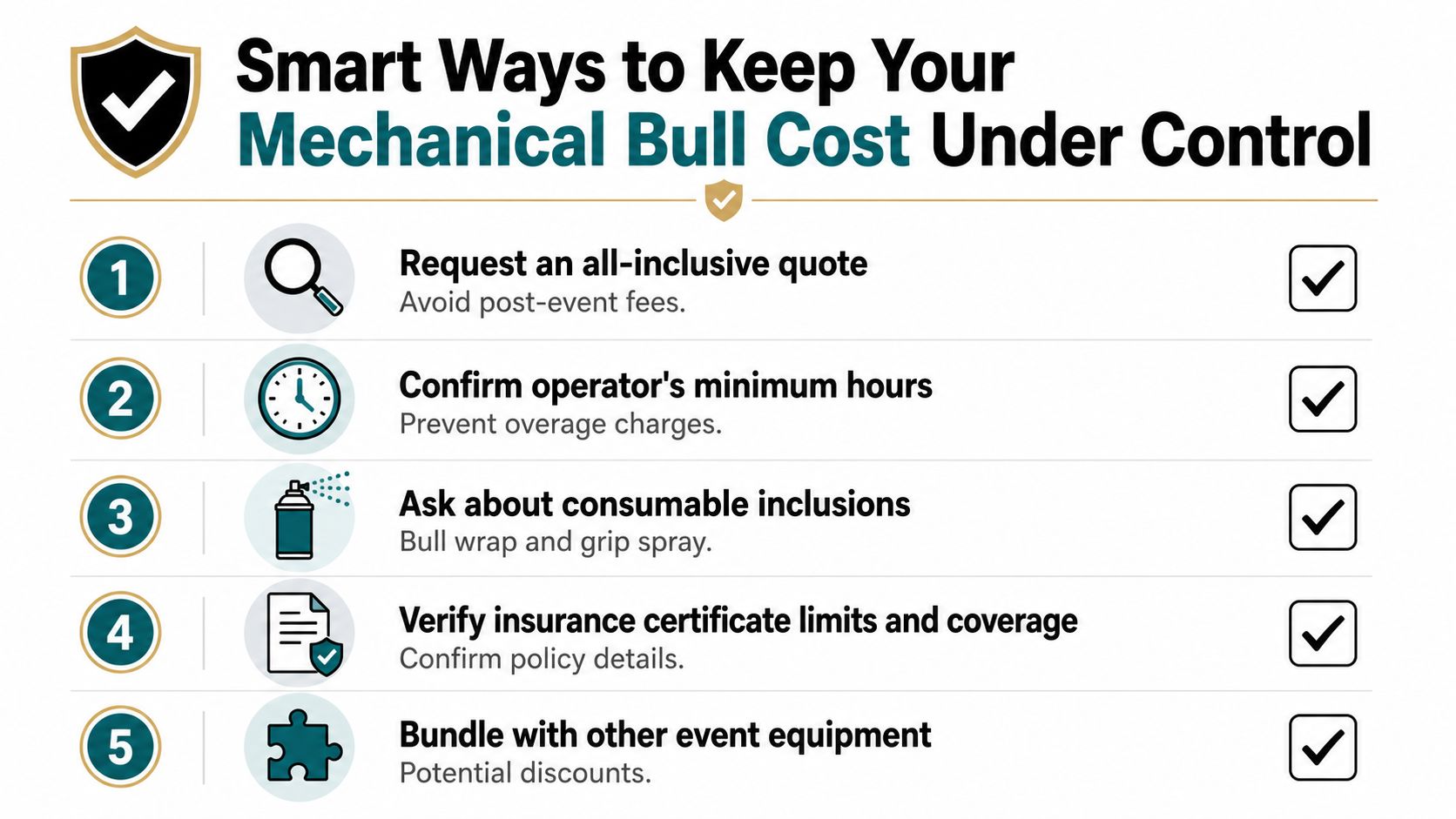
A low base quote can become an expensive invoice once delivery, operator time, power, insurance, and after-hours surcharges appear. Control the final delivered total before signing by forcing every cost into the written proposal.
Start with the operating window. Reserve the bull for the period when guests will ride, and ask the vendor to separate setup and teardown from paid operating hours. A school may need service during one activity block, while a corporate picnic can concentrate rides after lunch. Cutting idle time is usually more effective than negotiating a small discount on the rental fee.
Use these cost controls
- Bundle related attractions: If the same vendor supplies games, inflatables, photo experiences, or other rentals, request one delivery and setup plan. Removing duplicate transport and labor can lower the combined quote.
- Choose a quieter date: Midweek and off-season bookings often give the vendor more scheduling flexibility than peak weekend dates.
- Provide suitable power: Confirm the equipment specification early. If the venue circuit meets it, supplying that power can avoid a generator charge.
- Clarify insurance paperwork: Ask which certificates, waivers, and venue documents are included before the contract is prepared. Required paperwork should not appear as a surprise administrative fee.
- Check the travel radius: Provide the exact address and ask about mileage, transport, stairs, elevators, loading restrictions, and difficult access.
- Confirm consumables: Verify whether grip spray, bull wrap, cleaning supplies, and other operating materials are included.
Before approving the booking, pressure-test the proposal:
- Is the final delivered total written in the quote?
- Are operator hours, overtime, arrival, and departure times clear?
- Are delivery, setup, teardown, taxes, and gratuity included?
- Does the venue meet space, clearance, access, and power requirements?
- Are insurance documents, waivers, weather terms, and cancellation rules stated?
- Are optional upgrades selected or explicitly declined?
Phantom Entertainment lists delivery, setup, professional operation, insurance documentation, and venue planning support among its mechanical bull rental services. Request a quote at Phantom Entertainment with the event date, venue, operating window, and power details, then compare its all-in total against competing proposals.
Ready to Book Your Event?
PA state-inspected, fully insured since 1979. Call us or get a free quote today.