

Search for hot air balloons for rent and the same advice comes back from nearly every page: book early, pick the scenic launch site, and let the balloon be the centerpiece of the day. That advice is easy to follow and mostly beside the point. What you're buying isn't an attraction bolted onto a schedule. It's a flight in a registered aircraft, with a certificated pilot, airspace rules, and a launch decision that belongs to someone else.
The planners who end up with a flight that looks effortless worked backward from the aircraft. They chose a field a pilot could use, took the early slot instead of the midday one, and settled the cancellation terms before any deposit moved. The basket photos and the toast come later, and they only happen when the aviation half of the booking is already right.
Plan Your Balloon Event Around the Aircraft
Two operators can quote the same Saturday morning and be selling you different products. One has priced a flight decision a pilot will make at dawn on your field; the other has priced a deposit. A balloon needs room to lay out and inflate, a wind it can work with, and a place to come down that a chase vehicle can reach. Build the plan around those requirements and the day runs itself. Build it around a fixed run sheet and you will spend the morning negotiating with a pilot who cannot give you what you are asking for.
Four answers shape every quote you receive: where the balloon can launch and land, who will be aboard and what they need, how the go or no-go call gets made, and what happens to the crowd if the flight is scrubbed at sunrise. Settle those four and pricing becomes a straightforward comparison. Skip them and you are comparing brochures.
The requirements change with the event
| Event type | Launch site needs | Passenger rules to confirm | Weather plan |
|---|---|---|---|
| Corporate picnic | Open field with a clear approach and a fenced crowd zone | Mixed ages, weight and height limits, mobility needs | Flexible date plus a ground-based backup attraction |
| School field day or homecoming | Large lawn away from power lines and roads | Guardian consent for younger riders, supervised boarding | Rain date and a substitute activity on standby |
| Wedding or private celebration | Venue with clear overhead space and vehicle access | Guest eligibility and companion policy | Early or late slot with cancellation terms in writing |
| Community festival | Permitted launch zone with crowd exclusion and staffed queue | Public boarding limits and passenger briefing | Scheduled launch window with a substitute attraction |
Read the school field day row first, because it is the one schools get wrong. A large lawn away from power lines and roads is not decoration; it is the difference between a usable launch and a site a pilot declines on arrival. The fenced crowd zone and supervised boarding carry as much weight as the guardian consent forms, because a field day audience is children who will run at the envelope the moment it starts to fill.
Crowds are the other half of that row. The Smithsonian National Air and Space Museum records that on December 1, 1783, as many as 400,000 people, reported as approximately half of Paris's population, gathered in the city to watch a hydrogen balloon fly. The pull has not faded, which is why crowd flow belongs in the plan beside the launch site. A site map that marks queue lines, staff positions and the exclusion boundary does more for a balloon event than any decoration, and the PADL outdoor corporate event playbook covers that layout work properly.
Weddings need their own treatment because the flight competes with a fixed timeline. Sequence it against the ceremony, the meal and the first dance, and take the early or late slot rather than the midday one couples first ask for. If the flight is scrubbed, ground-level entertainment fills the gap, and a rental company's wedding entertainment options page shows the kind of fallback inventory worth holding in reserve.
The test I apply before any quote: if the date, the launch site and the backup plan aren't fixed yet, the balloon isn't bookable, however good the deposit terms look.
Venue and Launch Site Checks Before You Book
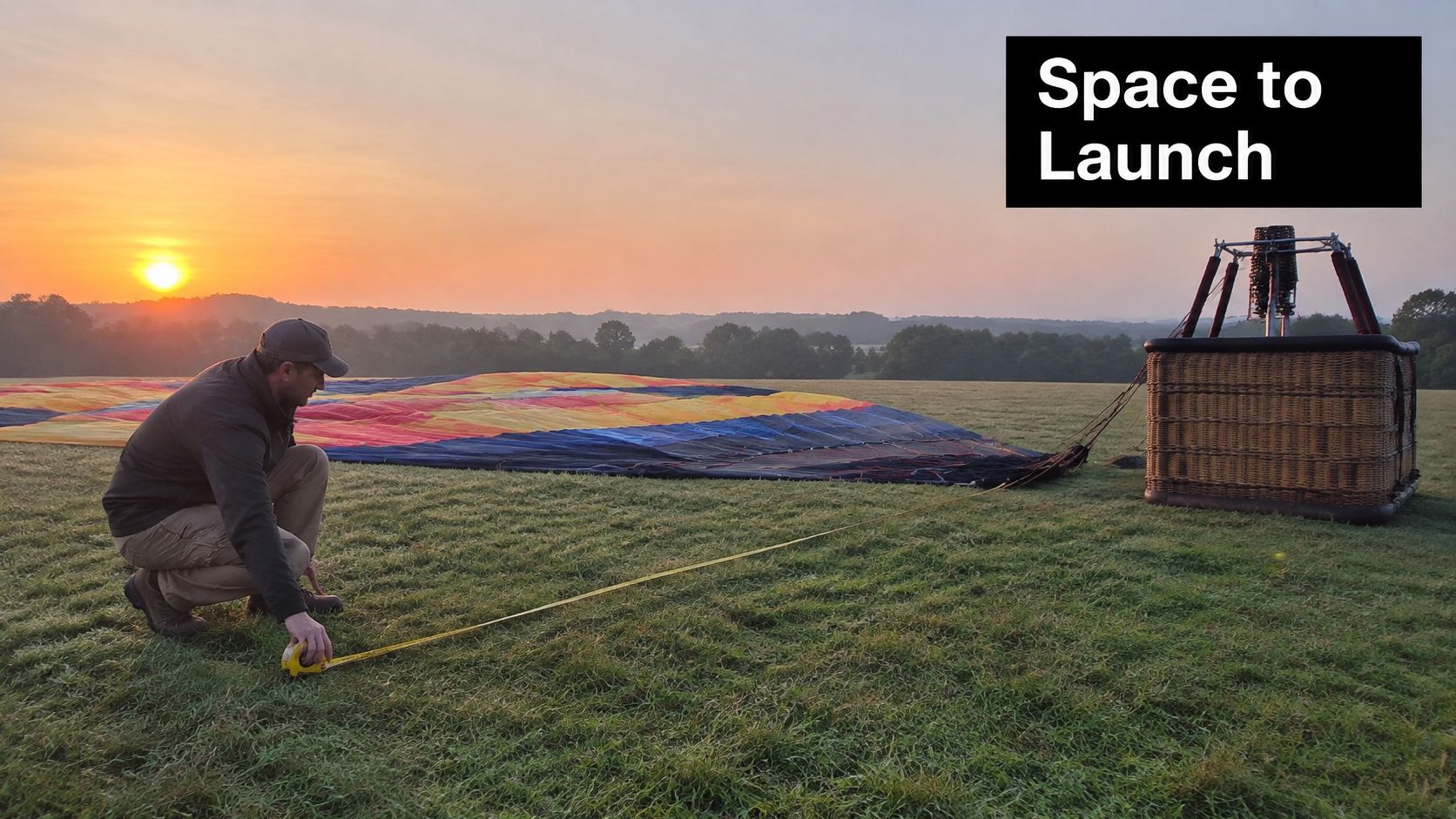
Most balloon dates are lost at the site survey, weeks before anyone opens a forecast. A field that looks generous from a car window can be unusable once you account for the ground needed to lay out and inflate the envelope, space for the basket to stand upright, and a landing zone the crew can reach by vehicle.
The crew work is ground work, and the site has to support it long before the balloon lifts.
Six checks to run with the pilot
- Walk the field and name the wind direction. The pilot makes the wind judgment on site, so you need to know which side is upwind before you place a single table or generator.
- Mark every obstacle upwind. Trees, poles, power lines and buildings on the approach side remove options at precisely the moment the pilot needs them.
- Ask about airspace. Nearby airports and restricted zones can rule out a launch you'd assumed was fine, and that answer has to come before invitations go out.
- Rope and staff a crowd exclusion zone. Inflation and landing areas need a physical boundary with a person assigned to hold it, not a laminated sign nobody watches.
- Confirm vehicle access. The crew truck has to get to the landing zone, and guests with mobility needs need a route that isn't a plowed furrow.
- Name a fallback launch spot. If the main field is waterlogged or the wind swings, a second location on the same property keeps the date alive.
A school field with a tree line on the south side is the classic case. Shift the launch to the north end and the landing area moves with it, which changes the guest route, the queue position and where the chase vehicle parks. Decide that during the walkthrough, not at 6 a.m. on the day.
Put one question to the venue in writing: which part of the property can be used for an open launch at this date and time, and who signs off on it? If the balloon shares the field with ground attractions, settle the footprint for both at once, because the inflatables and party rentals that usually fill the rest of the day need that same clear approach kept open.
Weather Limits That Decide Whether the Balloon Flies
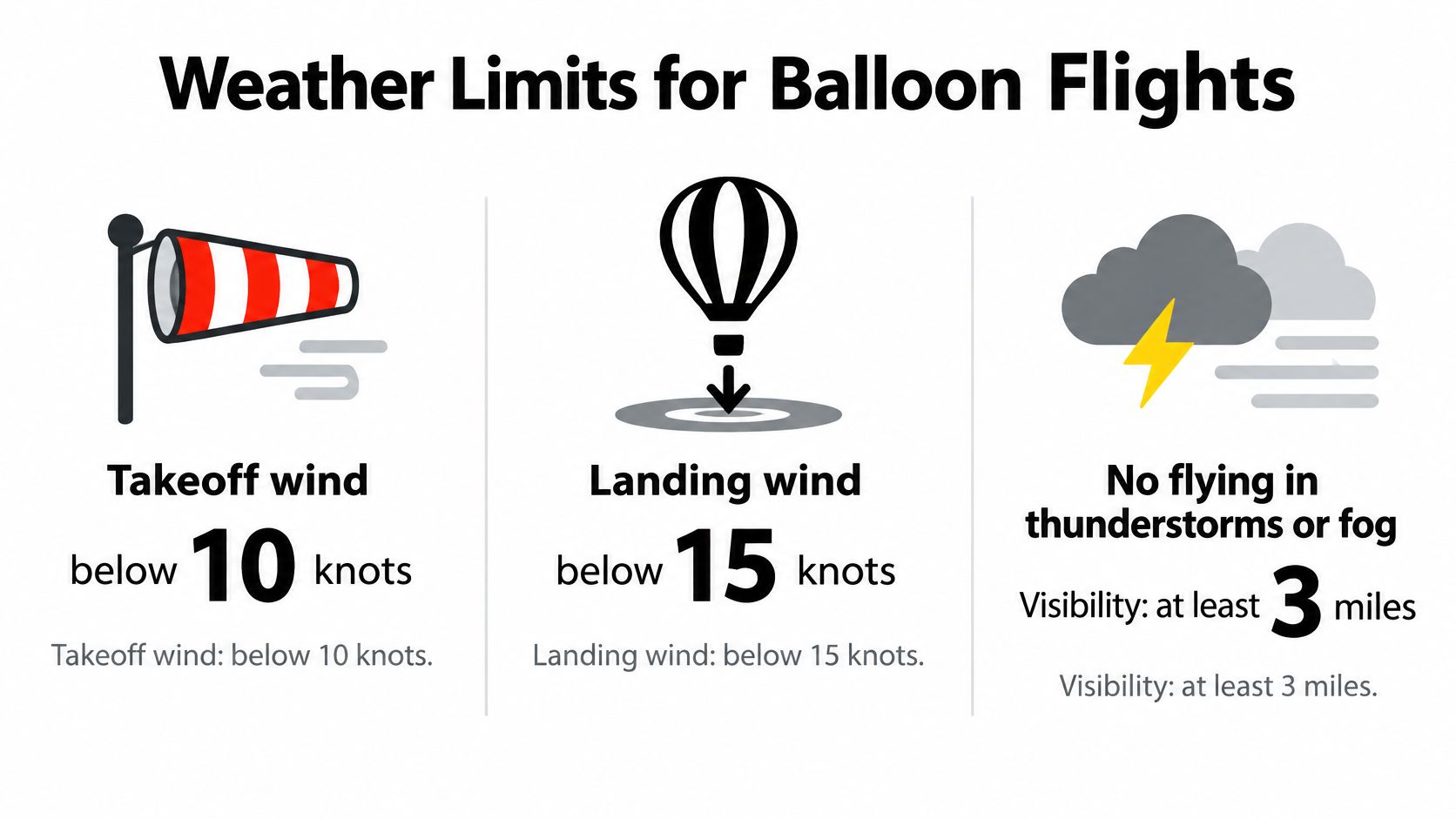
Wind decides the day, and the thresholds a pilot works to sit lower than most planners expect. Treat them as fixed purchase terms: get them into the contract conversation before dates and deposits, because they determine which slots are worth requesting at all.
Weather and airspace reference limits for balloon flights
| Condition | Reference limit | What it means for your booking |
|---|---|---|
| Wind at takeoff | Below 10 knots (EASA reference) | Flight manual limits can be stricter |
| Wind at landing | Below 15 knots (EASA reference) | Landing zone size must allow for drift |
| Visibility for visual flight | At least 1 statute mile at or below 1,200 ft AGL (FAA) | Fog or haze can end the flight |
| Cloud clearance | Remain clear of clouds at or below 1,200 ft AGL (FAA) | Overcast forecasts need a backup plan |
| Altitude over crowds | 1,000 ft above highest obstacle within 2,000 ft (FAA, congested areas) | Dense crowds shape the flight path |
| Burner power at altitude | Burner output and air density both fall at hotter, higher sites | Hot, high sites carry less payload |
Those are reference values, not guarantees. EASA's guidance presents the 10-knot takeoff and 15-knot landing figures as generally safe limits while noting that turbulence, the aircraft's characteristics and the flight manual can impose stricter ones, and it requires the pilot to assess wind direction and speed at the launch site and stay inside the flight manual's meteorological limits (EASA ballooning safety guidance). In the United States the same judgment sits inside visual flight rules: at or below 1,200 feet above ground level in applicable airspace, the pilot must stay clear of clouds with at least one statute mile of visibility, and over congested areas or open assemblies the aircraft must generally hold 1,000 feet above the highest obstacle within 2,000 feet.
Three conditions cancel most bookings: wind at takeoff, wind at the landing zone and visibility at the site. A forecast grazing any one of them leaves no room for the morning to shift against you.
What the limits do to a booking calendar
Air is usually steadiest shortly after sunrise and again in the hours before sunset, so those are the slots worth building a day around. A midday slot in July is a booking that will be moved or lost, and pretending otherwise only shifts the disappointment onto the venue and the guests.
Elevation and heat cost you lift. Burner output falls with altitude, so a hot, high site carries less passenger weight than a sea-level demonstration flight suggests, and capacity quoted for a different airport is not your capacity. Crowd density matters too, because the altitude rule over open assemblies pushes the pilot higher and further out. A packed festival can lose a perfectly calm morning without a cloud in the sky.
The same wind logic governs the rest of the day's program, and this guide to weather and wind decisions for outdoor inflatables covers how to make those calls for the ground attractions sharing the site.
A worked example at 2,500 feet
A wedding sits on the calendar at a site 2,500 feet above sea level, in an afternoon slot, with a forecast near the wind limit. The pilot faces three problems at once: reduced payload at that elevation, a forecast with no margin, and 120 guests waiting on a schedule. The fix lives in the schedule itself. Move the flight to the early slot, keep the ceremony independent of it, and give the pilot written authority to cancel so the go/no-go call happens privately, in writing, before guests arrive.
Ask two questions when you request pricing for hot air balloons for rent: what is the elevation of my launch site, and what are your written limits for wind, visibility and cloud? A provider who answers in general terms hasn't answered.
Operator Documents That Prove a Safe Flight
The envelope, the propane burner and the basket function as one integrated aircraft, and the paperwork behind them should read like aircraft paperwork. FAA guidance describes typical burners producing approximately 20 million BTU in operation, calls for fabric damage beyond manufacturer limits to be repaired before the envelope returns to service, and calls for at least an annual inspection by an appropriately qualified repair station, manufacturer or authorized mechanic (FAA Balloon Flying Handbook, chapter 2). An operator carrying paying passengers should be able to produce records at least that complete.
The commercial side of ballooning is small and closely watched. An FAA review counted 54 commercial hot-air-balloon accidents from 2003 through 2013, four of them fatal, and cited industry estimates of 100,000 to 250,000 passenger rides a year (FAA commercial balloon review). A small fleet, real consequences, and a paperwork trail that either exists on request or doesn't exist at all.
Operator documents to request before booking
| Document | What it proves | Red flag |
|---|---|---|
| Pilot balloon rating | The named pilot is qualified to fly this aircraft | Rating not shown on request |
| FAA registration | The balloon is registered as an aircraft | Registration number missing |
| Most recent annual inspection | The aircraft has been inspected and is airworthy | No inspection date given |
| Fabric repair record | Damage was repaired to manufacturer limits before return to service | Patches with no repair record |
| Burner output and capacity at event elevation | Passenger payload suits the site altitude and temperature | Capacity quoted without site elevation |
| Insurance certificate | Liability cover applies to the event | Verbal assurance only |
How to read the documents
Work through the table in order.
The pilot rating comes first because the aircraft is only as good as the person flying it, and a rating that can't be produced on request ends the conversation politely. Registration and the inspection date come next, with the fabric repair record directly beside them: a patch with no documentation raises a question about every other patch on the envelope.
Maintenance history is the part planners rarely request and the part that shows how the aircraft has been kept between inspections. DuBois Aviation logbook guidance explains what a complete logbook should contain, which gives you a working checklist to hold a provider against.
Ask for capacity in writing
The capacity row is where quotes go wrong most often. A professional operator will put passenger payload in writing against your launch site's elevation and the expected temperature, because those figures change what the burner can lift. A seat count offered without asking where you're flying describes somebody else's event.
Request the full set in writing before any deposit is paid, and confirm that the pilot named in the documents is the person who will fly your event. Subcontracted pilots are common in peak season, and a substitution made on the morning of the event changes the booking you approved.
Passenger Eligibility and Accessibility Rules
Family-friendly is a phrase that survives right up until a guest with a walker reaches the basket. Passenger rules are physical, and the good operators publish them. Transport Canada's passenger guide states them plainly: riders should be able to see over a basket approximately 42 inches high, stand for the entire flight, enter and exit without assistance, and handle a landing impact comparable to jumping from a kitchen chair (Transport Canada hot air balloon passenger guide).
Passenger requirements and the questions to ask
| Requirement | Reference value | Question to ask the provider |
|---|---|---|
| Basket height | Riders should see over a basket about 42 inches high | What is the exact basket height for this aircraft? |
| Standing | Riders must stand for the entire flight | Are seats available for guests who cannot stand? |
| Boarding | Riders enter and exit without assistance | What help does ground crew give at boarding and landing? |
| Landing impact | Comparable to jumping from a kitchen chair | What is the landing terrain and how is it accessed? |
| Wheelchairs | Cannot travel aboard; transfer into seating may be needed | Can ground crew transport mobility equipment? |
| Medical conditions | Consult a doctor; tell the pilot before flight | How will the pilot brief riders with medical needs? |
What wheelchair access does and doesn't cover
A modified basket door is not the same thing as a wheelchair flight. Accessible-flight guidance describes exactly that modification and still states that wheelchairs cannot travel aboard and that passengers may need to transfer into seating. Ask about the transfer itself, not the door.
Plan the whole path, not the door
Accessibility runs from the parking area to the recovery vehicle. A guest who can board the basket may still face a rough walk to the launch field, uneven ground at a landing site nobody has chosen yet, and a wait while the crew packs the envelope. Assign a named staff member to that guest for the duration rather than assuming the crew can absorb the job while they're chasing a balloon across a field.
A university orientation with a guest who uses a walker is the case I'd plan first. Request the basket height and door dimensions, ask what the ground crew can do at boarding and at landing, confirm the walker can ride in the chase vehicle, and brief the pilot before the day so nobody improvises at the front of a queue. Then send the guest an honest description: standing time, terrain, and what the landing feels like.
Anyone with a medical condition or a joint replacement should talk to a doctor and tell the pilot before the flight. That isn't a line to bury in a waiver; it's a briefing item, and it changes how the pilot plans the descent.
What accessible should mean here: the parking, the walk in, the boarding, the landing terrain and the ride back. A wider basket door on its own isn't accessibility.
Contingency Plans and Final Sign-Off
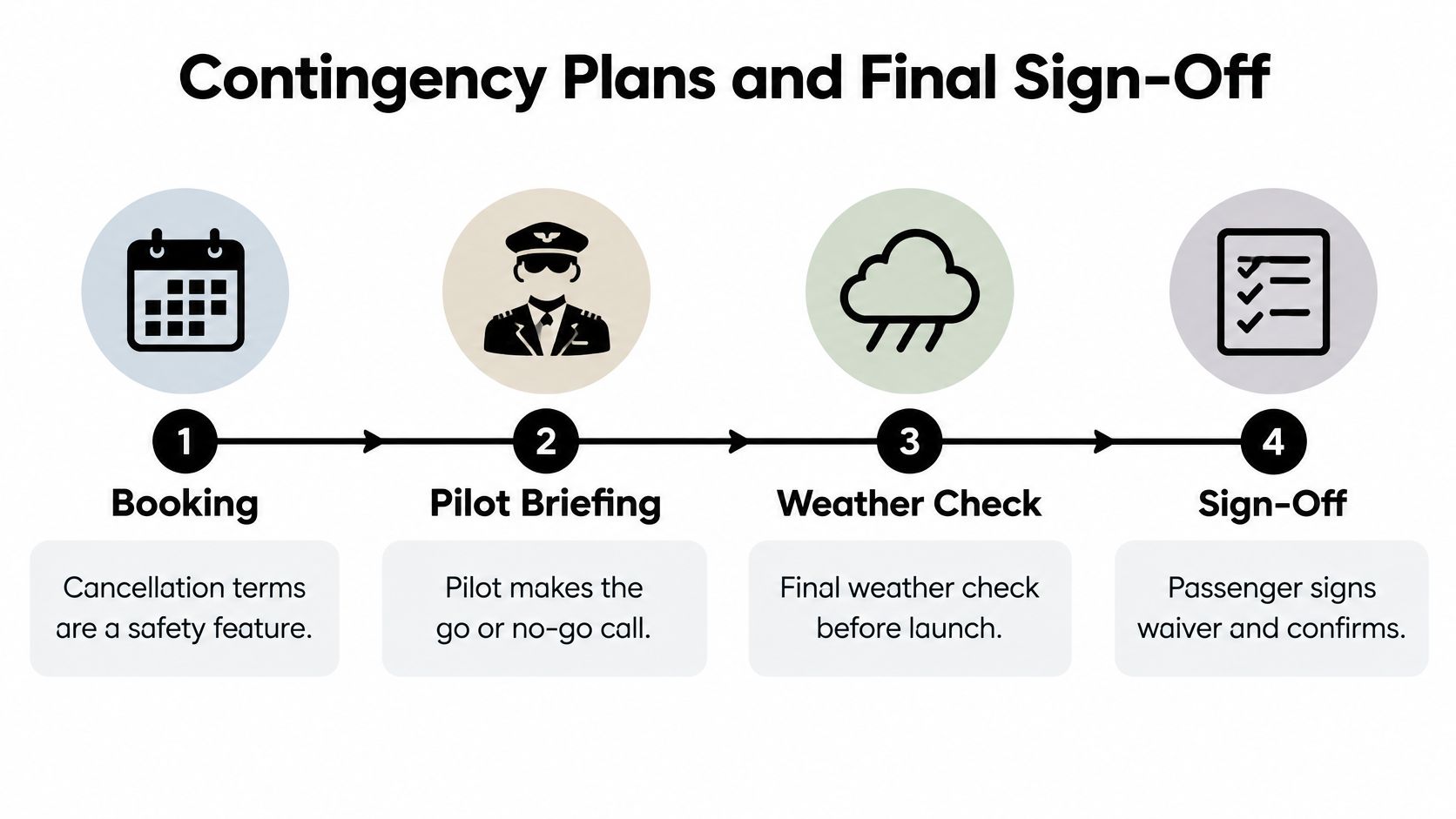
Cancellation terms are a safety feature, not evidence of a fragile supplier. A balloon's route and landing point depend on wind that shifts hour by hour, so a pilot who can call a flight off without a fight with the client is a pilot who will make that call early enough to protect everyone.
FAA guidance for balloon operations requires pilots to obtain weather reports and forecasts, and modern planning lets a pilot read winds at several altitudes before committing (FAA, keeping aviation's slow, low and beautiful element safe). Expect weather to ground a share of flights in any season. Build the event so a scrubbed morning costs you a time slot, not the whole day.
Take a school homecoming where the morning forecast shows wind near the limit. The planner moves the flight to an evening slot, the contract carries a substitution clause, and the deposit stays with the event while the ground attractions carry the afternoon. The flight happens. That outcome is a decision made while options still existed.
- Name the decision-maker and the hour. Write down who calls go or no-go on the day and when they'll call it, so the venue isn't texting you at five in the morning.
- Set a notification deadline. Catering and staffing need a number to work to, and guests need time to change plans without a scramble.
- Fix the minimum forecast window. Agree how many hours out the provider will hold the booking before the call is made.
- Book a backup date in the same season. A rain date three months later isn't a backup, it's a second event.
- Agree the substitute attraction. If the balloon can't fly, something has to hold the crowd, and a mobile escape room or a mobile zipline does that better than an apology and a clipboard.
- Get refund and rescheduling terms in writing. Deposit movement, transfer to a substitute, and what happens if the second date also fails.
The sequence is short, and it works in that order.
Before the deposit, send one email. Ask the provider to confirm the aircraft and its registration, the named pilot and rating, the inspection and insurance documents, who makes the weather call and when, and what the backup date and substitution terms are. A provider who answers all of it in writing has earned the booking. One who answers half of it has handed you a decision, and you should make it before money moves.
Phantom Entertainment handles the ground half of a balloon day: inflatables, mobile escape rooms, mobile ziplines and mechanical bulls, delivered, set up and staffed across Pennsylvania, Maryland, New York, Virginia and West Virginia, with certificates of insurance and venue-ready safety documentation your venue will ask for anyway. If the wind keeps the balloon on the ground, the crowd still has somewhere to be. Visit Phantom Entertainment to build that backup plan before you need it.
Ready to Book Your Event?
PA state-inspected, fully insured since 1979. Call us or get a free quote today.