
The best event rental isn't always the biggest attraction. It's the option that fits the audience, venue, activity level, weather exposure, guest throughput, and available supervision. A mechanical bull can anchor an adult company picnic, yet create a poor experience at a quiet family luncheon. A bounce house may work beautifully for a backyard birthday, while a mobile escape room may serve a university orientation more effectively because groups can rotate through timed sessions.
The strongest event rental ideas follow a simple operating framework: choose one centerpiece, add complementary activities, confirm space, power, access, staffing, and safety requirements, then reserve early. The right package should give guests something to do while they wait, move naturally through the venue, and remain manageable for the event team.
This list organizes ten options by audience and planning purpose, from high-energy school attractions to polished adult entertainment. For broader programming support, planners can also review these polished event schedule ideas before assigning activity blocks.
Phantom Entertainment is one example of a turnkey provider serving Pennsylvania and the Mid-Atlantic, with delivery, setup, professional operation, insurance, and safety documentation available for event rentals. That kind of support matters when a school, company, municipality, or nonprofit needs more than equipment dropped at the curb.
1. Interactive Inflatable Bounce Houses and Obstacle Courses
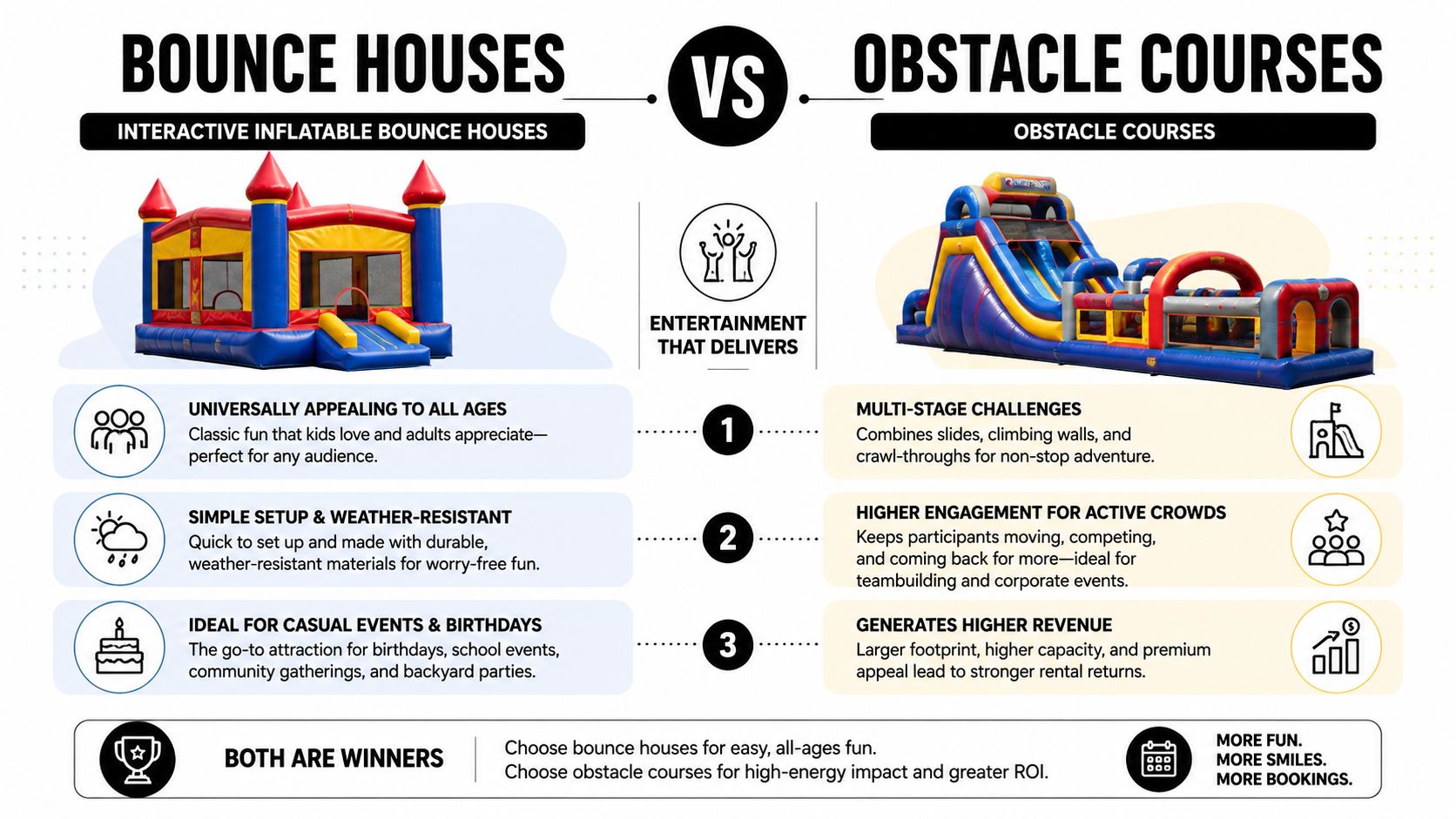
Inflatables are dependable centerpieces for school field days, family fun days, birthdays, and community festivals because they give guests an obvious activity as soon as they enter the event area. A basic bounce house suits younger children and smaller celebrations. An obstacle course adds movement, friendly competition, and a clearer operating rhythm for larger gatherings.
The main trade-off is capacity. One large attraction can look impressive but create a long queue if every guest arrives at once. Pairing a bounce house with an obstacle course, carnival games, or a photo station spreads participation across the site and improves guest flow.
Practical rule: Treat commercial inflatables as regulated technical equipment, not casual party décor. ASTM F2374-based guidance calls for commercial-grade equipment, documented anchoring, trained supervision, and a default shutdown threshold at 15 mph sustained wind. Review the commercial inflatable safety guidance with the rental provider before booking.
Match the setup to the site
Confirm level ground, a debris-free surface, nearby power, delivery access, and an indoor or weather-protected backup before signing the rental agreement. A basic bounce house may need a footprint of at least 20 by 20 feet, as specified in the planning brief, while larger obstacle courses require substantially more clearance. Don't rely on a rough visual estimate. Ask for the attraction's operating footprint and required safety perimeter.
Use age and size grouping, waiver procedures where appropriate, and an operator present throughout the active rental period. For a school or corporate event, divide participants into manageable groups rather than letting an uncontrolled crowd gather at the entrance.
For operating guidance and attraction selection, see this inflatable party entertainment guide. In practical terms, inflatables work best when the organizer plans the queue, supervision, weather response, and complementary activities with the same care as the attraction itself.
2. Mobile Escape Rooms
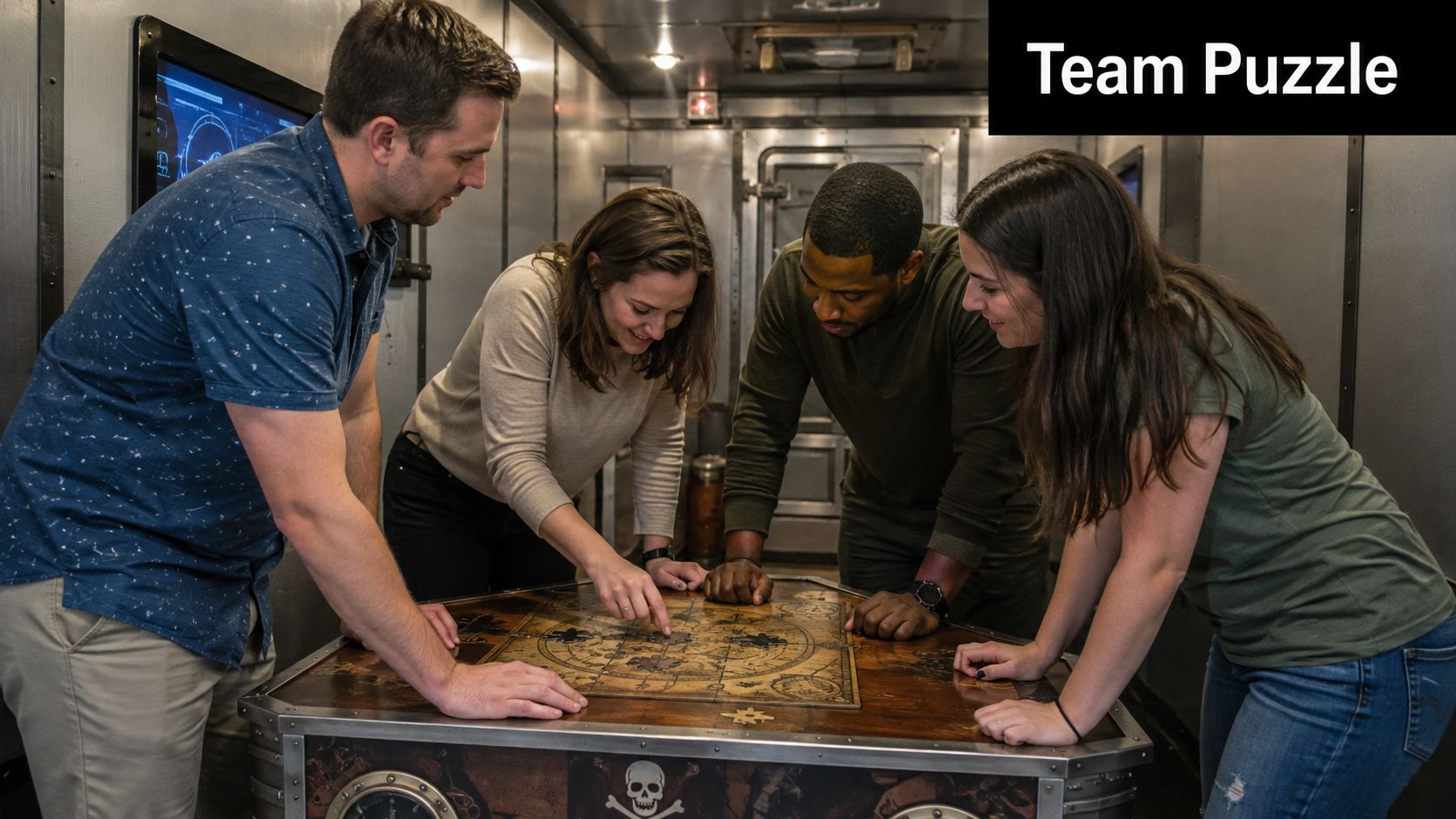
A mobile escape room gives guests a shared problem to solve instead of a passive attraction to watch. Themed environments, logic puzzles, and timed challenges make it especially useful for corporate team-building, university orientation, high school grad nights, and older birthday groups.
Unlike an inflatable, an escape room operates through scheduled sessions. That's both its strength and its limitation. A good rotation plan creates anticipation and keeps groups focused, but an informal drop-in approach can leave guests confused or produce idle periods between sessions.
Start by estimating how groups will move through the experience. Corporate teams may appreciate a more challenging scenario, while new students or mixed-age groups may need clearer instructions and an accessible difficulty level. Ask the provider whether puzzles can be adjusted to suit the audience.
Build rotations into the schedule
Place the escape room near lower-intensity activities, such as arcade games, photo novelties, or refreshments. Guests can wait socially without blocking the entrance, and organizers can give each group pre-game instructions before their assigned start time. Promote the theme in advance if the attraction is part of a university or corporate event, since advance interest makes rotation management easier.
The unit also needs a practical delivery route, a stable setup area, and enough room for guests to enter and exit without crossing another queue. Confirm access restrictions at campuses, hotels, schools, and corporate properties early.
For planning details and package possibilities, review these mobile escape room rental options. An escape room is a strong premium centerpiece when the event values collaboration and conversation, but it shouldn't be the only activity at a large open-house format where guests expect continuous, unscheduled entertainment.
3. Mechanical Bull Riding
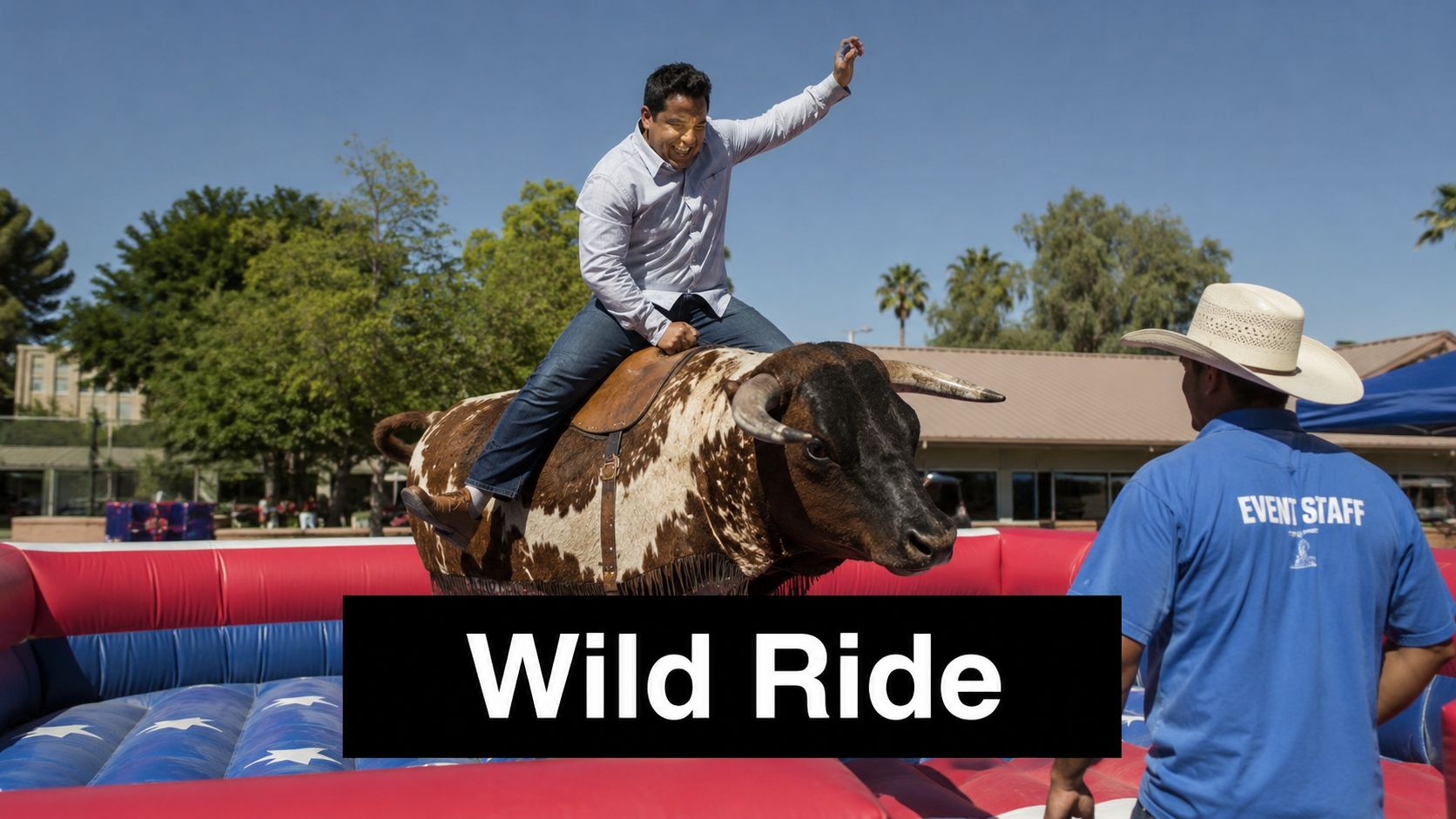
Mechanical bull riding creates a natural focal point because riders perform while spectators react. The attraction fits adult birthdays, corporate picnics, college events, spring flings, homecomings, festivals, and bar or bat mitzvah celebrations with older participants.
Its appeal comes from adjustable intensity. New riders can begin at a beginner setting, while experienced participants may request a more demanding ride. That flexibility makes the bull easier to program than an attraction with one fixed experience, but it also makes trained operation essential.
Set the bull where spectators can see it without standing inside the operating area. A nearby photographer can capture the ride, while a separate viewing zone keeps the queue from spilling into food service or other activities. Short, controlled turns usually maintain interest better than allowing one participant to dominate the attraction.
Put safety before spectacle
Require waivers when the provider and venue call for them, explain the rules before riders enter, and verify participant requirements. Helmets, proper supervision, and clear procedures for starting and stopping the ride should be part of the package, not improvised on event day.
The event schedule matters, too. A bull works well during a peak-attendance period, when spectators can gather and cheer, but it may be less effective during a formal meal or presentation. Pair it with lower-intensity entertainment, such as a DJ, photo booth, or arcade area, so guests who don't want to ride still have a reason to stay nearby.
For a closer look at operating considerations, use this mechanical bull safety resource. The bull is a strong choice for an audience that wants a memorable challenge, but it isn't the right centerpiece for events where quiet conversation, very young children, or limited supervision are the priority.
4. Mobile Zip Lines
A mobile zip line functions as a premium adventure attraction for school field days, corporate retreats, university orientation programs, community festivals, and grad nights. Participants move from a high platform along a cable while wearing a professional harness and receiving direct operator supervision.
The planning challenge is site control. Zip lines need a clear installation area, safe approach and exit paths, and careful review of overhead conditions. The suggested planning footprint is at least 50 by 50 feet, and organizers must check for branches, utility lines, structures, and other obstacles before the crew arrives.
That makes a zip line better suited to a spacious school field, park, or festival ground than a crowded backyard or compact courtyard. A site visit or detailed venue map can prevent a late discovery that the attraction can't be installed safely.
Design the queue before the booking
A zip line can become a memorable “bucket list” moment, but only if guests understand where to line up, how they'll be screened, and what happens after the ride. Use clear signage, a waiting area, and a separate landing path. Ask the provider about health screening questions, participant requirements, weather rules, and the operator's role throughout the event.
Pair the zip line with a rock wall, obstacle course, or passive activity such as a photo station. That gives guests different ways to participate and prevents one attraction from carrying the entire event.
For institutional buyers, request insurance and venue-ready safety documentation early. Schools and corporate properties often need those materials before approving a high-energy attraction, and compliance delays can affect the entire booking schedule.
5. Rock Climbing Walls
Portable rock climbing walls work well when an organizer wants a physical challenge with visible progress. Multiple routes and varied difficulty levels can serve school field days, youth programs, corporate wellness events, nonprofit gatherings, church activities, festivals, and college orientation programs.
The attraction rewards thoughtful pacing. Participants need harnessing, instruction, climbing time, rest, and a safe return to the ground. Spectators also become part of the experience because classmates, coworkers, friends, or family members can encourage the climber and celebrate a completed route.
Start with achievable routes rather than presenting the hardest climb as the main objective. For younger guests or first-time climbers, visible difficulty markers help them choose a challenge that feels attainable. For corporate wellness events, frame the wall around confidence, encouragement, and personal progress rather than only speed or height.
Balance intensity and recovery
A climbing wall pairs naturally with lower-impact options, including arcade games, photo novelties, or a DJ. Put water and seating nearby, while keeping the spectator zone outside the operating area. High-volume school or festival programs may need more than one trained operator to keep the queue moving and maintain attention to harnessing and participant readiness.
A timed challenge can add energy, but competition shouldn't pressure tired or hesitant guests to continue. Give participants a clear option to stop, and let staff manage the transition between climbers.
Confirm the wall's footprint, surface requirements, overhead clearance, power needs if applicable, delivery route, and weather plan. It's an excellent centerpiece for an active audience, but it requires more operational planning than a simple game station.
6. Laser Tag Arenas
Mobile laser tag creates team-based play without the mess associated with paintball. Vests, infrared blasters, and portable arena elements support corporate team-building, university social events, teen birthdays, spring flings, homecomings, grad nights, and community tournaments.
The best laser tag programs feel organized from the first briefing. Explain boundaries, scoring, safe equipment handling, and the objective before the first game. Balanced teams matter, especially when experienced players join a group of beginners. A tournament format can add structure for a school or college event, while a casual rotation may work better for a corporate family day.
Give nonplayers a role
Not everyone will want to play every round. Place a viewing or social zone nearby, and offer a complementary attraction such as an arcade area, photo booth, or snack station. That keeps the event inclusive and reduces pressure on guests who need a break.
Indoor venues offer climate control and predictable surfaces, while outdoor arenas provide more room but require weather and ground planning. In either setting, check lighting, access, power, and the distance between the arena and other activities. Avoid placing active play beside dining areas or narrow pedestrian routes.
For corporate buyers, market laser tag as a structured collaboration activity rather than just a combat game. Teams can use changing group assignments, timed rounds, and recognition for winners to encourage interaction without making the event feel like a mandatory training exercise.
Photo and video capture can add social value, but obtain the venue's permission and establish clear expectations about participant privacy. Laser tag works best when the organizer plans both the games and the spaces between them.
7. Paintball Experiences
Paintball suits groups that want a more immersive, competitive outdoor experience. Mobile setups typically use professional markers, protective equipment, and inflatable cover structures for corporate retreats, bachelor or bachelorette parties, birthdays, student organizations, youth groups, and community activities.
The trade-off is that paintball demands stronger participant controls than many other event rentals. Organizers need defined game zones, out-of-bounds areas, equipment instruction, protective gear, supervision, and a clear first-aid response plan. The provider should explain how markers are checked, how teams are formed, and how the field is reset between games.
Use equal team compositions rather than allowing the most experienced players to dominate. Recreational participants should understand the rules and have a way to participate at their own comfort level. A short orientation before play reduces confusion and helps staff identify guests who need extra support.
Operational insight: Paintball is rarely a good “drop-in anywhere” attraction. It works when the venue gives the provider room to control boundaries, queues, equipment, and spectators.
Plan for comfort and recovery
Schedule breaks between rounds and provide a protected staging area for gearing up and cooling down. Keep spectators outside the active field, and make photo opportunities part of the plan, especially for parties where guests may want a group image in full equipment.
Corporate planners should ask about waivers, insurance, trained staff, first-aid coverage, equipment inspection, and weather cancellation procedures before presenting the package for approval. Those documents can determine whether the attraction is acceptable to the venue.
Paintball is a strong fit for adventure-seeking groups, but it's not the best option for mixed audiences with very different comfort levels. In that case, combine it with a less intense activity or choose laser tag instead.
8. Casino Nights and Gambling Experiences
A casino night brings staffed blackjack, roulette, poker, or craps tables into a gala, fundraiser, corporate party, formal dance, or adult celebration. Certified dealers and play-money chips create the atmosphere of casino entertainment without making the event depend on actual wagering.
Legal and venue requirements need attention before design decisions. Confirm state and local rules, then position the experience clearly as entertainment. Play money can preserve the social competition while avoiding the complications associated with real gambling, but the provider and organizer should agree on the format in writing.
This option works particularly well when the event already includes dinner, cocktails, formal décor, or a fundraising program. Place tables where guests can circulate easily rather than clustering them in a corner. Tournament brackets, prize recognition, or a charitable conversion of chips can give guests a reason to keep participating.
Use the format to support the event goal
For a corporate holiday party, the casino can serve as a social mixer. For a nonprofit gala, the chip system can connect play to the fundraising message, subject to applicable rules and the organizer's chosen structure. For a university senior event, it can offer a polished evening activity alongside music and photo services.
Professional dealers should explain the games in accessible language. Guests shouldn't need prior knowledge to join, and the event team should avoid letting the tables interrupt speeches, meal service, or important announcements.
Pair casino tables with a DJ, lighting, photo booth, or lounge furniture when the venue supports it. Unlike a mechanical attraction, casino entertainment depends on conversation and atmosphere, so layout and pacing matter as much as the equipment itself.
9. Arcade Games, Virtual Reality and Photo Novelty Services
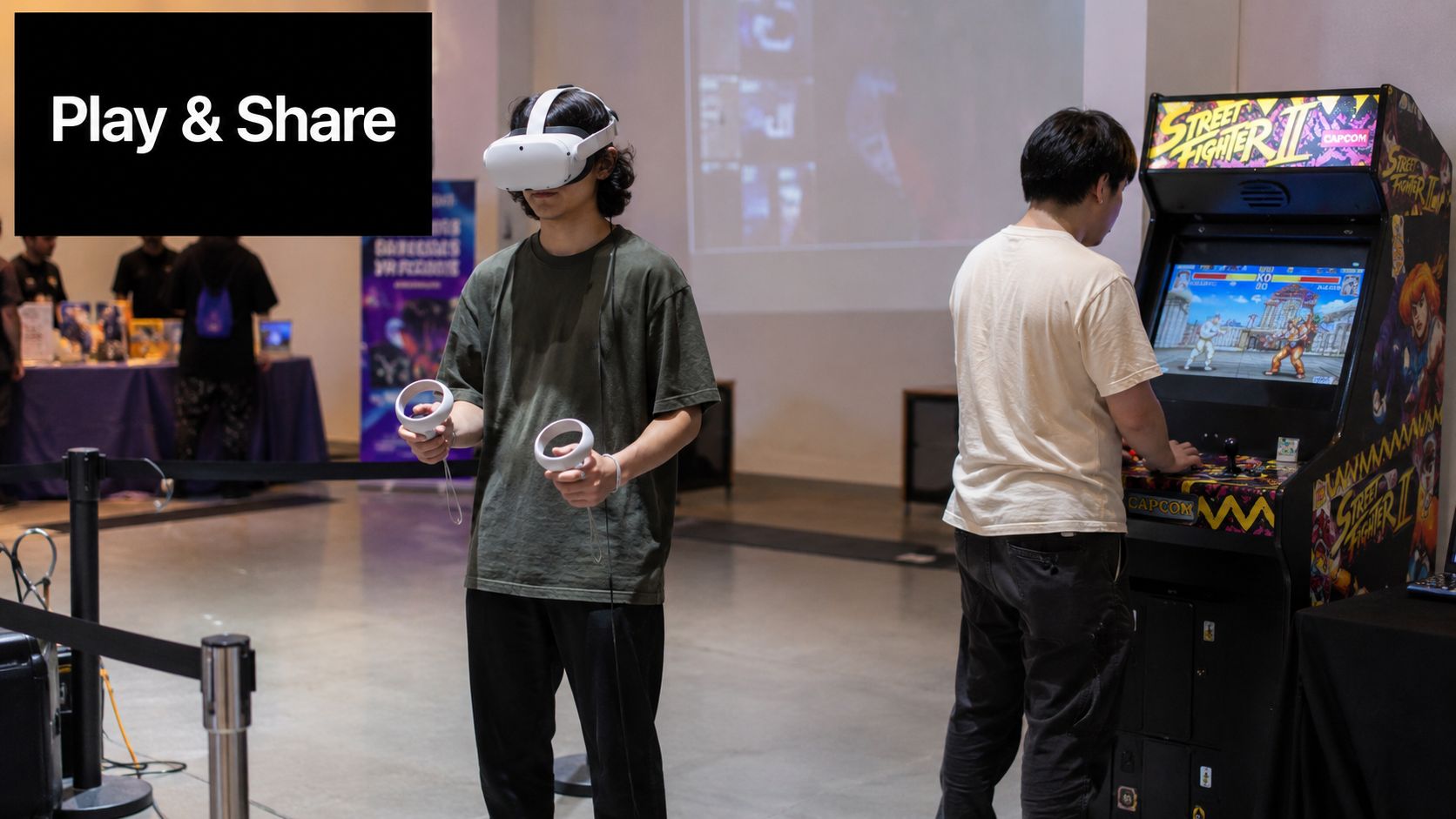
This combined category is useful when an event needs flexible entertainment for different ages, energy levels, and weather conditions. Classic arcade cabinets, modern gaming stations, virtual reality, photo booths, themed backdrops, and props can serve school events, corporate family days, birthdays, college orientations, festivals, spring flings, homecomings, grad nights, and bar or bat mitzvahs.
The strongest package mixes active and passive participation. A VR station may attract guests who want an immersive challenge, while an arcade cabinet offers quick play and a photo booth gives nonplayers a social activity. That variety is more valuable than filling the room with several versions of the same game.
Protect the flow around digital stations
Give VR enough room for safe movement, place seating close by, and keep cables managed. Stations shouldn't face narrow walkways or sit so close together that players collide with people waiting. Indoor, climate-controlled placement is often preferable for VR, while arcade and photo services can adapt to many event layouts.
Leaderboards and friendly tournaments can make repeat play more engaging. Digital sharing tools, including QR-based delivery where available, can extend the experience after the event, but organizers should confirm privacy expectations before encouraging social posting.
Technical support matters. Ask who handles headset setup, game changes, troubleshooting, and photo equipment issues. For a large audience, multiple photo stations may be more useful than one elaborate booth because they reduce queues and keep the activity visible.
This category is also a good weather backup for outdoor programs. If rain changes the plan, arcade games, photo novelties, and selected indoor attractions can preserve the social energy without requiring the entire event to be redesigned.
10. DJ Services and Karaoke Entertainment
A professional DJ or karaoke system shapes the atmosphere rather than occupying a single activity zone. That makes it appropriate for weddings, school dances, grad nights, corporate picnics, family events, birthdays, church gatherings, college socials, spring flings, and homecomings.
A DJ manages song selection, sound levels, announcements, transitions, and crowd participation. Karaoke adds a performance element that can engage guests who don't want a physical attraction. The two services can stand alone for a simple celebration or support a larger package with games, inflatables, photo stations, and lighting.
Send the DJ the event theme, audience profile, schedule, and must-play preferences in advance. A sound check before guests arrive allows the operator to manage volume and identify venue restrictions. During meals or speeches, sound should support conversation and announcements rather than compete with them.
Use music to connect the package
Place the DJ where the dance floor and main activity area remain visible, but don't block guest circulation or emergency access. A karaoke station needs enough room for performers, microphones, a screen, and spectators. Establish a song request process so the operator can keep the program aligned with the event's age range and tone.
For a school or university event, the DJ can announce game rounds, tournament winners, or transitions between activities. At a corporate family day, music can maintain energy while guests rotate through attractions. At a wedding, the DJ's schedule must follow formal moments, meals, dances, and speeches.
Confirm arrival time, equipment responsibility, backup procedures, power needs, and venue sound limits. DJ and karaoke services are often the most adaptable add-on in a package, but poor timing or excessive volume can affect the entire guest experience.
Top 10 Event Rental Ideas Comparison
| Item | Implementation Complexity 🔄 | Resource Requirements ⚡ | Expected Outcomes ⭐📊 | Ideal Use Cases | Key Advantages 💡 |
|---|---|---|---|---|---|
| Interactive Inflatable Bounce Houses & Obstacle Courses | 🔄🔄, moderate (delivery, setup, supervision) | Large outdoor footprint; 1–2 operators; weather contingency | ⭐⭐⭐, broad family appeal; strong attendance draw 📊 | School field days, community festivals, birthday parties | Widely appealing; proven crowd engagement; insured/safe equipment |
| Mobile Escape Rooms | 🔄🔄🔄, high (theming, game-master skills) | Self-contained unit; power required; 1 skilled operator; compact footprint | ⭐⭐⭐⭐, immersive, memorable; strong team-building impact 📊 | Corporate team-building, university events, premium parties | Weather-independent immersion; adjustable difficulty; repeat sessions |
| Mechanical Bull Riding | 🔄🔄, moderate (motorized equipment, operator) | Moderate space + safety perimeter; power; trained operator; quick turnover | ⭐⭐⭐⭐, high social/media impact; spectator engagement 📊 | Festivals, college events, adult parties, corporate picnics | Viral photo/video potential; high-perceived value; flexible scheduling |
| Mobile Zip Lines | 🔄🔄🔄, high (rigging, anchors, safety) | Large open area; multiple operators; time-intensive setup; harnesses | ⭐⭐⭐⭐, premium, unforgettable experience; good revenue potential 📊 | Corporate retreats, large festivals, school adventure days | Unique thrill; premium pricing; strong photo/content opportunities |
| Rock Climbing Walls | 🔄🔄, moderate (modular build, belay ops) | Dedicated level space; certified belayers; harnesses & padding | ⭐⭐⭐, confidence-building; steady participation 📊 | School events, corporate wellness, youth programs, festivals | Inclusive routes for varied skills; measurable achievement |
| Laser Tag Arenas | 🔄🔄, moderate (arena layout, game management) | Indoor/covered space; multiple vests/blasters; power & operator | ⭐⭐⭐, high-energy, repeatable team play; tournament potential 📊 | Corporate team-building, teen parties, university events, festivals | Multiple game modes; scalable group play; strong teen appeal |
| Paintball Experiences | 🔄🔄🔄, high (safety, field prep, gear) | Large outdoor field; many staff; protective gear; cleanup & med support | ⭐⭐⭐, intense engagement; strong team-building; higher risk 📊 | Corporate retreats, bachelor/bachelorette parties, youth outings | Realistic competition; leadership/strategy development |
| Casino Nights & Gambling Experiences | 🔄🔄, moderate (regulatory & staffing needs) | Indoor table space; certified dealers; age verification; possible licensing | ⭐⭐⭐, sophisticated entertainment; fundraising revenue potential 📊 | Fundraisers, galas, corporate evening events, adult-only parties | Elegant atmosphere; revenue via chip sales; networking-friendly |
| Arcade Games, VR & Photo Novelty Services | 🔄🔄, low-to-moderate (tech setup & support) | Power and connectivity; multiple stations; on-site tech support | ⭐⭐⭐, wide demographic appeal; social sharing & keepsakes 📊 | Family fun days, corporate family areas, birthdays, college events | Weather-independent; scalable; instant digital/print mementos |
| DJ Services & Karaoke Entertainment | 🔄, low (audio setup, playlist curation) | Power, PA system, DJ/operator; microphone/lighting gear | ⭐⭐⭐⭐, sustained atmosphere control; drives participation 📊 | Weddings, dances, corporate parties, school events | Versatile foundation for events; real-time crowd control; pairs with all offerings |
Turn Ideas Into a Smooth, Well-Run Event
Choosing among these event rental ideas starts with the audience, not the inventory catalog. A school field day may need active stations with clear age grouping and fast rotations. A corporate family day may benefit from a mix of inflatables, arcade games, photo novelties, and a DJ so children, parents, and employees can participate at different intensity levels. A formal fundraiser may call for casino entertainment, music, and a carefully managed social layout rather than a high-energy ride.
Build the package around one centerpiece and supporting activities with different energy levels. A mechanical bull can pair with music and photo services. A rock wall can sit beside arcade games or refreshments. An escape room needs an organized rotation plan and a nearby waiting activity. A zip line or paintball field requires enough space that the attraction doesn't interfere with dining, parking, emergency access, or ordinary pedestrian movement.
Before confirming the booking, document the practical details:
- Venue dimensions: Request the attraction's operating footprint, safety perimeter, queue area, and access requirements.
- Surface and clearance: Confirm level ground, overhead obstacles, indoor restrictions, and protection from weather where necessary.
- Power and delivery: Identify outlets, cable routes, loading access, parking restrictions, stairs, elevators, and setup timing.
- Staffing and supervision: Confirm who operates the equipment, manages lines, briefs guests, checks requirements, and responds to interruptions.
- Safety and compliance: Ask for waivers, insurance certificates, inspection records, anchoring procedures, operating rules, and venue-ready documentation.
- Weather backup: Establish shutdown rules, rain procedures, wind limits for applicable equipment, and whether an indoor relocation is feasible.
- Guest flow: Map entrances, exits, food service, restrooms, seating, activity queues, and spectator zones before finalizing the layout.
Approval gets easier when the proposal answers the venue's questions before the venue has to ask them.
A practical booking timeline keeps the work manageable. First, define the audience, event purpose, date, venue, and expected activity pattern. Next, shortlist attractions and request availability, package options, operating requirements, and documentation. Then confirm dimensions, surfaces, power, access, staffing, insurance, waivers, and weather contingencies with the venue and provider.
After the site plan is approved, finalize the event schedule and guest-flow plan. Assign activity blocks, meal periods, speeches, rotations, breaks, and backup programming. Reconfirm delivery time, setup location, contact people, operator coverage, equipment list, and cancellation or weather procedures before the event.
The market context supports taking this planning seriously. The global party and event rental market is projected to move from USD 20.46 billion in 2025 to USD 63.78 billion by 2034, implying a 13.47% CAGR, according to market rental industry projections. That expansion reflects a broader shift from basic tables and chairs toward experiences, attractions, and turnkey entertainment.
The U.S. ecosystem is also highly fragmented. A 2026 estimate places the U.S. party supply rental sector at about USD 8.5 billion, with roughly 7,390 active businesses and 45,000 employees, while the four largest operators hold 9.0% of national market share, as reported in U.S. party rental industry data. For buyers, that means local providers can offer specialized inventory and planning support, but it also means you should compare documentation, operating standards, communication, and logistics instead of choosing on attraction names alone.
Phantom Entertainment can help planners match an audience and venue to a workable package, including delivery, setup, professional operation, insurance, and safety documentation across Pennsylvania and the Mid-Atlantic. Contact the team early enough to review availability, site requirements, compliance needs, and the schedule before the event plan becomes difficult to change.
Phantom Entertainment offers turnkey rentals including inflatables, mobile escape rooms, mechanical bulls, zip lines, rock walls, laser tag, paintball, casino nights, arcade games, VR, photo novelties, DJs, and karaoke. Visit Phantom Entertainment to discuss event rental ideas, venue logistics, safety documentation, and a package suited to your audience.
Ready to Book Your Event?
PA state-inspected, fully insured since 1979. Call us or get a free quote today.