
Bounce houses are safe when they're properly anchored, supervised, and operated within ASTM and manufacturer limits. The U.S. Consumer Product Safety Commission estimated that more than 18,000 bounce-house injuries were treated in emergency departments in 2018, so the key question isn't whether inflatables are automatically dangerous, but whether the event is being run correctly.
That distinction matters to every parent, school, corporate event planner, and festival organizer. The inflatable shell usually isn't the deciding factor. Anchoring, occupancy, age separation, supervision, weather decisions, and documentation determine whether a rental is responsibly managed or an avoidable liability.
The Honest Answer About Bounce House Safety
The candid answer to “are bounce houses safe” is yes, but only when people control the conditions around the equipment. The CPSC's estimate of more than 18,000 emergency-department injuries associated with bounce houses in 2018 shows that inflatable amusements create a meaningful injury burden, but it doesn't prove that every bounce house is unsafe. The agency's consumer guidance focuses on the failures that repeatedly create danger, including inadequate supervision, overcrowding, unsafe play, poor anchoring, and operation in unsuitable weather. The CPSC's bounce-house safety guidance specifically recommends trained attendants, grouping participants by similar age and size, respecting occupancy limits, and keeping people out during inflation and deflation.
I've inspected enough inflatables to know what separates a safe rental from a risky one. It isn't a shiny vinyl surface or an impressive theme. It's whether the operator can explain the setup, show the paperwork, assign a real attendant, and shut the unit down when conditions change.
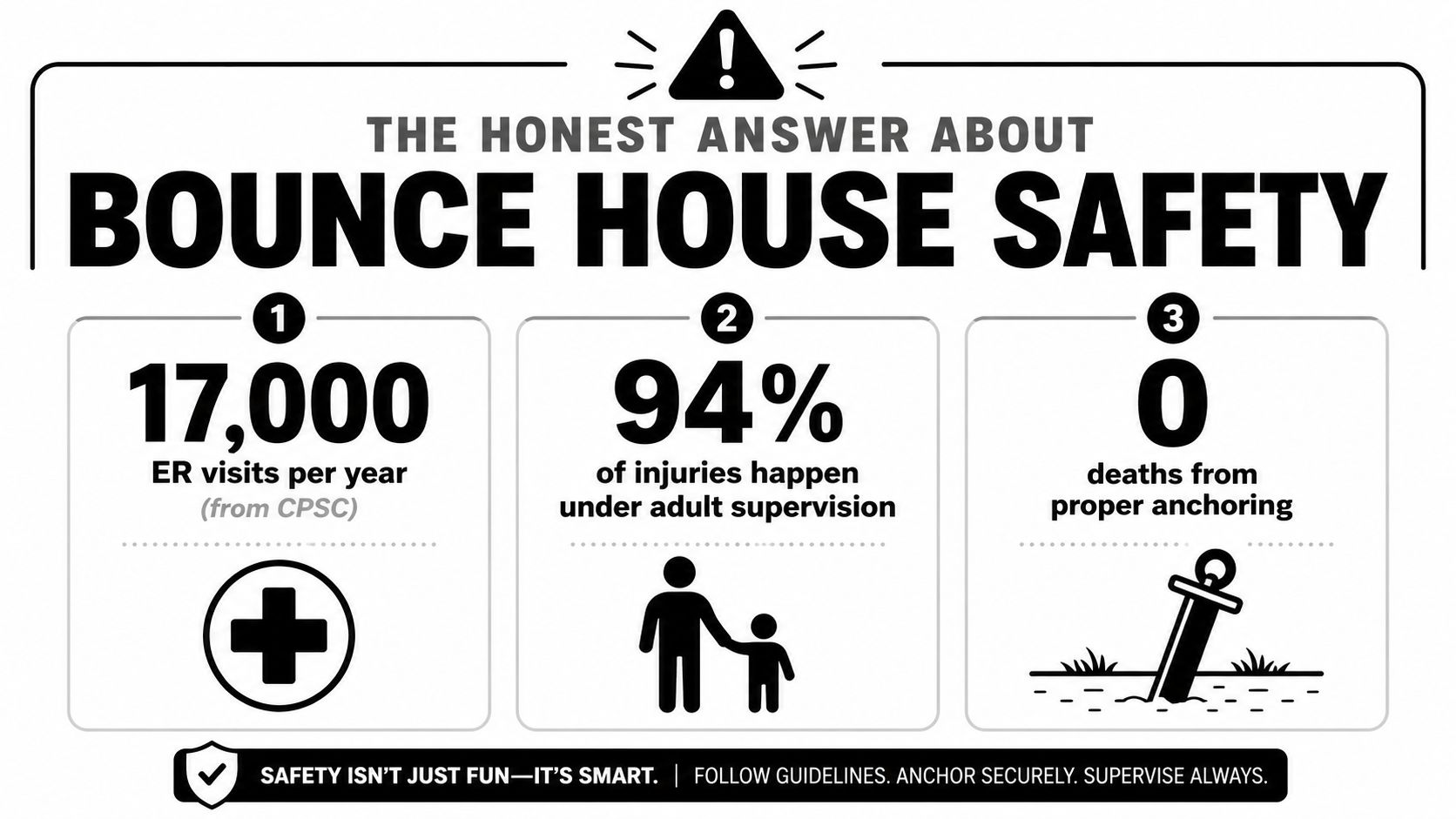
The five controls that matter most
- Anchoring: The unit must be secured according to the manufacturer's specifications and the site surface.
- Supervision: A trained attendant needs an unobstructed view and authority to stop play.
- Occupancy: The posted maximum isn't a suggestion. Operators must enforce it in real time.
- Age and size separation: Small children shouldn't share active play space with much larger jumpers.
- Weather and compliance: Wind, storms, setup conditions, standards, and inspection records all affect the decision to operate.
A parent can use the same standard as a professional planner. Ask who's supervising, how the inflatable is anchored, what happens if wind increases, and which documents prove the unit is maintained and approved. Phantom Entertainment's inflatable rental FAQ can also help renters understand the operational questions they should raise before booking.
Practical rule: If a rental company talks about themes and package pricing but can't clearly explain anchoring, wind shutdowns, staffing, and documentation, keep calling other providers.
What the Injury Data Actually Shows
The injury data points toward specific mechanisms, not a vague problem with bouncing. Nationwide Children's reports that inflatable-bouncer injuries treated in U.S. emergency departments now exceed 30 children per day. Its public-health guidance also notes that older reporting found more than one-third of injuries occurred in children age 5 and younger. Nationwide Children's inflatable-bouncer safety guidance emphasizes supervision, age-appropriate use, and separating children by size.
Those findings change how an event planner should think. A “safe” unit can still produce a bad outcome when a small child shares the space with older, heavier children, when the operator permits rough play, or when the occupancy limit is ignored. Falls, collisions, awkward landings, and flips are operational events. They're often preventable through entrance control and active monitoring.
Inflatable injury snapshot
| Metric | Figure | Source |
|---|---|---|
| Bounce-house injuries treated in emergency departments in 2018 | More than 18,000 | U.S. Consumer Product Safety Commission |
| Inflatable-bouncer injuries treated in U.S. emergency departments | More than 30 children per day | Nationwide Children's Hospital |
| Injuries among children age 5 and younger in older public-health reporting | More than one-third | Nationwide Children's Hospital |
The numbers don't justify treating every inflatable as unacceptable. They justify managing it like a physical activity with known collision and fall risks. The planner's job is to reduce the opportunities for those mechanisms to occur.
That means a single mixed-age session is a poor operating model. A better plan uses scheduled turns, a visible capacity limit, an attendant at the entrance, and clear rules against flips, climbing, pushing, and roughhousing. The equipment category isn't blameless, but the strongest controls sit with the people who select, install, staff, and operate the unit.
Safety Standards and Inspection Requirements
A legitimate rental company should be able to explain its safety system in documents, not just assurances. ASTM F2374 covers the design, manufacture, operation, and maintenance of inflatable amusement devices. That standard is the technical benchmark a planner should ask about, because appearance, age of the vinyl, and material thickness alone can't establish whether a unit is properly designed or operated. The ASTM F2374 standard overview identifies the scope of the standard for inflatable amusement devices.
CPSC requirements also matter for child-oriented constant-air inflatables. Depending on the product and its use, the operator should be able to address requirements involving lead, phthalates, tracking labels, and a Children's Product Certificate. Compliance isn't a decorative badge. It connects the unit to product-safety obligations and traceability.
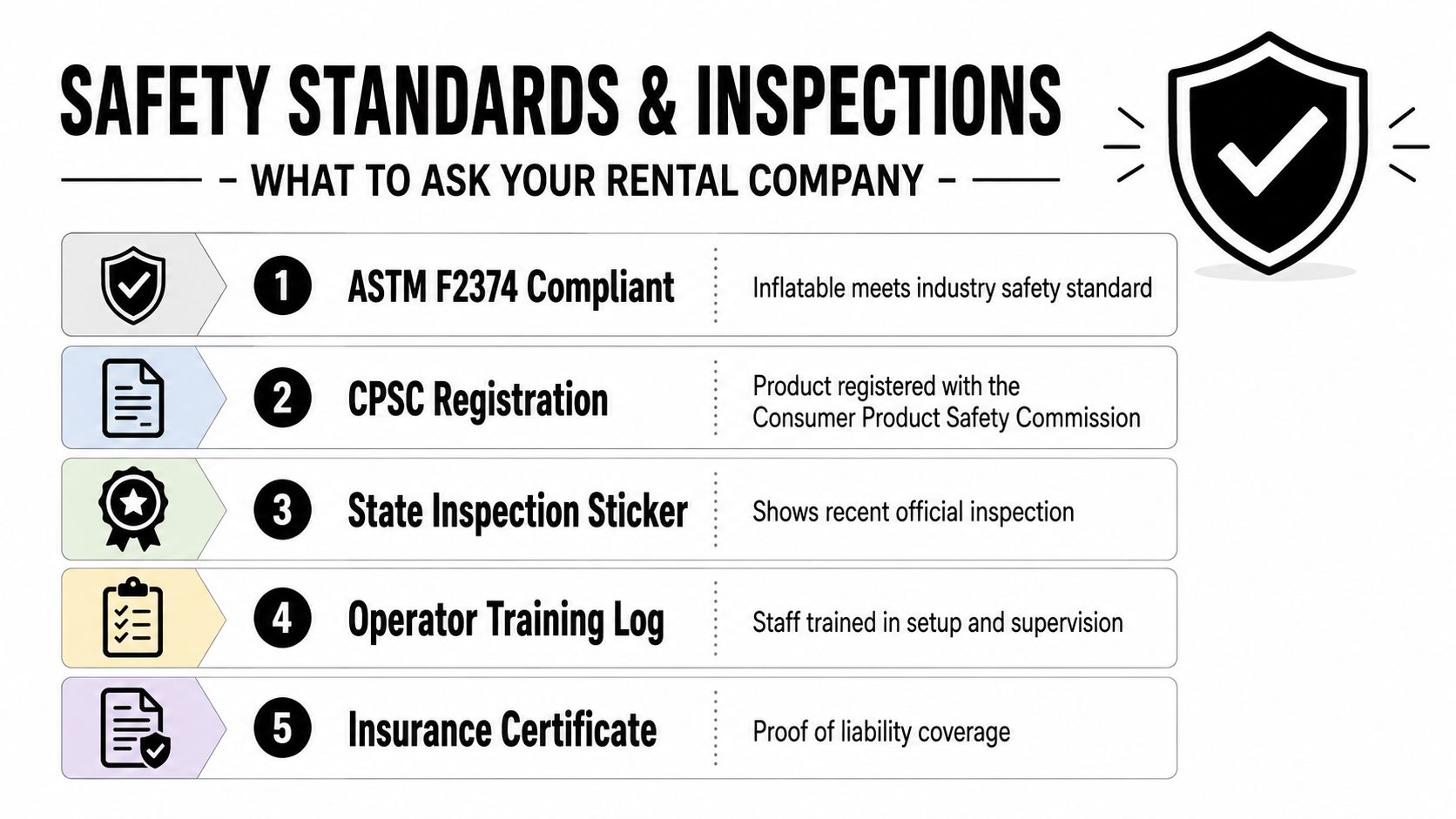
Ask for the paperwork before delivery
Request these records before you sign:
- ASTM documentation: Ask which units are covered and whether the company can identify the applicable compliance records.
- Manufacturer operator manual: The manual should state anchoring, occupancy, wind, setup, and operating requirements.
- Inspection report or sticker: State and local rules vary. Ask what inspection authority applies at your venue and whether the unit carries current evidence.
- Material and product records: Ask for the Children's Product Certificate or other applicable product-safety documentation for child-oriented units.
- Serial-number records: The unit's serial number should match maintenance and inspection logs.
- Fire-retardant documentation: Ask for material certification when your venue, jurisdiction, or insurer requires it.
State amusement-ride codes don't operate identically across the country. Some jurisdictions regulate inflatables directly, while others classify or exempt certain units based on factors such as participant height or equipment type. Don't assume a sticker from another state satisfies your venue's requirements.
A provider that supplies delivery-day paperwork, a setup walkthrough, and a named safety contact is showing operational discipline. You can also review Phantom Entertainment's inflatable offerings while comparing what different companies provide in their rental process.
Age Groups, Occupancy, and Size Limits
Age mixing is one of the easiest risks to prevent and one of the most commonly ignored. A toddler and a much larger child don't have comparable momentum, balance, reaction time, or ability to avoid a landing. When an older jumper lands nearby, the smaller child may be knocked down, launched, or stepped on.
Use separate sessions or separate units for clearly different age and size groups. A practical event plan may divide children into younger participants, school-age participants, and teens, but the manufacturer's rules always control. The operator should read the capacity and participant restrictions from the tag or manual inside the unit instead of relying on memory or a generic rental listing.
Bounce house occupancy by age group
| Unit Size | Ages 3-6 | Ages 7-12 | Ages 13+ |
|---|---|---|---|
| Small residential-style unit | Follow manufacturer's posted limit and size rules | Follow manufacturer's posted limit and size rules | Often unsuitable unless specifically approved |
| Commercial bounce house | Use the posted child limit for similar-sized participants | Use the posted child limit for similar-sized participants | Use the manufacturer's separate teen or adult limit |
| Combo or larger commercial unit | Use the designated child zone when provided | Use the designated age and size zone | Confirm adult or teen suitability before booking |
Don't treat a capacity sign as a passive warning. The attendant should count entrants, stop additional children at the limit, and remove jumpers before admitting replacements. The same person should watch for changes in the group, because a session that begins with similarly sized children can become mixed when guests rotate in.
Read the manufacturer's example carefully
Suppose a manufacturer rates a 13-by-13-foot bounce house for 8 to 10 children under 100 pounds, but only 3 to 4 teens. Those are different operating limits for different participant groups. A planner can't safely convert the larger child capacity into an adult or teen capacity because the floor area looks spacious.
Disclose guest ages and approximate sizes when requesting a quote. Ask for age-separated zones or timed rotations, and reject any operator who says mixed-age play is fine because “there's plenty of room.” Space doesn't remove the force of a collision.
Anchoring, Setup, and Weather Risks
Weather is the hazard that generic bounce-house advice underplays most often. A University of Georgia meteorology analysis identified at least 479 injuries and 28 deaths worldwide from more than 130 bounce-house accidents tied to weather events since 2000. The University of Georgia analysis of weather-related bounce-house accidents also discussed severe incidents involving winds around 25 mph, while CPSC guidance says wind should be no more than 15 to 25 mph. These figures aren't theoretical. They're a reason to establish a shutdown decision before guests arrive.
Anchor to the surface, not to convenience
On suitable firm ground, the installer should use the manufacturer-specified anchoring system, such as steel stakes driven securely and flush where the site allows. On concrete or asphalt, the operator needs an approved ballast method, such as properly weighted sandbags or water ballasts. Improvised weights, loose straps, and a few casual stakes are not a safety system.
The site should be level, clear of overhead lines and nearby obstacles, and large enough for the unit, blower, access route, and evacuation space. Don't let a rental crew squeeze an inflatable against a fence, beneath branches, or into a location where an emergency exit becomes difficult.
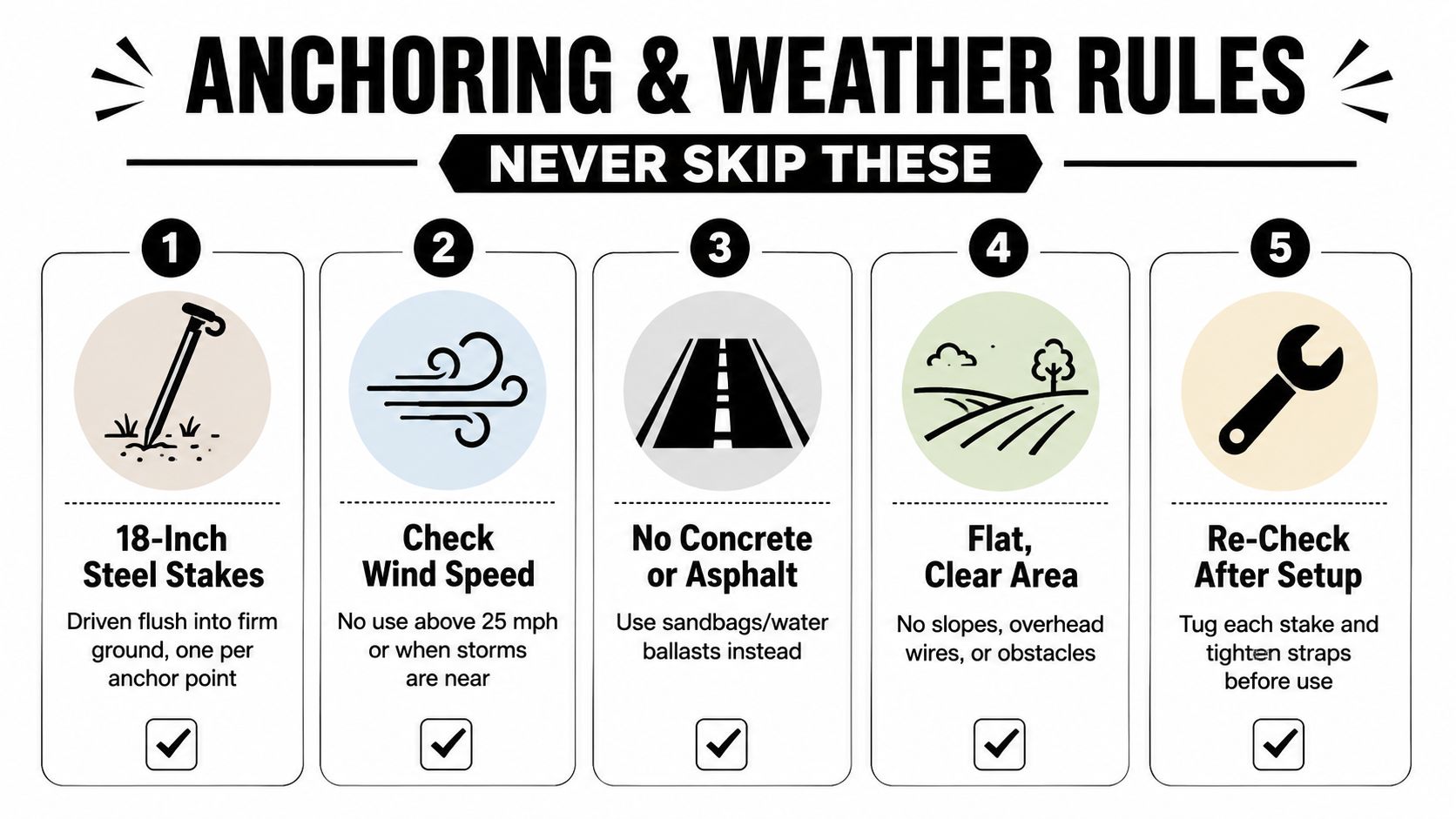
Require a written weather protocol
Your contract should explain:
- Wind monitoring: The operator must state the anemometer or weather source used and the shutdown threshold.
- Mid-event shutdown: Staff should stop entry, clear the unit, and secure or deflate it when wind approaches the manufacturer or CPSC limit.
- Rain response: Wet vinyl becomes slippery, so the unit should be cleared and assessed before use resumes.
- Storm response: Lightning or nearby severe weather requires immediate evacuation and an indoor shelter plan.
- Restart authority: One named supervisor should decide whether conditions are safe enough to resume.
A weather policy that says “we'll keep an eye on it” is inadequate. Ask how the company handles gusts, not just average wind, and how staff will communicate an evacuation to a large crowd. This weather and wind planning resource from Phantom Entertainment is useful when building that conversation into the event plan.
Supervision and On-Site Staffing
At a school field day with 200 guests, competent supervision looks concrete. One trained attendant controls the entrance, counts participants, separates a 5-year-old from incoming sixth graders, removes shoes and loose objects, and stops play when wind conditions worsen. The attendant isn't standing nearby checking a phone. They're watching the active area and making immediate decisions.
At a backyard party, the opposite pattern is common. The host is grilling, several adults assume someone else is watching, and a teenager is left at the entrance without authority or training. That's when children enter over capacity, larger jumpers collide with smaller ones, and flips or climbing go unchallenged.
The attendant's responsibilities should be written into the event plan:
- Control entry: Count children and prevent overcapacity.
- Match participants: Keep similarly aged and sized children together.
- Stop prohibited behavior: Ban flips, wrestling, pushing, climbing, shoes, food, and sharp objects.
- Watch the structure: Notice deflation, movement, damaged seams, or unusual blower behavior.
- Manage emergencies: Clear the unit quickly and follow the weather shutdown procedure.
- Maintain line of sight: Stand where the entire play area is visible, not behind a tent or at a distant registration table.
One trained attendant per inflatable is a sensible baseline for active events. Multiple units also need a site supervisor who can coordinate breaks, weather decisions, emergency communication, and crowd movement. A single person can't safely monitor several inflatables from one position.
This short safety video can supplement, but never replace, an in-person briefing and assigned staffing plan:
A supervisor who can't stop the activity isn't supervising. Give the attendant a clear role, a visible position, and permission to shut the unit down.
Insurance, Documentation, and Maintenance
Insurance paperwork won't prevent a collision, but missing paperwork tells you the operator may not have a mature safety program. Request a Certificate of Insurance, or COI, before the event date. It should identify the rental company as the named insured, list the venue or event host as the certificate holder when required, and describe coverage that applies to inflatable amusement operations.
Many venues, schools, parks, and corporate clients also require an additional insured endorsement. Don't confuse that endorsement with the COI itself. The venue should tell you exactly what its risk office requires, and the rental company should provide the applicable documents before delivery, not after an incident.
For broader context on evaluating commercial coverage, review the insurance advice from Select Insurance Group. It's a useful reminder that the certificate is evidence of coverage, not a substitute for reading requirements or confirming the operation is included.
Documents every renter should request
| Document | What It Should Show | Why It Matters |
|---|---|---|
| Certificate of Insurance | Insured business, certificate holder, policy details, and relevant operations | Helps the venue verify that the booking fits its risk requirements |
| Additional insured endorsement | The required venue, school, municipality, or host designation | Addresses contract requirements that a COI alone may not satisfy |
| Pre-event inspection log | Dated checks of seams, blower function, anchor points, cleanliness, and condition | Shows the unit was assessed before guests used it |
| Maintenance record | Repairs, patches, cleaning, equipment servicing, and retirement decisions | Connects the specific unit to a defensible maintenance history |
| Unit serial record | Serial number matching the inspection and maintenance documents | Prevents generic paperwork from being presented for another inflatable |
Look for dated and signed inspection records. The installer should check seams, anchor points, blower connections, inflation stability, access points, and the condition of the material. A fresh patch isn't automatically disqualifying, but duct tape applied on the morning of the event is not a maintenance program.
The strongest operators connect every unit to a serial number, manual, inspection history, and service record. That system makes it possible to identify what was delivered, who inspected it, how it was anchored, and whether it was removed from service when its condition no longer supported safe use.
What to Demand From Any Rental Company
Use a short phone call to expose weak operators before they reach your venue. Don't ask only whether the bounce house is “safe.” Ask questions that require operational answers and documents.
The five-minute screening call
- Which ASTM standard applies to this unit, and can you provide the relevant compliance documentation?
- What wind limit appears in the manufacturer's manual, and what is your written shutdown procedure?
- How will you separate toddlers, school-age children, and teens?
- Is a trained attendant included, and will that person remain assigned to the inflatable while it's operating?
- What anchoring method will you use at my exact site, and how will the anchor count match the manufacturer's requirements?
- Can you send the COI and any required additional insured endorsement before the event?
- Will the unit arrive with its serial number, inspection records, and delivery-day setup documentation?
- Can someone complete a site walkthrough if the venue has access, surface, weather, or power restrictions?
A credible operator answers directly. A weak one changes the subject, promises that “the crew knows what they're doing,” or treats safety staffing as an unexpected upgrade. Don't accept cash-only arrangements with no written contract, no published safety standards, no identifiable liability carrier, or pressure to skip a site inspection.
Demand age-appropriate equipment, documented anchoring, active supervision, a weather plan, and venue-ready records. Those aren't luxury preferences. They're the controls that address the predictable ways inflatable events go wrong.
For its rentals, Phantom Entertainment provides delivery and setup, professional operation, insurance certificates, and venue-ready safety documentation, while offering inflatable attractions alongside broader event entertainment across the Mid-Atlantic. Treat that as a comparison point, then require every provider you call to explain its own process with the same level of specificity.
Phantom Entertainment offers professionally delivered and operated inflatable rentals with setup support, insurance certificates, and safety documentation for schools, corporate family days, community events, and private celebrations. Visit Phantom Entertainment to discuss an event plan built around proper staffing, anchoring, weather decisions, and age-appropriate play.
Ready to Book Your Event?
PA state-inspected, fully insured since 1979. Call us or get a free quote today.