
The zip line arrives, the first ten guests line up, and nobody has decided where the cable ends, where the queue stands, or what the other sixty people do while one rider is in the air. That stall is the party. The ride itself is the easy part. The flow is the work.
The eight formats below each come with a layout, a rotation, a staffing plan, and a pairing strategy, so the cable runs like a working station instead of a bottleneck. Every format assumes a professionally delivered, inspected, and supervised mobile unit. Nobody is stringing a cable between backyard trees.
Zip-line entertainment grew out of canopy research. Wildlife biologists in Costa Rica used zip lines in the 1970s to move through rainforest canopies, and the Original Canopy Tour in Monteverde became the first publicly available zip-line canopy tour in 1997, according to a peer-reviewed history of the commercial market. The same account counts only 10 commercial zip lines in the United States in 2001, and more than 200 by 2012. Treat the attraction like a specialized outdoor station from the first site walk.
Décor comes after the cable run is drawn. If you want a theme layer once the station is mapped, browse marquee party themes and match it to the format you pick. The format decides the footprint, the queue, and the staffing. The theme just dresses it.
1. Mobile Zip Line Backyard Party
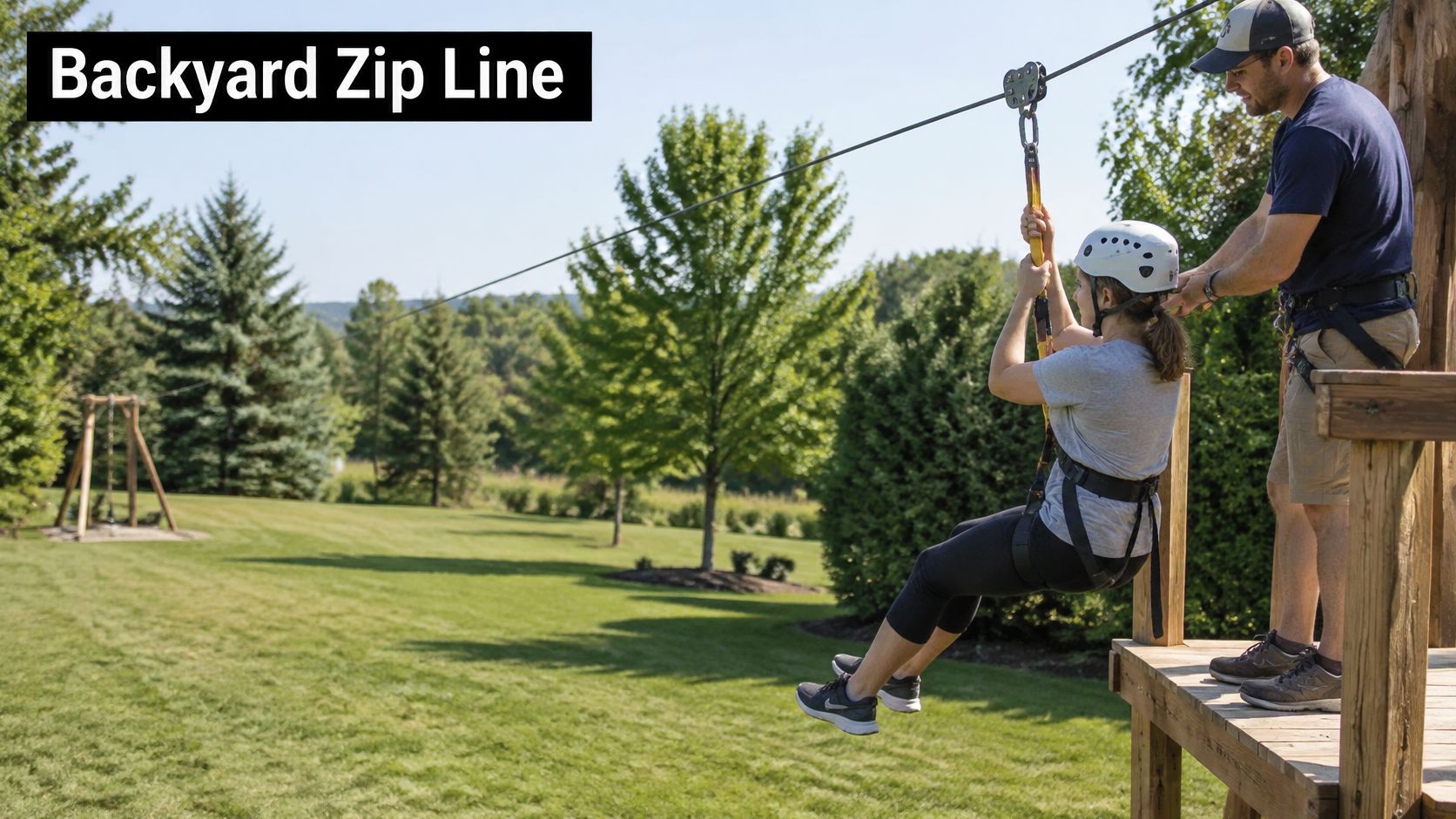
Decide the run before you pick the cake table. A portable zip line on a lawn or park works for birthdays, graduations, and neighborhood gatherings because guests stay on one property. It fails when the landing zone sits on the path to the bathroom or the food line.
Parents spent an average of $314 on a child's birthday party in 2024, and 20% reported spending more than $500, according to a What to Expect survey of 404 women. A supervised cable eats a real share of that budget, so don't also book three other headline attractions. Pair it with one bounce house and a food truck, or with a DJ and a photo booth at a graduation open house.
How the station actually runs
Ask for a site walk before the deposit. You need run length, anchor points, overhead clearance, and a landing that doesn't dump riders into a deck stair.
Practical rule: Schedule the open window for the middle of the event. Early rides empty the welcome line. Late rides leave you striking gear in the dark with tired kids still harnessed.
Staff it as three posts: launch operator, landing operator, and a host-side queue person with a clipboard. Groups of eight, about ten minutes on the line, then they peel off to food. Continuous open riding looks generous and creates a forty-person snake across the yard.
Confirm certificates of insurance if a park or HOA asks. Write a rain and heat trigger in the contract, with a shaded or indoor backup, so a delay doesn't become an argument at the curb.
2. Zip Line Field Day Challenge
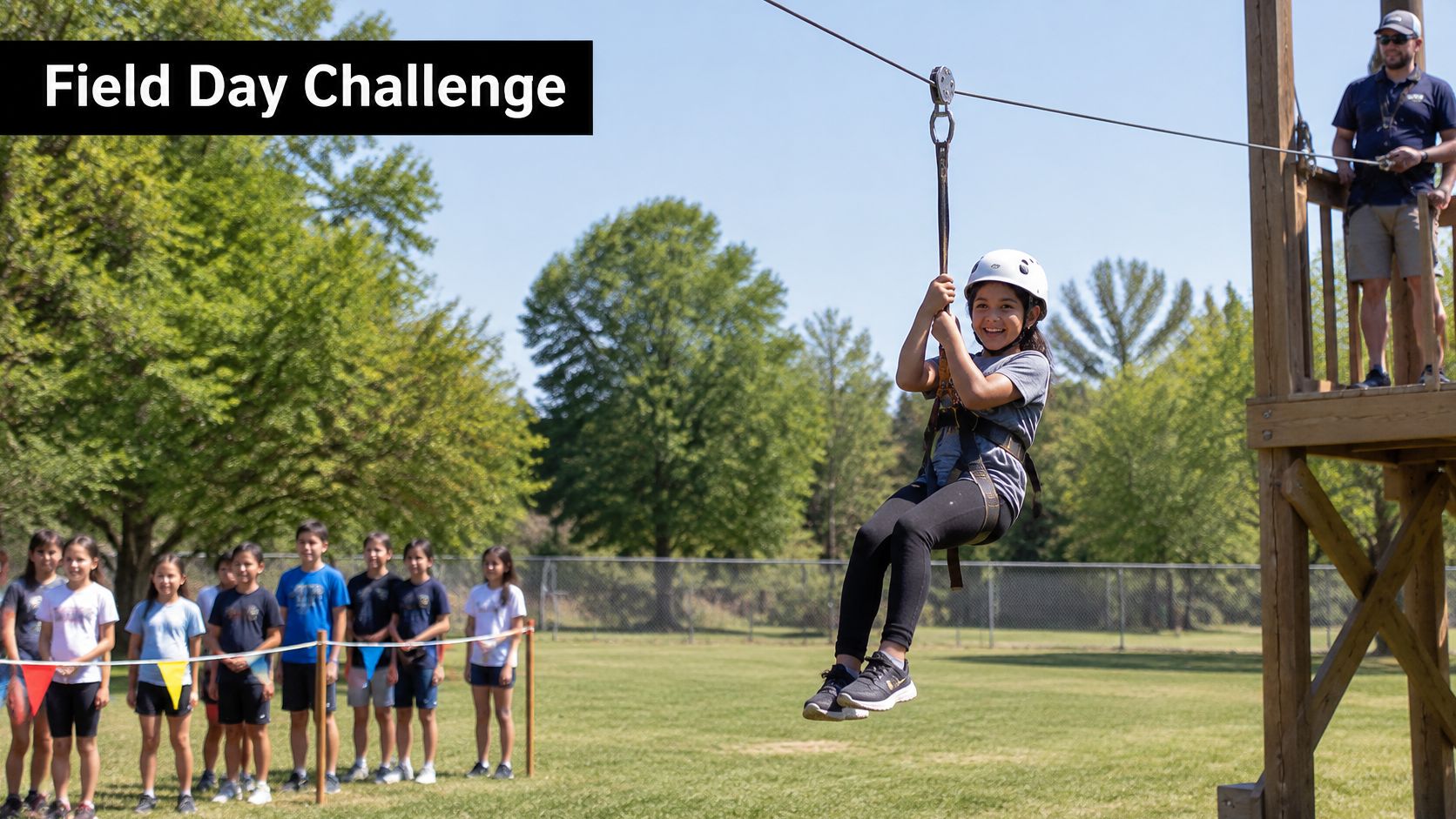
Put the zip line inside the rotation. On a school field day or campus fun day it is one timed station among several. Students earn a point for a completed, rule-following ride, then they move. If the whole grade camps at the platform, the other stations die.
A peer-reviewed analysis of U.S. emergency-department data estimated 16,850 zip-line-related injuries from 1997–2012, with approximately 70% in public settings and 30% in residential settings, and it notes that recognized standards cover engineering, installation, operation, maintenance, staff training, harnesses, dual-cable systems, and automatic braking, as detailed in the published injury analysis. A teacher nearby is supervision. It is not launch control, landing control, or queue control.
Rotation that teachers can actually run
Run it like a timed heat. Six groups, twelve minutes per station, one whistle, and a teacher who stays with the group instead of chasing stragglers. Keep riders behind a cone until the landing operator calls the lane clear, then send one harness to the platform at a time.
- Opt-out lane: Put a carnival game or scorekeeper role beside the platform so a student who will not ride still finishes the rotation.
- Advance rules: Send height, weight, and footwear limits home before the day, not at the harness.
- Stop call: Give the operator authority to hold launches for lightning, hard gusts, a fouled landing, or a loose strap. A held line beats a confused one.
- Paper trail: Collect the operator's insurance certificate and safety packet for the school file.
Choice lowers friction at the platform. Brief the ride once, let the student pass without a speech, and keep the line moving. I would rather run shorter heats with clean handoffs than chase a perfect participation rate.
3. Zip Line and Obstacle Course Combo
Make the zip line the finish, not the warm-up. Teams climb, crawl, and balance on an inflatable obstacle or ninja-style course, then one rider launches. It suits church youth nights and corporate race days because the course burns the crowd while the cable stays single-file.
Don't stack the two activities nose to nose. Winded riders fumble harnesses, and a staggered start on the course still dumps everyone at the platform at once. Build a rest pocket between the last obstacle and the launch: water, a bench, a gear check.
Watch how a clean course keeps bodies out of the finish lane. Your site has to do the same job without a broadcast crew.
ASTM F2959 covers commercial zip lines across design, manufacture, installation, operation, maintenance, auditing, and major modification, which is the standard behind a real safety packet rather than a pretty photo, per the ASTM F2959 standard. A 2023 British Columbia investigation found a rider suffered major blunt-force trauma and severe bleeding after striking a metal staircase left in the landing path, and it called for a documented patron clearance envelope, fail-safe control of movable gear, and a clear-to-fly check before each launch.
- Separate lanes: Stagger team starts so two finishers aren't fighting one harness.
- Finish kit: Helmets, gloves, and closed-toe shoes posted where the course ends, not in a tent across the field.
- Medic spot: Park first aid at the landing, where falls and hard arrivals show up.
One operator runs the course clock. A different operator runs the cable. Combining those jobs is how races get sloppy.
4. Glow Zip Line Grad Night
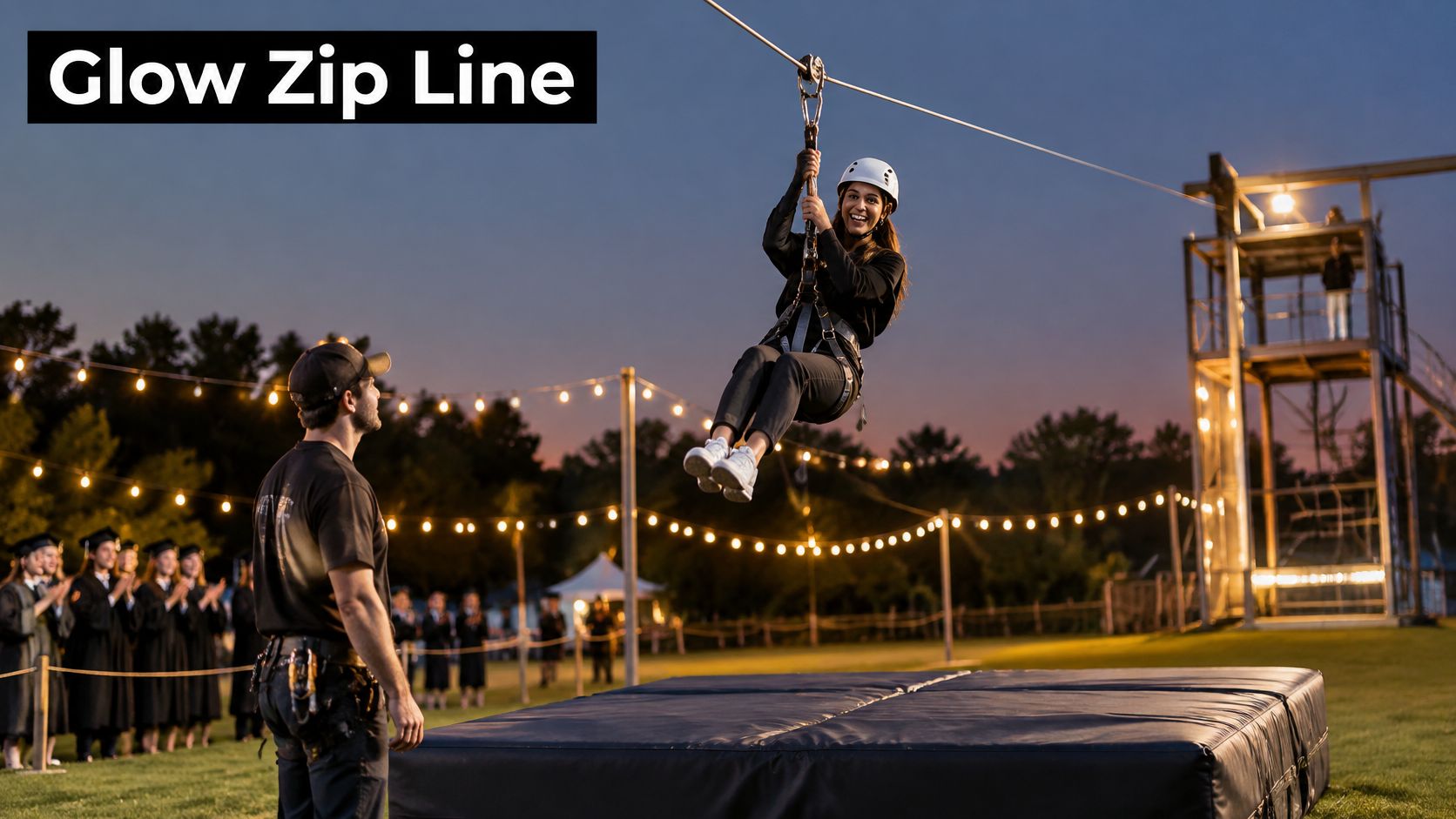
Light the landing before you light the backdrop. An evening zip line with string lights, glow gear, and music works for after-prom and campus grad night because the ride feels like an event, not a daytime add-on. It only works if riders can see the deck.
In 2024, 72% of people ages 21–35 said they felt positively toward events offering meaningful, memorable experiences, according to Eventbrite's event-trends research. A lit cable can be that moment. A dark landing is just a hazard with a playlist.
Confirm power, blackout zones, and noise limits with the operator and the venue before you book a DJ. Finish lights belong on the landing deck and the last twenty feet of cable, aimed so they don't blind the launch. Handheld glow sticks are décor. They are not runway lighting.
Run rides before peak dance hours. Once the floor fills, your queue marshals lose people and the line doubles back through the crowd. Cap the ride block, then send guests to the blacklight party setup so the cable crew can shut down while the night is still going.
A rain plan and a layer of clothing belong on the invite. Evening fields get cold and wet faster than the dance tent does.
Say a high school books the athletic field from 8 to 11. Rides run 8:15 to 9:30 in heats of ten. After that the platform goes dark and the photo line takes the glow crowd. That cutoff is what keeps the landing clear.
5. Corporate Picnic Zip Line Team Challenge
Score participation, not bravery. At a company picnic the zip line is a team station with timed heats or a simple completion point. It is a bad idea when HR frames it as a test of nerve. People opt out, then spend the afternoon explaining themselves to a boss.
U.S. consumers spent an average of $951 on entertainment fees and admissions in 2023, according to the U.S. Bureau of Labor Statistics. Your guests already buy thrills on their own time. At a family fun day they want a choice, a short line, and a way to sit with coworkers who won't ride.
Send the waiver and the limits a week out, through the same channel you use for corporate parties. Day-of paperwork at a picnic table kills the first hour.
What the captains actually do
Give each team a captain with a heat sheet. The captain does not coach from the platform. They keep their eight people in the holding box and send the next name when the landing radios clear.
- Non-ride points: A photo challenge or a mini-golf hole scores the same team total, so opting out doesn't zero the group.
- Insurance early: Corporate venues want the certificate before procurement will release the date.
- Family split: Kids and adults in separate heats. Mixed family lines look inclusive and run slow.
A regional picnic with food trucks and a casino night can keep three hundred people moving if the cable is one stop on a loop. If it is the only thing with a crowd, you built a queue, not a picnic.
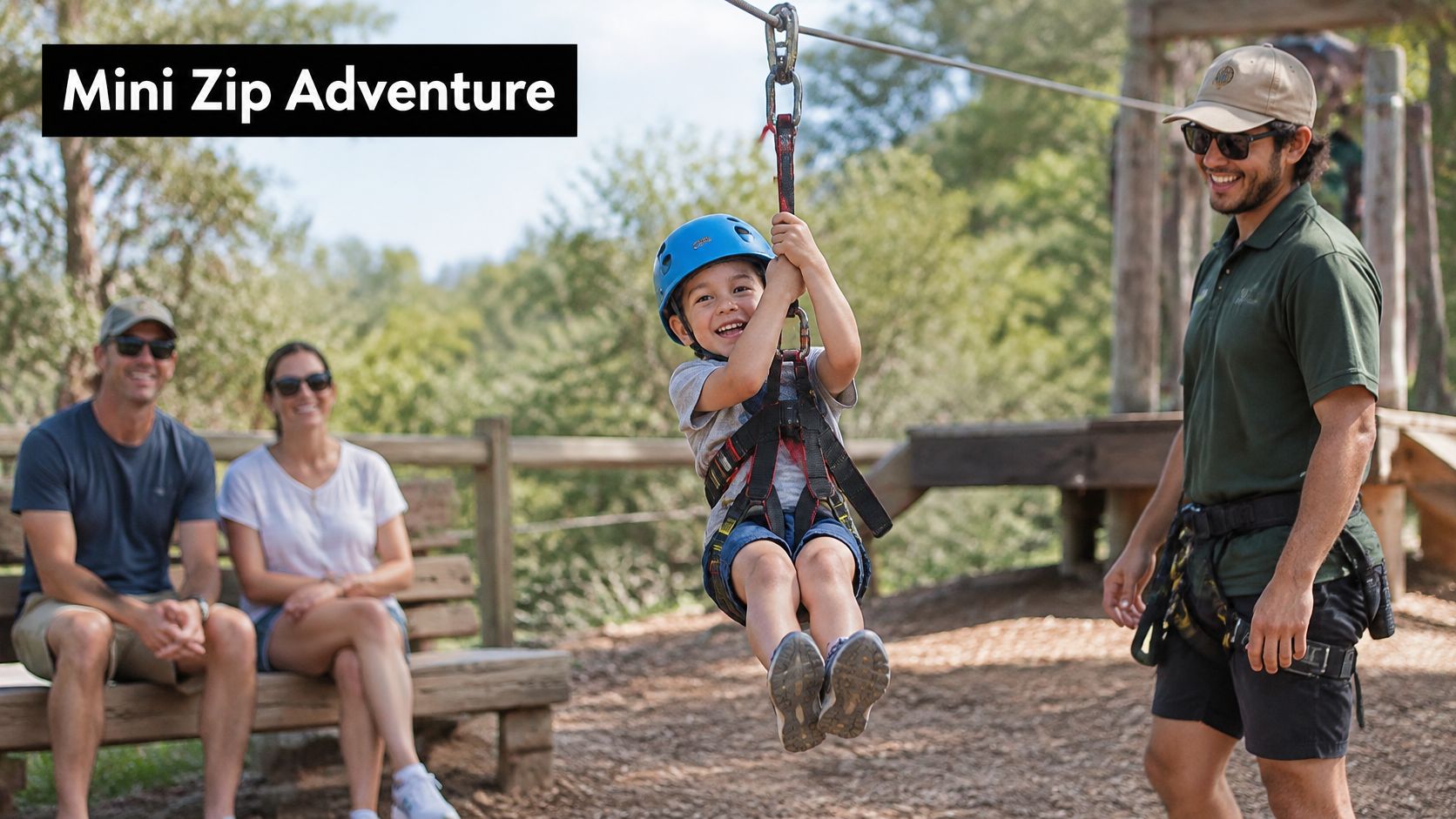
6. Kids Mini Zip Line Birthday Adventure
Choose the small unit on purpose. A lower, shorter kids zip line at a birthday or block party is an introduction, not a miniature version of an adult canopy tour. Parents should be able to watch from a shaded seat without standing in the launch path.
Children under 10 accounted for 45% of injured patients in a U.S. emergency-department study of zip-line injuries, ages 10–19 accounted for another 33%, falls caused 77% of injuries, and 12% of patients were hospitalized, which is why the HealthyChildren.org zip line safety guidance pushes helmets, harnesses, trained operators, inspections, and posted rules instead of casual supervision.
Get minimum and maximum age, height, and weight in writing before invitations go out. A child who is turned away at the step is the story of the party. Share a two-minute parent briefing before the first launch: where to stand, who buckles, and that a pass is allowed.
Short sessions beat open riding. Six kids, one ride each, then a break for face painting or the bounce house beside it. Our kids parties setups work when the zip line is one piece of that circuit, not the only thing a five-year-old is promised for two hours.
Maximizing riders is not the win. A shorter, tiered session keeps siblings from melting down in a line they can't see the end of.
Place the holding rope so parents aren't in the landing envelope. One adult per riding child in the viewing zone is plenty. Extra bodies on the platform are how a simple kids station gets crowded.
7. Homecoming and Spring Fling Zip Line Race
Turn the cable into a spectator sport only if the operator can support it. A homecoming or spring fling race is a bracket: two parallel lines, or sequential heats on one line with a posted clock. Student clubs and class years advance on time. If the unit is a single cable with a slow retrieve, call it exhibition laps and skip the tournament language.
Confirm parallel runs in the site plan, not in a group chat. Parallel lines need separate launch commands, separate landing catchers, and a gap wide enough that a swinging rider can't reach the other cable. Sequential heats are slower and safer when the field is narrow.
Write the race rules on one page.
- Start: Both riders leave on one verbal count. A flinch is a redo, not a win.
- Time: The clock stops at a marked point on the landing, judged by one person, not by the crowd.
- Eligibility: Height, weight, and age limits are the same as a normal ride. Spirit points don't waive them.
- Crowd: Spectators stand behind a rope at mid-span. They do not line the landing.
Student activities should own promotion and the bracket board. The operator owns the launch. When those jobs blur, someone waves a rider off while the deck is still occupied.
Say eight clubs enter, four heats, winners ride a final. The rest of campus is at lawn games fifty yards off the run, not stacked on the platform stairs. That split is what keeps a race from becoming a surge.
8. Community Festival Zip Line Fundraiser
Price the ride, then separate the money from the line. At a church fair, nonprofit day, or municipal festival, the zip line runs as a paid attraction with proceeds going to a youth program or a parks fund. It draws a crowd, and it creates a second queue the moment tickets get sold at the platform.
Set a per-ride price and a small bundle, three rides for a modest break, so families aren't renegotiating at the step. A ticket booth sits off the cable with its own shade. Riders arrive holding a ticket. The launch crew never touches cash.
Sponsor boards along the queue follow the same placement logic behind sponsor visibility at trade shows: banners go on the fence line where waiting families read them, outside the rider path and the landing zone. Booth signs name the cause and the goal in one sentence.
Treat heat as an operations call. The World Health Organization's 2025 event guidance notes that nine in ten worker exposures to excessive heat and eight in ten occupational injuries linked to excessive heat occur outside a heatwave, and it recommends tested contingency plans in the WHO mass-gatherings heat digest. Plan shade at the booth, water along the queue, and a slower rotation once the afternoon peaks.
Name one person who can pause the ride, and write the triggers down: lightning, wind, wet gear, heat, plus how you text guests. A rain date with no shaded fallback still leaves a line of kids in the sun. Check the permit and the fundraising rules before a single ticket prints.
Comparing the 8 Zip Line Party Formats at a Glance
| Format | Best For | Space & Setup | Pairs Well With | Main Watch-Out |
|---|---|---|---|---|
| Mobile Zip Line Backyard Party | Birthdays, graduations, and neighborhood gatherings | Needs a clear, flat outdoor run with overhead clearance and a safe landing zone | Bounce houses, food trucks, DJs, and photo booths | Weather can stop rides; rental costs and space needs can be substantial |
| Zip Line Field Day Challenge | School field days and community activity days | Requires scheduled rotations, eligibility checks, and dedicated safety staff | Relay races, tug-of-war, inflatables, and carnival games | Poor scheduling can create long lines; provide an alternative for students who opt out |
| Zip Line and Obstacle Course Combo | Youth groups, teams, and corporate events | Needs a larger footprint and coordinated setup for sequenced stations | Team races, scoring, and spectator viewing | Manage fatigue, lane spacing, and transitions to reduce safety risks |
| Glow Zip Line Grad Night | After-prom parties, graduations, and campus evening events | Requires approved lighting, a clearly lit landing area, and permitted outdoor space | DJs, glow décor, photo booths, and carnival games | Venue rules, visibility, weather, and cooler temperatures can affect the event |
| Corporate Picnic Zip Line Team Challenge | Company picnics and employee appreciation events | Needs organized group scheduling, waivers, and clear safety procedures | Food service, team competitions, awards, and lower-intensity games | Review insurance and liability requirements; offer an option for non-riders |
| Kids Mini Zip Line Birthday Adventure | Young children's birthdays and family events | Uses a shorter, lower-height setup with close supervision and a designated kid zone | Bounce houses, face painting, and shaded parent seating | Confirm operator availability and age, height, and weight requirements |
| Homecoming and Spring Fling Zip Line Race | School and university campus celebrations | Requires a safe race layout, spectator zones, and structured heats | Announcers, prizes, food trucks, and other school-spirit activities | Racing needs extra staffing and careful crowd and heat management |
| Community Festival Zip Line Fundraiser | Community festivals, church events, and nonprofit fairs | Needs a managed ride queue, separate ticketing, and clear pricing | Vendor booths, sponsors, dunk tanks, and carnival games | Cash handling, crowd flow, permits, and ride volume can affect fundraising results |
Pick the Format First, Then Book the Ride
Choose the audience, then the format. A backyard birthday, a field-day rotation, a race bracket, and a paid festival booth are different stations. They don't share a layout just because they share a cable.
Sketch the run on a site map before you talk décor. Mark launch, landing, spectator rope, queue, and the path people use for food and restrooms. If those lines cross, move the cable, not the guests.
Assign the non-rider attractions next. Inflatables, carnival games, mini golf, a DJ, or a photo stop are what keep sixty people circulating while eight are in harnesses. A single attraction with a long line is a bottleneck with a harness on it.
Only then confirm height and weight limits, the weather triggers, the certificate of insurance, and who stands at launch, landing, and queue. Book after that packet exists. Booking first and hoping the lawn works is how you spend the party moving picnic tables.
The strongest events treat the ride as one station in a circuit. Phantom Entertainment delivers, sets up, and professionally operates mobile zip lines plus matching attractions such as inflatables, DJs, photo novelties, and carnival games for schools, campuses, churches, companies, and community festivals across PA, MD, NY, VA, and WV, and can supply venue-ready safety documentation and certificates of insurance while you are still drawing the map.
Phantom Entertainment brings a supervised mobile zip line to the party and runs it as a real station, with delivery, setup, and operators who keep the queue and the landing in order. Pair it with the inflatables, games, and music that hold the guests who aren't riding, for field days, picnics, grad nights, and festivals across the Mid-Atlantic. Visit Phantom Entertainment to plan the cable run, the rotation, and the paperwork before you lock the date.
Ready to Book Your Event?
PA state-inspected, fully insured since 1979. Call us or get a free quote today.