
Two-story bounce houses require commercial-grade anchoring, trained attendant supervision, and ASTM F2374 compliance. They are engineered amusement devices, not backyard toys, and need professional setup for events of any size.
You may be organizing a school field day, corporate family picnic, or community festival when someone suggests a two-story bounce house because it looks more exciting in event photos. Then the rental crew arrives and asks about anchoring surfaces, access routes, wind monitoring, inspection records, and trained attendants. The surprise isn't that the unit needs planning. The surprise is how different that planning is from a standard inflatable.
Across Pennsylvania, the smoothest setups start with the site and safety requirements, not the promotional photograph. A taller inflatable changes how wind affects the structure, how children move through it, and how staff must supervise it. The right unit can create a memorable centerpiece, but only when the operator treats it as commercial amusement equipment from the beginning.
Why Two-Story Bounce Houses Need Different Planning
A corporate family day at a park can look simple on paper. There's a field, a registration tent, food trucks, and enough room for games. The committee chooses a two-story bounce house because it offers climbing, bouncing, and a strong visual focal point. During the site visit, the rental company asks whether the grass can accept commercial anchors, where the delivery vehicle can unload, and how the unit will be positioned relative to trees, power lines, fences, and guest traffic.
That's where the plan becomes practical. A two-story unit isn't just a standard bounce house with extra decoration. Its height creates more exposed surface, its play layout introduces additional movement between levels, and its operation depends on more deliberate control of entry, exits, capacity, and weather.
The photograph isn't the operating plan
Commercial two-story bounce houses fall under ASTM F2374, which covers the design, manufacture, installation, operation, maintenance, inspection, training, auditing, and major modification of commercial inflatable amusement devices, as described by the ASTM F2374 standard. That broad scope matters because the safety work doesn't end when the blower starts.
A professional operator must account for:
- Anchorage: The unit needs a securing system appropriate for the surface and the manufacturer's instructions.
- Access and egress: Children must be able to move through stairs, ramps, platforms, and exits without creating bottlenecks.
- Inspection: Staff should complete pre-operation checks before guests enter and continue monitoring during use.
- Supervision: Attendants manage behavior, age or size separation where applicable, occupancy, and unsafe play.
- Weather response: The crew needs a clear shutdown procedure, not an improvised decision after conditions deteriorate.
Practical rule: If the vendor can't explain how the unit will be anchored, inspected, staffed, and shut down for weather, the booking isn't ready.
Build the event around the equipment
A two-story bounce house can affect the rest of the event layout. Put food service, registration, and quiet seating away from the active play zone. Leave a clear path for delivery and emergency access. Confirm the venue's surface rules before choosing a unit, because a grassy park, paved plaza, gymnasium, and artificial-turf field may require different securing methods or approvals.
This early conversation saves more than setup time. It prevents a common failure, choosing an attraction based on appearance and discovering that the venue, insurance contact, or weather plan can't support it. For a professional event, the rental agreement should identify the equipment category, operator responsibilities, inspection process, attendant requirements, and cancellation or deflation procedure.
What Makes a Two-Story Bounce House Different
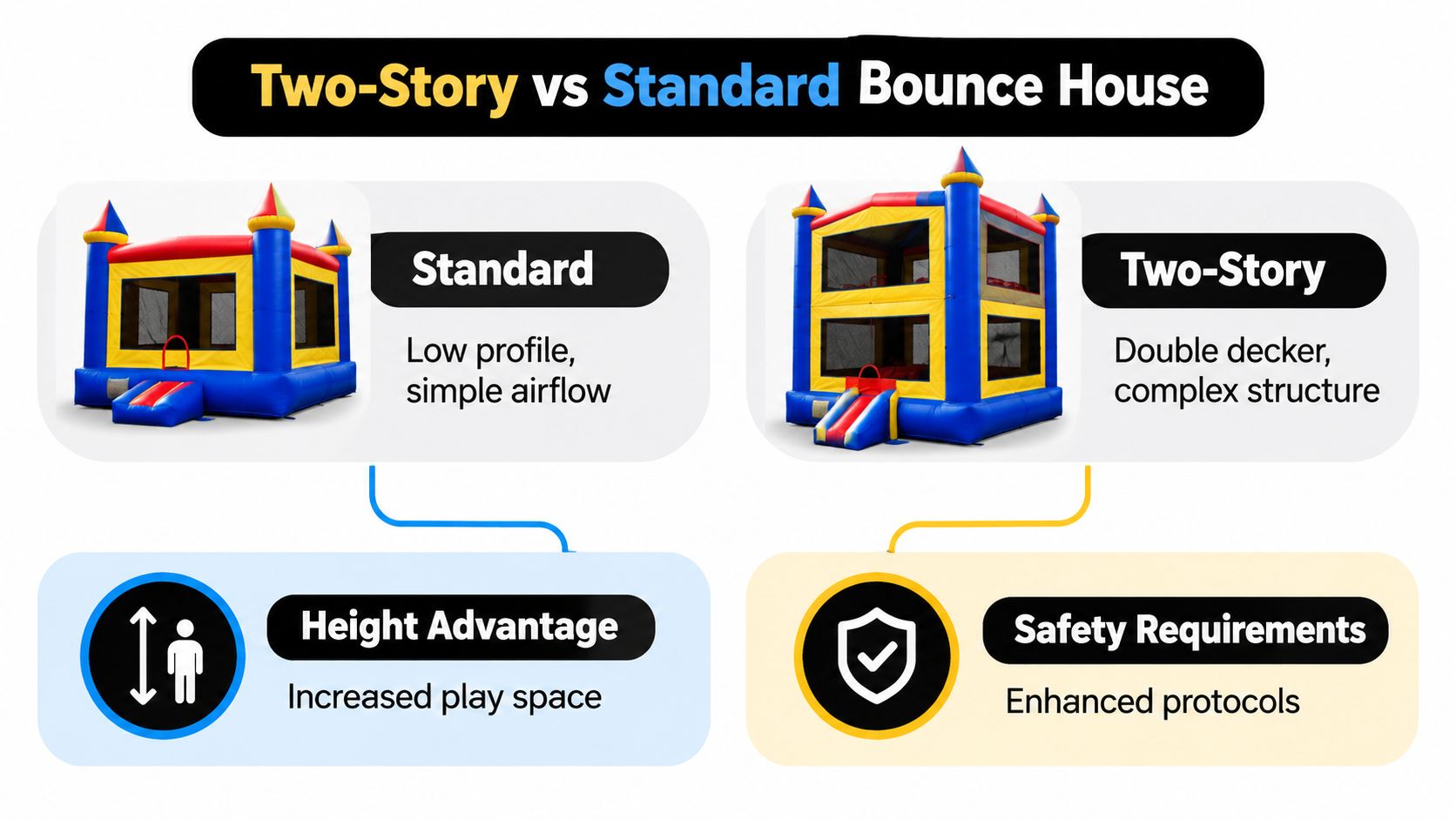
A single-level inflatable spreads most activity close to the ground. A two-story bounce house adds height, internal transitions, and more points where children interact with the structure. The building analogy is useful. A one-level unit is closer to a small, open play room, while a two-story design behaves more like a compact building with a floor above the first level, circulation routes, and raised landing areas.
That difference affects both equipment selection and staffing. The CPSC describes commercial bounce houses as constant-air inflatable play devices, meaning continuous air pressure keeps the structure in shape. The agency also explains that there isn't a mandatory federal performance standard for these devices, while voluntary standards represent industry best practices. Commercial and home-use units fall under different considerations, with ASTM F2374 applying to commercial use, as outlined in the CPSC guidance on constant-air inflatable play devices.
Height changes the operating picture
The vertical profile creates more exposure to wind and makes anchoring verification more important. It also introduces stairs, ramps, raised platforms, and landing zones that require closer attendant attention than an uncomplicated bouncing area.
Look for these characteristics when reviewing a commercial unit:
- Commercial construction: Materials, seams, attachment points, and protective features should be designed for repeated rental use.
- Multiple air chambers: Separate chambers can support more controlled operation and may help the operator identify an airflow problem rather than treating the entire structure as one undifferentiated space.
- Defined exits: Entrances and exits should be easy for attendants to monitor and free from crowding.
- Manufacturer capacity guidance: Staff must follow the posted capacity and user restrictions for that specific unit.
- Operational documentation: A credible vendor should be able to explain inspection, cleaning, anchoring, weather, and emergency procedures.
A decorative home-use product may look impressive online, but appearance doesn't establish commercial suitability. Ask whether the unit is intended for commercial rental, what documentation accompanies it, and how the operator applies the manufacturer's instructions at your venue.
Technical Specifications and Setup Requirements
The site determines whether a two-story bounce house is workable long before the delivery truck arrives. Start by measuring the usable area, then account for the unit's footprint, access path, anchor points, blower placement, guest circulation, and a buffer around the attraction. The published product dimensions are only one part of the decision.
Power deserves early attention. Continuous-air inflatables depend on blowers that must stay connected during operation. Confirm the outlet location, circuit availability, extension-cord policy, generator rules, and protection from public foot traffic. A vendor should provide the equipment-specific electrical requirements rather than asking the venue to guess.
If you're comparing blower arrangements or want a basic explanation of how continuous inflation works, review this guide to a bounce house with a blower. It's also useful to ask who supplies backup equipment and what happens if a blower loses power during the event.
Specifications that affect the venue
| Specification | Typical Range | Why It Matters |
|---|---|---|
| Overall footprint | Varies by commercial model | Determines whether the venue can provide safe clearance, guest circulation, and delivery access. |
| Overall height | Varies by commercial model | Affects wind exposure, venue restrictions, sightlines, and inspection planning. |
| User capacity | Manufacturer-specific | Controls crowding, attendant decisions, and the pace of entry and exit. |
| Blower requirement | Equipment-specific | Determines outlet, circuit, generator, cable-routing, and contingency needs. |
| Anchor system | Surface and manufacturer-specific | Keeps the unit secured under operating conditions and may require suitable soil or approved alternatives. |
| Access and egress layout | Model-specific | Influences supervision, queue design, emergency movement, and the placement of staff. |
Match anchoring to the surface
Grass usually allows the operator to use approved ground anchors when the site conditions support them. Hard surfaces require a different conversation. Don't assume sandbags, water weights, or other ballast are acceptable because the unit can physically sit on pavement. The operator must follow the manufacturer's instructions and applicable local requirements.
The venue should also disclose underground utilities, drainage concerns, slope, soft ground, sprinkler lines, and restrictions on stakes. A flat-looking field can still create problems if anchors can't be placed safely or if rain changes the soil condition.
Treat capacity, anchoring, power, and access as booking requirements. If any of those details remain unknown, the attraction hasn't been properly matched to the event.
Safety Standards and Inspection Requirements
At a commercial event, a two-story unit should not open because it inflated successfully. The operator must inspect the structure, anchors, blower connections, seams, exits, access routes, surrounding area, and current operating conditions. Height adds another inspection question: can attendants see movement between levels, monitor raised transitions, and reach a child who falls or becomes distressed?
Schools, campuses, and municipal venues often request maintenance and training records before approving a booking. Ask for those documents during the inquiry stage, not the week of the event. The operating file should also identify inspection procedures, staff responsibilities, and the records kept after each use.
Wind decisions require a real threshold
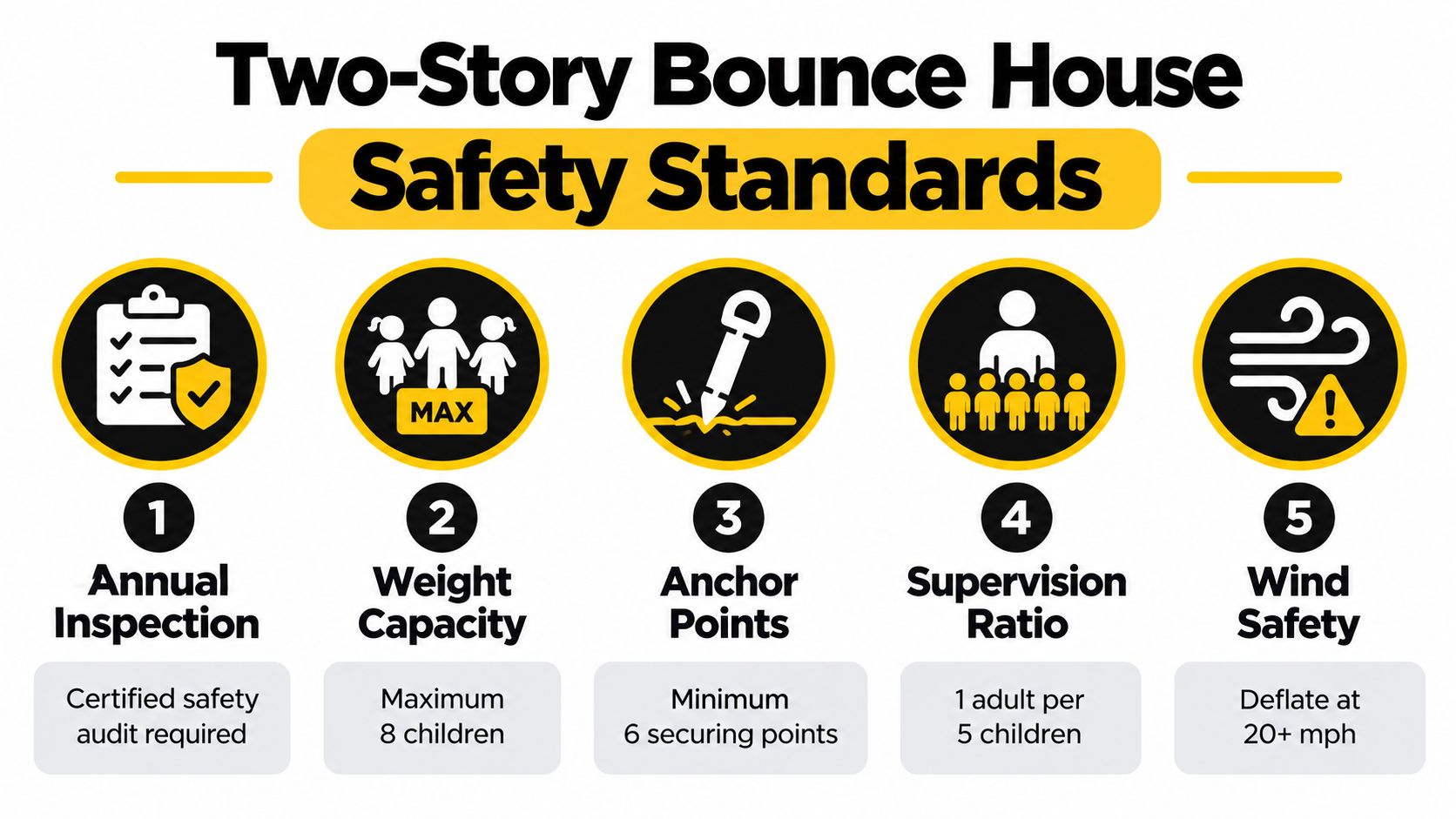
ASTM guidance and regulator summaries cite 25 mph as the baseline maximum operational wind speed, unless a professional engineer verifies a higher limit. Treat that figure as a shutdown boundary, not a target for continued operation. The manufacturer's instructions, local rules, gusts, changing conditions, and the operator's judgment may require stopping earlier.
Wind-related incidents are a documented inflatable failure mode, and taller units can present greater wind exposure. The operating procedure should state who monitors weather, who can order a shutdown, how the blower and unit will be handled, and how guests will leave the attraction safely.
Weather policy: Set the shutdown threshold and decision-maker before guests arrive.
Supervision addresses behavior and visibility
A clinical review found that severe injuries occur disproportionately among children over age six. Reported injuries commonly include fractures, strains, and contusions, while concussion is more prevalent among older children, according to the clinical review of inflatable amusement device injuries.
Attendants do more than watch the entrance. They enforce posted rules, control occupancy, stop rough play, prevent children from climbing outside designated routes, monitor transitions between levels, separate incompatible users when needed, and respond to falls or equipment problems. Confirm how the vendor trains attendants and whether the rental includes them or requires the organizer to provide staff.
For Pennsylvania events, the venue may request inspection records, certificates of insurance, operating procedures, or other documentation. Use this Pennsylvania state inspection requirements guide during planning, then verify current requirements with the venue and applicable authority.
Event Planning and Setup Logistics
A reliable booking begins with a site conversation, not a form that collects only an address and event date. Give the rental company the venue type, surface, access restrictions, expected attendance, event hours, power availability, and whether children will use the attraction continuously or in scheduled groups. For a two-story unit, those details affect delivery, anchoring, supervision, and the time required for inspection.
Work through the site in order
Confirm placement first. Measure the usable area and check for overhead obstructions, low branches, lighting, sprinklers, fences, and nearby activities. The unit needs clear entry and exit routes, room for anchors, and enough separation to keep queues away from vehicle paths and food service.
Plan delivery next. Ask where the truck can stop, how far the crew must move the equipment, whether gates are wide enough, and whether the venue requires a certificate of insurance before arrival. At a school or corporate campus, assign one contact who can open access points and approve the final location.
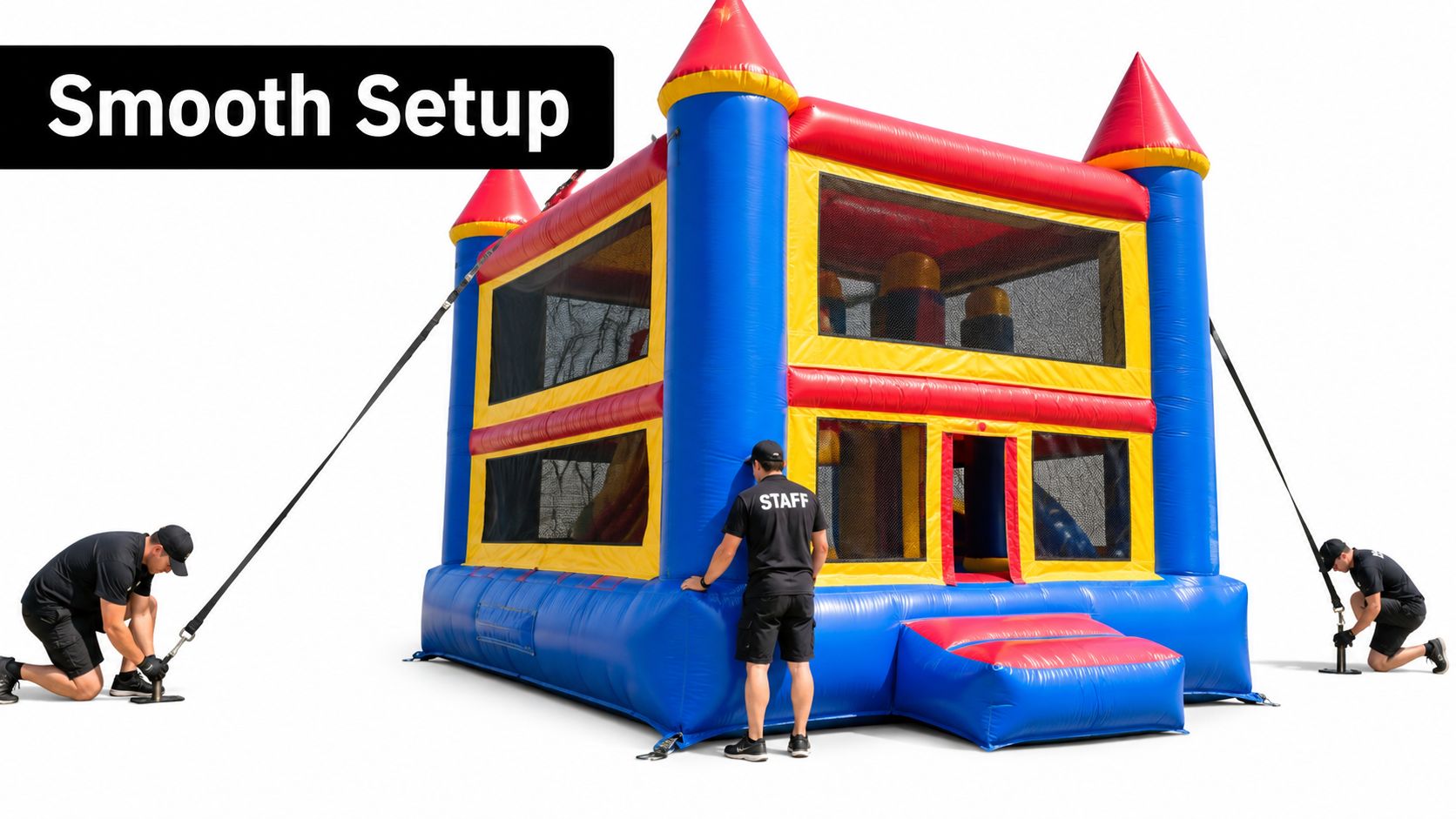
Schedule setup before guests arrive. The crew must unload, position, anchor, inflate, inspect, and review the operating area. Build in time for a final briefing with attendants and the event lead instead of booking delivery for the same moment guests enter.
Put weather in writing
A breakfast forecast does not cover changing conditions during an outdoor event. Name the person who monitors weather, identify the wind reading that controls the decision, establish how guests will be notified, and confirm how the unit will be deflated safely if conditions worsen. The documented record of wind-related bounce house incidents shows why weather planning belongs in the contract and event run sheet, not in a casual text message. Write the shutdown trigger as a named role and a wind reading, so the decision does not depend on whoever happens to be holding the anemometer when a gust front arrives.
Organizers handling a public event in New Jersey or working with regional partners can use this New Jersey event insurance guide to frame questions about coverage, certificates, exclusions, and venue requests. Insurance does not replace safe operation, but it can expose documentation gaps before setup day.
Assign responsibilities clearly
Before the event, confirm who supplies attendants, controls the queue, communicates a weather shutdown, contacts emergency services, and records incidents. At teardown, keep guests away from the deflation and loading area. The crew should remove anchors and equipment.
A practical logistics plan gives every decision an owner, from site access through final loading.
Pricing, Rental Checklist, and Alternatives
Rental pricing for a two-story bounce house depends on the specific unit, event duration, travel distance, surface, staffing, delivery complexity, insurance documentation, and whether the booking includes other attractions. A low quote may exclude attendants, generators, delivery fees, or a required setup condition. Compare the complete operating package rather than the headline rental amount.
For a broader explanation of the factors that shape bounce house rental cost, review the agreement line by line. Ask whether the quote includes delivery, setup, anchoring, takedown, cleaning, supervision, weather procedures, and certificates requested by the venue.
Use the attraction that fits the audience
| Event Type | Recommended Option | Key Considerations |
|---|---|---|
| Corporate family day | Two-story unit with professional attendants | Confirm venue insurance, employee-family age range, queue flow, and a weather shutdown plan. |
| School field day | Two-story unit or scheduled single-level rotations | Match the equipment to student ages, staffing, school documentation, and group movement. |
| Community festival | Two-story unit within a managed activity zone | Plan queue control, public access, emergency routes, insurance, and changing weather. |
| Small backyard party | Single-level inflatable may be more practical | Check space, power, surface, supervision, and whether the added height provides real value. |
| Graduation celebration | Two-story unit paired with other age-appropriate activities | Coordinate arrival times, venue rules, adult oversight, and a complete event schedule. |
A rental checklist that catches gaps
- Commercial use: Confirm the unit is intended for commercial rental, not home use.
- Standards and records: Ask for applicable inspection documentation, maintenance records, and operating instructions.
- Anchoring: Get the anchoring method in writing for the actual surface.
- Attendants: Confirm who provides trained attendants and how many are assigned.
- Weather: Identify the wind limit, monitoring process, shutdown authority, and cancellation terms.
- Insurance: Ask what certificate and additional-insured language the venue requires.
- Power: Verify blower requirements, circuit access, generator rules, and cable protection.
- Access: Confirm delivery clearance, setup timing, gates, stairs, elevators, and unloading restrictions.
- Capacity: Follow the manufacturer's posted user limits and age or size rules.
- Emergency response: Make sure staff know how to stop operation and direct guests away from the unit.
Graduation planners should also coordinate entertainment with arrival, photography, food, speeches, and guest movement. A broader graduation checklist from Gradshop can help organize those non-inflatable details.
A single-story unit often works better when the venue has limited height clearance, difficult anchoring conditions, a young audience, or a small operating area. A two-story bounce house makes more sense when the site, staff, weather plan, and documentation support its added play value.
Putting It All Together - Your Event Success Plan
A successful two-story bounce house event is a managed operation with entertainment inside it. Start by selecting a commercial unit that fits the audience and venue. Then verify the surface, access, power, anchoring method, capacity rules, attendants, inspection records, insurance documents, and weather procedure before signing the agreement.
For corporate planners
Give the vendor the campus map, event schedule, expected attendance, and venue contact. Ask for a certificate of insurance and a written weather process early, then keep the attraction away from food lines, presentation areas, and vehicle traffic.
For schools and universities
Assign one staff member to coordinate with the operator. Build the attraction into rotations or supervised activity blocks, and confirm that the vendor can provide the documentation required by the school, campus, or district.
For municipalities and community groups
Treat the attraction as part of the site safety plan. Mark the queue, preserve emergency access, establish a weather-monitoring role, and make sure volunteers don't assume they can replace trained attendants without proper instruction.
For families
Choose a unit that fits the actual property, not the largest model in a photograph. Confirm anchoring, supervision, capacity, power, and cancellation terms, and keep children away while the crew sets up or removes the equipment.
The right question isn't “How big is it?” It's “Can this venue operate it safely, with the staff and documentation in place?”
A two-story bounce house can be an excellent centerpiece for a Pennsylvania event when the operator handles it as engineered commercial equipment. Professional anchoring, inspection, trained supervision, and a firm weather plan matter more than decoration or height.
Phantom Entertainment provides commercial bounce house rentals with delivery, setup, professional operation, and venue-ready safety documentation for events across Pennsylvania and the Mid-Atlantic. For a two-story bounce house plan that accounts for site access, anchoring, staffing, insurance, and weather, visit Phantom Entertainment and request event guidance before you book.
Ready to Book Your Event?
PA state-inspected, fully insured since 1979. Call us or get a free quote today.