
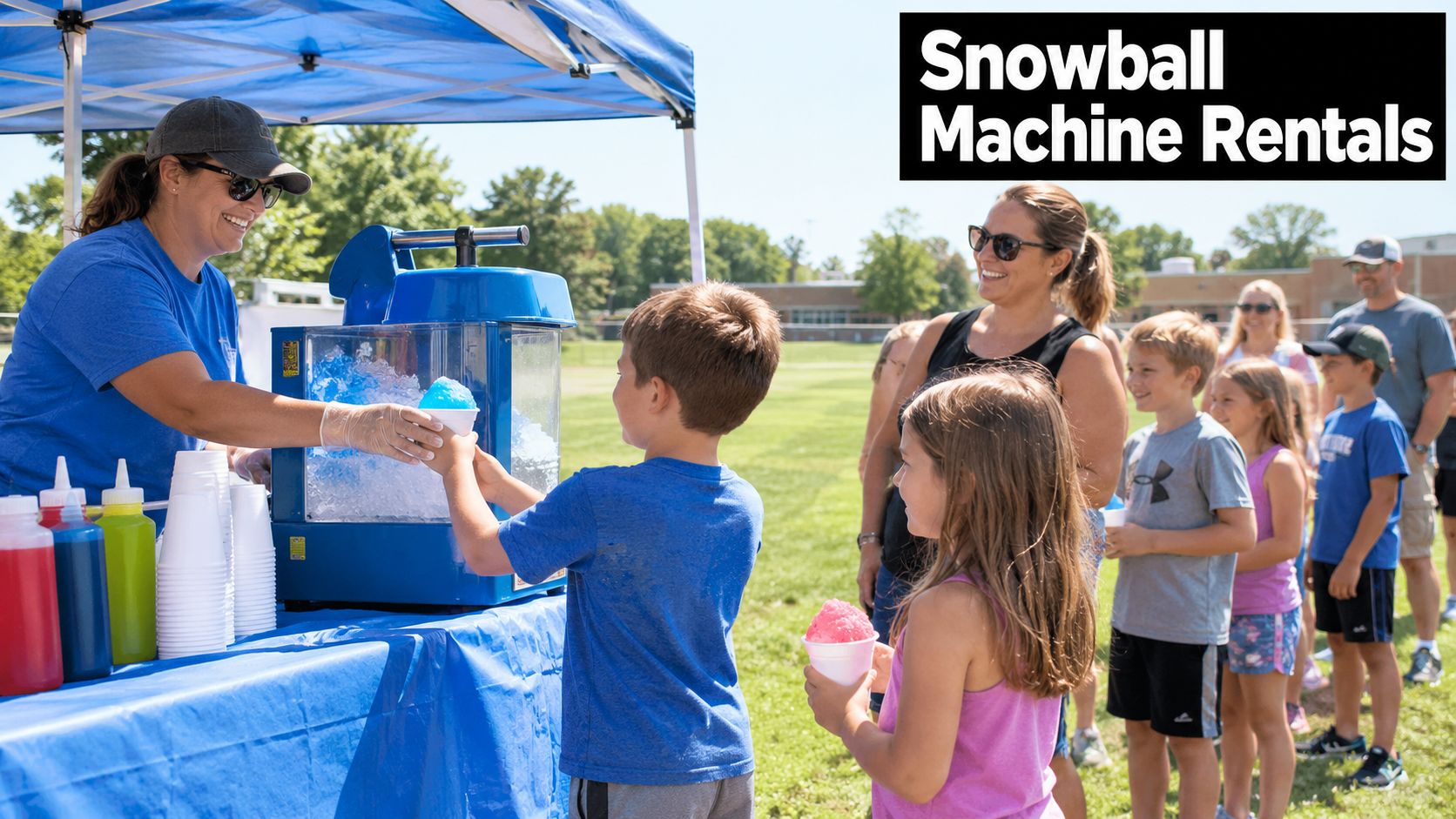
A single commercial snowball machine can serve roughly 200 to 400 guests per hour, depending on event size and service style, so most mid-sized events need just one unit staffed by a dedicated attendant. The right choice depends less on total attendance than on how many guests arrive at the station during the busiest part of service.
At a Central Pennsylvania school field day, the line usually forms quickly. Children finish a game, spot the shaved-ice station, and converge on it with teachers and parents close behind. At a company picnic, the same thing happens after lunch, except guests arrive in waves from different activities. A well-placed snowball machine turns that rush into an organized, high-volume dessert service instead of a bottleneck.
What to Expect When You Rent a Snowball Machine
A snowball machine for rent is food-service equipment, not a decorative snow effect. It shaves real ice into a soft, snow-like texture, then an attendant portions it into cups or bowls and adds concentrated syrups selected by the guests.
That distinction matters. Artificial-snow machines create foam, mist, or another visual effect. A shaved-ice machine produces a dessert people consume, so the rental involves more than dropping off an appliance. The service normally combines the machine, ice, flavors, serving supplies, an operator, and a plan for sanitation and cleanup.
What arrives with the rental
Before you sign, ask the rental company to separate equipment from service. A complete package may include:
- Commercial shaved-ice equipment: The unit should be designed for continuous food service, with accessible food-contact parts and a safety interlock.
- Ice supply: Confirm whether the provider delivers ice, how it's stored, and who replenishes it during service.
- Syrups and serving ware: Cups or bowls, spoons, napkins, and several flavor options keep the station moving.
- Dedicated operation: An attendant shaves the ice, portions it, and manages the machine instead of leaving guests to operate commercial equipment.
- Protection and cleanup: Floor covering, towels, waste containers, and post-service wiping may be included or charged separately.
Professional delivery also changes the host's role. The rental crew can transport the machine, establish the station, check the power connection, operate the equipment, and remove the setup afterward. The event organizer can focus on schedules, vendors, supervision, and guests.
Practical rule: Treat the snowball station as a staffed food-service point, not as a self-serve table with a machine on it.
The product has roots in the broader shaved-ice tradition associated with New Orleans and the development of finely textured snowballs during the early twentieth century. Its appeal still comes from the combination of texture and customization, which is why it works at school events, corporate family days, festivals, church gatherings, and backyard celebrations.
Choosing the Right Snowball Machine for Your Event
At a Central Pennsylvania school event, the line can go from empty to several dozen guests as soon as buses arrive. That situation calls for an electric commercial snowball machine, not a hand-operated unit. Commercial models commonly advertise 400 to 500 pounds of shaved ice per hour in equipment guidance from Off Key Tiki, but that figure describes machine output, not completed servings during a busy service period.
Portable manual units work well for small family gatherings with steady, gradual arrivals. Hand operation, ice preparation, and portioning slow the station when a corporate picnic, school event, or festival sends guests through at once. Concession-grade machines handle sustained demand better, although they can require more counter space, electrical planning, and room around the service point.
| Machine Type | Hourly Capacity | Ideal Event Size | Staffing Need | Power Requirement |
|---|---|---|---|---|
| Electric commercial unit | 400-500 lb/hr (gross) | Small to mid-sized events with a defined service window | One dedicated attendant | Standard outlet, subject to the model and venue circuit |
| Portable or manual unit | Varies by operator speed and ice preparation | Small private gatherings with gradual guest flow | One operator, often the host | Manual operation or limited electrical support |
| Concession-grade commercial unit | High sustained output, determined by the model | Festivals, fairs, and large events with concentrated demand | One operator, plus a support person during peaks | Confirm circuit, placement, and venue requirements in advance |
Size for the peak, not the invitation list
Start with the busiest 15 to 30 minutes, then estimate how many guests will reach the station during that period. Plan around only 60 to 70% of the manufacturer's stated capacity. Loading, portioning, syrup application, queue management, meltwater, and brief operator pauses all reduce practical throughput.
A 500-person picnic spread across several hours may run comfortably with one staffed unit. A 200-person school event can require faster service support when everyone arrives together. The booking discussion should therefore cover arrival waves, the serving window, and crowd movement, rather than attendance alone.
Frozen refreshments create a useful comparison. Simply Hospitality's frozen drink guide covers frozen-drink machines, which follow the same peak-hour sizing logic but do not require a separate ice supply plan. That difference can help determine whether shaved ice or frozen drinks fit the event's menu and operating setup better.
Sizing, Delivery, and Setup Logistics
A smooth snowball service begins before the truck leaves the rental warehouse. Give the provider the event location, expected peak attendance, service window, indoor or outdoor status, surface type, weather exposure, and the electrical access available at the station.
Those details determine more than delivery time. They influence the machine category, the amount of ice needed, the number of attendants, the location of waste and meltwater controls, and whether the rental crew needs shade or weather protection.
Build the setup around the guest flow
The venue should provide a level, clear surface close to the service area. Keep the machine near an appropriate outlet, but don't place it where guests will cross the power cord or where rain can reach electrical connections. Outdoor setups generally need shade, a stable canopy arrangement, and protection from wind that could scatter cups, napkins, or syrup supplies.
A typical operational timeline looks like this:
- Booking review: The rental company confirms guest flow, operating hours, access routes, power, surface, and venue rules.
- Delivery access: Someone verifies parking, unloading distance, stairs, elevators, gates, and the route to the station.
- Station preparation: The crew establishes floor protection, places the machine, arranges syrups and serving ware, and checks the drain area.
- Ice readiness: The provider either delivers the planned ice supply or confirms exactly what the venue must supply and store.
- Service and replenishment: The attendant monitors ice, syrup levels, cups, meltwater, queue length, and electrical safety.
- Teardown: The machine is emptied, cleaned according to the agreed procedure, packed, and removed with waste and protective materials.
Ice logistics deserve specific attention. A machine's theoretical hourly production doesn't tell you how much usable product the event will consume, because serving size and guest behavior vary. Confirm who supplies the ice, where it will be stored, how it stays protected, and who handles replenishment if the station runs longer than planned.
Setup insight: The best station is close enough to the crowd to be visible, but far enough from entrances, electrical hazards, and narrow walkways to keep the queue controlled.
Schools, churches, cafeterias, and corporate venues may have rules about food equipment, drainage, floor coverings, and water near electrical devices. Ask the venue before booking rather than discovering a placement restriction during unloading. For more planning guidance on access and site coordination, use this party rental delivery guide.
Safety and Food-Safety Requirements
Snowball service has two separate safety responsibilities. The first protects the food. The second protects guests, attendants, floors, and electrical equipment around the station.
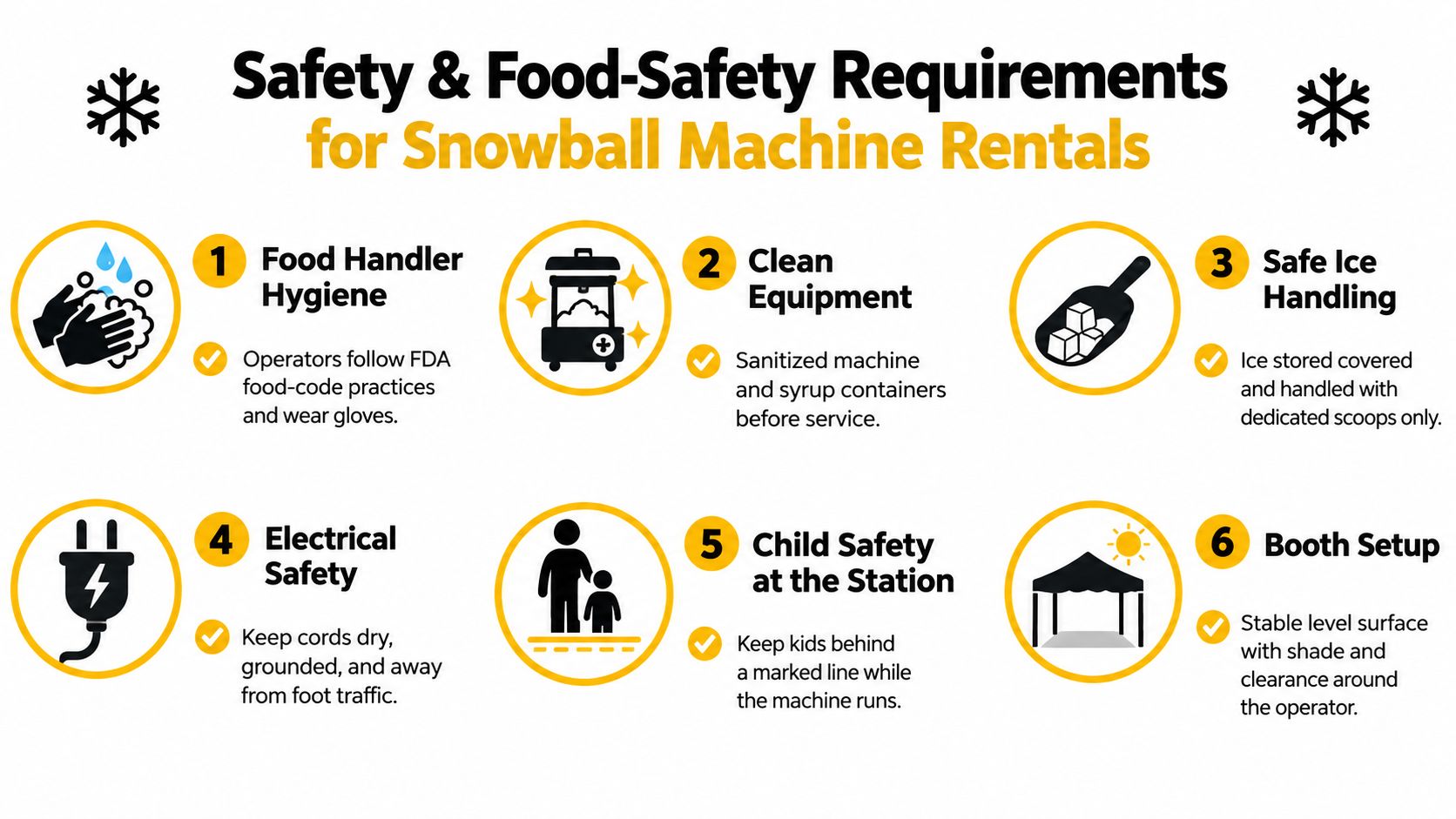
FDA guidance says ice used as food must be handled under protected conditions. It also advises using clean, non-breakable utensils and avoiding contact between ice and dirty hands or glasses in its packaged-ice safety guidance.
Protect the product from opening through closing
Set up the ice in a clean, food-safe container. Keep it covered or otherwise protected from hands, cups, dust, and nearby traffic. The attendant should use a clean scoop or tongs, never bare hands, a drinking glass, or a scoop that has touched the ground.
Keep syrup bottles, cups, toppings, and utensils on a clean work surface. They shouldn't sit directly on grass, pavement, or a dirty floor. Before service, sanitize the hopper, blades, chute, scoop, syrup nozzles, and surrounding work surfaces. Follow the applicable state or county food code for cleaning intervals during service and at closing.
A written checklist helps prevent rushed mistakes:
- Operator hygiene: Wash hands before handling food and after touching waste, money, phones, or other contaminated surfaces.
- Ice protection: Store ice in a clean container and use only dedicated scoops or tongs.
- Equipment sanitation: Clean and sanitize food-contact parts before service and at the required intervals.
- Cross-contact control: Keep payment, waste, and food handling separate whenever staffing allows.
- Documentation: Record opening checks, ice-source details, sanitation, spills, and closing procedures.
Control the work area
Assign one person to the machine and, where the queue warrants it, another to handle payment, cups, toppings, or waste. The split is most valuable during the busiest period, when a single attendant is likely to touch money, reach for supplies, and handle food without noticing the cross-contact risk.
Operational controls matter just as much. Keep cords dry and away from foot traffic, use floor protection on hard surfaces, and prevent meltwater from pooling under the machine. Children should remain on the guest side of the station while the attendant operates the unit. Staff should understand the machine's plunger or lid safety interlock and shouldn't bypass it.
For a broader sanitation setup, especially at schools and outdoor programs, a portable hand-washing station rental guide can help you plan hand hygiene away from the main building.
This video provides another visual reference for station procedures:
A reputable rental provider should inspect and sanitize the equipment as part of its service. The venue still needs to communicate local requirements, provide a suitable placement area, and follow any health-department instructions that apply to the event.
Pricing and Rental Value
A snowball machine quote covers more than the stainless-steel unit. Equipment type, rental length, travel, staffing, ice, syrups, cups, floor protection, cleanup, and package discounts can all change the total. A low equipment-only price may become expensive once delivery, an operator, and supplies are added.
Compare the service, not just the headline number. A staffed station usually carries a higher fee than a pickup rental, but it also reduces queue delays, operating mistakes, and the risk of leaving food handling to an untrained volunteer. For a corporate picnic, school event, or community festival, that difference can affect the guest experience more than the machine itself.
Compare the service behind the number
Ask every provider to identify these line items:
- Equipment: Which machine is supplied, and can it handle the expected peak?
- Labor: Is a trained attendant included for the entire service window?
- Consumables: Are ice, syrups, cups, spoons, napkins, and waste supplies included?
- Site work: Does the crew deliver, set up, protect the floor, control drainage, and remove the equipment?
- Risk documentation: Can the provider supply a certificate of insurance and venue-ready safety documents?
- Contingencies: What happens if service runs longer, weather changes, or supplies need replenishment?
The U.S. event-rental market was estimated at $32.1 billion in 2023 and projected toward $41.8 billion by 2028 according to this industry estimate. That broad figure does not price snowball machines specifically, but it helps explain why rental companies often bundle refreshment equipment with delivery, staffing, and other event services.
Request an itemized quote with separate charges for the machine, labor, travel, consumables, setup, and cleanup. Then ask whether the operator remains on site during the full service period. A package with dependable equipment and trained staffing can provide better value than a cheaper rental that leaves production, replenishment, and guest flow to your event team.
Phantom Entertainment has operated in the Mid-Atlantic region since 1979 and provides certificates of insurance and venue-ready safety documentation. Use this party rental pricing guide when comparing broader packages, then request a written quote that states exactly what the snowball station includes.
Common Problems and How to Fix Them
At one event, the machine was running, but the ice came out coarse instead of soft and snow-like. The usual causes are a dull or worn blade, an incorrect feed rate, or ice that wasn't frozen to the required density. The attendant should stop serving, check the operating settings and ice condition, and contact the rental company if the blade or internal adjustment needs attention.
A separate slowdown during peak service looked like a machine failure at first. The equipment was working normally, but one person was trying to shave ice, portion cups, add syrup, answer questions, and manage the queue. Adding a second attendant for cups, toppings, payment, and waste let the primary operator stay focused on production.
Other common problems have simple first checks:
- Clogged syrup nozzle: Remove the nozzle according to the provider's instructions and clear it with approved cleaning tools.
- Meltwater under the unit: Check the drain position, replace saturated towels, and keep water away from cords and electrical connections.
- Flavor running low: Monitor popular syrups during service and replenish before the bottle is empty, rather than waiting for the line to stop.
Don't disassemble a commercial machine or replace calibrated parts in the field. Call the rental company when the blade, motor, interlock, drain assembly, or electrical system is involved. Experienced attendants can handle routine adjustments, while trained technicians should manage repairs.
Phantom Entertainment provides staffed snowball machines, delivery, setup, teardown, and venue-ready event support across Pennsylvania and the Mid-Atlantic. Visit Phantom Entertainment to plan a shaved-ice station for your school event, company picnic, festival, church gathering, or private celebration.
Ready to Book Your Event?
PA state-inspected, fully insured since 1979. Call us or get a free quote today.