
The field day schedule is ready, classes are waiting for their activity assignments, and the forecast suddenly shows rain. You've got a crowded site, limited staff, and families expecting something more engaging than another line of cones. The right obstacle course can fit those constraints. The wrong one can leave you managing queues, slippery surfaces, and participants who can't use the equipment.
Choose the format for the event goal, not just the attraction photo. An inflatable course suits a rotating school activity. A facilitated ropes course suits a team that needs to practice communication. A mission-based route gives people who don't want to race a useful way to contribute.
Before committing, sketch the entrance, waiting area, obstacles, finish, and emergency access on the same site plan. Include spectators and staff positions, not just the equipment footprint. Then decide how participants will leave the course without walking through the next group.
These obstacle course ideas range from simple agility lanes to professionally operated climbing challenges. Each works best with a particular crowd, layout, and dispatch method. Keep participation voluntary, provide meaningful alternatives, and treat weather decisions as part of planning rather than something to settle while guests are arriving.
1. Inflatable Obstacle Course
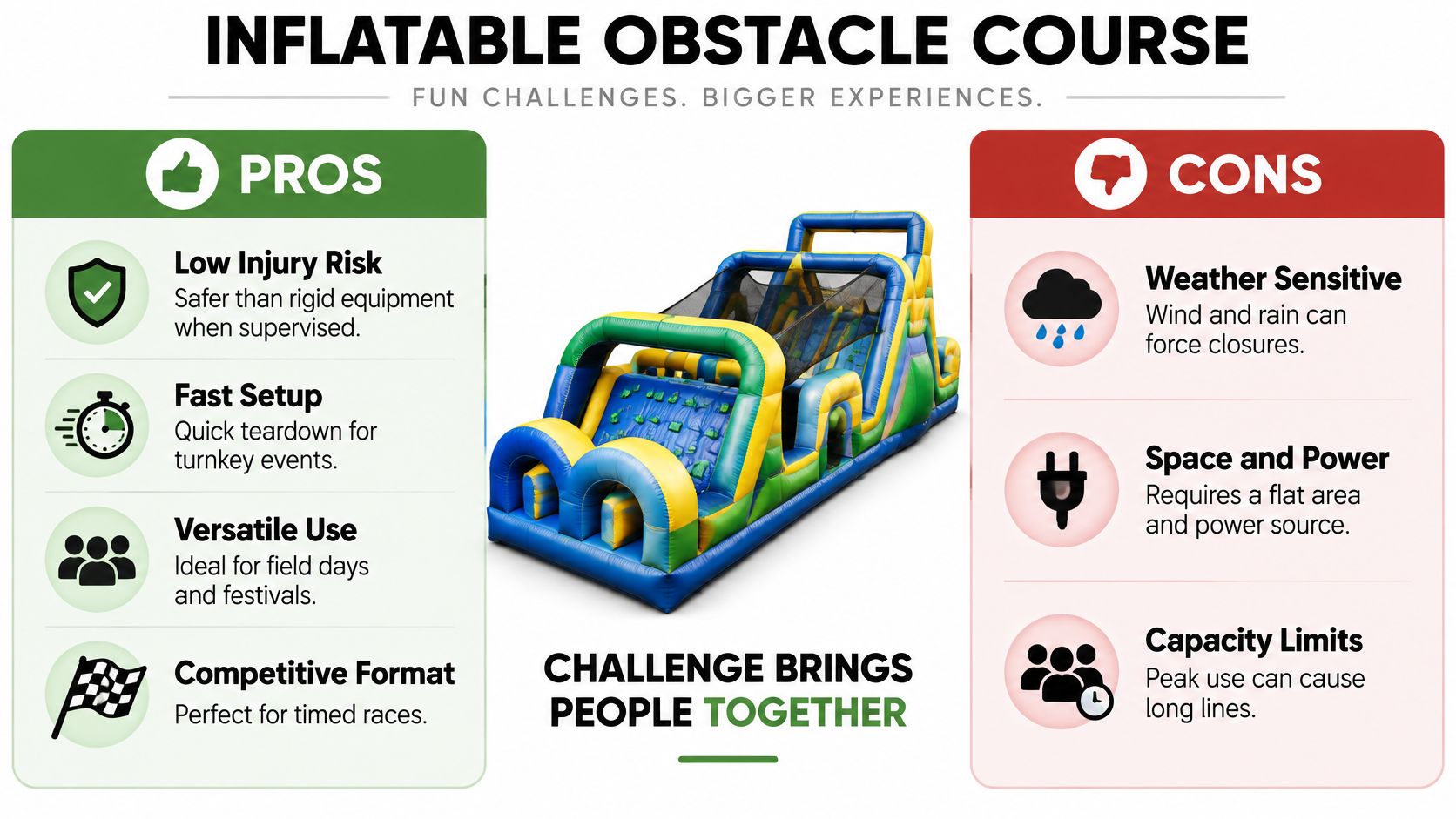
Best for school field days, family festivals, and mixed-age recreation, an inflatable course combines crawling, climbing, squeezing through barriers, and sliding within a defined footprint. It's a useful choice when you want a recognizable attraction without building separate stations across the field.
For a school rotation, stage the arriving class outside the operating perimeter while the previous class finishes. Separate younger children from larger participants according to the equipment's operating rules, rather than sending an entire mixed-age group through together.
Build the Queue Around the Exit
Review inflatable course options alongside your available footprint, power access, anchoring conditions, and spectator space. A course that fits on paper may still leave no practical room for its queue.
- Dispatch: Release participants only when the operator confirms the next section is clear.
- Staffing: Keep queue management separate from active equipment supervision.
- Documentation: Confirm applicable inspection records, insurance certificates, and venue requirements before booking.
- Weather: Record the manufacturer's operating limits and the operator's shutdown procedure, with an indoor alternative or rain-date plan.
Allow each rotation to include briefing, activity, and an orderly handover. Don't promise continuous racing until the operator has confirmed how participants can safely move through the specific unit.
2. Ninja Warrior-Style Course
A university activity night needs a different challenge from an elementary field day. A Ninja Warrior-style course suits older teens and adults who actively want a demanding individual attempt, with spectators watching from outside the landing zones.
Build the sequence around balance steps, hanging grips, rings, and an appropriately designed wall challenge. Don't add advanced apparatus, such as a salmon ladder, unless the equipment, operator, and participant screening support it.
For a campus competition, publish the scoring method before registration: obstacle completion first, elapsed time as the tie-breaker. Set an attempt limit and a clear route off the course after an unsuccessful stage so competitors don't repeatedly block the same obstacle.
Keep Difficulty Separate From Congestion
Provide a beginner route beside the advanced sequence, with comparable recognition for completion. Position trained staff at major obstacles according to the operator's supervision plan, and use landing protection designed for the equipment and potential falls.
Practical rule: A waiver doesn't replace suitable equipment, landing protection, participant briefing, or competent supervision.
Inspect grip surfaces between sessions, especially outdoors. Rain, condensation, or sweaty holds may require a pause even when the rest of the site remains usable. If staffing is limited, reduce the active obstacles rather than asking a distant marshal to watch everything.
3. Field Day Relay Obstacle Course
For elementary and middle school groups, relay courses offer flexible participation without a large equipment footprint. A simple route might involve weaving through cones, stepping through hoops, carrying a beanbag, and returning along a separate lane to tag a teammate.
At a church youth event, use parallel team lanes with matching equipment and clear turnaround markers. Keep the activity cooperative by awarding recognition for accurate completion and encouragement, not just speed.
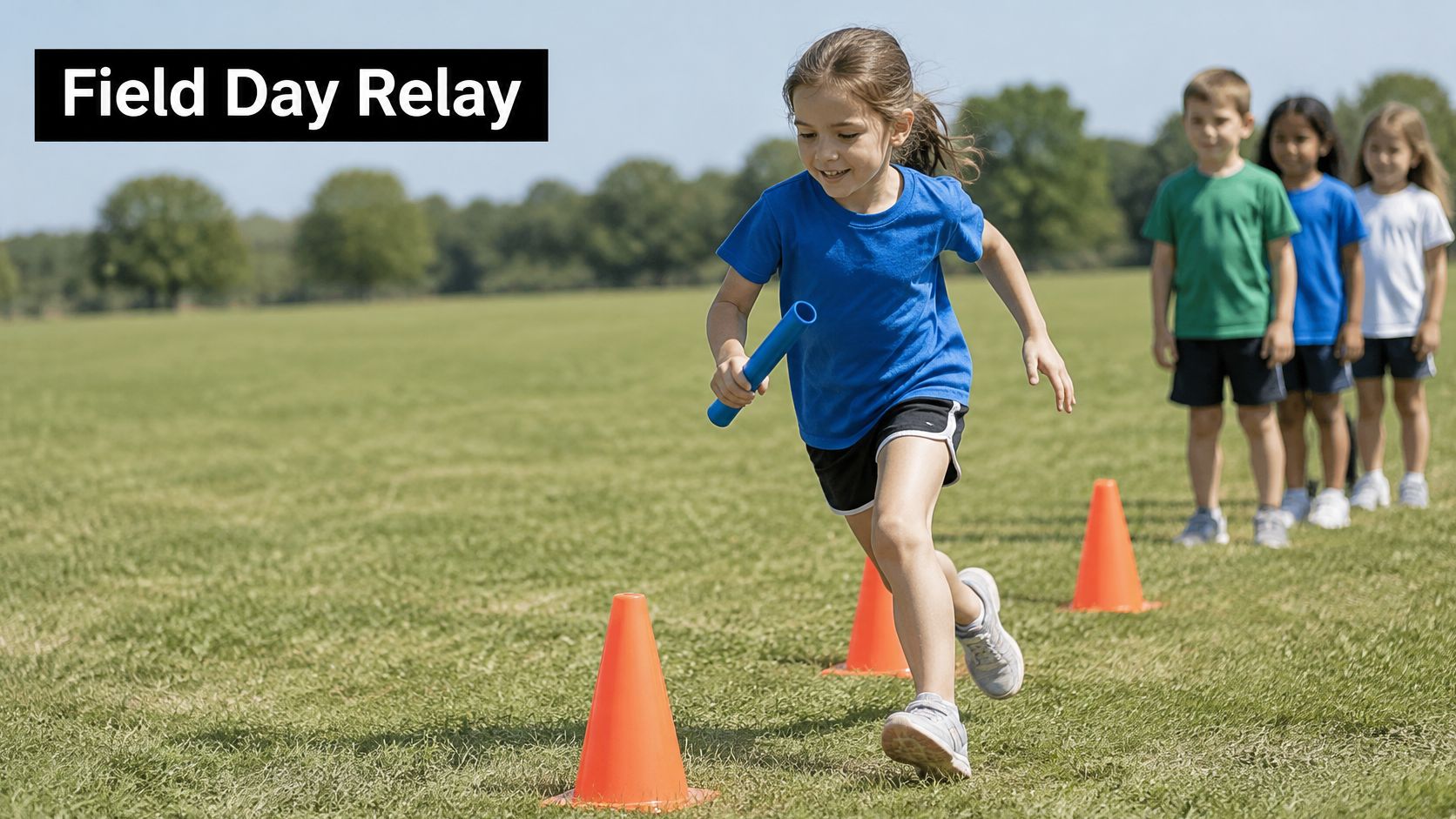
The layout matters more than elaborate props. Returning runners shouldn't cross outgoing runners, and waiting teammates should stand behind a marked boundary rather than crowding the tag point.
- Team identification: Use colored bibs or wristbands that match lane signs.
- Station control: Place a captain where participants need instructions or equipment resets.
- Timing: End rounds at a planned rotation signal instead of waiting indefinitely for every team to finish.
- Fairness: Rotate lane assignments and starting order between rounds.
A climbing attraction can add variety, but it shouldn't become a compulsory relay bottleneck. Run it as a separate rotation if harness fitting or individual supervision takes longer than the other tasks.
On wet ground, remove sharp turns and jumping tasks before considering whether the remaining route is usable. Move to a suitable indoor version if footing remains unreliable.
4. Mud Run and Obstacle Race Course
Choose a mud run for willing adults and appropriately screened teens seeking an endurance challenge, not as the default activity at a company picnic. Walls, carries, crawling zones, and rough terrain require a different operating plan from a short lawn course.
A community fundraiser could use a marked outdoor loop with obstacle bypasses and wave starts. Keep a shorter, cleaner beginner route separate from the main race, with its own briefing and finish.
Commercial obstacle racing has substantial reach: a MIT Sloan case study reported that approximately 4.5 million people in the United States finished an obstacle-course race in 2015. That popularity isn't a reason to copy an endurance event's difficulty onto an unprepared audience.
Plan Access Before Adding Mud
Map how medical personnel can reach each obstacle without following the entire running route. Put hydration, rest space, and first aid where participants can find them, and arrange handwashing, changing, and muddy-clothing management near the finish.
- Wave control: Adjust dispatch intervals when marshals report queues at walls or crossings.
- Ground conditions: Inspect drainage, hidden holes, debris, and changing traction.
- Recovery: Keep the finish clear of spectators and provide a place to stop without obstructing runners.
- Weather response: Establish cancellation and suspension decisions before registration opens.
Don't improvise muddy water pits or high walls to make a route look authentic. Use professionally designed obstacles and remove any feature you can't inspect, supervise, or access effectively.
5. Ropes and Challenge Course
If the event objective is communication, trust, or shared problem-solving, a facilitated challenge course is a better match than a straight race. Low elements can ask a team to move objects, negotiate a balance task, or plan a route together; high elements add personal challenge but also require specialized systems and supervision.
For a corporate retreat, begin with a low-element task where everyone can contribute. Follow it with an optional higher activity rather than treating willingness to climb as evidence of leadership.
Buy Facilitation, Not Just Equipment
Use appropriately qualified facilitators and verify inspection, insurance, rescue arrangements, and the systems used for high elements. Discuss the learning objective beforehand so the facilitator can select an activity that fits it.
Climbing rope drills for functional power may be useful preparation for an athletic participant, but conditioning advice doesn't establish readiness for a particular challenge course.
A participant who declines height can still contribute to planning, communication, observation, and the debrief.
Schedule time after the task to discuss specific behavior: who shared information, how the group handled disagreement, and whether everyone understood the plan. Without that conversation, an expensive team-building activity can become a climbing outing.
For outdoor sessions, confirm the operator's weather procedures and shelter arrangements. Keep waiting teams away from cable paths, landing areas, and equipment checks, and don't compress safety briefings to recover a delayed schedule.
6. Glow-in-the-Dark Night Obstacle Course
A glow course suits teen celebrations, grad nights, and evening community events when atmosphere matters more than technical difficulty. Use a familiar ground-level route with reflective cones, illuminated boundaries, and broad, clearly visible transitions.
At a high school celebration, participants could follow a glowing weave lane, complete a low step-over sequence, and finish at a lit target station. Keep spectators and the return route outside the active lane.
The essential distinction is between decorative lighting and working visibility. Blacklights and glow sticks can establish the theme, but staff still need to see feet, obstacles, faces, and the ground.
- Lighting: Illuminate entrances, exits, queues, surface changes, and emergency access.
- Materials: Use products intended for the setting, secure decorations, and keep loose cords out of travel paths.
- Sensory access: Offer a quieter session or route without flashing effects and heavy music.
- Sound: Confirm venue restrictions and applicable local noise requirements before adding a DJ.
Test the course in daylight, then repeat the inspection under event lighting. A cone that stands out at sunset may disappear against decorative lights after dark.
Avoid fog around footing changes or anywhere it reduces staff visibility. If rain makes cables, surfaces, or electrical equipment unsuitable, stop the activity rather than relying on the glow theme to disguise an ordinary outdoor course's limitations.
7. Military-Style Confidence Course
A confidence course works for youth camps, scouting groups, and leadership programs when the emphasis is controlled achievement rather than intimidation. Low walls, crawl sections, balance elements, and carrying tasks can create a clear progression without requiring every participant to climb high.
The military connection is genuine: the history of obstacle sports traces purpose-built courses to European armies during the nineteenth century. For a civilian event, borrow the variety of movement, not the expectation that everyone must push through discomfort.
Make Completion the Main Achievement
At a youth camp, provide a ground-level balance route alongside a raised option, and let participants select their challenge without announcing a reason. Offer separate timed and untimed participation so a cautious first attempt still counts.
A peer-reviewed review of obstacle-course hazards recommends inspecting structural integrity, sharp projections, rope deterioration, corrosion, abrasion risks, landing cushioning, and surrounding hazards; it also advises against placing the highest or most difficult obstacles at the finish.
Brief each group on stopping, passing, and requesting help. Station supervisors where a participant could fall or become stuck, rather than clustering staff at the start.
Use mats or other specified landing systems where the design requires them, but don't assume padding makes an improvised raised obstacle acceptable. Finish with an easy weave or controlled run-through so tired participants aren't facing the course's hardest technical task.
8. Rock Wall and Climbing Challenge Course
A portable climbing wall creates a visible centerpiece for campus fairs, older children's parties, and family events with willing climbers. It also introduces a queue-management problem: fitting safety equipment and completing checks can take longer than the climb itself.
For a university activity fair, keep the wall as a staffed station beside a ground-level circuit rather than making every participant climb before continuing. Review the portable rock wall attraction against the site's access, operating footprint, and waiting-space requirements.
Separate Preparation From the Climb
Create distinct areas for waiting, equipment fitting, active climbing, and equipment removal. Participants shouldn't walk beneath active routes or enter the operator's work area to watch a friend.
- Eligibility: Use the equipment's stated participant limits and harness-fit requirements, not age or height rules invented for the event.
- Operator competence: Verify training, inspection documentation, and the procedures for harness and climbing-system checks.
- Scoring: Recognize route completion or controlled progress rather than encouraging desperate reaches against the clock.
- Rotations: Base booking slots on the complete preparation-and-climb cycle.
Offer a ground-level challenge with equal recognition for people who can't or don't want to climb. Don't make participation a condition of earning a team prize.
Outdoors, let the operator determine whether wind, rain, heat, or surface conditions require suspension. Keep an alternative activity ready so a shutdown doesn't leave the entire rotation waiting at the wall.
9. Speed and Agility Cone Course
Choose an agility course when space, setup time, or budget rules out larger attractions. It suits physical education classes, youth sports camps, and short activity rotations, provided you don't present an athletic drill as equally accessible to everyone.
For a school sports afternoon, lay out a forward weave, a marked footwork pattern, a controlled direction change, and a separate return path. Start with a demonstration at walking pace so participants understand the route before timing begins.
Unlike a climbing course, this layout can be adjusted quickly. Wider turns, fewer direction changes, and a rolling or walking route let you change the movement demand without rebuilding the station.
Keep the Route Easy to Read
Use matching colors for each lane's start, route, and finish. Avoid overlapping patterns that require a marshal to shout directions while participants are moving.
- Staffing: Assign a starter who checks lane clearance and a finish marshal who manages departures and resets.
- Timing: Release the next participant only after the shared movement area is clear.
- Equipment: Choose stable markers and low-profile footwork equipment suited to the surface.
- Choice: Provide an untimed route without public rankings.
Layout test: If a participant needs to cross an active lane to return to the queue, redraw the course.
On grass, inspect holes and uneven ground before placing markers. On hard indoor flooring, check traction and secure approved floor markings; don't substitute loose mats that shift during turns.
10. Mission-Based Themed Obstacle Course
Not every useful team member wants to be the fastest runner. Mission-based courses suit corporate picnics, university orientations, and mixed-age family groups because teams can divide physical, observational, and puzzle-solving work.
A campus orientation mission might combine a cone route, a symbol-matching puzzle, and a cooperative object transfer. Teams receive the next instruction after completing the task, with an accessible alternative that leads to the same outcome.
Use themed activity options as a planning reference, then keep the story simple enough to explain at the starting point. Elaborate fictional rules can create more confusion than engagement.
Prevent Puzzle Bottlenecks
Give each station a clear instruction card, a facilitator, a hint sequence, and a reset procedure. If a team becomes stuck, offer a hint or alternate task rather than letting the entire route back up.
- Roles: Include navigator, reader, solver, equipment handler, and physical-task roles that participants can exchange.
- Dispatch: Start teams at different stations where the story allows it.
- Boundaries: Keep clues away from vehicle routes, restricted buildings, and emergency exits.
- Weather: Use covered puzzle stations and a preplanned indoor route when available.
A review of inclusive learning supports providing guidance and alternative participation methods for people with visible and invisible disabilities. Apply that principle through readable instructions, visual demonstrations, low-impact tasks, and private choices about participation.
Test every puzzle with someone who didn't write it. If they need the author to explain the answer, rewrite the instructions before event day.
How the ten obstacle course formats compare for planning
| Item | Best for ages | Space needed | Supervision level | Setup complexity |
|---|---|---|---|---|
| Inflatable Obstacle Course | Ages 5+; adaptable for younger children | Large, flat, open area | Active supervision | Easy to moderate |
| Ninja Warrior-Style Course | Older teens and adults | Large area | High; trained spotters | Complex |
| Field Day Relay Obstacle Course | All ages; easily adapted | Flexible; add space for more lanes | Adult supervision | Simple |
| Mud Run and Obstacle Race Course | Teens and adults; adaptable for families | Extensive outdoor area | High; safety and medical support | Complex |
| Ropes and Challenge Course | Older youth and adults; adaptable | Large indoor or outdoor course area | High; certified facilitators | Complex |
| Glow-in-the-Dark Night Obstacle Course | Teens and young adults | Course-sized area with room for lighting | High; strong lighting and supervision | Moderate |
| Military-Style Confidence Course | Youth and adults; adapt to ability | Large area | Active supervision | Moderate to complex |
| Rock Wall and Climbing Challenge Course | Older kids and teens; age and height limits apply | Wall footprint with safety clearance | High; trained climbing staff | Complex |
| Speed and Agility Cone Course | Adaptable for different ages | Small area | Basic supervision | Simple |
| Mission-Based Themed Obstacle Course | Adaptable for family and group ages | Variable; space for stations | Moderate; staff at stations | Complex |
Choosing the Right Course for Your Event
Start with who is participating, what space and staff time you have, and what the event needs to achieve. Fitness, team bonding, and open-ended recreation call for different layouts. Don't book a demanding course because it photographs well.
For a school field day, prioritize predictable rotations and age-appropriate tasks. For a company family day, provide choices that work for children, adults, and guests who aren't participating physically. For an orientation event, favor formats that help strangers cooperate rather than publicly ranking athletic ability.
Match Capacity to the Slowest Task
Walk through the whole participant journey, including arrival, briefing, equipment checks, the activity itself, and departure. The slowest stage determines how quickly you can admit the next group. A fast running section won't compensate for a backed-up climbing station.
Ask the operating team to help test the schedule before publishing it. Leave room for resets, participant questions, accessibility adjustments, and weather interruptions instead of treating every scheduled moment as active course time.
- Map the full footprint: Include queues, spectators, anchors, power connections, staff positions, and emergency access.
- Confirm responsibilities: Name who supervises each element, controls admission, monitors weather, and authorizes a stop.
- Resolve paperwork early: Check insurance, applicable inspections, venue approval, and equipment-specific operating requirements.
- Provide equivalent choices: Include bypasses, quieter participation, accessible surfaces, and useful non-racing roles.
Write the Stop Plan Before Opening
Kyushu University's outdoor-activity safety guidance recommends inspecting sites for hazardous areas and supervising participants so they avoid them. Turn that principle into an event-specific walk-through, including slopes, drainage, branches, cables, and the route emergency personnel would use.
Write down the response to lightning, wind, heat, wet surfaces, and equipment concerns using the venue's procedures and the attraction's operating requirements. Identify where guests will go after a suspension, not just who makes the announcement. An indoor backup is only useful if it has permission, capacity, and an activity ready to run.
During operation, log repeated slips, congestion, and near misses as well as injuries. Pause and change the layout when staff identify a recurring problem. The strongest obstacle course ideas aren't necessarily the hardest or largest; they're the ones your crowd can understand, choose, and complete within a well-managed event.
We offer inflatable obstacle courses, mobile zip lines, and mobile escape rooms across Pennsylvania and the Mid-Atlantic. Visit Phantom Entertainment with your event date, venue, participant age groups, and activity goals so our planning team can help map a suitable layout and rotation plan.
Ready to Book Your Event?
PA state-inspected, fully insured since 1979. Call us or get a free quote today.