
In the 2026 nonprofit fundraising outlook, 77% of nonprofits that held events met or exceeded their 2025 fundraising goals, while 46% of nonprofits that didn't host events fell short of their goals, according to Bonterra's events fundraising outlook. That gap reframes nonprofit event planning. An event isn't merely a gala, walk, auction, or community gathering that needs to look polished. It's a revenue system, a donor cultivation opportunity, and a practical test of how well your organization turns attention into action.
The challenge is that many teams are planning under tighter budgets, slower sponsor decisions, and volunteer fatigue. The answer isn't automatically a larger venue, more elaborate decor, or premium entertainment. A simpler event with a clear purpose, disciplined budget, smooth registration, and well-timed fundraising ask can create more value than an expensive production that leaves guests entertained but unconnected to the mission.
Why Events Are Your Strongest Fundraising Lever
The strongest nonprofit events bring supporters close to the work. A donor can read an appeal online, but an event gives them a chance to hear directly from a program participant, speak with staff, meet other supporters, and see how the organization turns gifts into outcomes. That proximity creates several meaningful interactions around one fundraising moment instead of relying on one isolated transaction.
The data supports treating events as a measurable operating channel. The same Bonterra report found that 97% of nonprofits held an event in 2025, showing how central events remain to nonprofit fundraising and engagement. It also reported that 44% of nonprofits said supporters participated solely in person in 2023, a 12-point increase from 2022, which suggests that physical experience still matters even while hybrid options remain available.
Practical rule: Don't ask whether an event feels successful. Ask which part of the event moved a supporter closer to giving, volunteering, renewing, or introducing someone else to your organization.
Replace spectacle with intentional design
A common mistake is to treat production value as the experience. More lighting, elaborate staging, and decorative details can make a room attractive, but they won't repair a confusing registration process, an overlong program, or an unclear donation request. Under financial pressure, cut features that guests barely notice and preserve the elements that help them feel welcome, understand the mission, and act.
That might mean choosing a modest venue with dependable access, using a focused program instead of several entertainment segments, or renting only the equipment needed to support the event's purpose. If your team needs help developing a practical experience rather than adding more features, explore event planning ideas from Phantom.
High-performing organizations also stop viewing events as one-off celebrations. They use registration data to identify new supporters, seating and conversations to cultivate prospects, and follow-up messages to turn event energy into future giving. The event becomes one point in a relationship, not the entire relationship.
Design for the full supporter journey
An in-person event can attract attention, create emotional connection, and produce a direct fundraising opportunity in the same evening. A hybrid event can widen access, but it also adds technology, communication, and engagement demands. The correct format depends on your audience, capacity, and objective. Format alone won't determine the result.
The operational standard is simple. Every decision should support attendance, engagement, donor conversion, or long-term stewardship. If it doesn't support one of those outcomes, question whether it deserves a place in the budget.
Setting Measurable Goals and Building a Realistic Budget
Start with the financial result you need, then plan backward. “Raise awareness” can be a valid purpose, but it won't tell your team how many people to invite, what the event can cost, or whether the event worked. Define a primary outcome and supporting measures before choosing a venue or signing a vendor agreement.
A useful goal sheet includes:
- Net revenue: Set the surplus the event must contribute after all expenses.
- Donor acquisition: Track first-time donors separately from returning contributors.
- Gift quality: Monitor average gift size, recurring-gift commitments, and pledge fulfillment.
- Audience growth: Record new email subscribers, volunteer sign-ups, and qualified prospects.
- Experience quality: Capture attendance, engagement, survey feedback, and major operational issues.
The OneCause 2023 Fundraising Outlook found that approximately 52% of surveyed nonprofits raised in line with their 2022 budgets, while 26% surpassed them. Those figures reinforce the need to compare projected performance with actual results, rather than judging the event by attendance or gross revenue alone.
Build the budget from the net target
Separate costs into fixed, variable, and risk categories. Fixed costs may include the venue, insurance, permits, staging, rentals, and core staffing. Variable costs usually rise with attendance, including catering, printed materials, tickets, payment processing, and guest amenities.
Your budget also needs a contingency line. The guidance supplied for nonprofit event planning recommends a 10% to 15% contingency buffer for unexpected expenses, as documented in Bloomerang's nonprofit event management guide. Use that reserve for weather changes, replacement equipment, vendor cancellations, last-minute accessibility needs, or revised attendance estimates.
| Category | Typical Allocation | Hidden Costs to Include |
|---|---|---|
| Venue and compliance | Fixed allocation | Insurance premiums, permits, security, cleaning, overtime |
| Production and rentals | Fixed or contracted allocation | Delivery, setup, teardown, power, replacement equipment |
| Guest experience | Mixed allocation | Catering changes, accessibility needs, printing, signage |
| Fundraising operations | Variable allocation | Payment processing, auction tools, pledge tracking, receipts |
| Staffing and volunteers | Mixed allocation | Staff time, transportation, meals, training, appreciation |
| Contingency | Protected reserve | Weather response, vendor failure, attendance changes |
Before approving an expense, connect it to the event objective. A stage element that improves sightlines may be worth preserving. A decorative upgrade that doesn't improve guest movement or donor engagement probably isn't.
Test the break-even point
Calculate expected revenue from tickets, sponsorships, auctions, direct donations, pledges, and recurring gifts. Then subtract every cost, including staff time and post-event work. If the plan only breaks even under optimistic attendance and sponsor assumptions, redesign it before launch.
Review Phantom's event rental pricing information as one input when comparing equipment and experience options. The key question isn't whether a rental looks impressive. It's whether the cost supports the net revenue target without adding coordination risk.
Designing the Event as a Donor Conversion Funnel
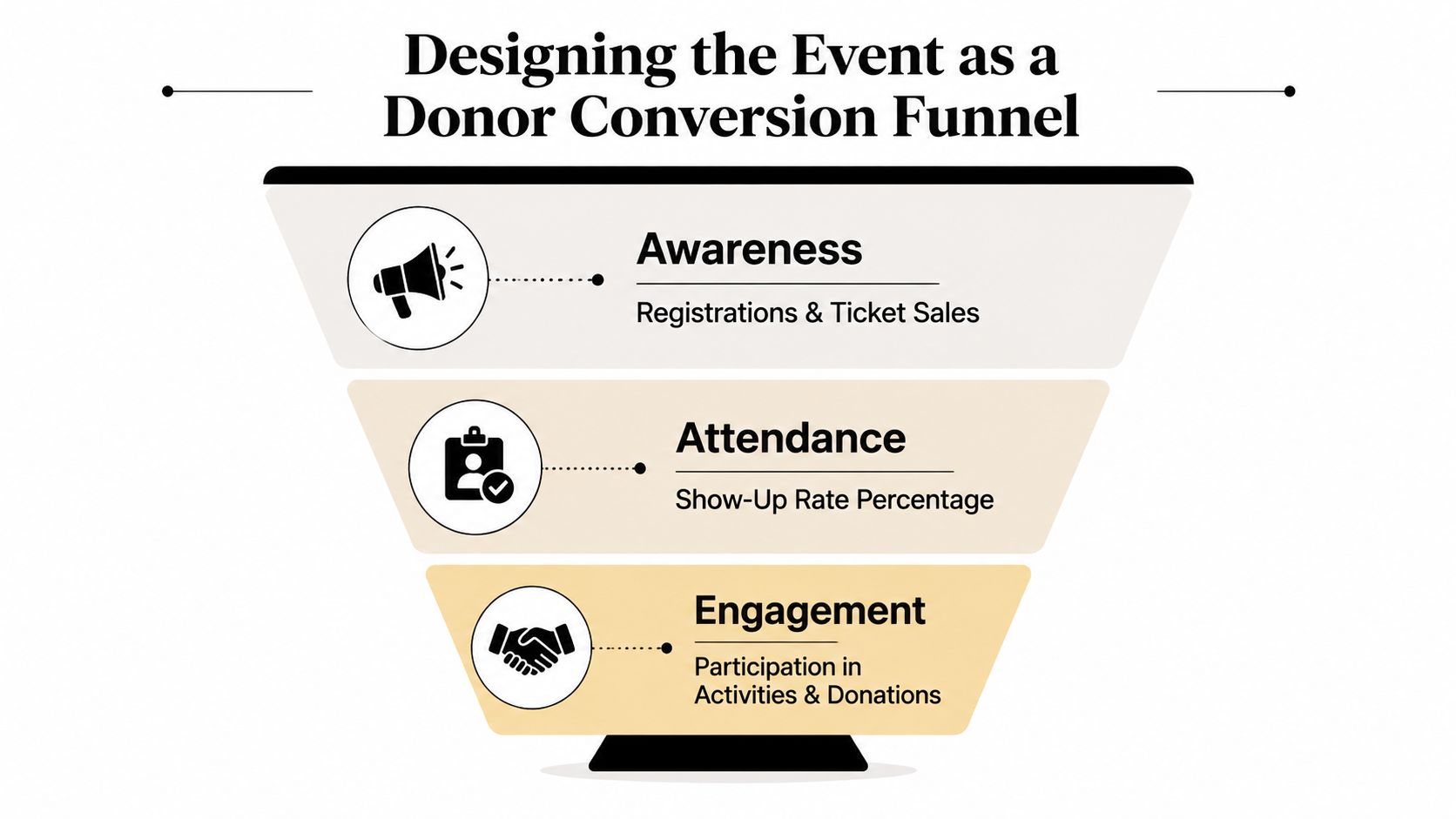
An event should have a measurable path from first invitation to sustained support. Treating the evening as a funnel changes the questions your team asks. Instead of saying, “We had a full room,” you can ask how many people registered, how many attended, how many participated, how many donated, and how many remained engaged afterward.
Expert guidance commonly defines event conversion rate as donors or actions taken divided by total attendees, multiplied by 100. Fundraising-event benchmarks often fall in the 15% to 25% range, while top-tier events can exceed 30%, according to RallyUp's event conversion rate guidance. Use those figures as comparison points, not promises. Your audience, event type, ask structure, and follow-up quality will affect the result.
Find the leaks before event day
At the awareness stage, the registration page should explain what attendance supports and make the next action obvious. Include a donation option during registration, but don't bury it beneath unnecessary fields. Use different messages for long-term donors, first-time prospects, volunteers, and sponsors.
Attendance problems often begin before the doors open. Send useful reminders, make parking and arrival instructions clear, and provide a contact for accessibility questions. A guest who arrives confused is less likely to settle into the experience or participate in the fundraising moment.
Engagement requires more than background entertainment. Give guests a reason to interact with the mission through a concise story, a program demonstration, an auction, a pledge card, a volunteer conversation, or a clearly explained impact activity. Your board members and staff should know which guests they're responsible for welcoming.
Make the ask easy to understand
The fundraising moment needs a deliberate place in the run sheet. A strong speaker can explain the need, show what support makes possible, and provide a direct next step. The audience shouldn't have to guess whether you're asking for a one-time gift, a recurring commitment, a pledge, or another form of support.
Afterward, track every action. A guest who didn't donate at the event may still become a donor through a follow-up message, a meeting, or a recurring-gift invitation. That's why conversion should be measured across the post-event period, not only during the program.
Securing Sponsorships and Choosing Turnkey Rental Solutions
Sponsors need a clear business case, especially when commitments are slower and budgets are tighter. Ask what audience the company wants to reach, which community it wants to support, and how it will judge participation. Then match benefits to those objectives. A sponsor focused on employee engagement may value volunteer opportunities, while a local business may prefer community visibility and direct attendee interaction.
A tiered structure makes discussions easier when each tier names specific deliverables rather than vague prestige.
| Tier Level | Expected Contribution | Key Deliverables | Sponsor ROI Metric |
|---|---|---|---|
| Platinum | Custom negotiated support | Prominent recognition, speaking opportunity, VIP allocation, mission integration | Qualified attendee reach and relationship opportunities |
| Gold | Custom negotiated support | Program recognition, selected signage, hosted activity or table | Brand impressions and engagement actions |
| Silver | Custom negotiated support | Program listing, shared recognition, standard event visibility | Attendance connected to sponsor exposure |
Document the value you promise. Track registrations tied to sponsor outreach, attendee interactions, website or QR-code actions, and renewal conversations. For golf fundraisers, these golf event sponsor ROI tips from Live Tourney offer practical ways to connect sponsor benefits with measurable outcomes.
Reduce vendor fragmentation
Separate providers for tents, staging, lighting, audio, entertainment, and photo experiences create more insurance documents, arrival windows, invoices, and day-of contacts. That workload grows when sponsors commit late and the event plan changes around their deliverables.
A turnkey rental partner can combine several operational needs in one plan. Phantom Entertainment, for example, offers event rentals and planning support that may include delivery, setup, operation, and teardown, depending on the selected service. Its photo booth rental service may suit an event that needs a simple participation feature without adding another vendor. Review the fit carefully. A consolidated provider reduces coordination, but it does not remove the need to check service terms, staffing, and backup plans.
Use this decision matrix before signing:
- Insurance and documentation: Confirm certificates of insurance, safety documentation, and venue requirements.
- Setup and teardown: Establish who handles delivery, installation, testing, removal, and cleanup.
- Contingency support: Ask what happens if weather, equipment failure, or access restrictions affect the plan.
- Single-point accountability: Identify who can resolve a day-of issue without sending your team across several vendors.
- Mission fit: Choose experiences that help guests connect, participate, or give rather than distracting from the purpose.
Lower production costs only help if the event remains easy to understand and easy to support. Put the budget into reliable access, clear sponsor fulfillment, and guest actions that strengthen participation. Fancy equipment cannot compensate for a confusing offer or an unprepared vendor.
Managing Volunteers, Promotion, and Day-of Logistics
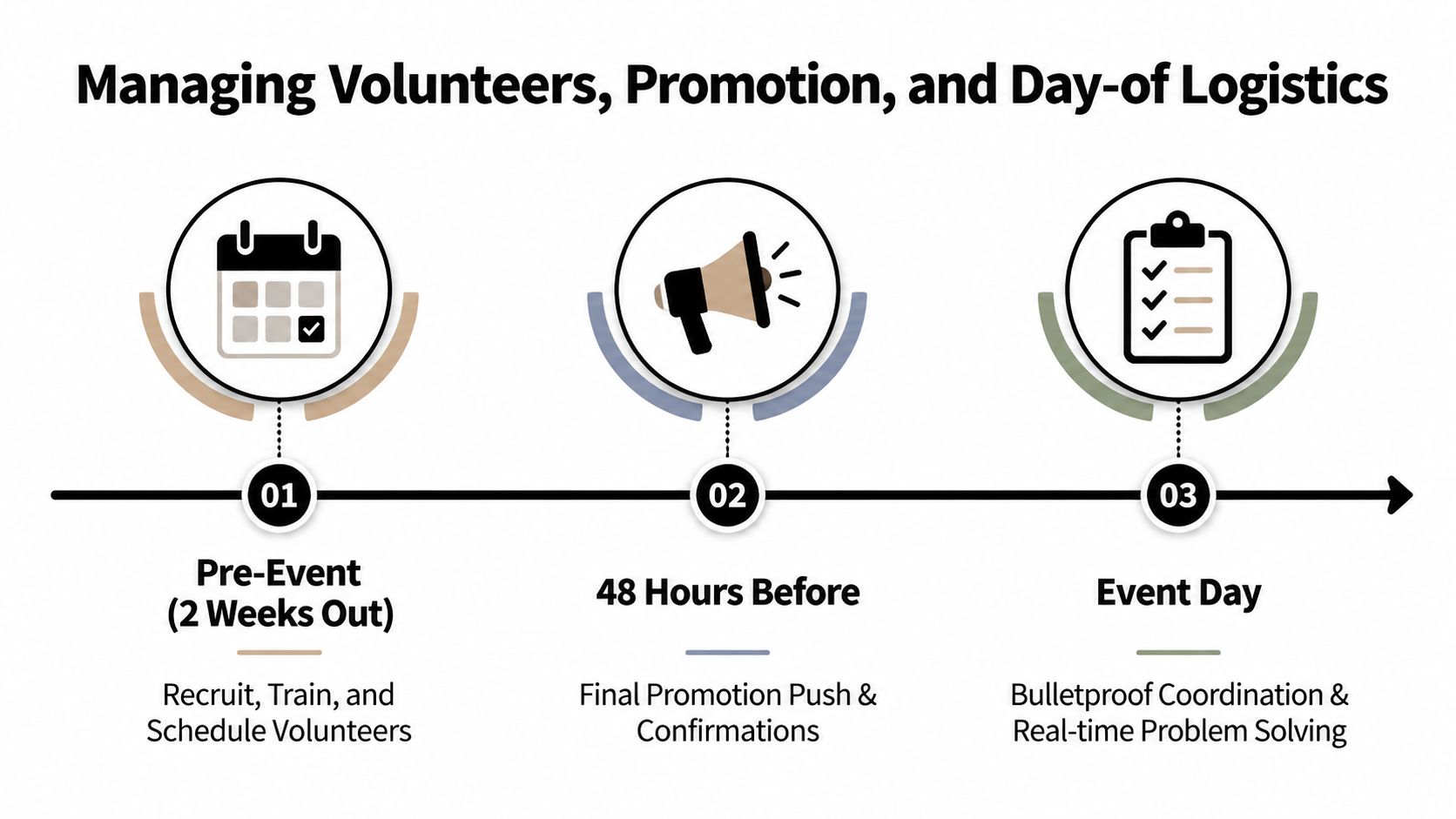
A volunteer may be enthusiastic and still fail in an undefined role. I've seen teams assign “general help” to several people, then discover that everyone thought someone else was handling check-in, speaker escort, or donation questions. The fix is simple but essential: give each person a named responsibility, a shift window, a meeting point, and an escalation path.
Appoint a volunteer captain. That person answers routine questions, reallocates coverage, and contacts the event lead when a problem affects donors or the program. Your core team should not be pulled away from guests because a registration table needs more pens.
Give promotion a rhythm
Begin with existing supporters and donors, then widen the message through partners, board members, social channels, and community groups. Share why the event matters, what guests will experience, and what their participation makes possible. Past event photos, speaker introductions, participant stories, and sponsor announcements can provide social proof without requiring expensive creative production.
Your final messages should remove hesitation. Confirm location, timing, parking, accessibility, ticket information, and the fundraising purpose. Last-chance communication works best when it creates clarity rather than panic.
Run the day from one document
Build a minute-by-minute run sheet that includes:
- Arrival: Vendor access, registration setup, volunteer briefing, technology checks.
- Guest flow: Parking, check-in, seating, food service, activities, and restrooms.
- Program transitions: Speaker cues, music changes, lighting, video playback, and timing.
- Fundraising ask: Speaker, story, donation method, pledge instructions, and support coverage.
- Closeout: Final announcements, guest questions, sponsor contacts, cash handling, and equipment removal.
A team can solve problems calmly when everyone knows who owns the decision. Turnkey setups with included teardown can also keep volunteers focused on guests instead of dismantling equipment after the final appeal.
Measuring True ROI and Building Long-Term Supporter Relationships
The event ends financially only after you account for the full cost of producing it and the revenue that follows. Gross dollars raised can look impressive while the net result remains weak. Calculate ROI as net income divided by expenses, multiplied by 100, and also track cost per dollar raised, pledge fulfillment, donor conversion, volunteer reactivation, and sponsor renewal.
The Julep CRM event fundraising summary emphasizes the importance of these measures and reports that 51% of nonprofits holding in-person or hybrid events met fundraising goals, compared with 9% of nonprofits that held no events. That comparison supports event activation, but it doesn't eliminate the need to assess net value and future relationship quality.
Treat follow-up as revenue work
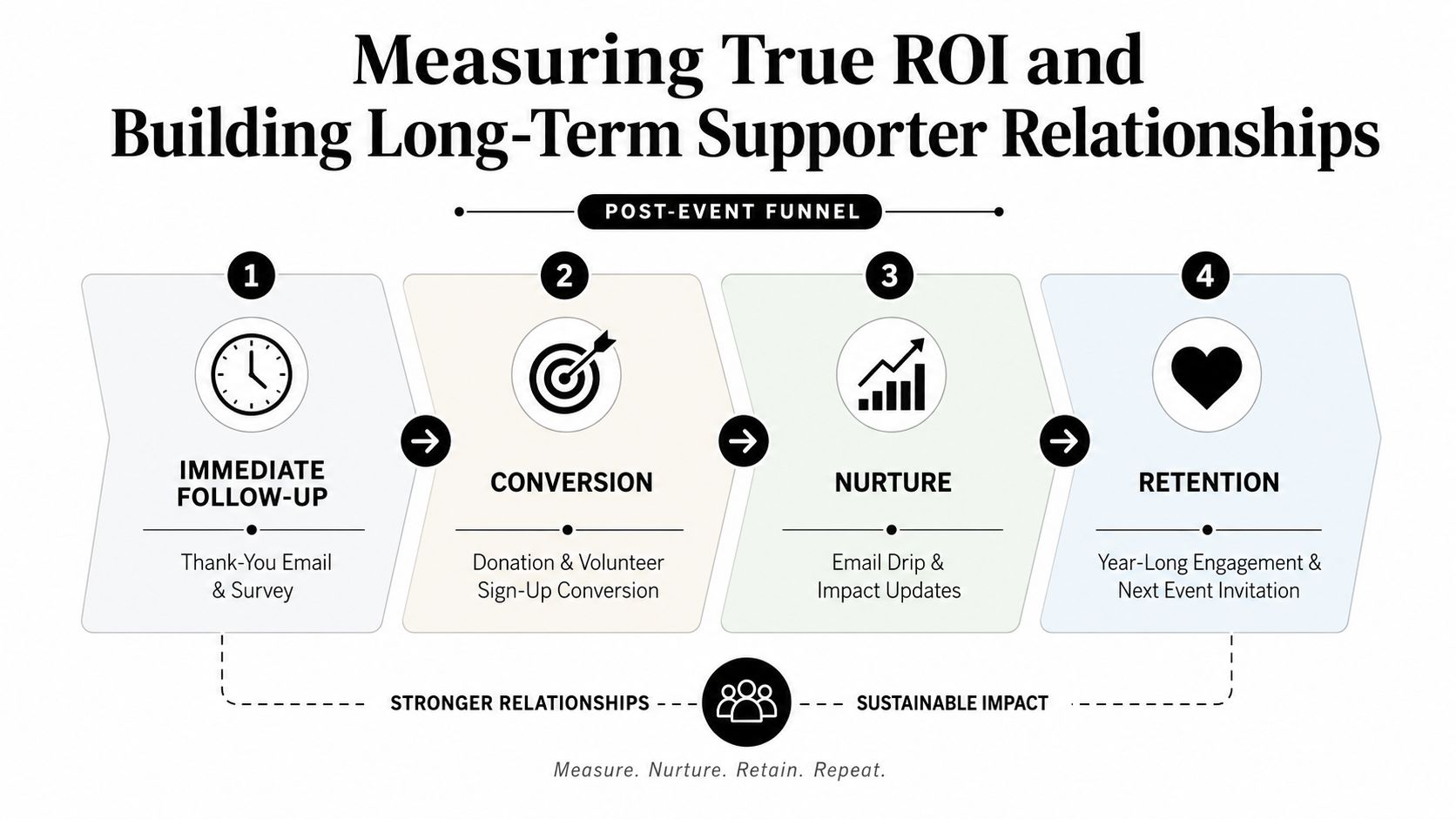
The first message should thank the supporter specifically and connect the event to the mission. Share an impact story, explain what the event made possible, and provide a clear next action. A recurring-gift invitation can work well for guests who showed strong interest but didn't make a substantial one-time contribution.
Segment the follow-up rather than sending one generic email to everyone:
- First-time attendees: Welcome them, explain the organization's work, and offer a simple next way to participate.
- Repeat attendees: Recognize their continued involvement and invite them into a deeper role.
- Lapsed donors: Reconnect their previous support with the current need and offer a low-friction return path.
- Volunteers: Thank them for their specific contribution and present another meaningful opportunity.
- Sponsors and major donors: Provide results, relationship notes, and a conversation about future partnership.
Send the initial thank-you promptly, then review donation activity, survey responses, meeting requests, and volunteer interest. For a broader framework on evaluating event performance beyond headline revenue, consult EventUploader's event ROI guide.
Create a usable event record
Your debrief should document what happened, not just how people felt. Record attendance, revenue by source, expenses by category, donor actions, unresolved issues, sponsor feedback, and volunteer observations. Note which parts of the program created energy and which caused delays or confusion.
That record lets the next planning team make informed trade-offs. A simpler event may be the stronger choice if it produces a healthier net result, cleaner donor data, stronger volunteer retention, and more sponsor confidence. The return is the combination of funds raised now and relationships that remain active afterward.
Phantom Entertainment provides event rentals, entertainment, delivery, setup, professional operation, and teardown options that can reduce logistical pressure for nonprofit fundraisers and community events. Visit Phantom Entertainment to discuss a turnkey event experience that protects your budget while keeping your team focused on donors and mission.
Ready to Book Your Event?
PA state-inspected, fully insured since 1979. Call us or get a free quote today.