

What makes a mini golf course work at an event: the windmill guests photograph, or the layout that lets them play without blocking the entrance? A memorable obstacle helps, but it's only useful when the surrounding course fits the venue, the audience and the operating plan.
Think of a portable course as a small event within your event. Players need equipment, a clear starting point, understandable challenges and somewhere to go when they finish. The best mini golf features support that whole journey, not just the photograph.
Mini Golf Features at a Glance
Mini golf features fall into three groups: lanes and hole layouts, obstacles and themed targets, and digital or support add-ons. Each choice changes the floor space you need, the installation work and the supervision required.
| Feature | Typical Footprint | Setup Effort | Staffing Need |
|---|---|---|---|
| Standard straight putting lane | Full lane outline plus putting stance and circulation space | Position sections, join surfaces and test the roll | Shared course attendant where all assigned lanes remain visible |
| Windmill or rotating blade | Obstacle base plus guarded movement area and maintenance access | Secure, connect power if required and test the moving mechanism | Assign responsibility for monitoring and safe shutdown |
| Tunnel or hollow-log hazard | Tunnel length plus unobstructed entry and exit areas | Align with the lane, secure and check ball retrieval | Shared attendant if balls return without intervention |
| Ramp or bridge | Ramp approaches, raised section and safe landing area | Stabilize supports, check transitions and test shots | Shared attendant unless retrieval or access needs extra support |
| Animated or themed target | Target base plus service access and any moving-part clearance | Secure the target and complete its power and function checks | Named attendant for faults, resets and power checks |
| Digital scoring and leaderboard | Stand or table plus accessible user space and protected cables | Configure devices, test connectivity and prepare backup scoring | Named staff member for device support and score queries |
These are qualitative planning ranges, not quotes or measured specifications. Confirm actual dimensions, installation allowances and staffing with the operator for your site. A narrow-looking obstacle can need substantial clearance once players, spectators and maintenance access are included.
Read the footprint as usable space
A lane's physical outline isn't its operating footprint. Someone must stand beside the ball, another guest may need room to pass, and an attendant must reach a stalled mechanism without stepping through another player's shot.
Planning rule: Judge a feature by the space people need to use it, not just the space its base occupies.
Keep those table rows beside your site sketch. Compare each proposed feature with its playing effect, surface requirements, access needs and effect on the queue before approving the final layout.
Hole Designs, Obstacles and Themes
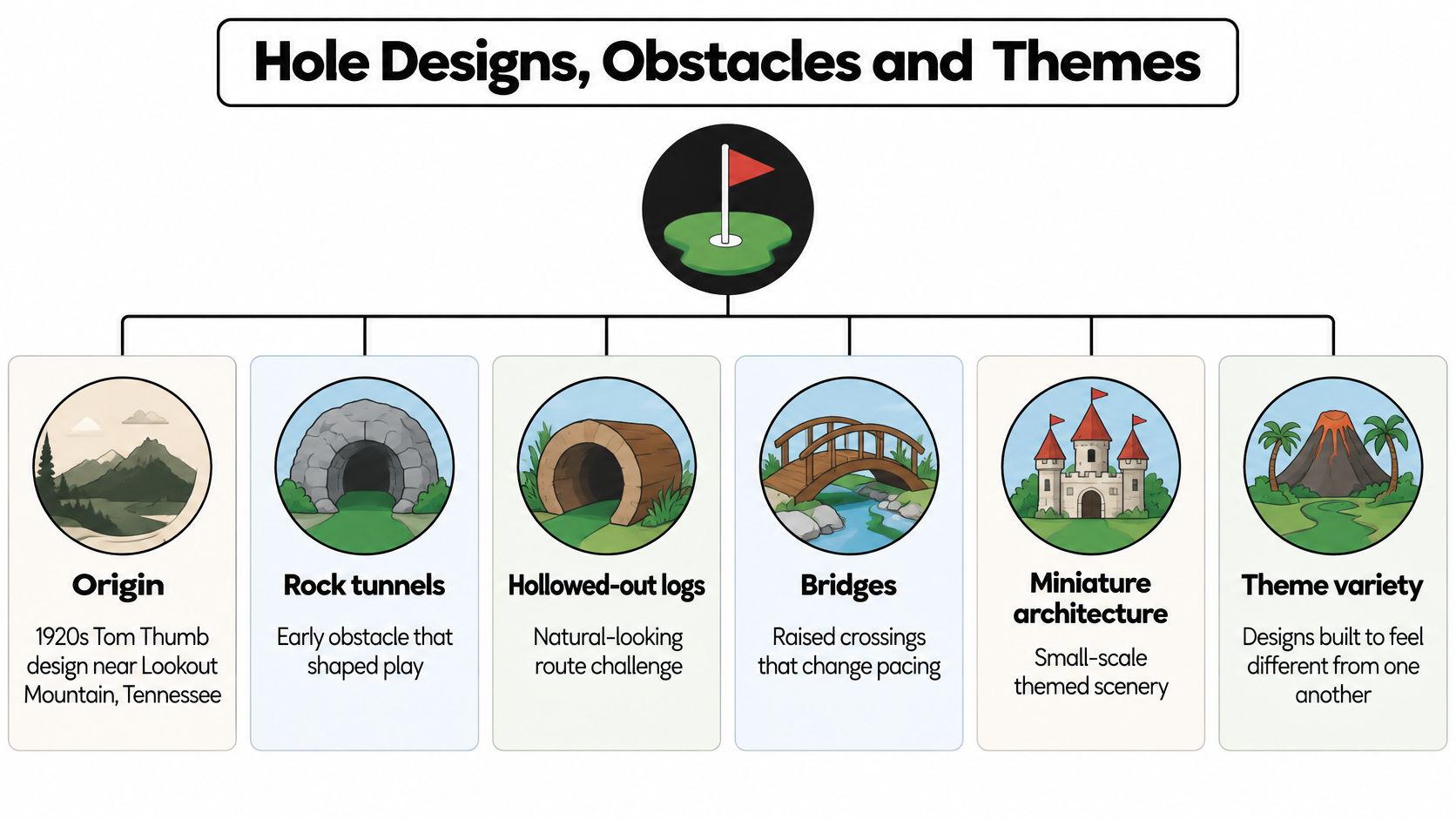
Modern obstacle golf grew from themed entertainment rather than just shrinking a golf course. According to Smithsonian Magazine's history of miniature golf, Garnet Carter's patented Tom Thumb design near Lookout Mountain, Tennessee, introduced rock tunnels, hollowed-out logs, bridges, miniature architecture, statuary and cottonseed-hull greens in the mid-1920s, and more than 25,000 courses reportedly operated in the United States by August 1930.
Think of a hole as a small stage set, with the ball as the performer. A useful obstacle changes what the player must do, while the scenery helps explain the setting.
The diagram separates those early design ingredients from their visual themes.
Group obstacles by the shot they create
- Timing challenges: Windmills and rotating blades ask players to wait for an opening. Check whether the mechanism is powered or passive, how it stops and whether an attendant can retrieve a trapped ball safely.
- Speed and risk challenges: Loop-the-loops and steep pirate-ship approaches reward a committed stroke. They also need containment, because a failed attempt shouldn't send the ball into a walkway.
- Hidden-route challenges: Tunnels and hollowed logs conceal part of the journey. Give players a clear entry line and make the exit easy for staff to inspect.
- Height changes: Bridges and ramps require enough speed to climb without overshooting the landing. Stable supports and smooth transitions matter more than dramatic height.
- Accuracy targets: Clown faces, themed openings and moving targets demand a precise line. Make the intended opening obvious from the putting position.
For younger children, favor visible routes and forgiving openings over demanding loops or exposed moving blades. Teenagers and adults may enjoy multi-stage tunnels and moving targets, provided the challenge doesn't require repeated staff intervention.
Separate the theme from the difficulty
Jungle, dinosaur, pirate, medieval, holiday and sports themes are usually a visual layer over those mechanics. A dinosaur mouth can surround an easy straight shot or a demanding narrow opening. Choose the imagery for the audience, then choose the challenge separately.
For accessory inspiration, the Waterloo Turf Indianapolis accessory recommendations offer a useful starting point for comparing putting-green additions. Treat that as an ideas list, not confirmation that an accessory suits temporary public use.
Our event themes page can help you coordinate the visual direction with the wider event. Keep tall scenery away from supervision sightlines, and use removable scenic panels when you want to refresh the appearance without rebuilding the playing surface.
A real playing feature changes the shot. Decoration changes the look.
Give each hole a clear main idea. Combining a hidden entrance, steep climb and moving exit can turn an entertaining challenge into a reset job.
Surfaces and Lane Speed That Stay Consistent
An Oregon State University study across 60 turf plots found that daily mowing followed by rolling produced an average ball-roll distance of 11 feet, about 15 inches farther than mowing alone; it also identified 8.5 feet as fast for ordinary play and 10.5 feet as fast for championship conditions. Those are putting-green reference points, not speed targets for a portable event course.
Players notice unpredictable roll before they appreciate elaborate scenery. If an apparently straight putt veers at a seam or stops on a wrinkle, they can't tell whether their stroke or the equipment caused the miss.
Choose consistency over maximum speed
Natural turf needs specialist maintenance. Cornell's putting-surface research describes closely maintained putting surfaces at approximately 2–4 mm and reports that heavier foot traffic reduces canopy cover, turf quality and ball-roll distance.
Synthetic lanes remove mowing from the event schedule, but they still need inspection. Match the pile across adjoining sections, flatten wrinkles and check that joins don't form a ridge. Keep pedestrian shortcuts off the playing surface, especially around popular targets.
On sloped outdoor sites, distinguish ground preparation from playing-surface adjustment. Modern Yard Landscapes' landscaping ideas for sloped Austin yards can help planners recognize grading and retaining-wall considerations, but landscaping inspiration doesn't establish whether a temporary lane is safely supported.
Run a repeatable roll check
- Set the test conditions: Use the same ball, marked starting position and repeatable stroke or suitable ball-release guide.
- Check the intended line: Test the route players are supposed to use, including joins, ramp transitions and the approach to the cup.
- Record exceptions: Mark lanes where the ball drifts, catches or travels noticeably farther than expected.
- Correct and retest: Remove debris, reset sections or groom the surface using the operator's approved method.
Repeat the check between sessions and after rain, heavy use or a moved section. Keep the test record with the attendant's opening checklist so the next shift knows which lane needs attention.
If a lane runs too fast, correct its surface or configuration. Adding another hazard won't repair inconsistent resistance, and it may make the queue longer.
Accessibility Features and How to Check Them
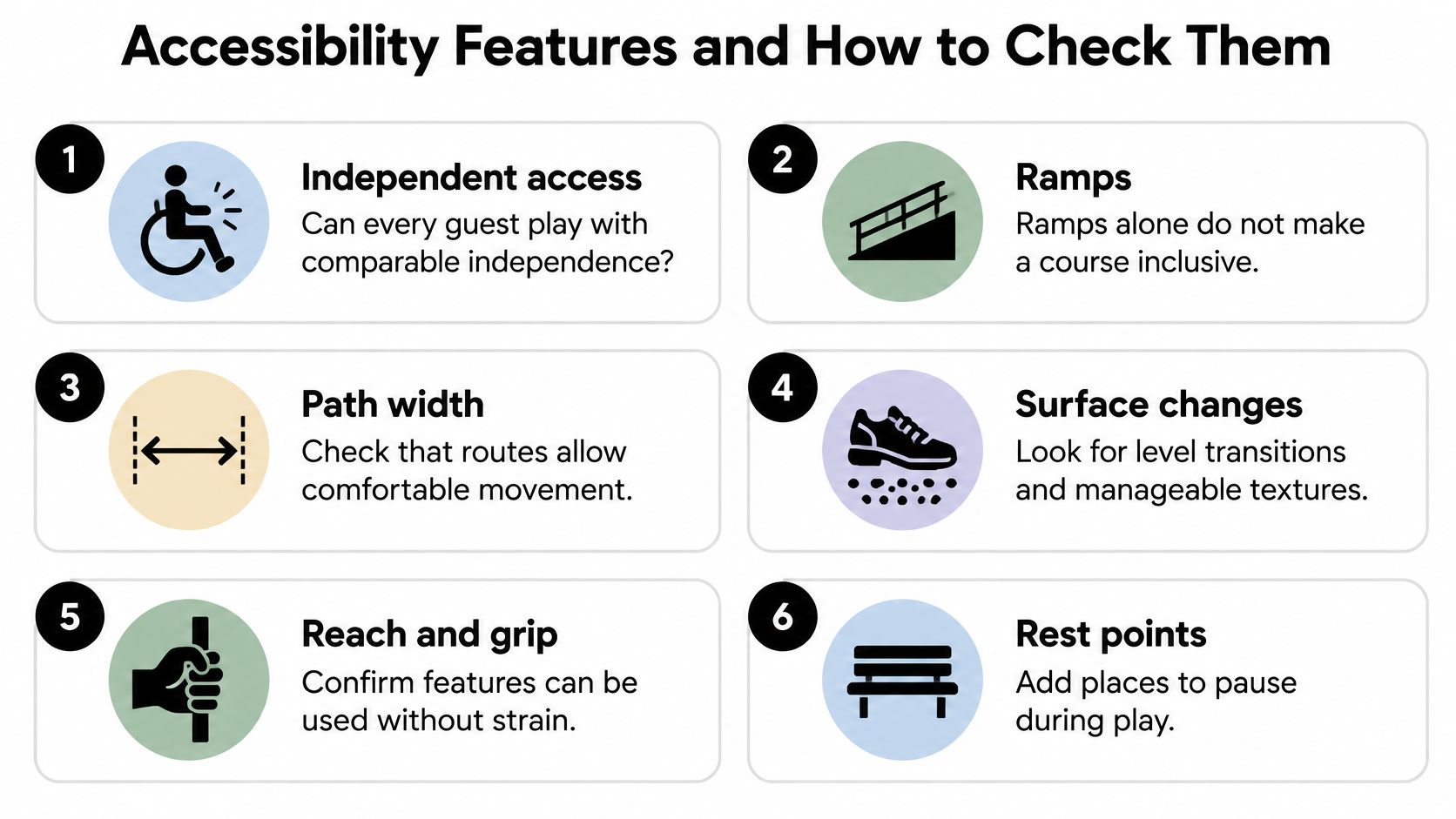
A ramp alone doesn't make a course inclusive. The practical question is whether guests can approach, play, retrieve equipment and keep score with comparable independence and dignity.
MarketIntelo's mini golf market report identifies accessibility requirements and safety responsibilities as operating considerations. For an event planner, that means replacing an all-ages claim with an inspection of the actual installation.
Use this checklist to frame that inspection.
Measure the complete player journey
Start at the event entrance, not the opening hole. Follow the route through equipment collection, play, resting places, scorekeeping and the exit.
| Element | Planning value |
|---|---|
| Accessible path between holes | Measure clear usable width and verify against applicable local requirements |
| Turning space | Confirm maneuvering space at tees, targets, junctions and dead ends |
| Reach range for scorekeeping and ball return | Check usable reach from seated and standing positions against applicable requirements |
| Route surface | Level or gently sloped, stable and free of abrupt transitions |
| Code check | Confirm dimensions and installation details against local code |
Don't treat a generic planning diagram as evidence of compliance. Ask for dimensioned documentation and check the installed route, including cables, sign bases and queue barriers that may narrow it.
Inspect the playing position as well as the path. A guest may reach a lane comfortably but still be unable to position a club beside a raised border.
- Grip and equipment: Ask what club lengths, grip options and ball choices are available, and whether a seated player can make a stroke.
- Visibility and rest: Check contrast around obstacles, readable hole numbers and seating that doesn't obstruct circulation.
- Scorekeeping and retrieval: Place scorecards, tablets and ball returns where guests can use them without stretching across equipment.
Include operations in the access plan
Sound, flashing lights, crowding and pressure to hurry can make a physically navigable course difficult to use. Offer a quieter playing period or lower-sensory route where feasible, and brief staff to explain rules plainly without rushing the player.
Staff should ask before assisting. Taking a club or moving a mobility aid without permission removes the independence the layout was intended to provide.
If a feature cannot be accessed, offer a comparable playing alternative, such as a seated putting station. Scoring can be an optional role, but it shouldn't become the default substitute for someone who wants to play.
Inclusion means offering a meaningful choice, not assigning someone to watch.
Before signing, request the route drawing, access documentation, assistance arrangements, weather alternative and a named contact for accommodation requests. Invite guests to raise access needs privately before the event, then confirm how those requests will be handled.
Matching Features to Each Event Type
The National Golf Foundation estimates that approximately 18 million Americans play mini golf annually, with 22% of participants classified as juniors. That mix supports family programming, but it doesn't mean every feature suits every audience.
Shared play works best when adults and children can understand the same hole without needing the same skill.
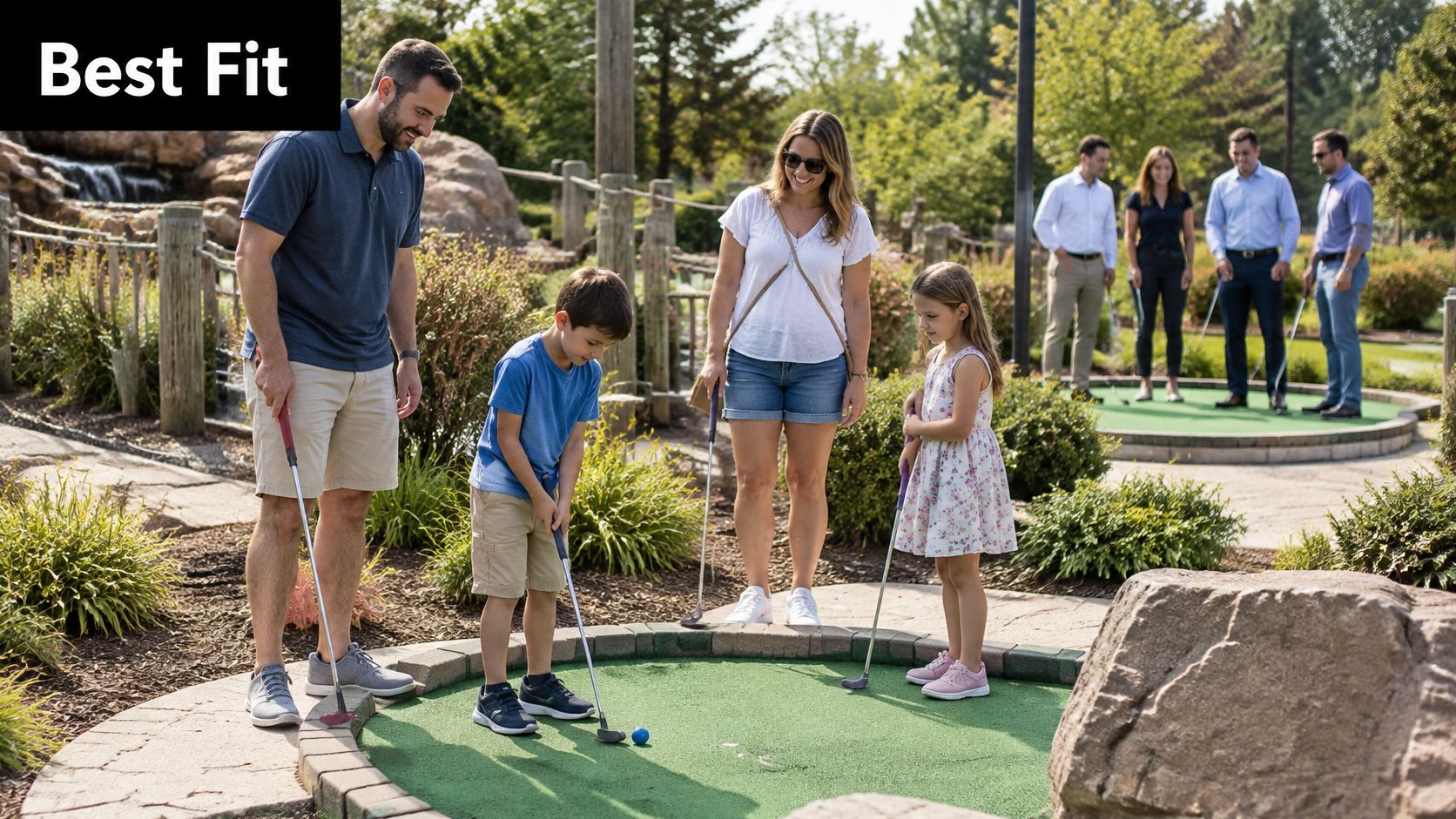
| Event Type | Best-Fit Features | Feature to Avoid | Typical Staffing |
|---|---|---|---|
| School field day | Short holes, numbered lanes, low obstacles | Mechanical targets needing long power runs | Allocate attendants by sightlines and student supervision needs |
| Corporate family day | Mixed-skill lanes, scorecards, shaded holes | Long rounds that stall the queue | Cover welcome, course assistance and breaks |
| Festival or fair | Themed holes, spectator space, quick rotations | Exposed lanes without nearby shade or seating | Separate queue management from course supervision |
| Birthday or grad party | Themed targets, optional digital leaderboard | Fast lanes for young children | Provide a named host and sufficient course oversight |
| Competitive league | Lane-speed control, digital scoring | Hazards with inconsistent playing behavior | Assign scoring support and an impartial rules official |
These staffing descriptions identify roles to cover, not guaranteed headcounts. Combine roles only when the layout, attendance and operator's safety plan permit it.
Match the feature to the audience's task
For a school field day, the task is moving a supervised group through an understandable activity. Visible numbering prevents wandering, while low obstacles let teachers and attendants see across the course. Long power runs introduce cable management without necessarily improving the children's game.
At a corporate family day, guests may stop to talk, help a child or join late. Give them forgiving routes and space to pause outside the active lane. Our corporate parties page provides context for fitting the activity into the wider gathering.
Festival visitors need a clear promise about where to start and when they'll finish. Put spectator space beside the course rather than across its exit, and provide a nearby resting option so waiting relatives don't occupy the playing area.
For parties, a leaderboard can create a shared focus, but it shouldn't require every young player to operate a device. Competitive groups have a different priority: predictable conditions and a clear process for handling disputed scores.
The video offers another visual reference for considering the attraction within an event setting.
Drop-in play needs a short commitment, scheduled rotations need orderly handovers, and leagues need consistent playing conditions. For a mixed-age event, the best feature keeps the queue moving while giving the youngest guest something achievable to enjoy.
Estimate Throughput and Queue Time
How many players can the installed course accommodate? A course inventory won't answer that question, because the slowest hole, the starting procedure and the number of groups allowed to play together all affect capacity.
Measure the operating format, not just the number of lanes. A lane is a playing station, not automatically a complete round.
Time a realistic rehearsal
- Count usable playing stations. Exclude any lane held back for maintenance, demonstrations or an alternative playing arrangement.
- Run the intended format. Have staff play with the planned group size, equipment handover and scoring method. Record full-round time and time spent at individual holes.
- Identify concurrent capacity. Establish how many groups can safely occupy the course without crowding or hitting into another group.
- Calculate a starting estimate. Divide the minutes available in an hour by the measured average round time, then multiply by concurrent groups and players per group. This is a planning calculation, not a promised delivery rate.
- Check the bottleneck. Compare that estimate with observed departures during the rehearsal and leave operating room for assistance, resets and breaks.
Don't multiply full-round turnover by every lane unless each lane supports an independent round. On a sequential course, that shortcut can overstate capacity because each group must travel through the same chain of holes.
Diagnose waiting before adding equipment
Record why players stop. A ball trapped inside a target requires a different fix from a guest waiting for a shared putter or a group struggling to enter scores.
- Equipment delays: Put spare clubs and balls at the handover point.
- Navigation delays: Make hole numbers and the exit visible from the preceding playing position.
- Feature delays: Simplify a repeatedly stalled mechanism or remove that hole from the active route until it's corrected.
- Arrival surges: Use scheduled starts or timed rotations rather than allowing the entrance queue to spill into circulation space.
Digital scoring earns its place when it supports the tournament or removes a demonstrated scoring delay. Otherwise, paper scorecards avoid charging, connectivity and device-support tasks.
Test capacity with people playing, not with empty lanes on a floor plan.
Confirm Footprint and Staffing Before You Book
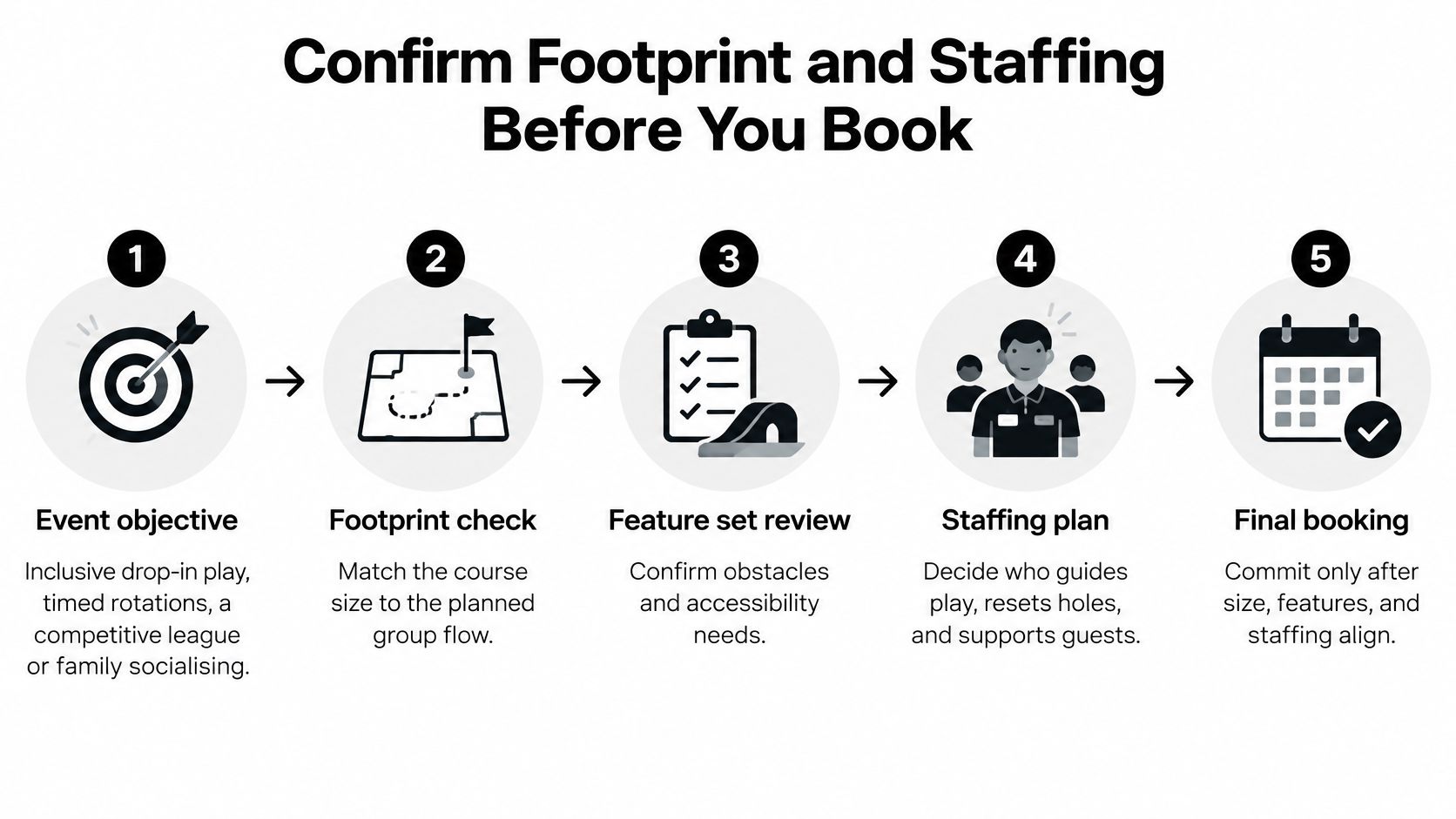
Start by naming the event objective: inclusive drop-in play, timed rotations, competitive play or family socializing. That decision gives you a practical way to reject features that look attractive but don't serve the event.
Greenspan's mini golf business trends overview discusses technology-led developments such as digital scoring and interactive experiences. For a temporary installation, approve those additions only after the physical and operational plan works.
Use this sequence to bring the decisions together.
Turn the concept into a booking specification
Survey the site. Measure the usable area, delivery route, surface condition and access to suitable power. Mark exits and protected circulation routes before drawing the course, because those spaces aren't available for obstacles.
Obtain a dimensioned layout. Show each hole's installed outline, playing position and service clearance. Include the queue and equipment desk so the drawing represents the attraction in operation.
Approve the feature set. Match each obstacle to the event objective and confirm its installation requirements. Identify powered components, protected cable routes and what happens if a feature stops working.
Assign operating roles. Name who welcomes guests, supervises play, handles resets and provides assistance. Give mechanical and digital equipment a named responsible person, adding dedicated coverage where the operating assessment requires it.
Validate capacity. Agree how round time and arrivals will be checked, and decide who can change the starting pace. A course that fits physically may still be unsuitable for a tightly scheduled rotation.
Include commissioning. Put surface inspection, test putts, mechanism checks and staff briefing on the opening checklist. Installation isn't complete merely because the sections have been unloaded and positioned.
Confirm contingencies. Document weather decisions, alternative layouts, accessibility arrangements and accommodation contacts. Specify who authorizes a pause or closure, rather than leaving that decision to an unbriefed attendant.
Confirm the interfaces in writing
Footprint, power, supervision and player flow interact. Moving a target to reach a socket may obstruct a route; changing the route may remove an attendant's sightline.
Use our frequently asked questions to prepare your booking discussion, then request event-specific confirmation of unresolved details. We list Mini Golf alongside Karaoke, Laser Tag and Lawn Games, but each activity still needs its own space and operating plan.
Confirm the site survey, layout, features, roles, capacity check, opening procedure and contingencies in writing. Book the feature set that passes those checks, rather than the most elaborate set that fits on the delivery truck.
Phantom Entertainment offers Mini Golf, Lawn Games, Laser Tag and Karaoke for event programming. Visit Phantom Entertainment with your site measurements, audience details and preferred playing format to discuss a mini golf setup that fits your event.
Ready to Book Your Event?
PA state-inspected, fully insured since 1979. Call us or get a free quote today.