
You're at a company picnic, school field day, or family party, and someone has just invited you to try the mechanical bull. The crowd is cheering, the operator is waiting, and you're wondering whether staying on is all about gripping harder. It isn't. Good mechanical bull riding tips start with knowing how to ride within your control, and what to do the instant you lose it.
The fall is the moment that deserves the most planning. A rider who knows when to release, where to move, and when to wait for the operator can avoid turning a fall into a second impact.
Core Riding Tips That Keep You in the Saddle
In a U.S. emergency-department study of mechanical bull injuries recorded from 2000 through 2020, 61.6% of estimated injuries involved a rider falling or being thrown. That makes fall prevention and a controlled exit more useful than trying to master a dramatic trick. The table puts the basic habits in one place. The study published in the American Journal of Emergency Medicine estimated 27,903 mechanical bull-riding injuries nationally over the study period.
| Element | Do | Avoid | Why it matters |
|---|---|---|---|
| Grip | Hold the handle firmly with your fingers around it | Wrapping your hand or wrist around the rope | A wrapped hand can trap the wrist when the bull jerks |
| Free arm | Keep it out, clear, and away from the bull | Tucking it under your body or gripping the frame | Upper-extremity injuries were the most common affected body area in the study |
| Seat and posture | Sit centred, hips over the saddle, knees soft | Leaning far forward or back, or locking your knees | Excessive lean shifts your weight beyond the balance point |
| Timing | Move with the bull's rhythm using small adjustments | Fighting each motion with large counter-moves | Big corrections can overshoot and throw you off balance |
| Starting speed | Begin on the operator's lowest setting | Asking for maximum speed on your first ride | A gradual start gives you time to learn the motion |
| Recovery | Release the handle and move away when balance is lost | Hanging on through a fall | Letting go helps keep you out of the bull's swing path |
| Ride length | Take short rides and rest between them | Chaining back-to-back rides | Fatigue can weaken your posture before you notice it |
Hold the handle securely, but don't wrap your hand around the rope. Keep your free arm clear instead of reaching for the frame or tucking it under your body. The study found that 45.8% of estimated injuries affected the upper extremity, a reason to avoid using an outstretched arm to catch yourself.
Stay centred and make small corrections through your hips. If you lean hard against every turn or jerk, your body can move farther than the bull does. Riders who want to build general trunk control can explore these core stability training tips, but fitness isn't a substitute for a safe setting or an attentive operator.
Beginner rule: Start at the lowest setting, take a short ride, and rest before another attempt. Before you climb on, decide what you'll do if your balance goes: release, move in the operator's indicated direction, and wait for the bull to stop.
If you're organizing a party or looking for a mechanical bull rental, ask the operator to explain the controls and stopping procedure before the first rider gets on.
What to Wear and Disclose Before You Climb On
Choose closed-toe shoes with grip and fitted clothing that won't snag or trail. Secure long hair, remove loose jewellery, and take off glasses or fasten them so they can't fall. Avoid dangling sleeves and drawstrings. These choices reduce distractions and loose items around moving equipment.
Screening matters as much as clothing. Tell the operator about back or neck problems, heart conditions, seizure disorders, a recent concussion, balance or inner-ear problems, and recent arm, wrist, or shoulder injuries. The operator should apply the vendor's age, height, and weight restrictions rather than making exceptions at the rope line. Those limits are part of how the equipment and its settings are intended to be used.
A 2025 pediatric trauma study found that among 35 children treated at a level-I trauma centre after mechanical-bull injuries, direct impact from the device was the most common mechanism, at 71.4%. The same study reported traumatic brain injury in 65.7% of those children. The pediatric study is a reminder that a slower ride alone doesn't remove the risks of contact with the moving bull.
Children and less confident riders need close supervision, suitable settings, and the freedom to opt out without being singled out. Offer a spectator role or another activity as a normal choice. Anyone who has been drinking or is otherwise impaired shouldn't ride. General screening isn't medical clearance. If a person has a relevant condition or recent injury, they should ask a qualified clinician whether riding is appropriate.
At the rope line, check: suitable shoes and clothing; honest disclosure; compliance with rider limits; no impairment; and a clear choice to ride or sit out.
Pre-Session Checks, Briefing and Operator Cues
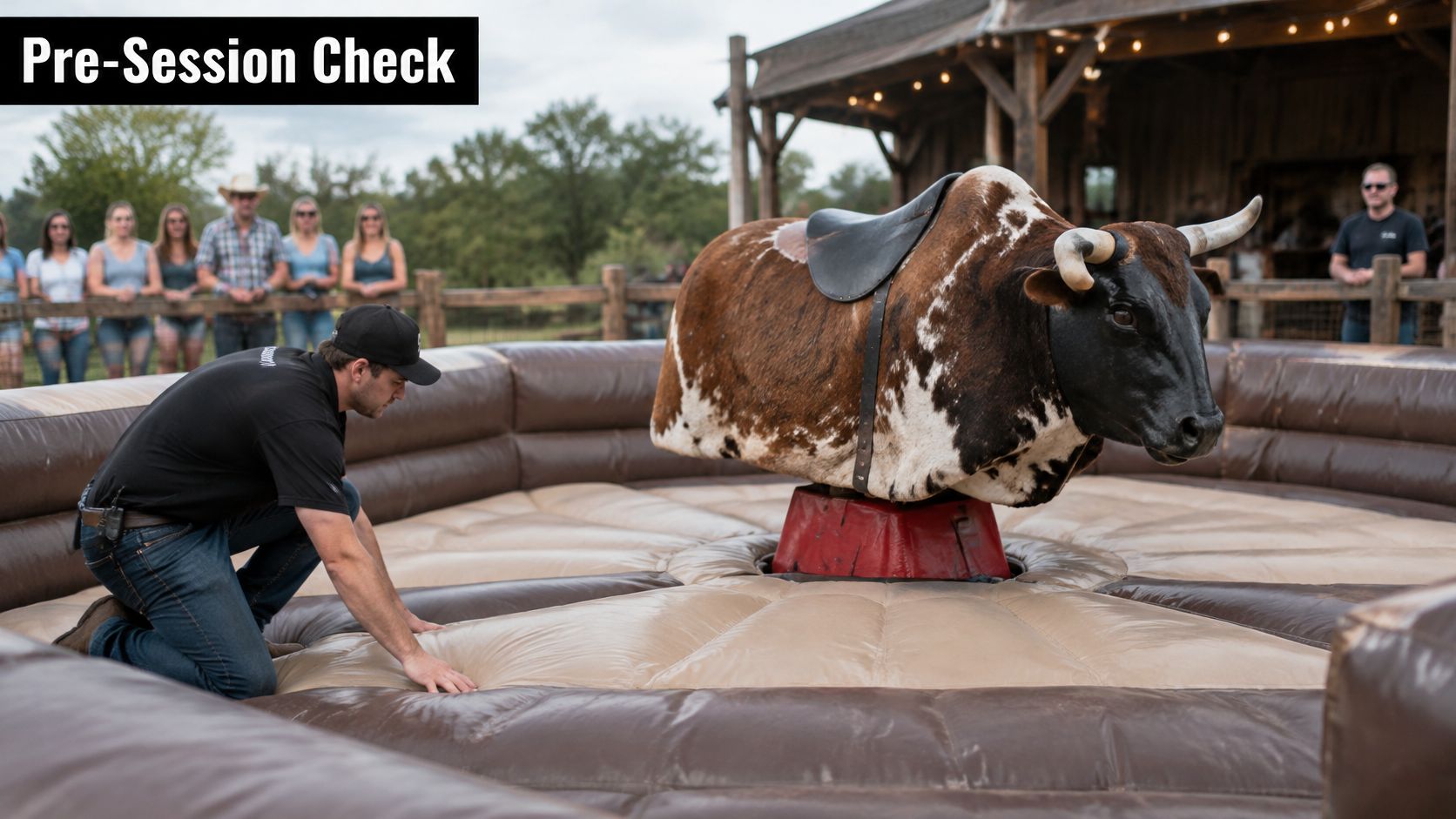
A fall rarely starts at the moment the rider lets go. It starts earlier, with a gap in the padding nobody noticed, an operator whose hand wasn't on the stop switch, or a rider who never learned the cue. Run the checks below in a fixed order before riders gather.
Confirm the landing padding is continuous, correctly positioned, and free of gaps or worn sections. Mark the clearance around the bull so spectators stay outside the fall zone; on outdoor ground, wetness or unevenness can undermine the landing surface. Inspect the handle, saddle, frame, cushioning, cords, anchors, and power supply. With the bull unoccupied, test the emergency stop and verify that the operator can reach and use it immediately. Keep the inspection log and the vendor's certificate of insurance on site. For a wider event checklist, planners can review amusement ride planning considerations alongside the ride-specific checks.
Then give every rider the same short briefing. The operator can read it aloud:
- "Sit centred, hold the handle without wrapping your hand, and keep your free arm clear."
- "Use the agreed stop cue if you feel unsafe or unwell."
- "If you fall, release, move away in the direction I indicate, and wait for a full stop."
- "No pushing or horseplay around the ride."
- "Tell me right away if you feel unwell."
Point 3 does the important work. A rider who has lost grip needs one decision: release and roll clear, not hang on. The operator's job in that same second is to stop the bull so the machine doesn't swing back into the fallen rider. Agree on the cue set before the ride starts: a spoken stop word, a raised free hand, and a signal the operator can see through noise and movement. Using a stop cue is never a failure, and a cheering crowd must not pressure a rider to accept a higher setting.
During each ride, keep a hand at the emergency stop, start at low intensity, and increase motion only while the rider remains controlled. Stop promptly if posture fails, the rider contacts the outer frame, or the rider drifts toward an edge. Spotters stand outside the fall zone and watch the rider rather than the crowd, ready to direct a fallen rider away from the bull's path. For children, assign one spotter per rider where possible.
ASTM F2291 identifies patron restraint, clearance-envelope, and containment design as safety criteria for amusement rides and devices. The ASTM F2291 standard gives planners and operators a technical reference for those design considerations. Log attempts, controlled dismounts, stops, and incidents for each session. A local record helps event teams review how their own operation is working.
Mounting, Riding and Exiting Step by Step
Follow the same order every time. The safest exit begins before anyone climbs on, with a clear cue and an operator who's ready to stop the machine.
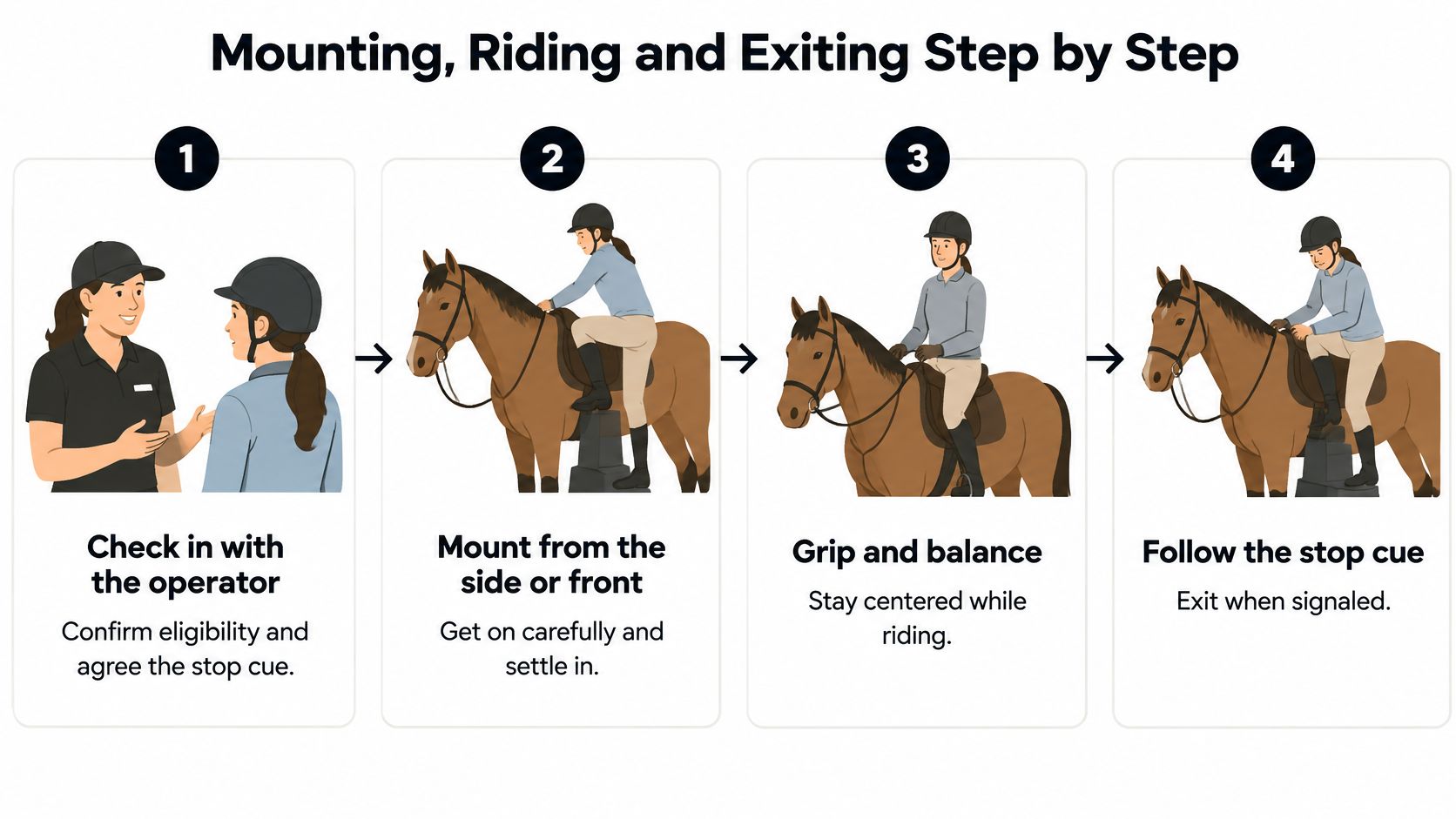
Check in with the operator. Confirm you meet the rider limits, disclose relevant concerns, and agree on the stop cue. Don't climb on until you know how to signal for a stop.
Mount as directed. Use the side or front position the operator indicates, then place your weight over the centre of the saddle. Set your closed-toe shoes flat on the footrests rather than stepping into the bull's moving area.
Set your grip and balance. Hold the handle with one hand, keep your free arm clear, and settle into a centred posture before asking for motion. Starting before you're balanced makes the first movement harder to manage.
Begin at the lowest setting. Ask the operator to start gently, and use the stop cue if your posture slips. Don't try to prove you can handle a setting that's already pushing you toward the edge.
Release when balance goes. Let go immediately instead of hanging on through a fall. Trying to recover with a desperate grip can pull your arm or shoulder into the bull's movement.
Move in the indicated direction. Once you're down, get clear of the bull's path as directed by the operator. Don't step back toward it or stay beside it to check what happened, because it can swing back.
Wait for a full stop. Stay where the operator directs until they confirm the equipment has stopped. Don't climb off or cross the landing area while the bull is still moving.
Leave the landing area. When the operator gives the signal, turn away from the bull, step down carefully, and move clear before the next rider approaches. The operator, not the crowd, should control when the area is ready.
Common Riding Problems and How to Fix Them
Sliding sideways is a sign that your weight or arm position is pulling you off centre. Reset your hips and relax your free arm; gripping harder often adds tension without fixing the shift. If it happens again at the same setting, stop and ask the operator to reduce the intensity or pause.
| Symptom | Likely cause | Fix during the ride | Stop immediately if |
|---|---|---|---|
| Sliding to one side | Weight shifted and free arm pulling | Re-centre your hips and relax your free arm | It happens on two attempts at the same setting |
| Feet bouncing off footrests | Knees locked or tensed | Soften your knees and absorb motion through your hips | Your feet leave the footrests and you can't reset |
| Pitching forward into each motion | Pulling on the handle and leaning in | Sit back, loosen your grip, and lift your chest | You can't sit back without losing the handle |
| Hands slipping | Sweaty or wrapped grip | Re-grip the handle, not the rope, and dry your hands between rounds | Your hand slips while the bull is moving fast |
| Feeling thrown toward an edge | Speed too high or weight off centre | Release the handle and move toward the operator's exit direction | You move toward the frame or edge |
| Freezing or panicking | Overwhelmed by speed or motion | Ask for a stop and step back from the bull | You can't release the handle on your own |
Most correctable problems call for a posture reset or a lower setting, not more force. A rider whose balance continues to fail shouldn't keep repeating the same attempt at the same intensity. Ask for a pause, then decide with the operator whether a gentler setting is suitable.
If you freeze, don't try to finish the ride. Signal for a stop, release the handle when you can, and let the operator help you exit.
Confirm the Setup and Rider Limits Before You Ride
Use three decisions when planning the session: go, adjust, or cancel. A good setup doesn't mean every rider should use the same setting, and a booking doesn't obligate an event to run when conditions are unsafe.
| Decision | Conditions |
|---|---|
| Go | Landing area is padded; operator is trained and has tested the emergency stop; briefing is complete; every rider has been screened |
| Adjust | Rider is borderline, the group includes younger or less confident participants, or the rider list is long. Slow settings, shorten rides, add a spotter, or offer an alternative attraction |
| Cancel | Surface is wet or uneven; the emergency stop can't be demonstrated; riders are impaired; spectators can't be kept outside the fall zone |
When booking, ask the provider for three things: a certificate of insurance, a walkthrough of the setup area, and written rider restrictions. These let you check the paperwork, physical layout, and eligibility rules before event day. For common planning questions, consult the mechanical bull rental FAQ.
No rider technique can compensate for an untested stop, an unsafe landing area, or an operator who isn't watching. If any of those essentials is missing, change the plan rather than asking riders to take the risk.
Phantom Entertainment brings mechanical bulls and other event attractions to schools, company gatherings, family celebrations, and community events, with delivery, setup, and professional operation. If you're planning an event in Pennsylvania or the Mid-Atlantic, visit Phantom Entertainment to explore the options and discuss the setup and rider needs for your gathering.
Ready to Book Your Event?
PA state-inspected, fully insured since 1979. Call us or get a free quote today.