
The most popular laser tag setup advice is to find the biggest open space available. That's the wrong starting point for a school field day or company picnic. A sprawling field won't help if children spend the round walking, staff can't see the far boundary, and the next team waits beside a pile of unpaired packs.
A practical laser tag set up starts with the number of guests you need to move through the activity, the equipment available, and the people supervising it. Then you draw a field that supports that plan. The play area matters, but so do the places where guests listen, get fitted, wait, and leave.
Space That Fits Your Player Count
In a school gym, corporate lawn, or festival lot, your first decision is how many people can play at once without crowding the usable field. Choose the format before measuring capacity. Traditional tag and tactical play don't use space in the same way.
Laser tag space and player capacity
The planning allowances and examples below follow Infinity Next Play's laser tag business guide, which gives approximately 140 square feet per traditional player, approximately 270 square feet per tactical player, and the corresponding capacity examples.
| Format | Space per player | Example field | Players that fit | Keep outside the field |
|---|---|---|---|---|
| Traditional gym or hall | About 140 sq ft | 3,000 sq ft | About 21 | Briefing, vesting, queue, exit |
| Tactical with cover and objectives | About 270 sq ft | 3,000 sq ft | About 11 | Briefing and equipment issue; preserve longer lanes within the field |
| Open-air mobile pad | About 140 sq ft traditional | Choose dimensions after marking staging | Usable active area divided by the allowance, rounded down | Spectator lane and power connection |
| Twenty-player traditional group | About 140 sq ft | About 2,800 sq ft active | 20 | Circulation beyond the active area |
Treat these as planning allowances, not approved occupancy limits. The equipment format, obstacles, supervision, and venue requirements still determine whether the proposed layout works.
Measure usable space, not the room label
Start with a tape measure or laser distance meter and sketch the actual perimeter. Mark doors, columns, folded bleachers, storage cages, trees, drainage dips, and anything else that takes space away from play. A venue's advertised floor area isn't necessarily available to your activity.
In a school gym, put the briefing and equipment tables along a permitted staging edge, not wherever the delivery cases happen to land. Keep the players' return path away from the next group's entry. If those functions consume part of the gym, reduce the active area before estimating player capacity.
On a corporate lawn, draw the boundary around the sound surface rather than around the property line. A broad lawn with a muddy depression through its center is not a broad usable field. Leave room for spectators to watch without becoming an accidental boundary.
Practical rule: Count only the space where a participant can actually move and play. Equipment tables, waiting families, and access routes don't belong in that calculation.
Choose the game before adding acreage
Tactical play needs room for deliberate movement, cover, and team objectives. Traditional event play can use a more compact arrangement with recognizable landmarks and straightforward routes.
For younger guests, I would choose a field staff can oversee easily rather than extend the boundary just because more lawn is available. Extra distance creates more walking, not necessarily better decisions or more enjoyable play. Add space when the game needs it, not because the venue has it.
How to Set Up the Field and Packs
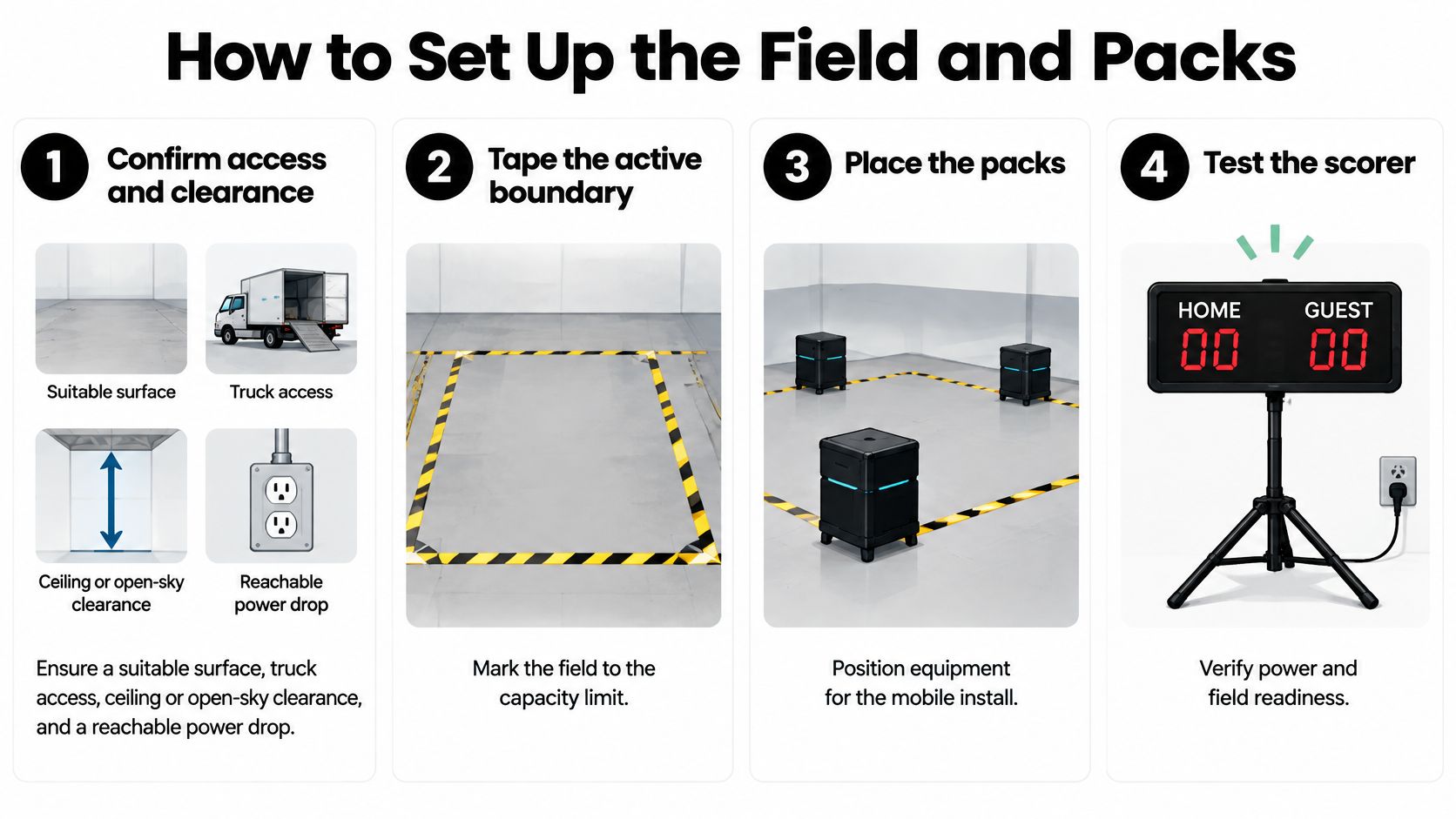
Unload in the order you'll build, not the order the cases fit in the truck. Keep the operating kit, boundary markers, and venue sketch accessible so the crew can establish the layout before spreading equipment across the site.
Build the field in a controlled sequence
Confirm access and clearance before unloading. Walk the truck route, inspect the surface, check overhead clearance, and identify the power connection required by the booked equipment. This prevents a completed layout from needing relocation. A common slip is accepting a nearby outlet without checking whether the scorer's cable can reach it safely.
Mark the active boundary and staging route. Use venue-approved floor tape indoors and suitable visible markers outdoors. Keep the incoming team's route outside active play so staff can prepare guests without interrupting a round. Don't drive stakes into a lawn until the venue has identified irrigation and underground services; a sprinkler head isn't a boundary anchor.
Place cover around movement and sight lines. Arrange obstacles so players can change direction without colliding at blind corners. Inspect protruding fittings, loose edges, and openings that encourage squeezing through. The usual mistake is creating an impressive-looking maze that staff can't supervise or that leaves a corner completely dark.
Position the scorer and equipment station. Put the control point where the operator can observe play and receive returning equipment. Keep emitters, vests, and charged spares on tables or racks rather than on the ground. Don't hide the scorer behind a neighboring bounce house just because that's where the extension cable ends.
Power on and test every assigned pack. Pair equipment, confirm team assignments, and register a test hit at each sensor position the system uses. Check the control display as well as the pack's local response. Skipping this until guests are already vested turns a simple equipment correction into a queue problem.
Walk the layout under operating conditions. Use the lighting planned for play, check the spectator edge, and follow the entire exit route. In a gym, look for floor-tape edges and cable crossings; on a festival lawn, inspect anchor lines and uneven transitions. Daylight inspection alone won't reveal what an evening participant can see.
Run a staff rehearsal and reset. Brief a practice team, issue equipment, start a short test game, and confirm that scores reset correctly afterward. This checks the handoff between equipment staff and the scorer. Don't let demonstration scores remain attached to the arriving guests.
Adapt the installation to the venue
A school gym needs floor protection, approved tape, and careful treatment of wall-mounted equipment. A festival lawn needs an installation that remains stable on the actual surface, with the control station protected according to the equipment's operating requirements.
If the event also includes a wet activity such as water tag, draw its wet zone separately. Don't route returning wet participants through the laser tag equipment station or assume neighboring activities can share an entrance without creating congestion.
Keep transport cases out of circulation once the field is built. A tidy installation gives staff somewhere to work when a strap needs adjusting or a pack needs swapping, without borrowing space from the game.
Safety Checks Before the First Game
Name the emergency-stop lead before issuing equipment. That person must know how to halt the game, deactivate the system where supported, and direct participants to a safe waiting location. Every staff member should know who takes over if the lead leaves the station.
The pre-game briefing must identify an unmistakable stop instruction and the response: stop moving, lower equipment, and listen. Demonstrate it rather than assuming guests will recognize a shouted instruction during an excited round.
Keep visibility and access independent of the game
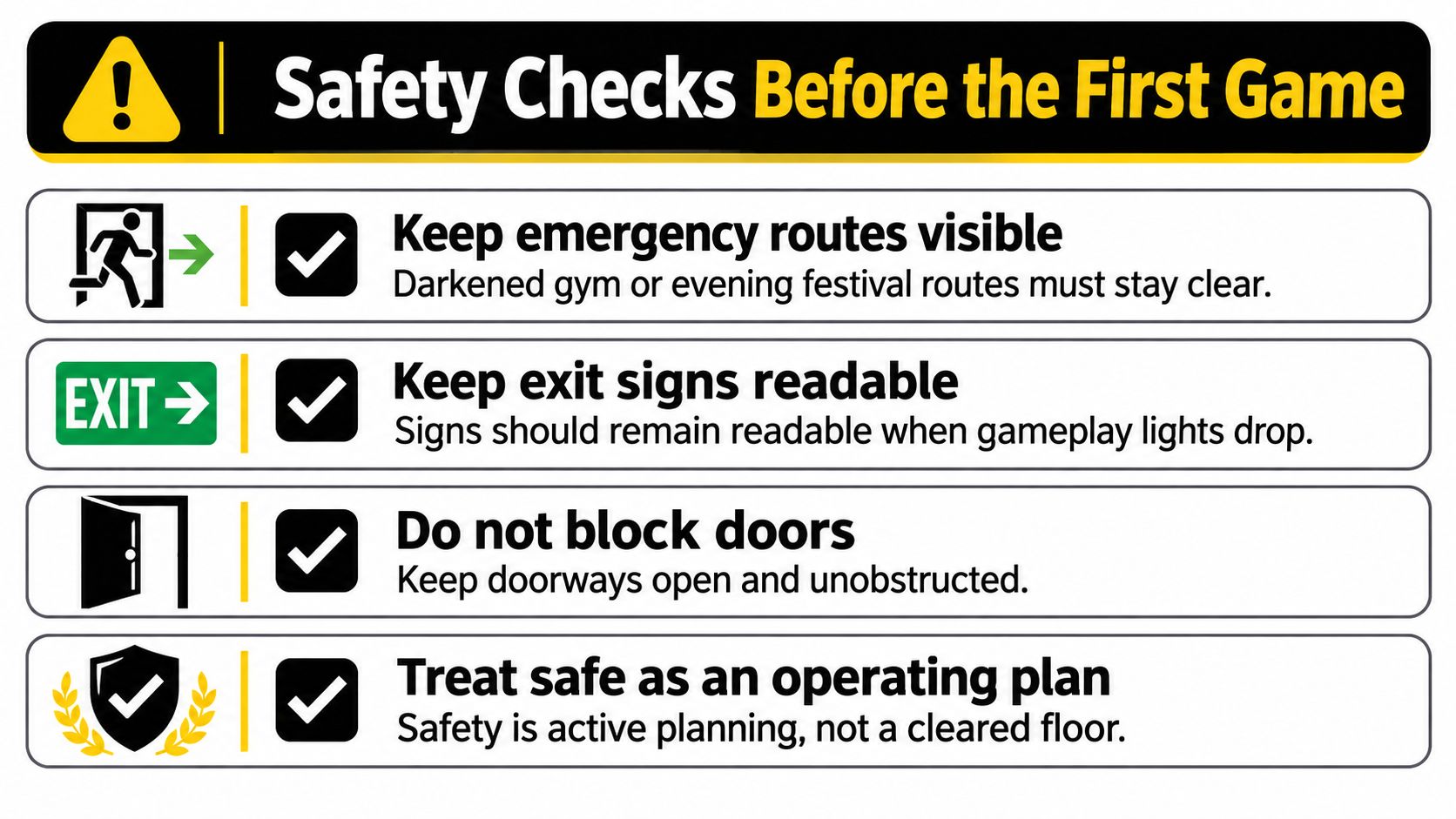
A cleared floor isn't a complete safety plan. The DHgate laser tag party booking guide addresses operating considerations including boundaries, footwear, supervision, and stopping play; temporary installations also need explicit decisions about lighting, emergency access, and differing participant needs.
Keep emergency routes visible and exit signs readable when gameplay lighting drops. Don't use a dramatic blackout as a substitute for a controlled atmosphere. Players must be able to recognize the route out without following another guest through the obstacles.
Ask the venue representative to confirm applicable occupancy, emergency-lighting, accessibility, and inspection requirements. Permanent-arena rules don't necessarily transfer unchanged to an outdoor temporary field, but the practical questions remain: can everyone leave, and can a guest with limited mobility reach a safe edge?
Separate spectators from players with a marked viewing lane. Assign a staff member a position with a view of both groups, especially where parents may step forward to photograph children. Keep doors, accessible routes, and service lanes free of cover, cables, and waiting guests.
Set participation conditions before excitement takes over
Require closed-toe shoes and remove loose objects or trip hazards before entry. Explain that climbing cover, physical contact, and chasing someone beyond the boundary will trigger staff intervention.
Offer a reduced-intensity option with brighter lighting, less sound, and a simpler objective. Ask what adjustments a participant needs rather than making assumptions from their age or appearance. If the event includes paintball, keep its activity-specific instructions separate; guests shouldn't assume the same equipment or conduct rules apply.
Set weather and surface pause conditions before opening. Stop if the floor becomes slippery, the lawn loses safe footing, or wind moves inflatable cover. Staff shouldn't negotiate those conditions with a waiting crowd.
The lead should initial a short pre-open sheet:
- Stop control: Lead named, backup identified, stop instruction rehearsed.
- Visibility: Operating lights checked and emergency signs readable.
- Routes: Doors, accessible paths, and service access unobstructed.
- Separation: Spectator lane marked and supervision positions assigned.
- Conditions: Footwear, surface, cover stability, and weather reviewed.
- Participation: Reduced-intensity arrangements explained to the team.
Staffing and Players per Hour
Cycle time equals play time plus briefing, vesting, equipment return, and reset. Divide the available operating period by that cycle to estimate waves, then multiply complete waves by the players you can equip. Don't multiply by pack count again if you've already used it to establish players per wave.
The following is a hypothetical scheduling model, not measured venue performance. Its assumed durations illustrate the arithmetic; test them during the rehearsal before committing to a guest schedule.
Planning cycles for laser tag throughput
| Session | Play time | Staging time | Full cycle | Waves per hour | Staffing note |
|---|---|---|---|---|---|
| School field day | Assumed 8 minutes | Assumed 7 minutes | Calculated 15 minutes | 4 | Rover plus vesting lead, with scorer responsibility assigned |
| Corporate team rounds | Assumed 12 minutes | Assumed 10 minutes | Calculated 22 minutes | 2 complete, approaching 3 over a longer block | Scorer and field staff covering issue and supervision |
| Festival drop-in | Assumed 10 minutes | Assumed 8 minutes | Calculated 18 minutes | 3 complete | Queue captain so the field never waits |
| Kids on a dense field | Assumed 8 minutes | Assumed 6 minutes | Calculated 14 minutes | 4 complete | Compact routes and a clear equipment handoff |
Staff the handoffs, not just the match
Assign responsibility for scoring, equipment issue, active-field supervision, and the queue. These are jobs before they're headcounts. A person can combine compatible tasks only while maintaining the required view and attention.
The scorer shouldn't leave the control point to fit a difficult vest while nobody watches the game. Add a rover when incoming and outgoing groups overlap. A walk-up festival also needs someone who can explain admission order, form balanced groups, and keep waiting guests out of the equipment-return lane.
BMI Leisure's laser tag business guide separates active-player space from the additional room needed for briefing, equipment distribution, circulation, and waiting. Apply that distinction to staffing too: a field marshal can supervise active play, but can't simultaneously manage an unseen queue around a building corner.
A larger field doesn't increase throughput if the same packs, the same briefing bottleneck, and the same equipment handoff still limit every wave.
Publish a usable capacity promise
Split guests into groups that match both usable equipment and field capacity. Hold the incoming group in staging, never inside the live boundary, and give departing players a direct return route.
For the hypothetical school schedule, multiply the complete waves shown in the table by the confirmed players per wave. Describe the result as player visits per hour, not necessarily unique guests: repeat players consume capacity too.
Don't promise fractional waves during a short booking. A round that finishes after the activity closes doesn't help the host clear the remaining queue. Leave room for equipment adjustments, late arrivals, and guests who need a slower fitting.
If briefing takes longer during rehearsal, revise the schedule rather than cutting essential instructions. For children, compact routes can preserve energy and simplify supervision; extending the lawn boundary can make turnover harder without increasing the equipment available.
Tips When Packs or Queues Fail
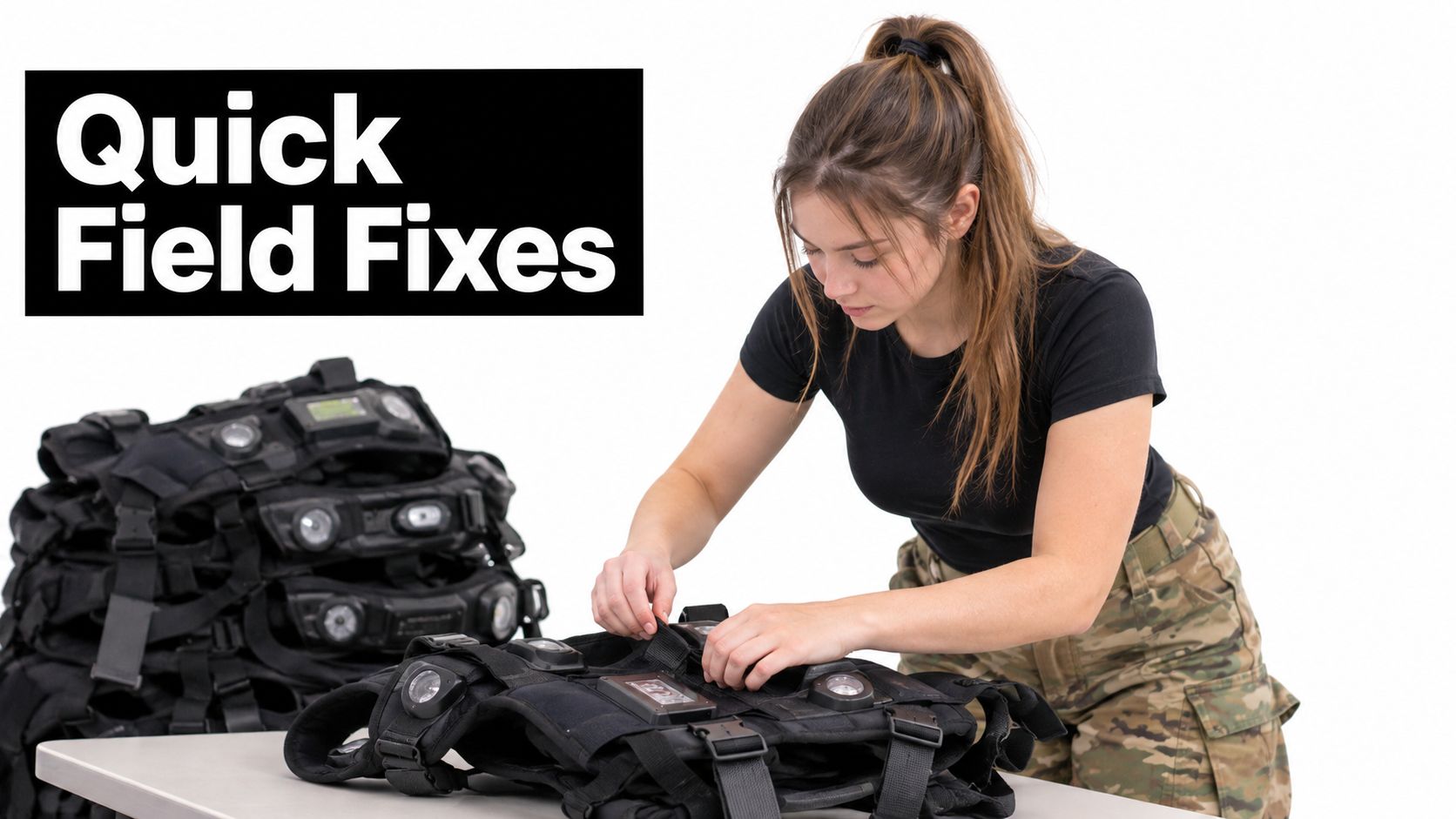
Swap a non-registering pack before troubleshooting it in front of a waiting team. Move the suspect unit to a clearly marked service area, fit a tested spare, and verify that the replacement registers correctly. Don't turn an equipment fault into an argument about whether the player aimed properly.
Separate the symptom from the cause
A missed hit doesn't automatically mean a dead battery. Check pairing, team settings, sensor obstruction, charge status, and the equipment's diagnostic display. Clean sensor surfaces only with the manufacturer-approved method, then test the unit away from active play.
Rotate equipment showing low-charge warnings at the reset. Keep charged spares organized by readiness, not mixed with returned packs that still need inspection. A spare that hasn't been paired or tested isn't ready to protect the schedule.
State the scoring policy before play. Explain which display records the result and how staff handle a confirmed fault, rather than inventing a ruling after disappointed players gather around the screen. Avoid promising that every disputed hit can be reconstructed.
Fix the bottleneck where it starts
Use the symptom to choose the intervention:
- Queue creep: Move waiting guests back to the marked staging position. Identify whether they're waiting for instructions, available equipment, or permission to enter.
- Slow equipment return: Direct departing players to the return station before they stop to compare scores. Keep that conversation away from incoming guests.
- Slippery surface or moving cover: Pause admission and secure the field. Slower running isn't a substitute for restoring safe conditions.
- Tired children: Simplify the objective, shorten the next round, or reduce unnecessary travel. Adding obstacles can make the problem worse.
- Repeated pack faults: Remove the unit from circulation until it passes a controlled test. Don't keep handing it to another guest and hoping it behaves differently.
Reset discipline: Repair equipment off the critical path. The next team needs a working pack, not a live demonstration of fault-finding.
When a queue forms, don't shorten the briefing to the point that guests miss the stop instruction or conduct rules. Remove repeated explanations and side conversations instead. Have the queue lead answer general questions before equipment issue begins.
Finish the intervention with a compact log: time, symptom, pack identifier, action taken, and whether the wave restarted. That record helps the next operator distinguish a recurring fault from a loose strap or a misunderstood game setting.
Confirm the Venue Plan Before Game Day
Send the venue a concise operating sheet before advertising the activity. The host, venue representative, and operating lead should be working from the same drawing, not separate descriptions of a large gym or a flat lawn.
Your sheet should show:
- Active dimensions: Measured play area, staging position, and viewing edge.
- Surface and clearance: Flooring or ground condition, ceiling restrictions, or open-sky exposure.
- Power and access: Approved connection location, unloading route, and equipment access.
- Attendance and age mix: Expected demand, arrival pattern, and participation needs.
- Lighting conditions: Daylight, evening, or darkened indoor operation.
- Operating ownership: Named stop lead, venue contact, and responsibility for queue management.
Match the promise to the operating sheet
Choose a capacity row and a cycle row, then show the host both players at once and expected player visits during the booking. Those answer different questions. A field that comfortably accommodates a group may still need more operating time to serve the whole event.
For a school, campus, church, or company picnic, include the reduced-intensity arrangement in the schedule rather than treating it as an improvised exception. If the room can't accommodate the intended group and staging, reduce group size or provide additional waves. Don't absorb the shortfall by moving a boundary into an exit route.
Phantom Entertainment lists Laser Tag, Karaoke, Mini Golf, and Lawn Games among our offerings. For organizers across Pennsylvania and the Mid-Atlantic, our delivery, setup, and professional operation can be planned around the venue's actual conditions; the mobile game rental planning guide also helps frame the wider event layout.
Lock the dimensions, attendance assumptions, and stop lead before promoting the date. Match attendance to a field-capacity choice and an achievable operating cycle, then give the venue that sheet for confirmation.
Phantom Entertainment offers laser tag with delivery, setup, and professional operation for events across Pennsylvania and the Mid-Atlantic. Visit Phantom Entertainment with your venue dimensions, expected attendance, age mix, and event schedule so we can help plan a field and guest rotation that fit the space.
Ready to Book Your Event?
PA state-inspected, fully insured since 1979. Call us or get a free quote today.