
Standard laser tag rules center on protective eyewear, controlled movement, safe equipment handling, no physical contact, clear boundaries, honest hit recognition, age-appropriate participation, and a prepared emergency response. Games often run for 10 to 20 minutes, so staff have a short window to explain expectations clearly and intervene before small problems disrupt the session.
Laser tag works best when players understand the rules before entering the arena, not after someone runs into a barrier or disputes a hit. The equipment uses infrared signals and sensors rather than physical projectiles, but the activity still requires disciplined movement, responsible handling, and active supervision. In enclosed arenas, players need clear sightlines, defined safe zones, and enough space to move without climbing, jumping, kneeling, or lying down. Published laser tag rules commonly prohibit those behaviors, along with physical contact and covering sensors.
The rules below separate universal safety expectations from game-format choices. A school field day may need different age groupings and supervision than a corporate family event, while a mobile outdoor setup needs stronger boundary controls than a permanent arena. Phantom Entertainment is one example of a turnkey event provider that can coordinate setup and professional operation for schools, family gatherings, corporate events, and community programs. Organizers can also review sports eSignature terms when preparing participant documentation.
1. Eye Protection and Goggle Requirements
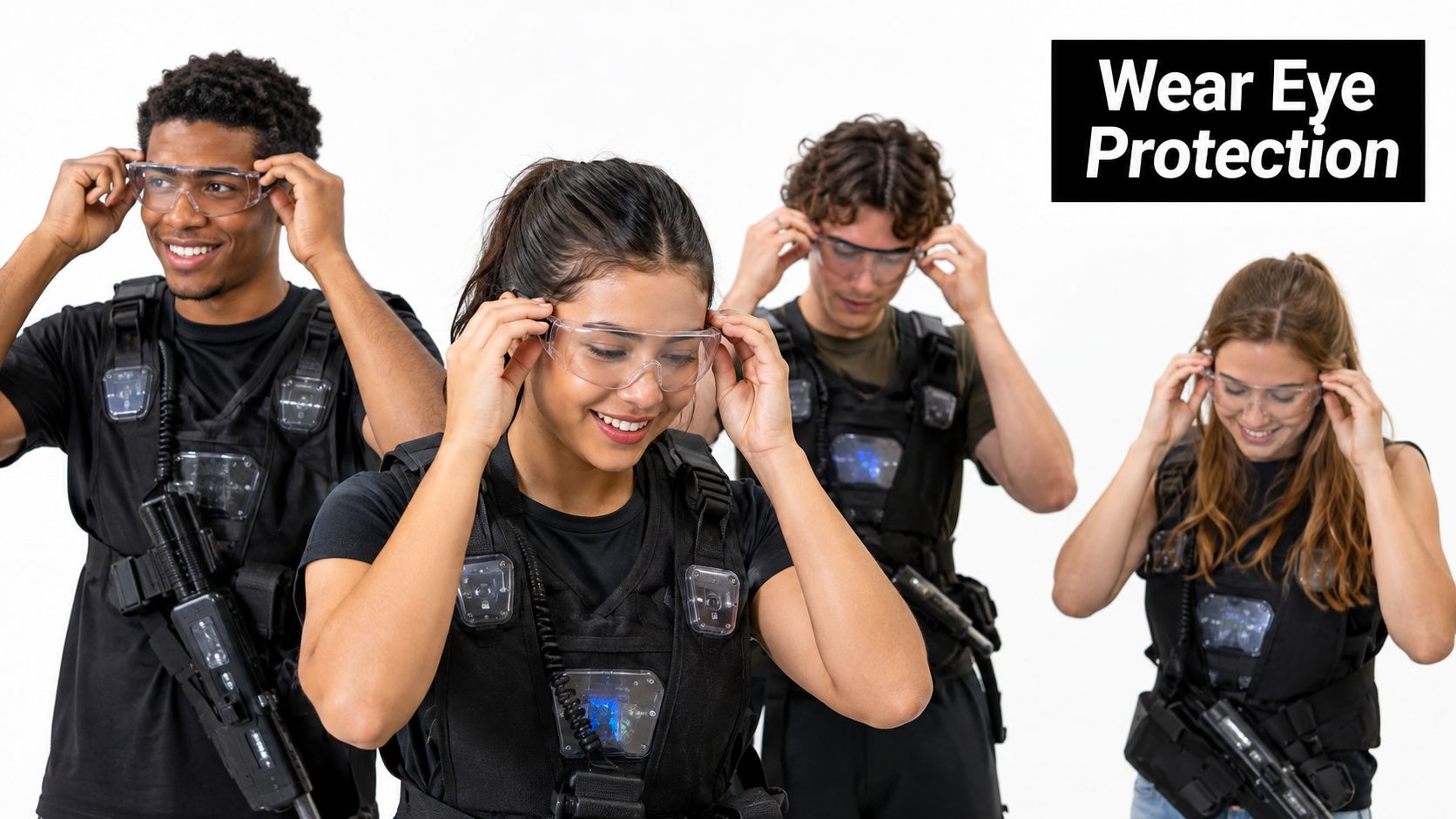
Eye protection is a required part of the equipment issue process, not an optional accessory. Give every participant correctly fitted goggles before entry, then confirm that they remain on during the briefing, practice round, active game, and walk to the exit. Staff should position themselves where they can see the entry point and the main play area, making removal easy to identify.
Laser tag systems used correctly are not considered hazardous to the eyes when they comply with exposure limits, according to guidance from the Swiss Federal Office of Public Health. Players must still avoid looking directly into a beam or deliberately aiming it at another person's eyes. Goggles also provide a practical safeguard around low-light obstacles, crowded routes, and accidental contact with arena fixtures.
Make the eyewear check visible
Before entry, a staff member should inspect each set and ask the player to move, look around, and confirm a clear view. Check for cracked frames, scratched lenses, loose straps, and goggles that sit too low or slip during movement. Replace damaged or poorly fitting equipment before the round starts.
If a player removes the goggles, pause that participant immediately and give a direct reminder. If the behavior continues, remove the player from the round. Staff should apply the same rule consistently, whether the issue occurs during practice, scoring, or active play.
Use a preparation routine that every staff member can follow:
- Clean between sessions: Use the venue's approved cleaning method and a soft microfiber cloth to keep lenses clear without damaging their surface.
- Prepare spare sets: Keep extra eyewear ready for unexpected attendance, damage, or poor fit.
- Control storage: Store goggles in a protected, dry location instead of a loose equipment bin where lenses may become scratched.
- Explain the reason: Tell players that the arena may be dark, equipment is shared, and aiming at eyes is prohibited.
For a mobile event, confirm how the provider manages cleaning, storage, replacements, and pre-game checks before booking. Phantom Entertainment's laser tag rental information gives planners practical equipment and service questions to raise with the provider.
2. Age and Physical Ability Requirements
Age limits should match the laser tag format, not a universal policy. Organizers need to confirm that participants can understand the briefing, carry and control the equipment, follow movement restrictions, recognize boundaries, and respond promptly to staff instructions. A child who manages a standard game may not be ready for darker conditions, faster transitions, or more complex objectives.
Technical safety guidance cited earlier recommends participation from about age 14 for certain formats. A separate laser tag safety briefing recommends standard laser tag for ages 5+ while reserving electrotag for ages 15+. These recommendations reflect different equipment and operating conditions. The provider should state which age policy applies to the selected venue and game.
Match the group to the format
Before booking, ask parents, teachers, or group leaders to identify participants who may need extra support with balance, hearing instructions, sensory conditions, or equipment weight. Staff should not diagnose a participant's ability. They should explain the physical and behavioral requirements clearly, then provide an alternative activity when a participant cannot comply safely.
For schools and family events, separate mixed-age groups into suitable rounds where practical. Younger players may need a shorter briefing, highly visible boundaries, slower transitions, and closer observation during the opening game. Staff should check that each player can hold the equipment correctly, hear the stop instruction, and reach the designated safe area before play begins. Older or experienced players still follow the same movement and conduct rules.
Venue setup should support the chosen group. Check the route, lighting, surface changes, and equipment weight before players arrive. Position staff near the entrance, briefing area, and any point where participants change rounds. One person should record team assignments and scoring, while another handles questions or escorts a player who needs to stop. This keeps eligibility checks separate from active game supervision.
Give providers the group's ages and relevant access requirements before the event. Booking materials, confirmation emails, and arrival instructions should explain suitable footwear, clothing, supervision arrangements, and what happens if a participant cannot meet the format's requirements. For home events, planning a laser tag party includes choosing a play area that suits the youngest eligible participant, not only the most athletic guest.

3. No Running and Controlled Movement Zones
Walking keeps laser tag safer and makes play easier to supervise. Players move through dim arenas with barriers, corners, ramps, and teammates nearby, while competitive pressure can make them speed up without noticing. A clear pace rule lets staff enforce one standard and keeps competition focused on positioning, communication, and accurate tagging.
Players should also avoid climbing, jumping, sitting, kneeling, lying down, and covering sensors. Laser tag safety rules commonly use these restrictions to support predictable movement and fair scoring, especially in enclosed arenas where visibility is limited.
Design the route before the briefing
At a temporary venue, inspect the route before players arrive. Remove loose objects, identify low obstacles, check changes between floor surfaces, and mark spectator areas. Use cones, rope, signs, or another visible boundary to define the play zone. In dark layouts, add path lighting or illuminated markers, but position them so glare does not hide obstacles or interfere with sensor visibility.
Set staff positions around the route rather than relying on one person to call out warnings. Place one monitor at the busiest transition, another near a blind corner or narrow passage, and another at entry or respawn points when the group requires it. Staff should agree in advance on when to pause play, including running toward a barrier, climbing an obstacle, or entering a restricted area.
Brief players with a short demonstration. Say “walk at all times,” then show the expected pace around a corner and beside another player. During the first round, give immediate reminders when movement starts to become unsafe. If a player keeps running, pause that player's participation, record the incident if the venue uses an event log, and explain the consequence calmly. Staff should also pause the round after a fall or collision, check the area, confirm that players are ready, and restart only when the route is clear. Consistent enforcement protects participants and keeps scoring fair for players who follow the rules.
4. Weapon Handling and Equipment Safety
Players should treat a laser tag phaser as electronic sporting equipment, never as a toy for striking, pushing, or intimidating another person. Staff need to demonstrate the correct grip, trigger use, sensor targets, and pointing direction before the first round. Participants should aim at active sensors within the agreed play area and keep the device pointed down or toward a safe direction outside gameplay.
Practical rule: If a player wouldn't point the device at someone in the briefing area, they shouldn't point it that way in the arena.
Equipment checks begin before players arrive. Staff should inspect phasers, vests, straps, sensors, cables, batteries, and visible casings for damage or loose parts. They should also confirm that each device communicates with the scoring system and that every player receives the equipment assigned to them. A faulty device should be removed from circulation rather than handed to a participant with a warning to “see if it works.”
Demonstrate before you distribute
A good briefing covers four actions:
- Hold the equipment correctly: Keep both hands where the operator directs and avoid swinging the phaser while moving.
- Aim responsibly: Target the opponent's designated sensor areas and never deliberately aim at a face.
- Report faults: Raise a hand or return to the designated staff point if the device stops responding.
- Store it properly: Place equipment in the collection area when the round ends instead of dropping it on the floor or carrying it into a spectator space.
For an event provider, the same procedure should appear in the staff run sheet, equipment checklist, and incident notes. Staff should know who can troubleshoot a device and who must take it out of service. A practice round can help inexperienced players learn the controls without the pressure of a full competitive game.
A visible safety demonstration also reduces confusion for spectators and event coordinators. Show where active play starts, where equipment is returned, and how players should request help. The video below can support a provider's preparation materials, but it shouldn't replace an in-person briefing designed for the actual venue.
5. Physical Contact Is Prohibited
Laser tag is built around non-contact play. Players tag sensors with infrared-emitting devices rather than physically striking opponents, and many rule sets explicitly prohibit contact. Pushing, shoving, tackling, grabbing, body-checking, blocking a passage with the body, or taking equipment from another player should all be treated as violations.
The rule needs a simple explanation because young players may understand “no fighting” but not recognize that a shoulder check or deliberate bump also breaks the standard. Demonstrate one acceptable example, such as moving around an opponent while maintaining space, and one unacceptable example, such as using the body to stop someone reaching a position. Don't leave the interpretation to players in the middle of a heated round.
Use a graduated response
For a first minor incident, pause the player and give a direct reminder. If the behavior is deliberate, repeated, or aggressive, remove the participant from the round. A serious incident should stop play in the affected area while staff separate the people involved, check for injury, and notify the event coordinator or responsible adult.
Teachers, HR coordinators, parents, and youth leaders should hear the same rule before gameplay begins. They need to know who has authority to stop a round and what happens after removal. A waiver may document participation terms, but it doesn't replace a spoken explanation or active supervision.
Mixed-age events deserve particular care. Older or more competitive players may move with greater confidence, while younger players may not anticipate a fast approach. Separate rounds can reduce that mismatch. If the venue can't separate groups, staff should adjust the game format, reduce crowding, and place monitors where players are most likely to converge.
The best enforcement is calm and predictable. Staff shouldn't argue about intent in front of the group. State what was observed, apply the published consequence, and give the participant a clear path to return only if the operator considers it safe and appropriate.
6. Out-of-Bounds Area Restrictions and Boundaries
A boundary is only useful when players can see it, understand it, and find a staff member nearby. Temporary events need more than a verbal instruction such as “stay on the field.” Parking areas, roads, water features, storage spaces, building entrances, public walkways, and spectator zones should be identified during the venue walk-through and excluded from play.
Use redundant signals. Cones can mark the edge, rope or temporary fencing can reinforce it, and signs can explain the restriction to players and spectators. Staff should stand where they have a clear view of likely exit points rather than positioning everyone near the equipment table. At a school, the play area might be a defined section of an athletic field. At a community festival, it may require separation from passing foot traffic. At a backyard event, property lines and natural features need an equally clear treatment.
Create safe zones, not dead ends
Players need to know where to go when they are eliminated, need help, or finish a round. Designate an entry point, exit point, equipment return point, and safe waiting area. Keep those locations outside active firing lines and away from narrow transitions. If eliminated players must wait before rejoining, make the waiting area visible to staff and comfortable enough that participants don't wander back into the arena.
Before opening the session, tell players the specific hazards associated with the boundary. A rope near a walkway may be easy to see in daylight but difficult to distinguish under event lighting. A cone beside a building may not be enough if spectators can move it. Staff should check the setup again after breaks, because participants and spectators can shift temporary markers.
A boundary should be designed for the distracted player, not the perfectly attentive one.
For outdoor events, conditions can change during the day. Recheck lighting, surface conditions, pedestrian flow, and access points between rounds. If the venue changes, pause the session and explain the new limit. A clear stop is safer and easier to manage than allowing players to improvise around an emerging hazard.
7. Respect Hit Indicators and Gameplay Mechanics
Fair play depends on accepting the equipment's hit signal and following the venue's elimination or respawn procedure. Players shouldn't argue with an opponent, continue firing after their own device indicates elimination, cover a sensor, or leave the designated area to avoid a result. Staff should explain the sequence before the game: what a hit looks or sounds like, when a player becomes inactive, where that player goes, and when participation resumes.
Scoring formats vary, so the briefing must describe the actual system rather than rely on assumptions. One published rules summary uses 5 points for an active arena target, 500 bonus points for an “Element,” and 1,500 bonus points for destroying a base. Another uses 100 points for hitting an opponent's phaser or shoulder and 200 points for front or back hits, as described in this laser tag scoring overview. Those differences show why organizers should test the selected game before participants arrive.
Give disputes a controlled path
A player who believes a sensor malfunctioned should report it to staff after leaving active play. The operator can inspect the equipment, review the system display where available, and decide whether the result stands. Don't let players settle disputes by returning to the arena or confronting the person who made the tag.
A staff member should watch the first round closely for missed signals, inactive devices, and players who don't understand the respawn process. Visible status indicators, score displays, or clear audio feedback can help, but every participant still needs a verbal explanation. Spectators also benefit from knowing what the colors, sounds, or scoreboard entries mean, especially during school tournaments and corporate events.
If equipment behaves inconsistently, pause the affected game rather than allowing the argument to spread. Record the device, player, round, and reported problem. That record helps the operator identify patterns and decide whether a device needs calibration, charging, repair, or removal from the next session.
8. Medical Emergency Protocols and Incident Response
Every event needs a response plan before the first phaser is issued. Staff should know how to stop the game, secure the play area, summon medical assistance, contact the responsible adult, and preserve a clear route for responders. The plan should cover obvious injuries such as a fall as well as less visible problems such as dizziness, breathing difficulty, distress, or a participant becoming overwhelmed by the environment.
The operator and event organizer should agree on the emergency contact process in advance. At a school, that may involve the nurse or designated administrator. At a corporate venue, the building's emergency procedure may control the response. At a festival, the laser tag team may need to contact the event medical coordinator rather than direct participants through an improvised route.
Assign roles before the doors open
One staff member should take charge of the participant and provide appropriate immediate assistance within their training. Another should stop gameplay and move other players away. A third should contact the responsible adult or emergency services and guide responders to the correct entrance. If the team is small, assign those tasks explicitly so nobody assumes someone else has made the call.
Record the event factually after the situation is stable. Note the time, location, people involved, observed condition, actions taken, witnesses, equipment in use, and who was notified. Avoid speculation. The organizer should retain the report according to the event's privacy and insurance procedures.
A pre-event review should identify the nearest treatment or staging area, emergency exits, address or site reference, communication tools, and participant contact information. Staff should also know when to end the session entirely. A minor disruption may permit a restart after inspection, while an injury involving a hazard, equipment fault, or repeated unsafe behavior may require the area to remain closed.
Organizers preparing broader event procedures can use event contingency planning guidance as a prompt for documenting responsibilities, communication routes, and fallback arrangements. The plan should be short enough for staff to use under pressure and specific enough that nobody has to invent a process during an incident.
8-Point Laser Tag Safety Rules Comparison
| Item | 🔄 Implementation Complexity | ⚡ Resource Requirements | ⭐ Effectiveness / Key Advantages | 📊 Expected Outcomes | 💡 Ideal Use Cases |
|---|---|---|---|---|---|
| Eye Protection and Goggle Requirements | Low–Medium, procurement, fit checks, sanitization | Moderate, ANSI Z87.1 goggles, cleaning supplies, storage | Very high, prevents eye injuries; insurance compliance | Reduced eye injuries; higher participant confidence | All events (indoor arenas, school trips, parties) |
| Age and Physical Ability Requirements | Medium, screening, communication, accommodations | Low–Moderate, staff training, documentation, modified gear | High, reduces mishandling; ensures rule comprehension | Fewer equipment-related incidents; age-appropriate play | Family events, school field days, mixed-age groups |
| No Running, Controlled Movement Zones | Medium, layout design, staff enforcement | Low–Moderate, tape/cones, staff, lighting for low-light | High, lowers trips/collisions; safer gameplay | Fewer falls/collisions; steadier game flow | Indoor arenas, uneven outdoor terrain, youth events |
| Weapon Handling and Equipment Safety | Medium–High, staff training, inspections, demos | Moderate, trained staff, inspection tools, secure storage | Very high, prevents misuse; reduces property damage | Reduced equipment incidents; consistent safe handling | All organized events; mandatory pre-game briefings |
| Physical Contact Prohibition | Low–Medium, rule clarity, monitoring, removal process | Low, staff monitoring, signage, enforcement protocol | High, prevents assaults/injuries; inclusive environment | Fewer aggressive incidents; safer mixed-age play | Family-friendly events, youth groups, tournaments |
| Out-of-Bounds Area Restrictions and Boundaries | Medium, venue assessment, boundary setup | Moderate, cones/rope/fencing, staff, signage | Very high, prevents off-site hazards; clearer control | Contained play area; reduced off-site incidents | Outdoor venues, parks, sites near hazards/public access |
| Respecting Hit Indicators and Gameplay Mechanics | Medium, calibration, staff mediation, appeals | Moderate, reliable electronics, displays, tech checks | High, fair, transparent scoring; reduces disputes | Smoother gameplay; objective results; fewer conflicts | Competitive events, large groups, spectator-friendly games |
| Medical Emergency Protocols and Incident Response | High, protocol development, training, drills | High, first-aid staff, supplies, AEDs, communication | Critical, enables rapid response; reduces severity | Faster medical response; documented incidents; legal compliance | Public events, large gatherings, events with minors or remote sites |
Turn Rules Into a Smoother Event
Good laser tag rules aren't just instructions printed on a waiver. They form an operating system for the event. The organizer sets the eligibility standard, prepares the equipment, controls the venue, explains the game, watches the activity, and responds consistently when something goes wrong.
Before participants arrive, confirm the format, age guidance, movement requirements, footwear expectations, clothing restrictions, and any accessibility questions. One published venue FAQ discourages slide shoes, high heels, cleats, roller shoes, face or body paint, and neon or blacklight hair products because they can create trip risks, damage equipment, or transfer onto other players' clothing. It also says children under 10 should only play when they can understand and follow instructions and are accompanied by a paying, playing parent or guardian, so event planners should ask the selected provider for its own written policy rather than assume every venue uses the same standard.
Inspect every phaser, vest, sensor, strap, goggle, battery, and charging point. Remove visibly damaged equipment. Test hit detection and scoring with the exact game settings planned for the session. If the event uses special targets, bases, team colors, respawn timing, or a scoreboard, staff should be able to explain each mechanic in plain language before players enter.
Then walk the venue as an operator, not as a guest. Mark boundaries, identify hazards, create safe zones, set spectator positions, and assign staff to blind corners, transitions, entry points, and elimination areas. A beautiful themed setup doesn't compensate for a boundary that disappears in low light or a monitor who can't see the busiest passage.
Pre-game operator check: Confirm the players, inspect the gear, test the scoring, mark the limits, assign the posts, deliver the briefing, and review the emergency response.
The briefing should be short enough to hold attention but complete enough to cover the essentials: wear the required eye protection, walk, avoid contact, handle equipment safely, stay inside the boundary, respect hit indicators, and report problems immediately. Ask players to demonstrate understanding where appropriate, especially younger participants or groups unfamiliar with the equipment.
During gameplay, apply the same standard to everyone. A school group, executive team, family party, and community festival all deserve clear enforcement, even though the game format and supervision plan may differ. Staff should avoid changing a rule mid-round unless a safety issue requires it. If a change is necessary, stop play, explain it, and restart only when everyone understands.
Phantom Entertainment offers laser tag among its event attractions and can support delivery, setup, operation, and event documentation for planners across Pennsylvania and the Mid-Atlantic. For schools, corporate organizers, families, and community groups, Phantom Entertainment is a relevant option to discuss when the event requires a managed setup rather than equipment alone.
Phantom Entertainment provides laser tag and other mobile event attractions with delivery, setup, and professional operation for schools, corporate gatherings, family parties, and community events. Visit Phantom Entertainment to discuss a laser tag format, venue plan, staffing approach, and safety documentation suited to your group.
Ready to Book Your Event?
PA state-inspected, fully insured since 1979. Call us or get a free quote today.