
Saturday morning, your kitchen table is covered in candles, paper plates, half-open gift bags, and a text thread full of last-minute RSVPs. One child is already asking when friends will arrive. Another wants to know where the “fun part” is. You still need to move chairs, chill drinks, and figure out who's watching the yard gate.
That's the moment when many parents, school staff, and event organizers realize they're not planning a party. They're trying to run a small live event.
That's why kids party entertainment packages matter. A good package isn't just a bounce house or a theme. It's a ready-made play system that combines the attraction, setup, supervision, and the little operational details that keep kids engaged instead of drifting into that familiar bored patch after the first burst of excitement.
The market signals are strong. The global children entertainment centers market was valued at $14.2 billion in 2025 and is projected to reach $28.6 billion by 2034, with kids ages 5 to 10 accounting for 38.5% of revenue in 2025. The same market reference describes birthday party packages for that age group as a major revenue driver, and notes that premium U.S. party packages average $35 to $55 per child and can generate 15% to 25% of total site revenues at many multi-concept family entertainment centers, according to children entertainment market data from Dataintelo.
Parents usually feel pressure to get every detail right, but the smartest planning move is often simpler than people expect. Start with the activity flow first. Then build the party around it.
If you're still choosing basics like cups, napkins, and themed tableware, a practical roundup of party supplies for kids events from Monopack ltd can help you cover the non-entertainment side without overthinking it. For venue-style celebration ideas and package formats, you can also browse birthday party planning examples.
Introduction to Stress Free Kids Party Planning
A stress-free party usually comes from one decision. Stop thinking in terms of “rentals” and start thinking in terms of managed play time.
Why bundled entertainment works better than separate pieces
When families piece a party together one item at a time, they often book the visible parts first. Balloons, cake table, themed plates, maybe one inflatable. What gets missed is the flow between those pieces. Kids don't care that the arch matches the napkins if there's nothing to do while adults are serving pizza.
A package solves that by bundling the parts that usually create friction:
- Arrival energy: Kids need something to do almost immediately.
- Transitions: Moving from one activity to another is where momentum gets lost.
- Operator coverage: Some attractions need active supervision, not occasional check-ins.
- Exit timing: A clean finish matters as much as a fun start.
Practical rule: If children are standing around waiting for instructions more than once, the package is too thin or the schedule is too loose.
Who benefits most from a package
These packages aren't only for backyard birthdays. They fit almost any event where kids need structured fun without constant adult improvising.
They work well for:
- Birthday parties: Especially when the host wants to enjoy the day instead of managing every station.
- School field days: Where activity rotation keeps classes moving.
- Church and nonprofit events: Where volunteers need clear support from a vendor.
- Company family days: Where planners need entertainment that works for mixed groups of children.
The common thread is simple. Someone needs a dependable way to convert open time into active fun.
The real promise of a package
People sometimes assume a party package is mostly about convenience. Convenience matters, but the bigger value is consistency. The kids know what to do. Adults know who's in charge. The venue knows what's arriving and how it will be run.
That's why the right package feels calmer, even when the event is loud and full of motion.
What Kids Party Entertainment Packages Actually Include
Think of a package like a stack of building blocks. Most buyers focus on the top block because it's the most exciting. But the event only works when the lower blocks are solid too.
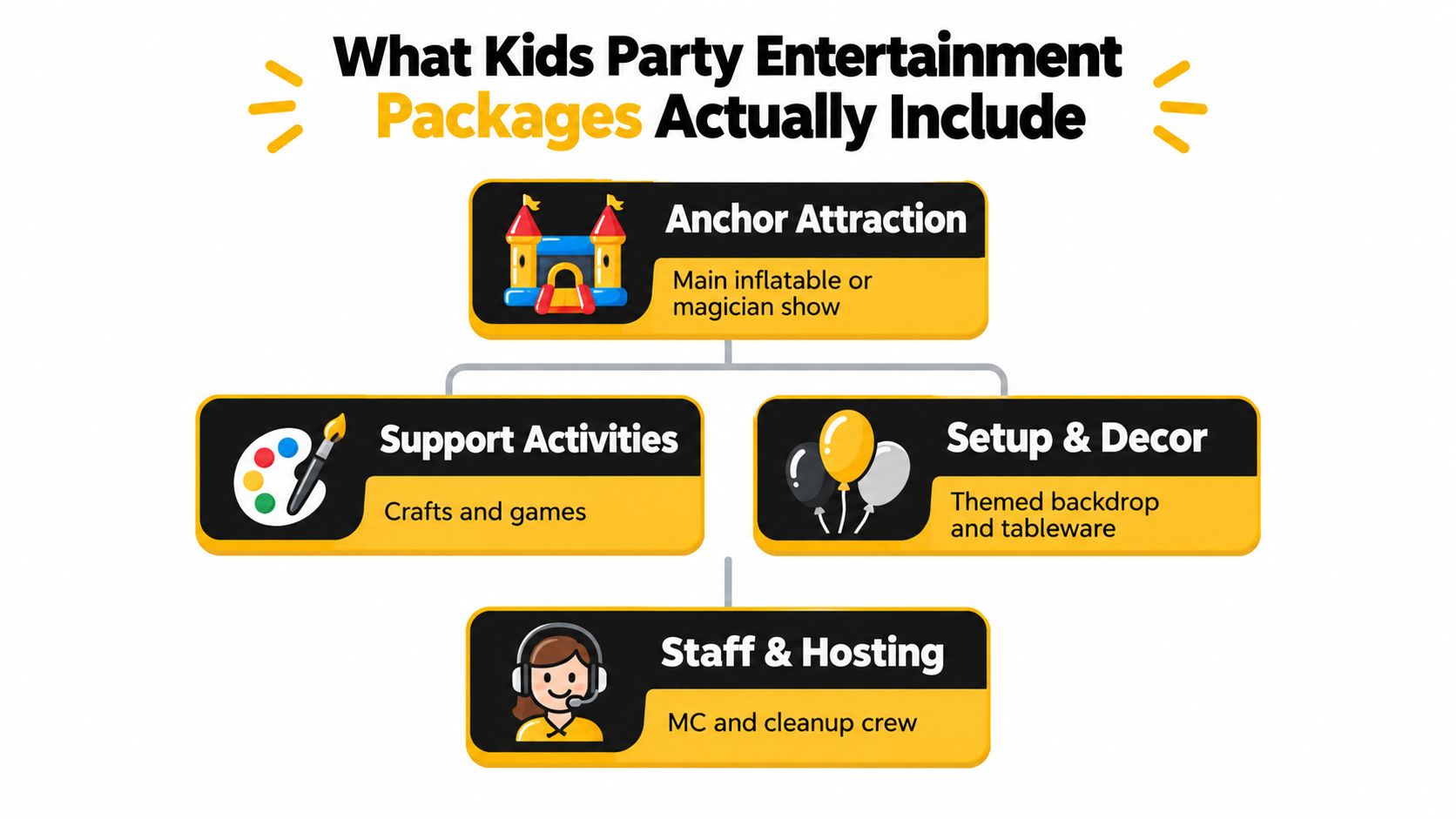
The four layers that matter
At minimum, most kids party entertainment packages include four parts.
Anchor attraction
This is the headline item. A bounce house combo, obstacle course, foam party, laser tag setup, DJ-led dance zone, or mobile escape room usually fills this role.Support activities
These keep children busy before, after, or between turns on the main attraction. Think carnival games, craft tables, simple contests, karaoke, or face painting.Staffing and logistics
Delivery, setup, breakdown, power planning, crowd flow, and trained attendants all sit here. This layer is easy to underestimate until event day.Safety documentation
For schools, churches, campuses, and many corporate sites, paperwork isn't extra. It's part of the package. Insurance documents, inspection records, and operating policies often determine whether the event can happen at all.
Why the lower blocks matter more than people think
A family might compare two inflatables and assume the cheaper one is the better value. But if one offer includes delivery only and the other includes setup, trained operation, and paperwork for a school or campus venue, those are not equal packages.
Commercial inflatables should be treated as regulated equipment, not casual toys. ASTM F2374-22 covers design, manufacture, installation, operation, maintenance, inspection, training, auditing, and major modification for commercial-use inflatables, and the CPSC distinguishes commercial devices from home-use products while noting children's inflatables intended for ages 12 and under must also meet federal product-safety requirements, as explained in ANSI's summary of ASTM F2374-22 and CPSC considerations.
A bounce house isn't the full product. The full product is the bounce house plus the installation method, the supervision plan, and the maintenance record.
Inflatable-only versus mixed-format packages
Inflatable-only bundles are straightforward. They're often ideal when the goal is free play and the guest group is narrow in age.
Mixed-format packages work better when the event needs pacing. One attraction burns energy. Another creates turn-taking. A quieter station gives kids a reset. In practical terms, that might mean an obstacle course plus carnival games, or foam dancing plus a DJ and a photo station.
Providers vary in how they bundle these layers. Some supply equipment only. Others handle active operation and venue paperwork. In the Mid-Atlantic, companies such as Phantom Entertainment package attractions with delivery, setup, and professional operation for events ranging from birthdays to school and campus programs, which makes apples-to-apples comparison much easier for planners.
Popular Package Types and How to Match Them to Your Group
Choosing the right package gets easier when you stop asking “What looks fun?” and start asking three better questions. Who are the kids, how do they like to play, and what kind of space do you really have?
The U.S. children entertainment centers market generated $4,880.53 million in 2023 and is projected to reach $10,672.61 million by 2033, growing at an 8.0% CAGR from 2024 to 2033. A related industry source also reports that North America held over 38% of the global market share in 2023, with families typically visiting full-featured family amusement centers 3.2 to 4.6 times per year and spending an average of $12 to $22 per visit, which helps explain why bundled kids party entertainment remains such a strong category in major markets, according to Allied Market Research on the U.S. children entertainment centers market.
Think by age first, then energy
Younger children usually need simpler rules, shorter turns, and attractions that don't intimidate them. Older kids can handle competition, multi-step games, and more independence.
A toddler group and a tween group can both love “active play,” but they won't enjoy the same format in the same way.
Package Types Compared by Age Energy and Space
| Package Type | Best Ages | Group Size and Space | Play Style |
|---|---|---|---|
| Bounce house combos | Younger kids through elementary ages | Good for smaller to medium groups with a backyard, gym, or open indoor room | Open jumping, climbing, sliding |
| Obstacle courses and giant slides | Elementary through early teen groups | Better for medium to larger groups and longer straight-line space | Fast rotation, racing, high movement |
| Mechanical bulls and spider jumpers | Older kids, teens, mixed-age festival groups | Need operator space and clear safety perimeter | Individual challenge, novelty, spectator fun |
| Mobile zip lines and rock walls | Older kids through adults at larger events | Need larger outdoor footprint and trained operation | Big-feature attraction, queue-based excitement |
| Laser tag and arcade setups | Elementary ages through teens | Flexible indoors or outdoors depending on format | Competitive team play or self-paced gaming |
| DJs and karaoke | Broad age range, strongest with confident social groups | Works in party rooms, gyms, and multipurpose spaces | Music-driven participation, dancing, singing |
| Foam dance parties | Elementary and tween groups | Outdoor or approved wash-down area works best | High-energy group play |
| Mobile escape rooms | Tweens, teens, families | Indoor or controlled outdoor space | Puzzle solving, teamwork, lower physical intensity |
Quick matching rules that save headaches
- For ages 4 to 6: Choose attractions with visible entry points and simple rules. Bounce combos, soft carnival games, and music-led activities usually land well.
- For ages 7 to 10: This is often the sweet spot for obstacle courses, foam fun, laser tag, and mixed active stations.
- For ages 11 to 14: Give them a challenge or a social hook. They usually respond better to competition, music, team games, and novelty attractions than to basic bounce time.
- For mixed ages: Don't force one attraction to serve everyone equally. Use two lanes of activity if possible, one more physical and one more flexible.
If you're comparing attraction formats across family audiences, this roundup of family-friendly attractions for events is useful because it frames the options by audience fit rather than by novelty alone.
Match the package to the space honestly
Planners get tripped up. They book by photo, then discover the yard slopes, the gym has awkward exits, or the church lot needs clear fire-lane access.
Use a simple lens:
- Tight backyard: One anchor piece plus one side activity.
- School gym: Rotation-based packages shine here.
- Large field or festival lawn: Bigger attractions can work if supervision and lines are managed.
- Multipurpose hall: Favor music, games, crafts, arcade units, or smaller inflatables.
The right package should feel like it belongs in the space. If it looks squeezed in on paper, it will feel chaotic in person.
Sample Itineraries by Age and Group Size That Keep Kids Active
Most party problems come from dead space, not bad attractions. Kids lose steam when too many people are waiting for one thing, or when every activity peaks at the same intensity.
A stronger plan alternates motion and reset. Recess with better timing.
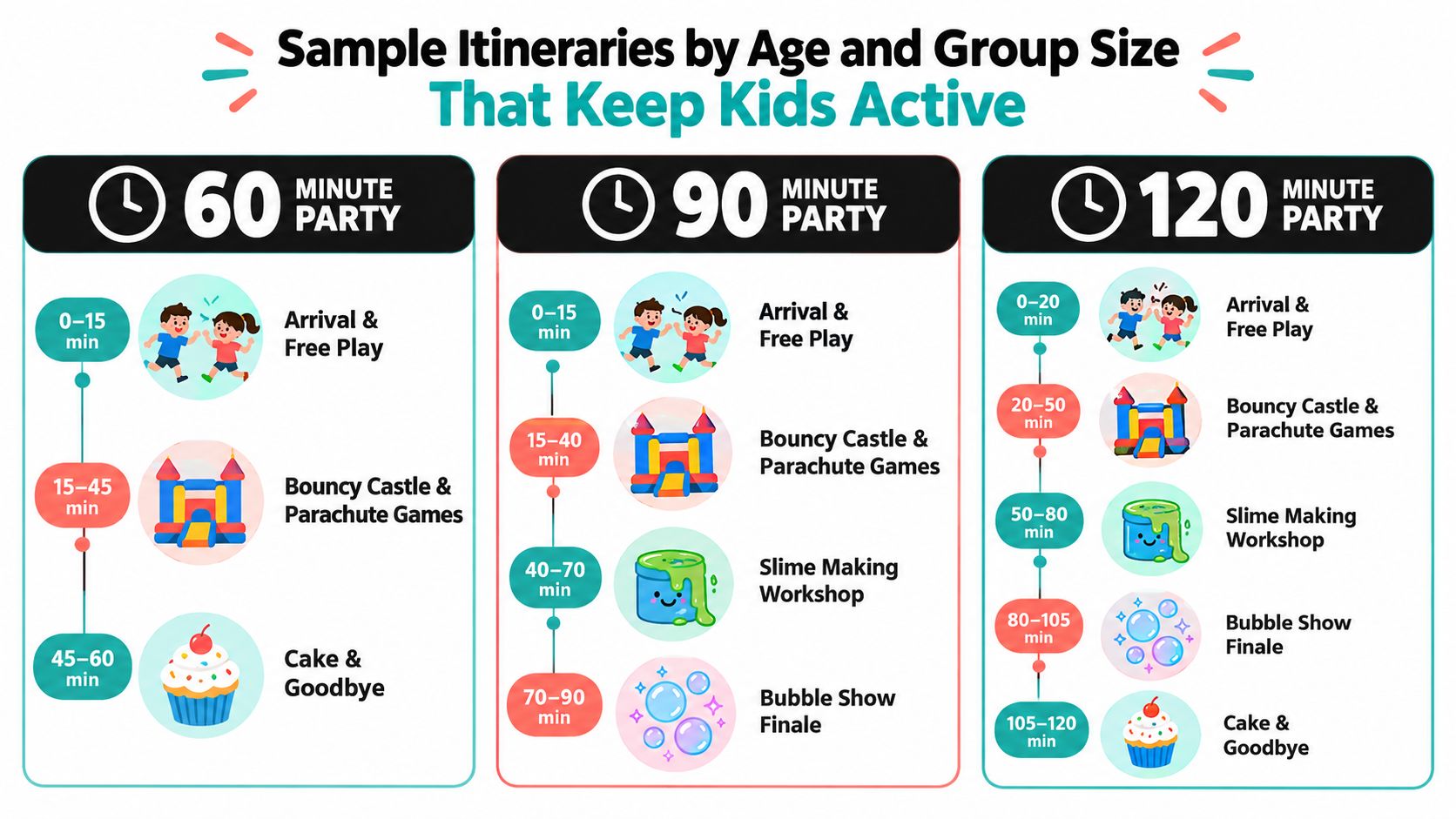
Ages 4 to 6 in a small backyard
For this age, shorter cycles work best. Younger kids don't need a packed menu. They need clear starts, easy wins, and very little waiting.
A simple flow looks like this:
- Arrival and free play: Start with a visible, low-pressure activity right away.
- Main attraction block: Use one inflatable or one active game zone as the center of the party.
- Reset activity: Bubbles, parachute games, or a guided music game helps settle the room before food.
- Cake and goodbye: Keep the ending tight while attention is still intact.
This age group does well when one adult or attendant guides transitions with cheerful, direct cues.
Ages 7 to 10 in a school or church setting
This group can handle stations. They usually enjoy rotation, friendly competition, and enough variety to avoid repeat boredom.
A useful format is:
- Check-in and warm-up game
- Obstacle or bounce rotation
- Carnival or skill station
- Group challenge or DJ-led game
- Food break
- Short final round on the favorite attraction
That “favorite attraction” return is often the smartest part of the schedule. Kids love knowing they'll get one more run, and it reduces the anxious crowding that happens when they think time is running out.
Field-tested advice: End with a familiar hit, not a brand-new activity. Kids leave happier when the finish feels earned, not interrupted.
Ages 11 to 14 at a larger community event
Older kids need more ownership. If the program feels babyish, they'll disengage fast.
A better itinerary gives them options:
- Open arrival window with music
- Choice between two active lanes, such as laser tag or an obstacle attraction
- Social side station, such as arcade units, karaoke, or a photo experience
- Finale challenge, such as team competition or timed contest
Turnkey staffing matters. If an operator is managing the attraction, another person can keep the flow moving, redirect waiting groups, and tighten transitions without making the event feel over-controlled.
For larger youth events, it often helps to split guests by interest rather than by strict age. Some older kids want high-energy physical play. Others want a competitive or social format that lets them participate without climbing, bouncing, or racing.
Pricing Factors Customization Options and Add Ons That Add Value
A quote can look high or low on paper and still tell you very little about the actual party experience.
What matters is how much active play time the package creates for your group, and whether it fits your venue without last-minute fixes. I've seen families save money with a smaller, better-matched setup, and I've seen bigger packages create long lines because the age range, space, or staffing plan was off.
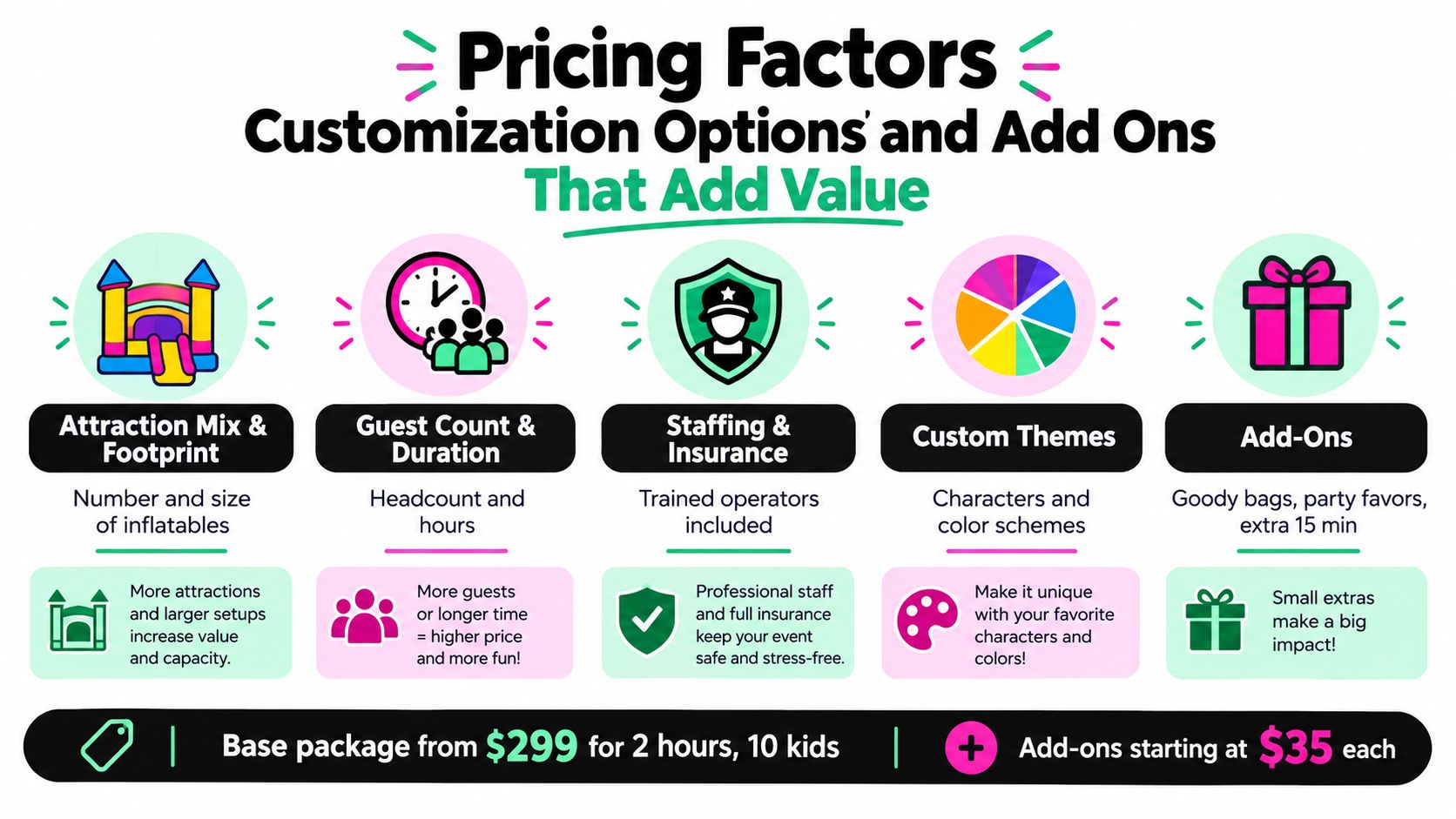
The five levers that change the quote
Most entertainment packages are priced around the same core variables.
- Attraction mix and footprint: Bigger inflatables, multi-station setups, and specialty attractions need more transport space, setup time, and labor.
- Guest count and event length: More children and longer run times usually increase supervision needs and equipment use.
- Staffing level: Staffed entertainment costs more because you are paying for operation, crowd flow, and safety oversight, not just equipment delivery.
- Delivery distance and venue access: Stairs, narrow gates, limited parking, long load-in routes, and strict setup windows can all affect labor time.
- Peak-date demand: Popular weekends, school breaks, and holiday seasons tend to book faster and price tighter.
A simple way to read those levers is this: you are paying for time, space, labor, and throughput.
How to judge value without getting distracted by the package name
Package names can be misleading. “Deluxe” or “ultimate” does not always mean better for your event.
A better test is active minutes per child. If 24 children are sharing one attraction for two hours, ask yourself how much of that time each child is really playing instead of waiting. A package with two smaller activity zones can outperform one large centerpiece because it keeps the line moving and gives children different ways to join in.
This works like planning recess. One ball for a whole class creates a crowd. Two or three activity choices usually create better flow.
Customization that actually helps
The best customization is usually practical, not flashy. It should match the children's age, the group's energy level, and the venue rules.
Useful adjustments often include:
- Swapping one large attraction for two medium ones to reduce waiting
- Adding a quieter station for children who do not want nonstop physical play
- Adjusting event timing so younger children play first, eat before they fade, and finish on time
- Choosing staffed operation for schools, churches, parks, or venues with stricter supervision expectations
- Building around site limits such as ceiling height, power access, gate width, or indoor floor protection
Those changes add value because they improve flow. They also reduce the risk of paying for features your space cannot even use.
Add-ons that usually earn their keep
The strongest add-ons do one of two jobs. They absorb downtime, or they widen the appeal for a mixed group.
Common high-value add-ons include:
- Photo novelties: Good for keepsakes and for children who want to participate without jumping or competing
- Mini golf or carnival games: Helpful for mixed ages and for guests who cycle in and out of active play
- Arcade or virtual reality units: Often a better fit for older kids, tweens, and social groups
- Extra attendant hours: Useful for longer events, larger crowds, or venues that expect tighter supervision
- Generator or power support: Worth considering if the venue's power access is far from the setup area
- Shade, fencing, or queue control items: Helpful at outdoor events where heat, crowding, or open access can create problems
One caution here. Add-ons have the most value when they solve a real flow problem. If they only decorate the quote, skip them.
Here's a short visual summary of the main cost drivers before you request a quote.
Ask for modular customization
Ask for a package that fits your group, not the largest package on the menu.
A good question is: “What setup keeps this age range actively engaged for the full event, within this space, with this guest count?” That gives the provider something useful to design around. It also brings out details many parents miss at first, such as line capacity, staffing needs, power requirements, and whether the setup is venue-ready without extra paperwork or changes later.
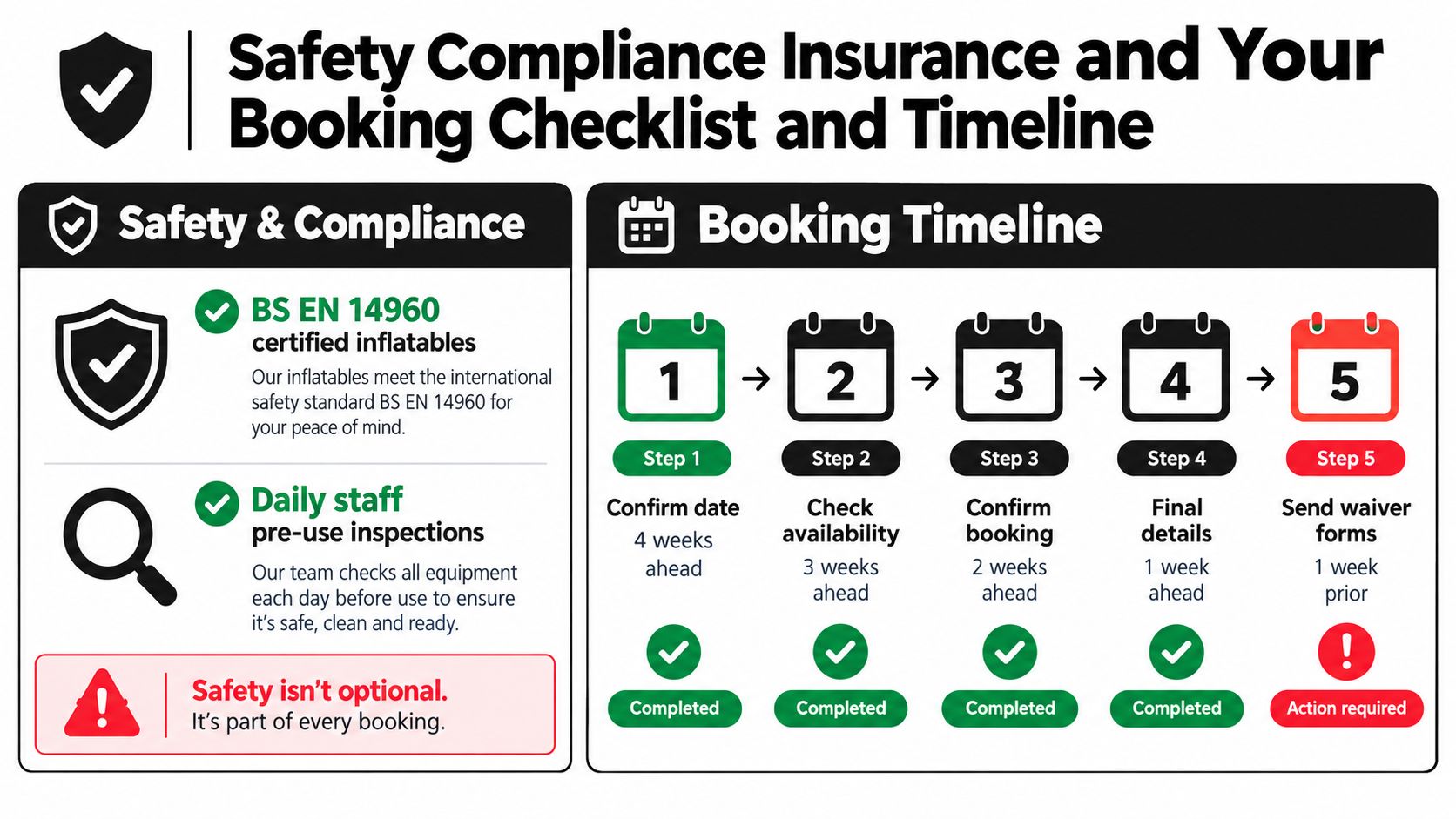
Safety Compliance Insurance and Your Booking Checklist and Timeline
This is the part many party guides skip. It's also the part that matters most when you're booking for a school, church, campus, or company event.
Fun gets approved when the paperwork is ready and the operating plan makes sense.
What to ask for before you book
If inflatables or amusement-style attractions are involved, ask the provider for documentation early. Don't wait until the week of the event.
A solid request list includes:
- Certificate of liability insurance
- Additional Insured status, when your venue requires it
- Current inspection or maintenance process
- Operating and supervision plan
- Venue-readiness details, including power, access, and setup surface
Independent event-safety guidance says game and amusement devices should be provided and run by an insured vendor, and that schools should request a Certificate of Liability and Additional Insured status, as outlined in event activity safety guidance for nonprofits and schools. If you need a plain-language explanation of what those insurance documents mean, this guide to a certificate of insurance for events helps translate the jargon.
The on-site safety details that actually matter
For inflatable-heavy packages, weather and setup quality are not side issues. They're central operating conditions.
UK safety guidance says play inflatables should have at least 6 functional anchor points, wind speed should be checked regularly with an anemometer, and inflatables should not be used when wind exceeds 24 mph (38 kph). The same guidance also calls for regular internal pressure measurement with a manometer and daily blower checks. U.S. campus safety guidance similarly recommends trained-attendant supervision at all times, no occupancy during inflation or deflation, grouping by similar height, weight, and age, and following the maximum occupancy shown on the device plate, according to HSE guidance on inflatable play devices and safe operation.
Non-negotiable: Safe operation depends on controlled installation, active supervision, participant grouping, and documented maintenance. It doesn't depend on the party theme.
A simple booking timeline that keeps paperwork from chasing you
Use this sequence to stay ahead of venue questions:
Start with date, headcount, and venue type
A backyard, school field, gym, and corporate lawn all create different requirements.Request package options with staffing included
This makes comparisons cleaner and reduces hidden assumptions.Ask for insurance and compliance documents early
Venues often need time to review them.Confirm your weather-stop policy and backup plan
Outdoor inflatable events need written rules, not verbal guesses.Do a final walkthrough of access and setup conditions
Gates, slopes, outlets, and load-in routes matter more than people expect.
For schools, churches, universities, and similar venues, this operational layer often decides whether a package is turnkey.
Choosing the Right Package and Planning Your Next Steps
The easiest way to choose among kids party entertainment packages is to sort your event into one of three lanes.
Use a simple decision framework
- Choose inflatable-heavy packages if the group is younger, the goal is free movement, and the space is open and straightforward.
- Choose mixed active-play packages if you have a wider age spread, a longer event window, or a venue where rotation matters.
- Choose entertainment-led packages such as DJs, karaoke, or game-based formats if the space is limited or the group prefers social energy over nonstop physical activity.
If you're stuck between two options, don't ask which package is more exciting. Ask which one gives your specific group the most uninterrupted fun with the least waiting.
The next steps that make booking easier
Before you lock anything in, confirm:
- Your realistic guest count
- Your usable space, not just total space
- Your venue rules
- Your weather policy
- Your required insurance paperwork
For planners who like working from a checklist, these WipesBlog.com event planner resources can help you organize venue questions, timing, and vendor follow-up without reinventing your system.
The best package usually isn't the biggest one. It's the one that fits the children, the space, and the operating reality of the day. When those three line up, the party feels easy. Kids stay busy. Adults stay relaxed. And you get to enjoy the event instead of managing it minute by minute.
Phantom Entertainment provides kids party entertainment packages that can include attractions, staffing, delivery, setup, and venue-ready documentation for birthdays, school events, church programs, and family fun days. If you want help matching the right activity mix to your age group, space, and compliance needs, visit Phantom Entertainment and start with a quote built around how your event works.
Ready to Book Your Event?
PA state-inspected, fully insured since 1979. Call us or get a free quote today.