

Karaoke isn't just a playlist with microphones. The format emerged as a defined entertainment style in Japan in the early 1970s, then evolved from public bars into private karaoke boxes, family settings, youth gatherings, and international competitions, according to this timeline of karaoke history. That history explains its planning advantage: karaoke can become a competition, school-spirit activity, family memory-maker, fundraiser, or dance-floor feature, depending on how you structure it.
The best karaoke party ideas aren't necessarily the most elaborate. They match the audience's comfort level, the venue's sound limits, the available equipment, and the amount of host attention the event can support. A casual family gathering needs a different plan from a bracketed corporate tournament or a silent headphone performance.
The guide below organizes ten formats by audience fit and planning complexity. Each idea includes practical execution steps, equipment considerations, and honest trade-offs. You'll also find ways to manage participation anxiety, keep transitions moving, add prizes or professional support, and use tools such as an AI karaoke maker when your preferred song isn't easy to source.
1. Corporate Team Building Karaoke Competition
A corporate karaoke competition works best when the structure encourages collaboration rather than turning the strongest singer into the automatic winner. Divide employees into departments, mixed-role teams, or randomly assigned groups. Each team chooses a song, assigns singers and backup performers, and earns points for presentation, creativity, audience engagement, and teamwork.
This format fits company picnics, holiday parties, retreats, and family fun days because employees can participate without making the event feel like a formal presentation. Duets and group performances also give hesitant employees a useful entry point. A two-person performance feels less exposed than a solo, while a team can contribute through dancing, props, harmonies, or choreography.
Practical rule: Score the performance experience, not just vocal accuracy. Otherwise, confident singers dominate and everyone else stops volunteering.
Make the competition manageable
Give teams a clear song list and simple judging rubric before the event. Include contemporary tracks, recognizable classics, and duet-friendly options. A mystery-song round can add spontaneity, but keep it optional or team-based so it doesn't embarrass employees who need more preparation.
Use a professional sound system, reliable lyric display, and a host who can queue tracks quickly. If the event also needs announcements, dancing, or awards, corporate party entertainment from Phantom can help consolidate those responsibilities. Schedule the competition when employees still have energy, rather than placing it after a long meal or formal program.
A small warm-up round helps break the ice. Let teams perform together before introducing individual recognition such as best stage presence or most creative arrangement. The trade-off is coordination. Team scoring, registration, and transitions take more preparation than open-mic karaoke, but the format produces stronger interaction and fewer awkward gaps.

2. School Spirit Karaoke Night
School karaoke succeeds when it feels like a shared campus tradition, not just a concert with students watching from the audience. Invite students, teachers, staff, clubs, athletic teams, and graduating classes to perform in defined slots. Mix school songs and fight songs with popular music so the event reflects institutional pride without limiting participation to one musical style.
This format suits homecoming, pep rallies, field days, orientation programs, and end-of-year celebrations. A class-versus-class structure can create energy, while club and team performances give students a natural reason to take the stage together. Teachers can also participate in a friendly challenge, provided the event remains welcoming rather than overly competitive.
Build the program around participation
Preselect school songs and confirm that usable karaoke versions are available. Ask clubs and teams to submit group performances in advance, then reserve open slots for individual students. School party entertainment from Phantom can support the sound, hosting, and pacing when staff members shouldn't have to manage equipment during the event.
Use small prizes or bragging-rights awards for categories such as loudest crowd, best class entrance, or most inventive group performance. Recording selected performances can create useful yearbook or social-media material, but obtain the permissions your school requires before filming students.
The main trade-off is supervision. School events need clearer boundaries around lyrics, movement, recording, and equipment access than private adult parties. A staff coordinator should approve the song list, manage the performance queue, and communicate expectations before the first microphone is handed out. Keep the stage visible, maintain a predictable schedule, and offer group roles for students who want to participate without singing solo.
3. Multi-Generational Family Karaoke Gathering
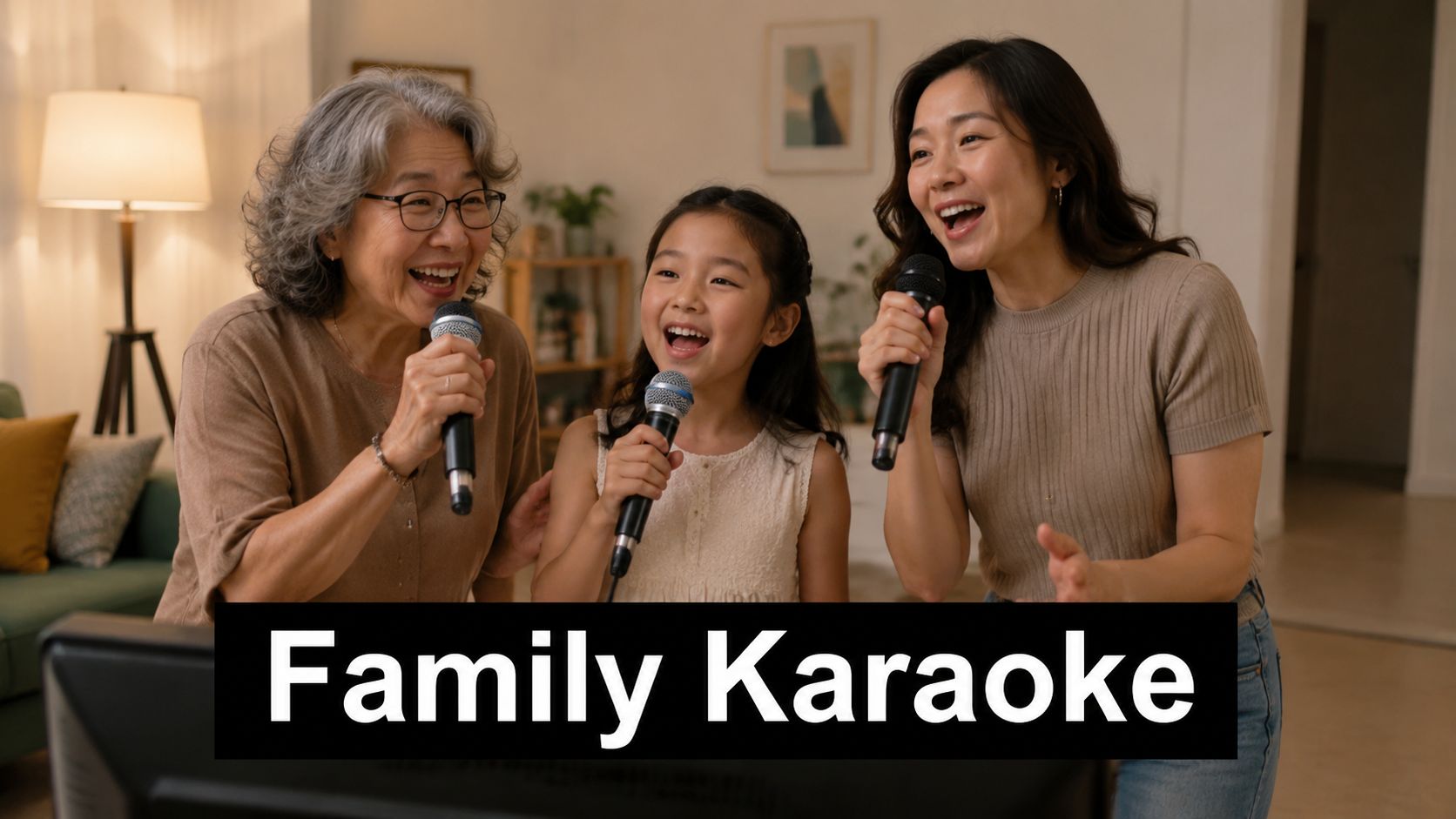
A family karaoke gathering should make grandparents, parents, teenagers, and children feel equally represented. Instead of asking everyone to browse one overwhelming catalog, organize suggestions into eras, artists, family traditions, and group-friendly songs. Labels such as “Grandparent Classics,” “Parent Favorites,” and “Kids' Picks” make selection faster and encourage relatives to share music across generations.
The format works for reunions, milestone birthdays, bar and bat mitzvah after-parties, graduations, and community festivals. Family duets are particularly effective because they create a reason for different generations to perform together. A grandparent and grandchild pairing, for example, can become a meaningful memory even if neither person considers themselves a singer.
Keep the rotation welcoming
Use wireless microphones if guests will move around a living room, banquet space, or outdoor gathering. Print song lists by era or artist, and place a visible sign-up sheet near the equipment. Short performance slots keep the queue moving and prevent one confident singer from occupying the microphone for too long.
- Start with group songs: Familiar choruses help younger and older guests settle into the format.
- Plan a few pairings: Ask relatives to choose duets before the event instead of forcing spontaneous decisions.
- Create a family archive: Record performances only after confirming that everyone shown is comfortable with it.
- Add another activity: Phantom's arcade games can give non-singers something active to do between performances.
The equipment trade-off is simplicity versus control. A home setup may feel intimate and inexpensive, but troubleshooting a television connection, microphone feedback, or missing lyrics can pull the host away from family time. Professional hosting costs more, yet it can make the event easier to operate and more inclusive for guests who don't want to handle technology.
4. Charity Benefit Karaoke Auction
A karaoke auction turns performance time into a fundraising experience. Guests can bid on solo spots, duets with local personalities, front-row tables, song requests, or special privileges such as choosing the opening number. The event becomes more compelling when the auction packages are specific and visibly connected to the entertainment.
This idea fits churches, schools, nonprofits, service clubs, and community organizations. Invite local business owners, radio personalities, community leaders, or recognizable performers early, and make their involvement clear in promotional materials. A duet with a familiar local figure can attract bidders who wouldn't otherwise volunteer for karaoke.
Design the giving experience
Offer a mixture of live and silent auction items so the night doesn't depend entirely on microphone bids. Music-related packages, event experiences, donated services, and themed gift items can keep people engaged between performances. A hybrid online and live auction can also include supporters who can't attend in person.
Set a fundraising objective and display progress during the event. The host should explain what each contribution supports without making unsupported promises about outcomes. Professional photography and video may help future promotion, but get permission from performers and identify any restrictions on recording.
The principal trade-off is atmosphere. An auction can generate excitement, but too much bidding language can interrupt the party. Keep packages limited enough to manage smoothly, use a confident MC, and group similar items together. A professional karaoke operator can handle microphones, tracks, and transitions while the nonprofit representative focuses on the mission, donor recognition, and payment process.
5. Themed Karaoke Party Nights
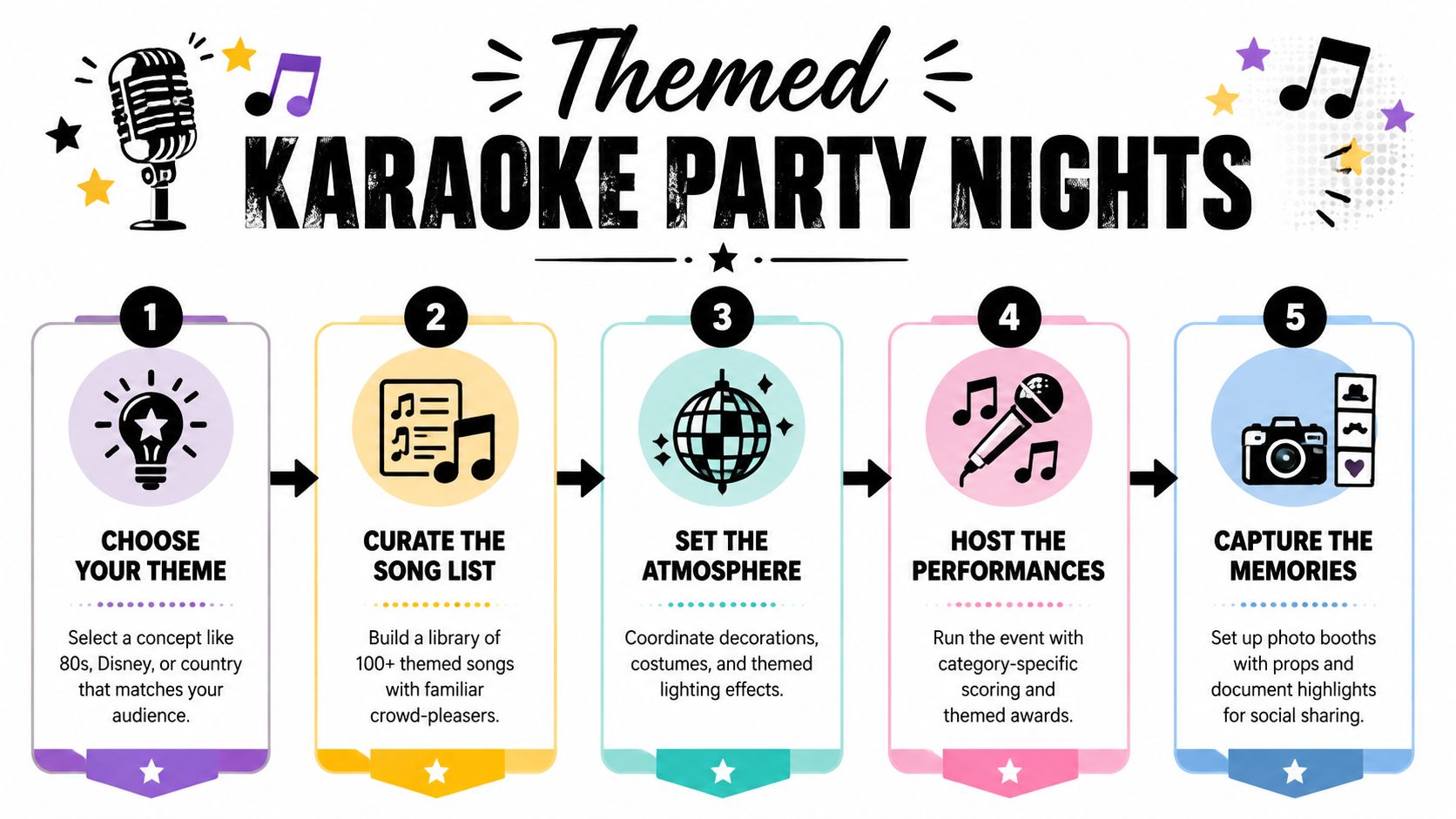
A themed karaoke night works best when the concept shapes the guest experience without restricting participation. An 80s party, movie-soundtrack night, Disney favorites event, hair-band rock gathering, or country showcase can guide songs, costumes, decor, lighting, awards, and photos without adding a formal competition.
Match the format to the audience and planning capacity. A college event may suit a decade or genre theme, while a family celebration needs a broader soundtrack. Keep costumes optional so guests can participate through a song, prop, backdrop photo, or audience role. For larger events or themes that require coordinated lighting and announcements, Phantom's professional karaoke and themed-party services can manage the technical flow.
Build a theme that still leaves room
Prepare a substantial catalog for the chosen concept, then add recognizable backup songs. Guests lose interest when they cannot find a track they know, so decide in advance whether requests outside the theme are allowed and tell the host how to handle them.
- Song planning: Group options by artist, decade, and energy level so guests can browse quickly and the host can maintain variety.
- Visual identity: Use a custom backdrop, consistent colors, and a photo area that make the concept visible as soon as guests arrive.
- Awards: Add categories such as best costume, strongest character performance, or most committed stage entrance. Keep judging simple enough to announce between singers.
- Technical support: Confirm microphone quantity, screen placement, track availability, lighting cues, and announcement responsibilities before doors open.
The main trade-off is focus versus flexibility. A narrow theme creates a stronger identity and simpler decor decisions, but it may exclude guests whose music tastes do not align. A broader theme welcomes more singers, though the event can feel like ordinary karaoke unless the host, visuals, song choices, and awards reinforce the concept throughout.
6. Battle of the Bands Karaoke Tournament
A Battle of the Bands karaoke tournament gives the night a clear narrative. Groups register as bands, perform through preliminary rounds, and advance through a bracket toward a final. Participants don't need instruments. They can create a band identity through coordinated singers, backing performers, costumes, choreography, or a shared theme.
This format suits schools, colleges, corporate departments, community events, and fundraisers that need entertainment to sustain attention across multiple rounds. Publish the scoring rubric before registration. Judges might assess song choice, teamwork, stage presence, audience connection, and overall execution, while audience voting can add a public element without making it the only measure.
Protect the pace
Use a tournament bracket tool such as Challonge or ChampionTournament.com, then assign a host to announce matchups and keep the program moving. Set a maximum performance length and collect song choices before the event. Live scores can increase attention, but only if the scoring system is easy to understand and the display updates reliably.
Audience engagement depends on visible progress. Show the bracket, announce the next matchup early, and give eliminated teams a reason to stay.
Provide consolation recognition for participants who don't advance. Awards such as best entrance, strongest group identity, or audience favorite can make the experience worthwhile beyond the final result. Record performances only with appropriate consent, especially at school events.
The trade-off is production complexity. A tournament needs registration, judges, score management, rehearsal communication, and a backup plan for missing teams. It offers more sustained excitement than open karaoke, but it isn't the right choice for a relaxed gathering where guests prefer to decide whether to sing at the last minute.
7. DJ and Karaoke Hybrid Dance Party
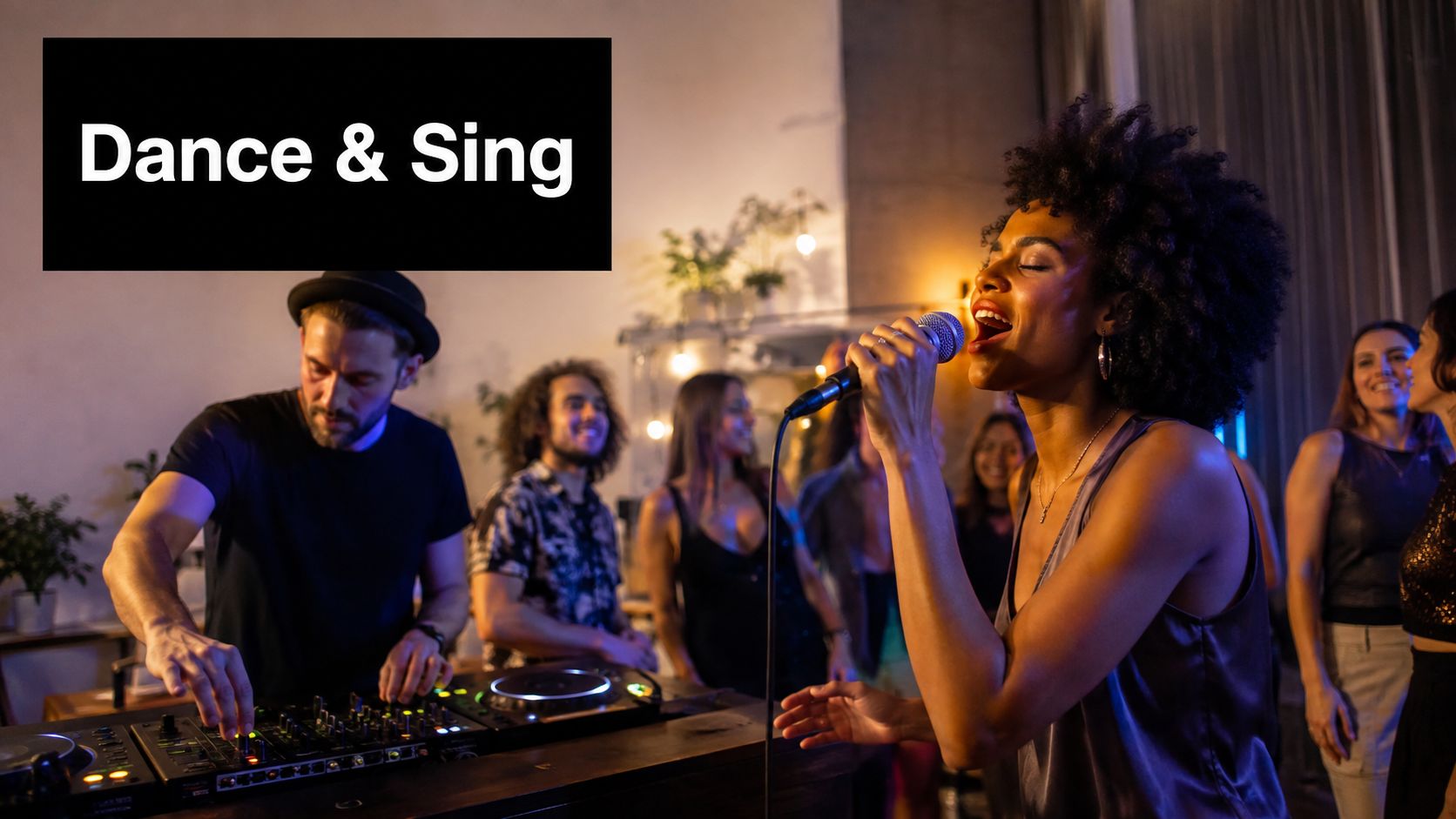
A DJ and karaoke hybrid works when singing should add performance moments without stopping the dance floor. The DJ maintains the broader musical flow, while the host inserts selected karaoke numbers at planned points. Guests can dance during the track, join the chorus, or step forward for a featured performance.
This format fits college parties, school dances, weddings, community festivals, and corporate celebrations. It works particularly well when the audience includes both active singers and guests who would rather dance. The event doesn't force everyone to wait through a long queue of individual performances.
Plan the transitions before guests arrive
Build karaoke slots into the DJ's set list rather than treating them as interruptions. Place a group singalong or recognizable duet early, then reserve more prominent performances for periods when the dance floor already has energy. A wireless microphone helps the performer move beyond a fixed stage, but the host still needs a defined performance area and clear sight lines.
A combined DJ and karaoke service can reduce handoffs between operators. The sound system must support both the DJ output and karaoke vocals without sudden changes in volume. Test microphone levels, lyric display, monitor placement, and lighting before guests enter.
The trade-off is control. Too much karaoke can drain dance momentum, while too little makes the feature feel decorative. A host who watches the room should be able to shorten a queue, switch back to DJ music, or turn a planned solo into a group performance when the crowd's energy changes.
8. Karaoke Talent Search and Showcase
A karaoke talent search raises the performance standard and gives participants a reason to prepare. Singers register in advance, perform before judges, and compete for prizes, coaching, recording opportunities, sponsorships, or a future performance slot. The event can still feel welcoming if organizers separate serious judging from casual audience participation.
This format suits schools, colleges, community groups, music programs, and organizations seeking emerging performers. Partner with local vocal coaches, music teachers, and performance venues for judges or workshop leaders. Clear criteria should cover vocal control, interpretation, stage presence, and connection with the audience, not just whether someone can reproduce a studio recording.
Make feedback part of the product
Registration should capture contact details, song choice, technical needs, and consent preferences. Offer a short feedback process to non-advancing performers, even if judges can only provide one or two practical observations. That turns rejection into a useful development moment and helps the event build credibility.
A pre-audition workshop can cover microphone technique, key selection, stage movement, and choosing a song that fits the singer. Professional sound and a capable MC matter because poor equipment can make a prepared performer appear weaker than they are. Recordings can support portfolios or promotion, but only when performers understand where the footage will appear.
The trade-off is intensity. A talent showcase attracts motivated singers, yet it may discourage casual guests who want to have fun. Consider dividing the schedule into judged showcase performances and an unscored community karaoke segment. That keeps the event aspirational without making vocal ability the only route to participation.
9. Karaoke Pub Crawl or Mobile Tour
A mobile karaoke tour combines the movement of a pub crawl with a performance schedule. The group visits multiple venues or locations, performs at each stop, and follows a planned route rather than staying in one room for the entire event. It suits bachelor and bachelorette parties, college activities, corporate outings, community tours, and destination celebrations.
The format requires more logistics than a stationary party. Confirm each venue's arrival time, sound restrictions, setup space, song access, food and beverage arrangements, and responsibility for microphones. A route with nearby stops is easier to manage than a scattered itinerary, particularly when guests may arrive separately.
Put one person in charge of movement
Distribute the itinerary before the event and appoint a coordinator at every stop. Use a check-in process so organizers know who has arrived, and establish clear start and departure times. If transportation is needed, arrange a shuttle or chartered vehicle rather than expecting every guest to travel independently.
Portable karaoke equipment can provide consistency from venue to venue, but battery levels, connectivity, and setup time require active management. Bring backup microphones, cables, and playback options. Confirm venue insurance requirements and any waivers before promotion, especially when the event involves transportation or multiple businesses.
The trade-off is variety versus control. Guests get a changing atmosphere and fresh audiences, but every move creates a chance for delays, missing participants, or incompatible equipment. This is a strong choice for social groups that value exploration. It isn't ideal when the audience includes young children, guests with mobility concerns, or attendees who need a predictable, accessible environment.
10. Silent Karaoke Party
Silent karaoke replaces the usual room-filling sound with wireless headphones. Singers hear the backing track through their own headphones and perform into microphones, while the audience watches the action without hearing the vocals through the venue speakers. The result resembles a silent disco, but the performance remains visible and theatrical.
This format fits noise-sensitive venues, tight urban spaces, corporate events, outdoor festivals, and celebrations where conventional amplified sound would create problems. It can also support simultaneous activity zones, provided the wireless system is designed for the venue and the operator manages channels carefully.
Treat the technology as the main attraction
Explain the format before the first performance. Guests need to know how to wear the headphones, control volume if permitted, hold the microphone, and follow the performance rotation. Test wireless transmission, battery levels, microphone response, and audience sight lines before doors open. Keep spare headphones and backup equipment ready.
Use lighting, a visible stage area, and screens or scoreboards to give spectators something to follow. Because the audience won't hear the singer, facial expression, movement, group choreography, and visual cues become more important than vocal detail. A short host explanation can prevent confusion and encourage spectators to cheer when the performer finishes.
Silent karaoke works because the visual performance carries the room. Give the audience a clear stage, not an invisible technical experiment.
The trade-off is equipment dependence. Traditional karaoke lets an operator recover from a small technical issue with ordinary speakers. Silent karaoke depends on wireless reliability, charged headphones, transmission range, and clear instructions. Test the system in the actual venue, and don't book this format without confirming that the provider can supply the necessary hardware and on-site support.
This silent karaoke demonstration shows why the format needs strong visual presentation as well as functioning audio.
10 Karaoke Party Ideas, Side-by-Side Comparison
| Event | 🔄 Complexity | ⚡ Resources & setup | 📊 Expected outcomes | Ideal use cases | ⭐ Key advantages / 💡 Tip |
|---|---|---|---|---|---|
| Corporate Team Building Karaoke Competition | Medium–High (scoring, MC, coordination) | Moderate–High: pro sound, host/MC, prizes, 2–3+ hrs | Boosted morale, cross-team bonding, shareable content | Company picnics, retreats, holiday parties, recognition events | Boosts engagement & unity; 💡 Offer duets/warm-ups to reduce performance anxiety |
| School Spirit Karaoke Night | Medium (scheduling, age groups) | Low–Moderate: school AV, themed displays, volunteers | Strengthened school pride, broad student participation | Homecoming, pep rallies, orientation, end-of-year celebrations | Inclusive community-building; 💡 Pre-select school songs and slots |
| Multi-Generational Family Karaoke Gathering | Low–Medium (song curation by age) | Low: basic AV, wireless mics, era playlists | Stronger family bonds, memorable traditions | Family reunions, birthdays, bar/bat mitzvahs, community festivals | Bridges generations; 💡 Use era-specific playlists & short slots |
| Charity Benefit Karaoke Auction | High (auctions, sponsorships, promotions) | High: professional production, promotion, auction platform | Significant fundraising, donor engagement, media exposure | Nonprofit fundraisers, church events, school fundraisers | Generates major fundraising & awareness; 💡 Secure celebrity/local partners early |
| Themed Karaoke Party Nights | Medium (theme curation, decor, coordination) | Moderate: themed props, playlists, lighting, optional costumes | Immersive experience, high social buzz, niche appeal | Birthday parties, college events, themed community festivals | Highly marketable & creative; 💡 Keep costume optional and promote theme early |
| Battle of the Bands Karaoke Tournament | High (brackets, scoring, multi-round logistics) | High: consistent sound, long runtime, bracket software, MC | Sustained audience investment, competitive excitement, social buzz | Extended school events, corporate team-building, community festivals | Creates dramatic engagement & rivalry; 💡 Use clear rubrics and live scoring |
| DJ + Karaoke Hybrid Dance Party | Medium–High (sync DJ/karaoke, transitions) | High: pro DJ, advanced sound/lighting, experienced staff | Continuous high energy, appeals to dancers & performers | College parties, weddings, corporate holiday events | High-energy, flexible format; 💡 Pre-plan performance slots within DJ sets |
| Karaoke Talent Search and Showcase | High (auditions, judging, mentorship) | High: expert judges, coaching, promo budget, recording support | Talent discovery, mentorship pipelines, sponsorships/media | University arts programs, talent agencies, community arts councils | Develops performers and pathways; 💡 Partner with music schools for credibility |
| Karaoke Pub Crawl or Mobile Tour | High (venue coordination, transport, permits) | Moderate–High: portable gear, logistics, transport, permits | Novel group bonding, venue promotion, extended entertainment | Bachelor/bachelorette parties, college town events, corporate outings | Unique community-engaging format; 💡 Limit to 3–5 nearby stops and assign leaders |
| Silent Karaoke Party (Wireless Headphone Format) | Medium (wireless setup, testing, operator) | Moderate–High: specialized headphones, wireless mics, tech operator | Noise-free performances, novel attendee experience, venue-compatible | Noise-restricted venues, corporate retreats, urban festivals | Eliminates noise complaints & enables simultaneous acts; 💡 Test headphones and batteries beforehand |
Choose the Format That Fits Your Crowd
The strongest karaoke party ideas begin with audience behavior, not a theme. A corporate group may respond to team scoring and duet options, while a family reunion may need era-based song browsing and flexible participation. A school event benefits from clubs, classes, and school songs, while a dance party needs a DJ who can protect the floor between featured performances.
Venue conditions matter just as much. Check whether the space supports amplified sound, where performers will stand, how guests will see lyrics, and whether the power and wireless environment can support the equipment. A mobile tour needs route coordination and transportation. A silent party needs headphone testing and visual staging. A tournament needs brackets, judges, registration, and time control. Choose the format whose operational demands match your available staff.
Participation comfort deserves equal attention. Not everyone wants to sing, and forcing reluctant guests onto a microphone can reduce engagement. Recent karaoke market reporting highlights social, interactive, and personalized entertainment, which supports a broader planning approach. Give non-singers meaningful roles such as duet partners, team strategists, lyric operators, dancers, judges, photographers, audience voters, or hosts for themed rounds.
Prepare the event in practical stages
Start by selecting one format and defining its purpose. Then build a song and performance plan that includes recognizable choices, different genres, group options, and alternatives for guests who don't want to perform. Confirm the catalog before advertising a specific theme or school song.
Next, define the equipment and staffing requirement. You may need microphones, speakers, monitors, lyric screens, wireless systems, lighting, a DJ, an MC, judges, registration support, or a technician. A provider that handles delivery, setup, operation, and teardown can remove several failure points, particularly for schools, corporate venues, and community events with strict schedules.
Finally, communicate the rules before guests arrive. Explain how people sign up, how long performances last, whether songs are judged, how prizes work, and what behavior keeps the event comfortable. A judgment-free tone doesn't mean an unplanned event. The host should still protect the queue, manage volume, resolve technical problems, and keep transitions short.
For song discovery, organizers can combine a hosted catalog with a genre-based music resource from House of Lyrics. The practical goal is a balanced event where singers have enough choice, the audience stays involved, and the operator can keep the program moving.
When the event needs professional karaoke, DJ services, delivery, setup, or on-site operation, Phantom Entertainment can help planners assemble a format around the venue and audience. Its service area includes Pennsylvania and the Mid-Atlantic, with entertainment options suited to company events, school programs, family celebrations, fundraisers, and community gatherings.
Phantom Entertainment provides hosted karaoke, DJ entertainment, delivery, setup, and event operation for parties that need more than a basic microphone and screen. Visit Phantom Entertainment to discuss your audience, venue, preferred karaoke party format, and the equipment or staffing support that will make the event easier to run.
Ready to Book Your Event?
PA state-inspected, fully insured since 1979. Call us or get a free quote today.