
Most advice about how to plan a neighborhood block party starts with food, games, and invitations. That order is backwards. A street party isn't just a backyard gathering moved onto asphalt. It's a temporary public-right-of-way operation, and the permit, emergency route, operating hours, equipment approvals, and resident expectations should shape the program before anyone books a band or orders tables.
The practical standard is simple. Design an event the municipality can authorize, first responders can handle, residents can tolerate, and guests with different ages and mobility needs can genuinely enjoy. Once those constraints are clear, the food and entertainment become much easier to manage.
Navigating Permits and Local Regulations
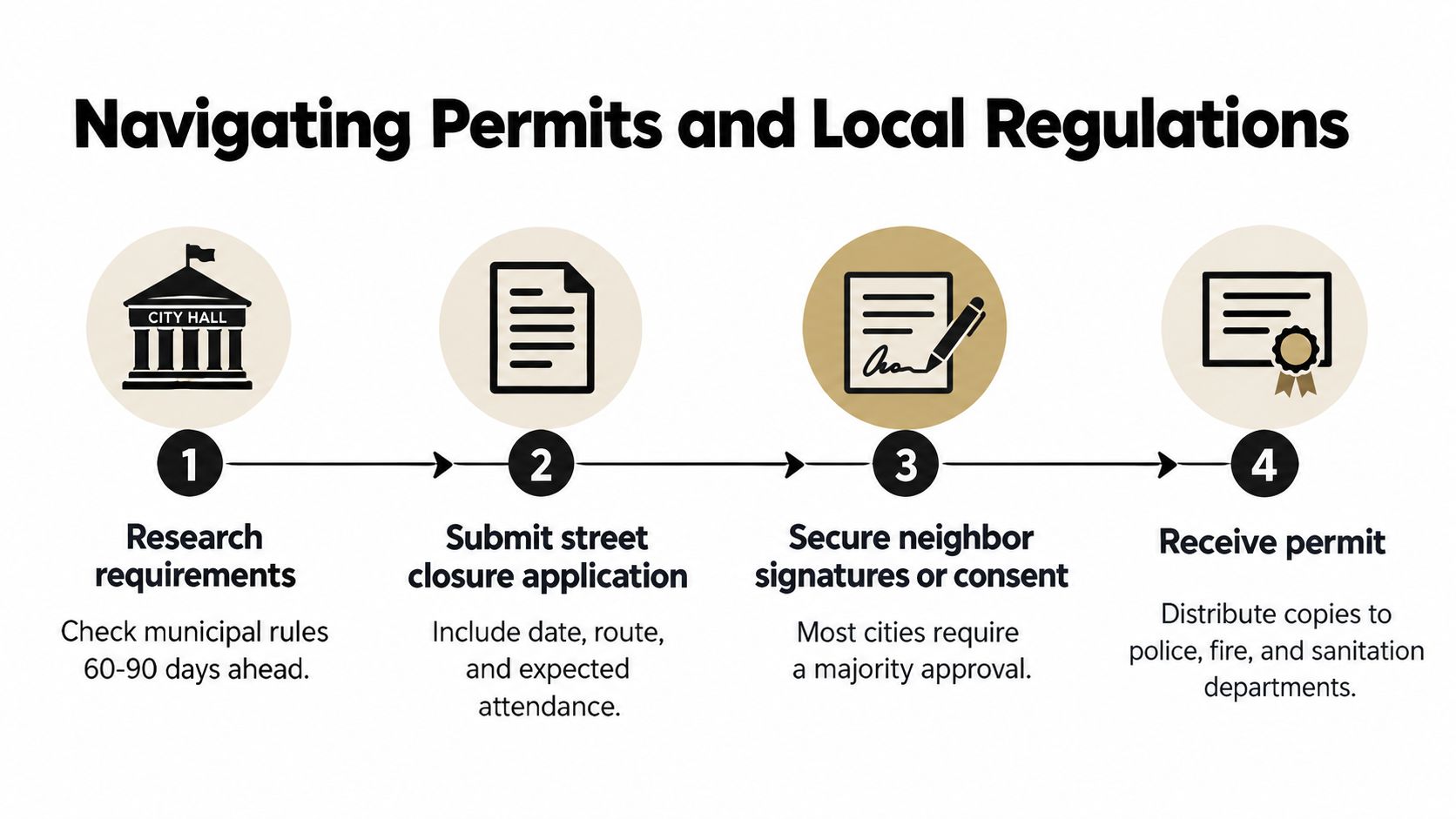
A block party permit isn't a minor administrative form. It determines where the event can operate, how long it can run, what equipment is acceptable, and whether the street can be closed at all. Start by checking the local government's street-closure process before choosing a date or distributing invitations.
Major-market rules show why early planning matters. San Francisco requires an application at least 30 days before the event and recommends applying 90 days ahead, while New York City requires applications 60 days before the party. Washington, D.C., uses a process requiring applications at least 30 business days in advance and consent from 51% of households. These requirements are documented by San Francisco's neighborhood block-party guidance and Washington, D.C.’s neighborhood block-party process.
Establish the legal footprint first
Confirm whether the street has transit service, substantial traffic, commercial activity, or businesses that need access. Sales, food trucks, amplified sound, alcohol, temporary structures, and rented attractions may trigger additional approvals. A standard residential closure may not cover all of them.
San Francisco limits its standard permit to one residential block, requires the event to remain under 8 hours including setup and cleanup, and allows operation between 7 a.m. and 10 p.m. New York City similarly limits a block party to one block, one day, and 9 consecutive hours, and expects the event to be open to neighbors rather than functioning as a private birthday party. Those limits aren't decorative details. They should control the schedule you publish and the contracts you sign.
Prepare a one-page site plan with the closure boundary, sidewalks, driveways, barricades, activities, food service, sound, toilets, waste stations, and emergency access. Give the municipality a usable operating picture rather than a vague description of a celebration.
Practical rule: Don't book equipment until you know whether the permit allows that equipment.
Keep permit documents, insurance requirements, vendor certificates, alcohol and food rules, noise limits, and inspection requirements in one shared folder. If a venue, school, or municipality needs proof of coverage, use a practical reference such as this guide to a certificate of insurance for events and confirm the exact wording with the relevant agency or insurer.
Designing a Safe and Accessible Site Plan
Once the closure is approved, treat the street like a compact event venue. Draw the plan around movement and risk, not around the most attractive arrangement of tables. Guests should be able to enter, circulate, sit, eat, use the restroom, and leave without crossing the path of vehicles, generators, grills, or active attractions.
The emergency lane is essential. Boston requires a continuously unobstructed 20-foot aisle across the entire block for emergency vehicles. San Francisco advises placing barricades no more than 6 feet apart, leaving no vehicle-sized gap, and assigning adults to monitor them. The sidewalks must remain usable. These requirements and operating practices appear in the federal special-events emergency-planning reference.
Build the layout around peak use
Estimate peak attendance, not the number of invitations delivered. A guest who arrives during the busiest period still needs a clear route, shade, water, sanitation, and a safe place to stand. Keep games, inflatables, grills, tables, spectators, and electrical equipment outside the emergency corridor.
Use a simple zone plan:
- Arrival zone: Place welcome information where it won't narrow the sidewalk or obstruct a driveway.
- Activity zones: Separate active attractions from quiet seating and pedestrian circulation.
- Food and power zone: Keep cooking equipment, cords, generators, and combustible materials away from children and high-traffic routes.
- First-aid point: Make it visible, centrally reachable, and known to every volunteer lead.
- Accessible route: Preserve a firm, practical path between the street entrance, seating, food, toilets, and exits.
For sanitation, use the planning benchmark of one portable restroom per 300 guests, with at least 10% ADA-compliant units, as described in the special-events planning guide from Washington, D.C.’s emergency management agency. Place accessible units where guests can reach them without navigating grass, steep surfaces, tangled cords, or blocked sidewalks. A unit technically present but practically unreachable doesn't solve the access problem.
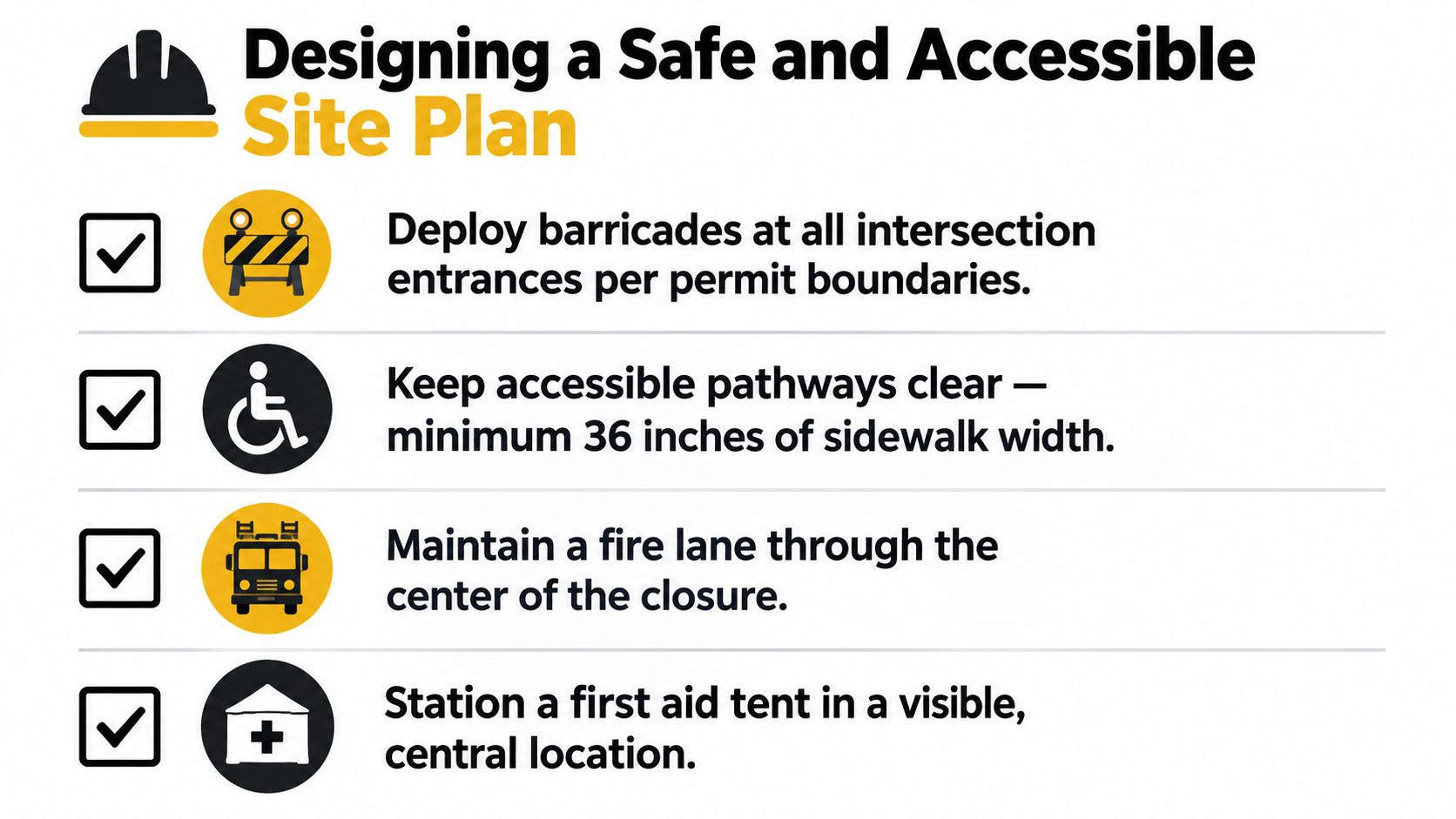
Federal emergency-planning guidance estimates that approximately 0.3% to 1.3% of event attendees may need some form of medical assistance. For a gathering of 300 people, that equates to roughly 1 to 4 attendees, so assign a named first-aid contact, keep emergency numbers available, and document the nearest hospital or urgent-care facility.
If the plan includes a tent, confirm its anchoring, placement, and approval requirements. A resource on tents with sides can help you identify practical setup questions, but the local authority and rental vendor remain responsible for confirming what the site permits.
Budgeting and Coordinating Entertainment Vendors
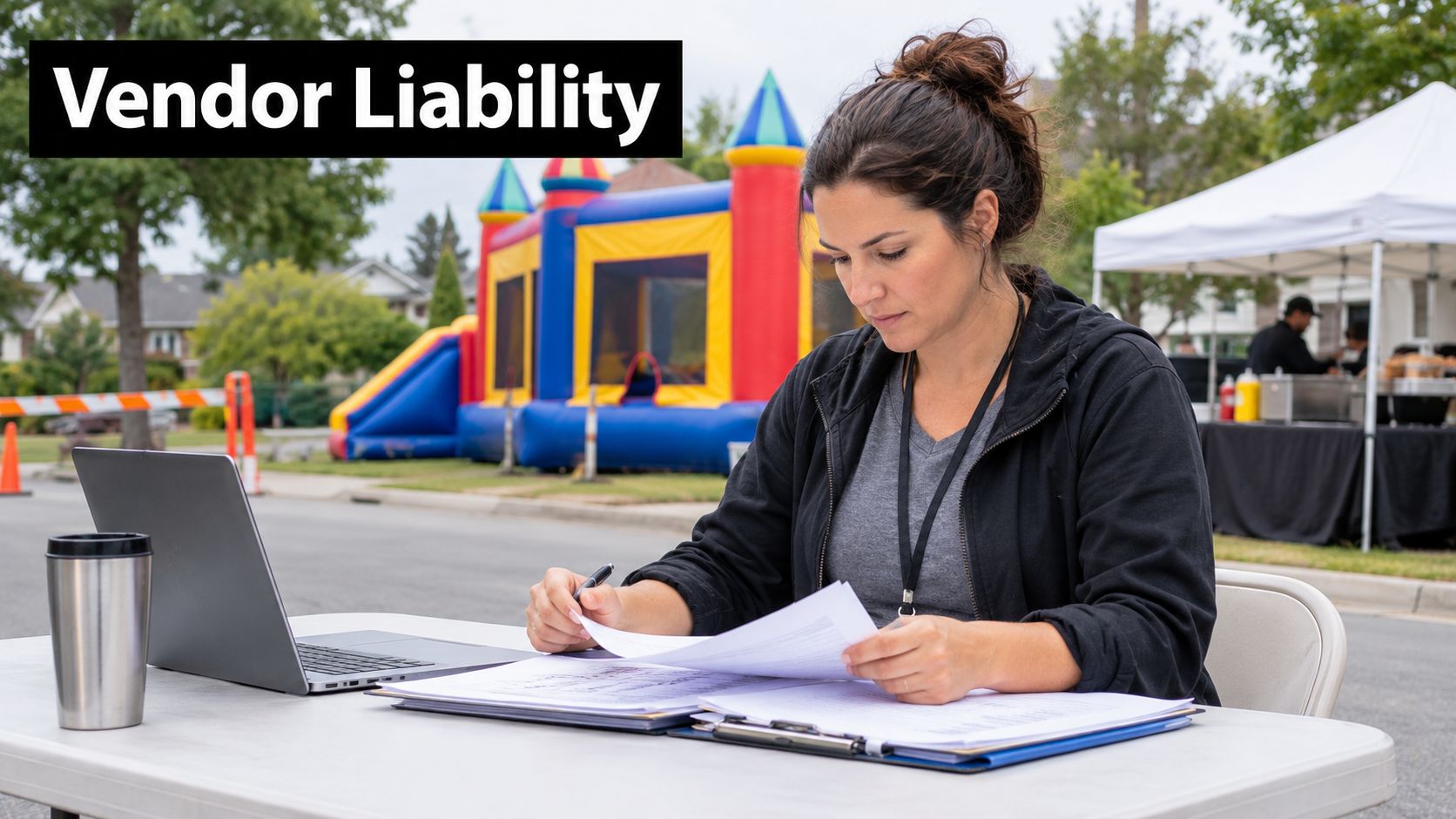
Entertainment changes the event from a simple social gathering into a coordinated production. A neighbor's folding table and a playlist have limited compliance implications. An inflatable, mechanical attraction, stage, mobile escape room, or food vendor introduces contracts, electrical needs, supervision, insurance, inspection records, delivery access, and a defined footprint.
The cheapest quote isn't always the cheapest plan. DIY equipment may appear affordable, but the organizer may still have to arrange transport, anchoring, supervision, weather decisions, repairs, cleanup, and insurance documentation. A professional rental company may cost more upfront while reducing the number of tasks that fall on volunteers during the event.
Use a written comparison before choosing:
| Option | What the organizer must manage | Main exposure |
|---|---|---|
| DIY equipment | Transport, setup, supervision, anchoring, inspection, teardown | A volunteer may lack the training or documentation needed for public use |
| Informal rental | Equipment delivery may be included, but responsibilities can remain unclear | Contract gaps, uncertain insurance, and unclear maintenance duties |
| Professional vendor | Delivery, setup, operating instructions, paperwork, and teardown may be coordinated | The equipment still needs municipal approval and a suitable site |
Ask each vendor for a certificate of insurance, inspection or licensing documents where applicable, equipment specifications, anchoring requirements, power needs, staffing details, weather policy, and cancellation terms. Verify that the certificate names the correct organization or venue if the municipality requires additional insured status.
A useful comparison method is to compare DIY and pro pest services as a general example of evaluating risk, responsibility, and professional documentation rather than comparing price alone. The same logic applies to event attractions. Ask who owns each task and what happens when conditions change.
Vendor test: If a supplier can't explain the equipment footprint, supervision plan, insurance documents, and weather procedure clearly, don't put that supplier inside a public street closure.
D.C.’s guidance specifically excludes rental equipment such as inflatables, stages, tents, and water-dunking booths from its neighborhood block-party permit. That means the street-closure approval may not authorize the attraction itself. Confirm separate permissions and vendor compliance before signing a contract, using the D.C. neighborhood block-party permit guide_0.pdf) as a reminder to separate the closure approval from equipment approval.
For the financial plan, group costs by operational function: permitting, traffic control, sanitation, power, food, entertainment, insurance, signage, waste removal, and contingency. A practical event budget-planning framework can help assign an owner and approval deadline to every line item.
Managing Weather Risks and Inclusive Programming
A pleasant afternoon is not a safety plan. Outdoor events need a clear response to heat, sudden storms, smoke, poor air quality, mobility barriers, and guests who need quiet or seated options. The strongest plans treat weather resilience and accessibility as the same design problem. Shade, rest areas, water, clear routes, and flexible programming protect more people at once.
The need is practical, not theoretical. During the first major U.S. heat wave of 2025, more than 90 million people were under extreme-heat alerts on June 23, and federal guidance recommends hydration, shade, and places to rest at hot-weather outdoor events. The National Oceanic and Atmospheric Administration guidance on outdoor events in a warming world supports making those provisions part of the operating plan.
Make comfort operational
Assign a weather-monitoring lead who checks conditions before setup and throughout the event. That person should have authority to pause an attraction, move guests into cooling areas, shorten activity rotations, or recommend postponement under the agreed cancellation policy.
Build the site with:
- Cooling areas: Provide shaded locations with seating, free water, and a clear route away from the busiest attractions.
- Shorter activity rotations: Alternate active entertainment with seated, shaded, or low-stimulation programming.
- Weather triggers: Write down what conditions require a pause, evacuation, relocation, or cancellation.
- Communication fallback: Prepare printed notices, door-to-door contacts, phone trees, or other methods for residents who don't reliably use the internet.
- Equipment limits: Confirm how inflatables, electrical systems, tents, and sound equipment should be handled in wind, rain, heat, or smoke.
Don't make the loudest attraction the only meaningful activity. Older adults, disabled residents, young children, and people with medical vulnerabilities may participate more comfortably when the program includes conversation areas, shaded seating, accessible routes, and predictable rest periods.
Accessibility also depends on what isn't placed in the street. Tables can't narrow sidewalks, cords can't cross essential paths without a safe treatment, and spectators can't be allowed to turn the emergency lane into standing room. A resident who can enter the closure but can't reach a seat, restroom, or exit hasn't been fully included.
Design principle: Inclusion improves the event for everyone. A shaded seat helps an older neighbor, a tired parent, a volunteer, and a guest recovering from the heat.
Communicating with Residents and Promoting the Event
Resident outreach should begin before promotion. The people who live on the block aren't just an audience. They're affected by vehicle restrictions, noise, delivery windows, driveway access, cleanup, and emergency procedures, so their concerns belong in the operating plan.
Start with a short, direct conversation at each residence. Explain the proposed date, closure area, purpose, expected activities, food or alcohol plans, and the help you need. Ask which driveways require access, who may need mobility accommodation, whether anyone works unusual hours, and which residents want to volunteer.
Turn consent into working information
A signature or consent process is only useful if the resulting information helps you operate the event. Keep a contact sheet with permission status, accessibility concerns, vehicle needs, volunteer assignments, and preferred communication methods. Protect that information and share it only with the people who need it.
A practical outreach sequence looks like this:
- Early discussion: Present the concept and ask for objections before submitting the final application.
- Permit-stage follow-up: Explain what the municipality requires and identify unresolved access or noise concerns.
- Pre-event notice: Distribute the approved closure area, setup window, expected sound, parking restrictions, and contact number.
- Final operational message: State where residents should move vehicles, when vendors will arrive, how rain decisions will be communicated, and who owns cleanup.
- Day-of contact: Keep one organizer reachable for access problems, deliveries, complaints, and urgent changes.
Avoid vague wording such as “the street will be closed for the afternoon.” Residents need to know when setup begins, when cars must move, whether they can cross the closure, and how emergency access will be preserved. Tell vendors the same thing. A delivery driver who arrives without the site plan can create a blockage before the event starts.
Post physical no-parking or closure notices according to local requirements, and don't rely only on a neighborhood social-media group. Some residents won't see online posts, and a printed notice gives people something concrete to reference.
Manage expectations honestly
A block party can be welcoming without promising silence, unlimited access, or an informal atmosphere that the permit doesn't allow. Explain that the event will operate within approved hours, that sidewalks and driveways remain important, and that volunteers will respond to noise, waste, and crowding concerns.
Invite residents to contribute in ways that match their capacity. Some can bring food or chairs, while others can staff a welcome table, monitor a quiet area, check waste stations, or help restore the street. Afterward, thank contributors individually and record what residents want changed before planning the next event.
Executing the Day-of Timeline and Teardown
On event day, the organizer's job changes from planning to control. Every major action needs a named owner, a defined location, and a handoff point. Don't let one person supervise children, direct vendors, monitor barricades, answer resident calls, and handle emergencies simultaneously.
Prepare a contact sheet for the permit holder, traffic lead, first-aid contact, vendor leads, weather lead, sanitation lead, and teardown coordinator. Keep the permit, site plan, insurance documents, vendor contacts, emergency information, and incident log together at the operations point. A simple action-plan template from Listava can help turn responsibilities into a visible checklist.
Use a controlled operating sequence
Before the closure begins, confirm that vehicles have moved, signage is visible, barricades are correctly positioned, sidewalks and driveways remain usable, and the emergency lane is completely clear. Don't accept a vendor delivery until the traffic lead confirms that the vehicle can enter, unload, and leave without blocking response access.
During setup, each supplier should report to an assigned zone. Inspect anchors, cords, cooking areas, tents, activity boundaries, sanitation access, waste stations, and first-aid visibility before guests arrive. Record unresolved issues and stop the affected activity until someone with authority corrects them.
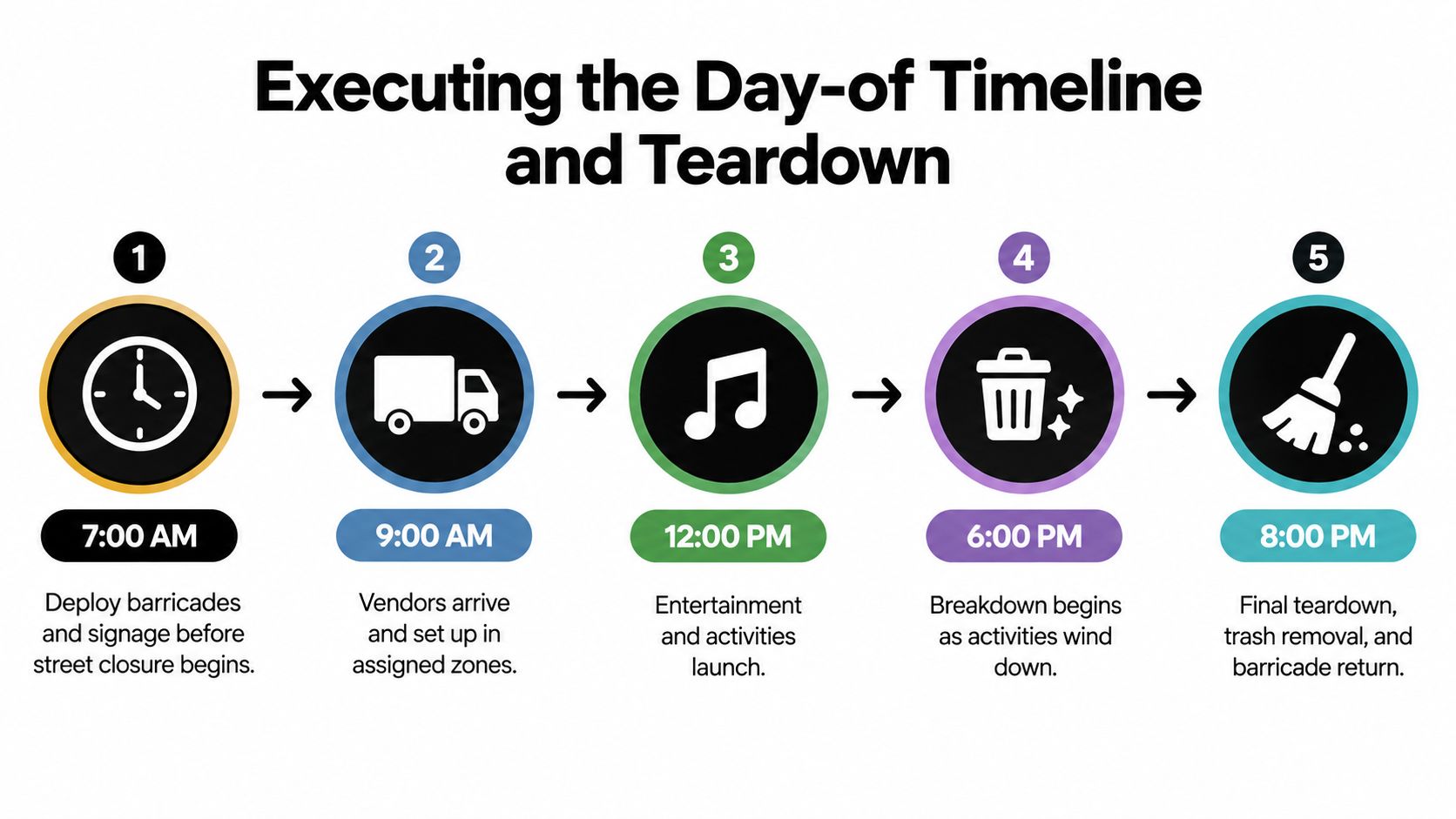
Use scheduled zone checks rather than waiting for a complaint. The traffic lead watches the emergency route. The activity lead checks capacity and supervision. The sanitation lead checks restrooms and waste. The weather lead monitors conditions and communicates pauses. The resident liaison handles driveway access, noise questions, and neighbors who need assistance.
If someone needs medical help, move spectators away, call emergency services when appropriate, send a person to guide responders, and document the incident afterward. For a missing child, assign one person to stay with the reporting adult, alert the operations lead, control exits without creating panic, and follow the agreed search procedure. Severe weather, fire, power failure, or crowd movement should trigger a written escalation plan, not improvised instructions.
Teardown is part of the permit
Begin breakdown early enough to remove guests, equipment, waste, and vehicles within the approved operating window. Vendors should pack their own equipment under the teardown coordinator's direction, while volunteers inspect sidewalks, driveways, storm drains, lawns, and the emergency lane for remaining hazards.
Do a final walk with the site plan in hand. Collect signage, remove barricades only when authorized, confirm that no equipment or rubbish remains, and document any damage or incident for follow-up. The public right-of-way should be restored deliberately, not abandoned as soon as the last attraction shuts down.
Final check: The event isn't finished when the music stops. It's finished when residents can use the street normally and the organizing team has closed every operational task.
Phantom Entertainment provides professionally delivered, set up, staffed, and removed attractions and DJ services that can support a neighborhood event when the equipment is permitted and the site plan can accommodate it. Visit Phantom Entertainment to discuss a compliant entertainment package for your block party.
Ready to Book Your Event?
PA state-inspected, fully insured since 1979. Call us or get a free quote today.