
The request usually arrives with very little warning. An HR manager is asked to create a casino-themed company social, a school coordinator needs an activity for a graduation event, or a church committee wants a fundraiser that feels more memorable than a dinner. Someone suggests renting blackjack and roulette tables. Suddenly, the organizer is responsible for permits, insurance, dealers, prizes, food service, guest flow, and a room full of people who may not know how casino games work.
A successful casino night isn't just a row of felt tables. It's a regulated event, a social experience, and often a fundraising mechanism operating at the same time. The strongest events treat the tables as one attraction inside a broader environment, with clear rules, alternative activities, and a plan for guests who don't want to gamble, even with play money.
The Casino Night You Are About to Plan
The first useful decision is to define what kind of event you're producing. A corporate casino night may use the tables as entertainment between dinner and a prize ceremony. A nonprofit fundraiser may use admission, sponsorships, auctions, or prize drawings to generate donations. A school or family event may use casino styling without permitting younger guests to participate in gaming activities at all.
Those formats can look similar to guests, but they don't create the same operational or legal obligations. Before you choose a game, write down the host organization, the venue location, the youngest expected guest, whether alcohol will be served, whether anyone will wager real money, and how prizes will be distributed.
Practical rule: Treat the casino theme as production design. Treat gaming, payments, prizes, alcohol, and age controls as compliance decisions.
The event usually has five working parts:
- Arrival: Guests check in, receive instructions, and learn whether their chips have entertainment value only.
- Activity floor: Dealers or facilitators run selected games and explain the rules to beginners.
- Hospitality: Food, drinks, music, seating, and conversation give nonplayers a reason to stay.
- Redemption or fundraising: Guests exchange chips according to the published prize or drawing rules.
- Closeout: The host reconciles materials, records distributions, and confirms that the room and equipment are returned properly.
The tables create movement and conversation, but they shouldn't carry the entire evening. A guest who dislikes gambling, has a religious objection, is underage, needs an accessible setup, or just wants to socialize should still find a satisfying place in the room. That may mean a lounge, arcade game, photo area, carnival activity, silent auction, demonstration table, or quiet seating zone.
The practical sequence is straightforward. Classify the event first, confirm local requirements second, design the guest experience third, and book equipment only after those decisions are settled. That order prevents the common mistake of spending money on a casino package before discovering that the planned format, age range, or prize system needs to change.
Licensing, Permits, and Insurance Essentials
A casino night can fall into very different legal categories. An entertainment-only event with clearly marked play money may be treated differently from charitable gaming, a raffle-based fundraiser, or an event involving real wagers. The same table setup can therefore require different approvals depending on the state, municipality, nonprofit status, payment method, prize structure, and alcohol service.
Start with the jurisdiction, not the vendor. Ask the state or municipal gaming authority these questions:
- Is the host eligible to conduct the event?
- Does play money remove the activity from charitable-gaming rules?
- Are raffles, prize drawings, or donated prizes regulated separately?
- Is a permit required, and what is the filing deadline?
- What ages apply to players, workers, dealers, and volunteers?
- Does alcohol require a separate permit?
- What rules must appear at registration, on the gaming floor, or on printed materials?
Louisiana's official guidance illustrates how specific the requirements can become. The verified guidance states that charitable casino gaming must be conducted by members of a licensed charitable organization, participating workers must be registered with the state Office of Charitable Gaming, players must be at least 21, and a session may last no more than six consecutive hours, with at least 12 hours between sessions. Alcohol service requires a separate special-event permit. See the Louisiana Office of Charitable Gaming guidance.pdf) before relying on a generic party-rental explanation.
Montana takes a different approach. Its guidance allows a nonprofit only one casino night per year, or two six-hour sessions on different dates, and requires a permit application at least 10 business days before the event. It also restricts payment and operating practices. Massachusetts provides another example, with a qualified nonprofit, municipal permit, a limit of three such events per permit year, a five-hour event limit, and a 5% tax on gross proceeds due within 10 days, according to the Massachusetts nonprofit gaming FAQ.
State-by-state casino night rules at a glance
| State | Permit lead time | Session length limit | Key restriction |
|---|---|---|---|
| Louisiana | Confirm with the state authority | No more than six consecutive hours in the cited guidance | Licensed charitable organization, registered workers, players at least 21, separate alcohol authorization |
| Montana | At least 10 business days | One casino night per year, or two six-hour sessions on different dates | No credit-card entry payments, authorized activities, and administrative expenses limited to 50% of proceeds |
| Massachusetts | Confirm municipal process and filing schedule | Five hours | Qualified nonprofit, municipal permit, three events per permit year, and 5% tax on gross proceeds within 10 days |
The Louisiana material also demonstrates why organizers should reconcile every rule against the current official form before advertising. Requirements can change by event type, and summaries may describe a different session category from the one you intend to run.
Insurance belongs in the same early conversation. Venues, schools, municipalities, and campuses may request a certificate of insurance naming the venue as an additional insured. Ask the venue for its coverage language, limits, deadline, and certificate holder details, then give those requirements to your broker. For a starting point when comparing coverage options, review Select Insurance Group options and confirm that the policy fits the actual event, location, activities, and equipment.
Choosing Rental Equipment and Vendors
Once the legal format is clear, build the rental package around the guest experience rather than the vendor's inventory list. Blackjack is usually the easiest teaching game. Roulette creates a visible focal point. Craps brings energy but needs a confident operator. Poker can work well for a defined group, though it may feel slow or intimidating when dropped into a general social event.
A practical package may include:
- Gaming tables: Blackjack, roulette, craps, poker, or a simpler wheel-based attraction.
- Operating materials: Chips, cards, dice, layouts, dealing shoes, chip racks, and replacement supplies.
- People: Professional dealers, table facilitators, a floor manager, and registration support.
- Guest materials: Rules, chip labels, prize instructions, directional signs, and redemption tickets.
- Atmosphere pieces: Table skirting, themed signage, lighting, photo backdrops, and lounge furniture.
Avoid choosing table count from the room's maximum capacity alone. Start with the number of guests who are likely to play at the same time, then consider how many tables your venue can place without compromising aisles, food service, accessibility, or emergency egress. A compact event with fewer tables and good facilitation often feels better than a large floor where guests can't approach a game.
The biggest vendor distinction is self-service rental versus operated entertainment. With self-dealt tables, the host must teach rules, resolve disputes, manage chips, and keep the pace moving. A professional dealer package shifts that workload to trained staff and gives beginners a more comfortable entry point. The trade-off is higher staffing cost, but the host gains consistency and can focus on registration, hospitality, fundraising, and guests.
Phantom Entertainment's casino party rentals illustrate the turnkey model: tables, custom materials, chips, dealers, delivery, setup, operation, and removal can be treated as one entertainment line item rather than a collection of separate rentals. Other vendors may quote tables alone, so compare the complete scope rather than the headline rental price.
Ask every vendor:
- What does delivery include, and who handles setup and removal?
- Are dealers included, and do they teach beginners?
- What are the arrival, operating, and pickup windows?
- Are chips clearly marked as entertainment currency?
- Is a certificate of insurance available?
- What happens if a table, dealer, or accessory becomes unavailable?
- Are prize systems, raffle materials, and signage included or extra?
- Can the vendor work within the venue's loading, noise, and access rules?
A reliable quote should make omissions visible. If the proposal doesn't name labor, setup time, insurance documentation, replacement materials, and pickup, ask for those details before signing.
Venue Layout and Guest Flow Design
The room should answer three questions without staff intervention: Where do I check in, where can I play, and what can I do if I don't want to play? A floor plan that answers those questions quickly feels organized even when the event is busy.
Use distinct zones:
- Entry and registration: Place check-in near the entrance, but keep the queue out of the main traffic aisle. Distribute chips only after explaining the play-money rules and prize process.
- Main gaming floor: Group tables by game type, with the most approachable table visible from the entrance. Keep high-energy games where their noise won't disrupt speeches or quiet seating.
- Hospitality: Put food and refreshments where guests can reach them without crossing table lines. Don't make the bar the only route to the exit.
- Alternatives and lounge: Include seating, conversation space, a photo area, arcade or carnival activities, and a quieter option for guests who need a break.
- Redemption: Give prize or ticket redemption a clear destination, separate from check-in. Guests should be able to understand the process without interrupting dealers.
This flow is also useful when documenting a venue plan for a large or unfamiliar site. Resources on indoor mapping in casinos offer a helpful way to think about circulation, visibility, and location-based guest behavior, even when your event is temporary.
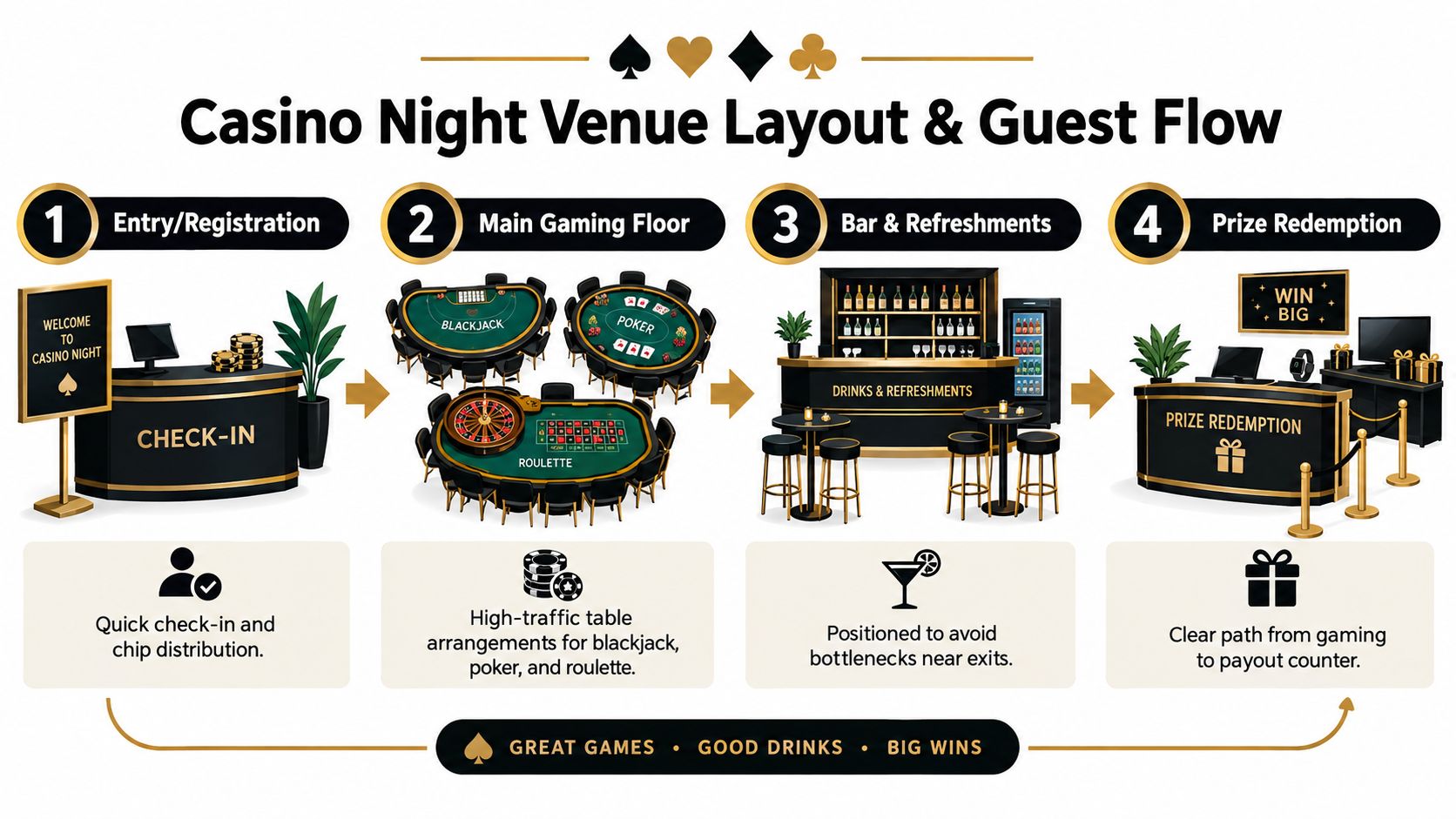
Table count should follow participation and space, not ambition. A host who fills every available corner with gaming equipment usually creates longer queues, crowded dealer positions, poor sight lines, and nowhere for guests to rest. Leave room for seated guests, mobility devices, service access, and staff movement. Confirm table heights with the vendor if the audience includes children, older adults, or guests who need seated play.
Put a beginner or demonstration table where it feels welcoming, not where experienced players can watch every mistake. Use large, high-contrast instructions, accessible seating, and simple explanations. Keep emergency exits, fire equipment, and required aisles clear at all times.
For a visual reference, this video demonstrates the kind of operational thinking that goes into casino-style event presentation:
Before setup ends, walk the route as a guest. Can someone move from check-in to refreshments without cutting through a game? Can a dealer see the floor manager? Can a nonplayer reach a comfortable seat? If not, the layout needs work.
Responsible Gaming and Inclusive Design
Responsible gaming controls aren't decorative compliance language. They define the boundaries of the experience and prevent guests from misunderstanding play money, prizes, or optional donations. A 2025 evidence assessment estimated that approximately 0.12% to 5.8% of American players develop a gambling problem, with comparable ranges reported internationally, as summarized in the University of Nevada, Las Vegas evidence assessment. The range varies because definitions, samples, and methods differ, but the practical conclusion is clear: don't present a themed event as unrestricted gambling.
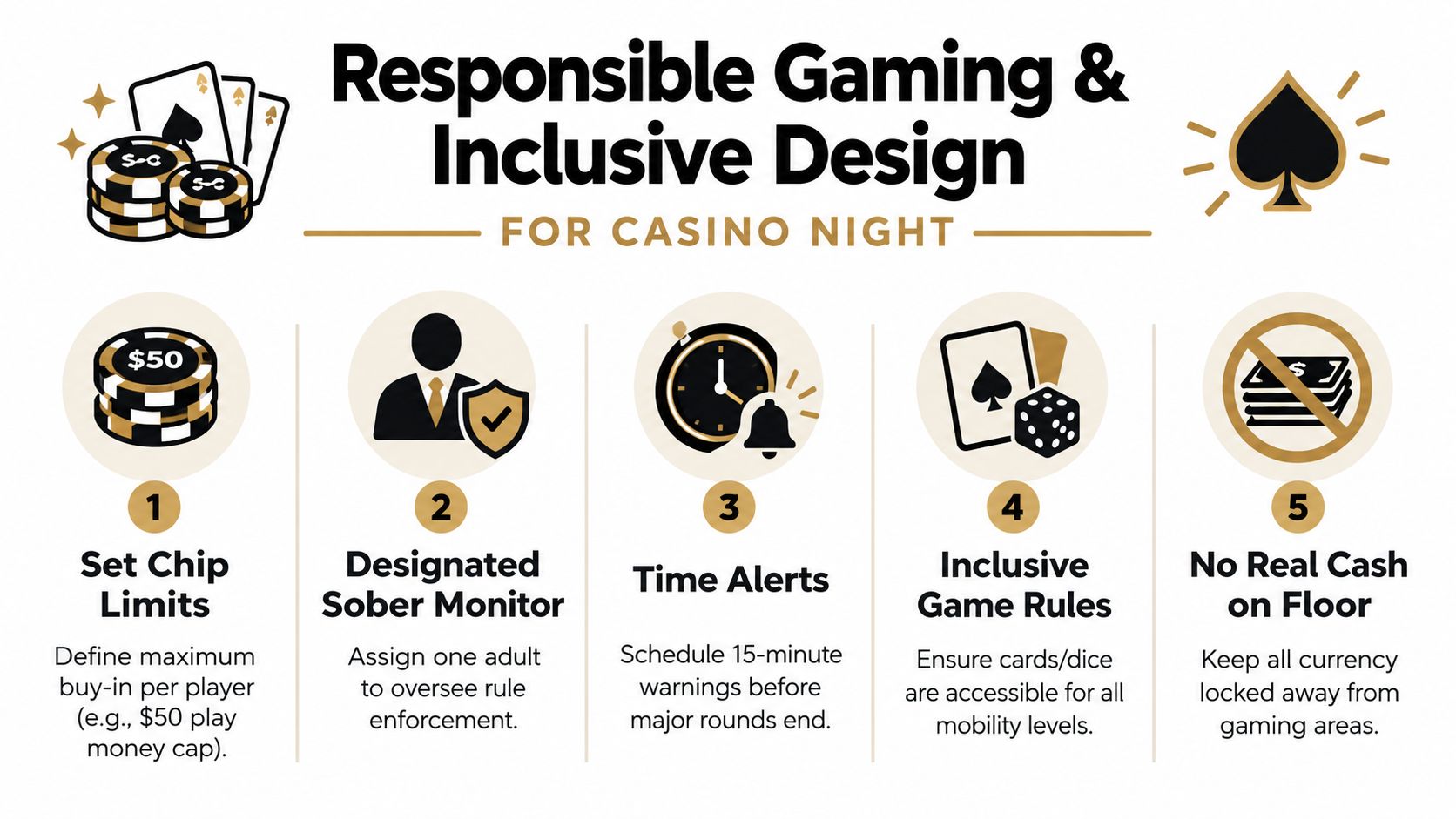
Use visible controls at registration and on the floor:
- Label chips clearly: Mark them as entertainment currency and keep that language on signs, tickets, and redemption instructions.
- Separate money from play: Don't allow cash wagering unless the format has been expressly reviewed and authorized. Keep real currency and payment processing away from the gaming surface.
- Publish the mechanics: Explain the starting allocation, any optional purchases, the end time, prize or drawing rules, and what happens to unused chips.
- Offer a real opt-out: A guest shouldn't have to justify declining the tables. Provide lounge seating, arcade or carnival activities, photo experiences, demonstrations, or food-focused social space.
- Train the staff: Dealers and facilitators should know how to answer questions, redirect attempts to wager real money, identify uncomfortable conduct, and call the floor manager.
The need for transparency isn't theoretical. UNLV's summary reports that awareness of a responsible-gambling program rose to 36.5% among guests visiting properties with state-regulated GameSense centers, compared with 7.4% at properties using a corporate-integrated model. Those figures concern casino settings, not private events, but they support a useful operating principle: visible information is more effective than assuming guests heard a brief announcement.
Mixed-age audiences require a parallel plan, not a watered-down gaming floor. Montana guidance, for example, allows only imitation money, limits activities to authorized formats, generally requires operators to be nonprofit volunteers aged 18 or older, and doesn't permit people under 18 to participate except in a raffle, according to the Montana casino-night guidelines. That makes a single casino floor a poor fit for some school, family, church, and community events.
Build inclusion into the map. Add teaching tables for beginners, timed demonstrations for spectators, accessible table positions, quiet seating, visual rules, and redemption mechanics that don't reward only experienced players. A relaxation lounge option can support guests who want a calmer social space while the gaming floor remains active.
The event works best when casino tables are one attraction among several. That approach protects the atmosphere, respects different comfort levels, and gives the host a practical answer when a guest asks, “What else is there to do?”
Staffing, Theme, and Event-Day Timeline
The host organization needs one accountable point person, even when a vendor supplies dealers. That person approves the floor plan, answers venue questions, coordinates catering and alcohol service, holds the permit file, and makes the final call if the schedule changes.
A workable staffing structure includes:
- Dealers or facilitators: Run the games, teach rules, manage pace, and protect the play-money boundaries.
- Floor manager: Resolves table questions, monitors conduct, coordinates breaks, and communicates with the host.
- Registration team: Checks guests in, distributes materials, explains the format, and directs people to alternatives.
- Hospitality staff: Manage food, refreshments, seating, and replenishment without blocking the gaming floor.
- Host representative: Handles the mission, announcements, sponsors, prizes, and any fundraising appeal.
- Venue or safety contact: Coordinates access, emergency procedures, and building requirements.
Professional dealers remove the most demanding part of the volunteer workload. Volunteers are often better used at check-in, prize tracking, guest welcome, sponsor recognition, and non-gaming activities, where local knowledge matters more than table-game expertise.
Theme spending should follow what guests see and touch. Custom table coverings, readable signs, good lighting, music, a photo moment, and a clean prize display usually do more for atmosphere than piles of small props. Keep branding consistent across the registration desk, table signs, prize area, and event screen.
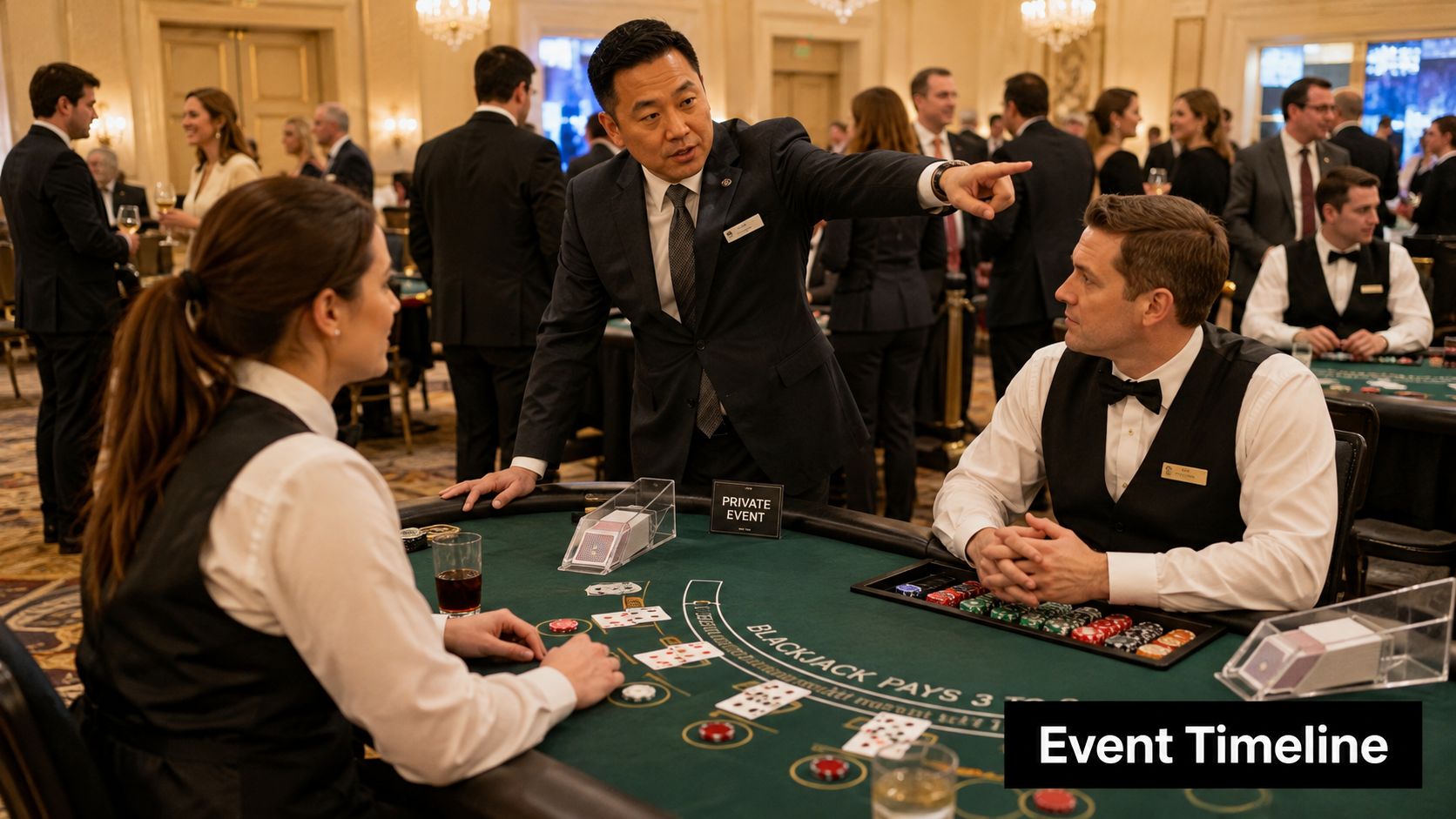
For a typical evening, build the schedule around the venue's access window rather than the guest arrival time:
- Morning or early afternoon: Confirm delivery access, protect floors, and mark table positions.
- Load-in: Set tables, signage, lounge furniture, registration, refreshments, and alternatives.
- Pre-opening: Brief dealers, test lighting and sound, count chips, review prize rules, and confirm emergency routes.
- Guest arrival: Keep check-in quick and explain the entertainment-currency system before directing guests to games.
- Peak play: Stagger food service and announcements so the room doesn't empty from the tables at once.
- Late event: Give clear reminders about final play, redemption, or prize-drawing deadlines.
- Close: Record chip and ticket counts, distribute prizes according to the published rules, and begin teardown only after the host signs off.
If you add a photo booth service, place it outside the gaming queue. Guests should be able to take photos without blocking registration or dealer access.
Budget, Closeout, and Post-Event Wrap-Up
Build the budget as a complete event model, not a table-rental estimate. List equipment, dealer labor, delivery, setup, teardown, venue, permits, insurance, food, beverages, décor, prizes, entertainment, staffing, accessibility needs, and a contingency line. Then divide the projected total by expected attendance to see whether the format works for your audience.
The easiest costs to flex are game mix, décor, food style, and the number of operated tables. Don't cut insurance, required permits, accessible seating, clear signage, or the staff responsible for running the floor. A smaller, well-operated event is usually more comfortable than an overloaded package that leaves the host managing every table.
Closeout should happen before the vendor leaves:
- Reconcile chips, tickets, raffle materials, and prize records.
- Confirm that every prize was distributed under the published rules.
- Photograph the cleared room and note any damage with the venue and vendor.
- Collect final invoices and confirm certificate-of-insurance documentation.
- Complete required nonprofit or charitable reports.
- Ask guests and staff what felt confusing, crowded, or underused.
- Record changes for the next event while the details are fresh.
Phantom Entertainment can serve as one consolidated casino-night entertainment line item, with tables, dealers, game materials, setup, operation, and removal handled within the agreed scope. That lets the host concentrate on hospitality, fundraising, or the broader guest experience rather than coordinating every piece separately.
For a turnkey casino night, Phantom Entertainment provides casino tables, professional dealers, game materials, delivery, setup, operation, and removal across its service region. Contact the team with your venue, guest profile, event purpose, and preferred date so they can help shape a compliant, inclusive entertainment package.
Ready to Book Your Event?
PA state-inspected, fully insured since 1979. Call us or get a free quote today.