

A successful graduation night rarely depends on one spectacular attraction. It depends on keeping a large, mixed-interest crowd moving through safe activities that run at the same time, without leaving half the class in a line while everyone else watches. The strongest grad night entertainment plans combine active challenges, social spaces, low-pressure keepsakes, food, music, and a schedule that gives students reasons to stay until the final class moment.
That model has deep roots. Disneyland's first Grad Nite, held on June 15, 1961, drew 8,500 students, and attendance approached 100,000 within the program's first decade. By the end of its second decade, it reached 135,000, and the program welcomed its 5 millionth guest by 2009, according to Disney history on Grad Nites. The format worked because it offered a controlled, all-night, alcohol-free environment built around rides, music, games, and shared experiences rather than a standard banquet.
This roundup organizes entertainment by its planning role, not just by novelty. For every idea, consider capacity, footprint, weather exposure, staffing, accessibility, crowd flow, insurance, inspection records, power, and setup time. Start with attendance and venue constraints, build a balanced package, then request a written quote that identifies exactly what the vendor delivers and operates. Schools comparing high school party ideas for 2026 can also use the sample itinerary and vendor questions below.
Phantom Entertainment is one turnkey option for schools across Pennsylvania and the Mid-Atlantic. Its Carlisle-based team handles delivery, setup, professional operation, certificates of insurance, and venue-ready safety documentation for state-inspected attractions, with service across PA, MD, NY, VA, and WV.
1. Interactive Laser Tag Arenas
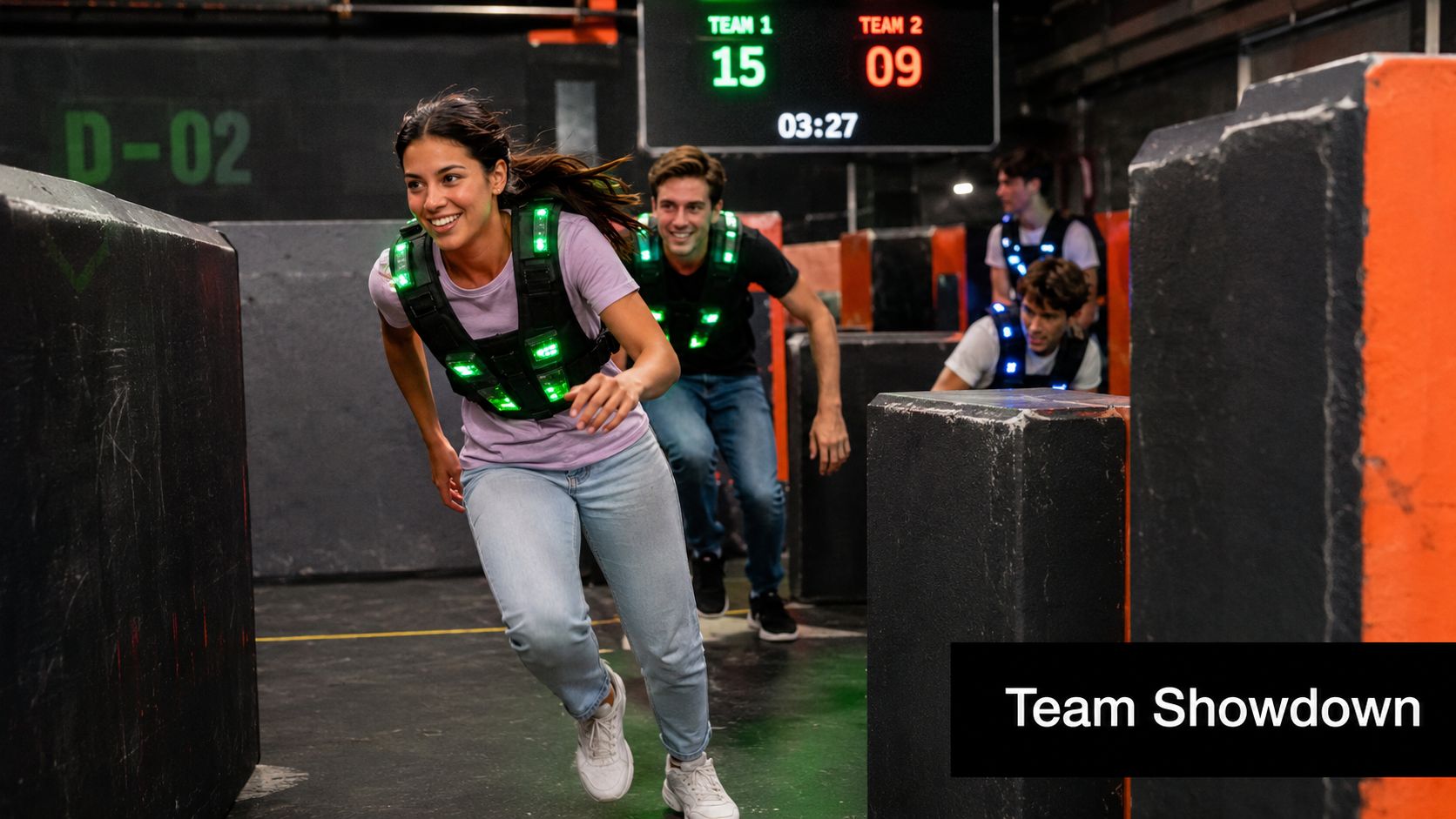
Laser tag is a strong anchor for students who want movement, teamwork, and competition without the physical contact associated with some sports or rodeo attractions. Players move through a themed arena using infrared equipment, complete objectives, and compare scores afterward. Because the experience naturally divides graduates into teams, it gives organizers an efficient way to rotate a large class while preserving the feeling of a special event.
The planning advantage is parallel engagement. A school can assign team colors, post a simple schedule, and send groups into successive rounds while other graduates use the photo booth, gaming area, food stations, or dance floor. The arena needs clear boundaries, controlled lighting, equipment storage, and enough space outside the entrance for students waiting to play. Keep that waiting area visible and well lit so staff can manage movement without creating a dark bottleneck.
Practical rule: Treat laser tag as a scheduled rotation, not an attraction students should discover by accident.
Make competition serve the schedule
Short rounds are easier to manage than open-ended play. Give each group a defined start, equipment check, game, score review, and exit path. A tournament bracket can maintain interest across the evening, but it shouldn't become so elaborate that students miss food, announcements, or their next scheduled activity.
Use a staff member at the entrance to verify group assignments and explain basic conduct. Pair the arena with a photo moment for winning teams, but don't let the photo queue spill into the equipment line. For larger classes, multiple parallel attractions are more valuable than adding complexity to the laser tag format itself.
Laser tag also works indoors or under a weather-protected structure, which makes it useful when rain, heat, or darkness could disrupt outdoor attractions. Ask the vendor for the arena dimensions, power requirements, staffing plan, accessibility accommodations, sanitation process, and insurance documentation before signing.
2. Mobile Escape Rooms
A mobile escape room gives graduates a concentrated puzzle experience without requiring a permanent entertainment venue. Teams examine clues, solve mechanisms, and achieve a themed objective together. That format appeals to students who prefer strategy and conversation over loud music or sustained physical activity, so it fills an important gap in a high school party package.
The main operational trade-off is throughput. An escape experience usually holds a defined group at a time, and each session takes longer than a quick carnival game or arcade turn. That makes it a poor choice as the only attraction, but a valuable scheduled station within a larger event. Place it near quieter activities and away from the loudest speakers so teams can communicate and staff can deliver hints clearly.
Prevent frustration before it starts
Schedule puzzle sessions earlier in the evening, when students are more likely to have patience and focus. Build in a hint system, whether that means visual prompts or staff-delivered guidance, so a difficult clue doesn't turn a premium attraction into a frustrating delay. Staff should explain the objective and time limit before participants enter, then reset the room immediately after each group exits.
Theme selection matters. Mystery, adventure, gaming, and comedy concepts can feel more personal than a generic room, especially when the school uses a class theme throughout decorations and photo areas. Mixed groups can encourage students to meet classmates outside their usual circles, though organizers should also respect accessibility, comfort, and friendship preferences when assigning teams.
Request the mobile unit's footprint, access path, parking requirements, electrical needs, staffing ratio, sanitation procedure, emergency release method, and weather plan. A portable escape room can fit a school, campus, or community venue, but delivery access and setup windows need confirmation well before event night.
3. DJ and Karaoke Entertainment
Music gives the entire event a shared soundtrack, while karaoke creates a visible performance outlet for students who want the spotlight. A professional DJ can manage transitions, announcements, dance blocks, contests, and energy changes without forcing the school committee to run the room from a laptop. Karaoke adds participation, but it also requires tighter scheduling because singers need stage access, lyric visibility, microphones, and a host who can keep the queue moving.
The best setup separates performance from circulation. Use a raised platform or clearly marked stage area where students can see the DJ and performers, while keeping food lines and emergency paths outside the dance zone. Confirm the venue's sound restrictions, weather protection, power access, speaker placement, lighting plan, and backup procedure for equipment issues.
For a combined service that connects music, visuals, and dancing, review the Music Video Dance Party service. The format can make karaoke feel like part of a produced event rather than an isolated microphone station.
Balance participation with momentum
A long karaoke queue will lose casual participants, while an uninterrupted dance set can exclude students who want to perform. Alternate open-dance blocks with short karaoke windows, then use a dance-off or best-performance moment only if the host can run it cleanly and age appropriately. Build the playlist from student requests, school-approved choices, current favorites, and recognizable throwbacks.
The DJ should also understand that a school event isn't a nightclub. Content approval, volume management, lighting safety, and clear announcements matter. A strong host can redirect inappropriate lyrics or behavior without embarrassing individual students, and staff should have a visible point of contact if a concern develops near the dance floor.
Use karaoke as a social option, not the sole evening centerpiece. Students who don't want to sing can dance, watch, take photos, or move to lower-pressure stations while the performance area remains active.
4. Mechanical Bull Riding
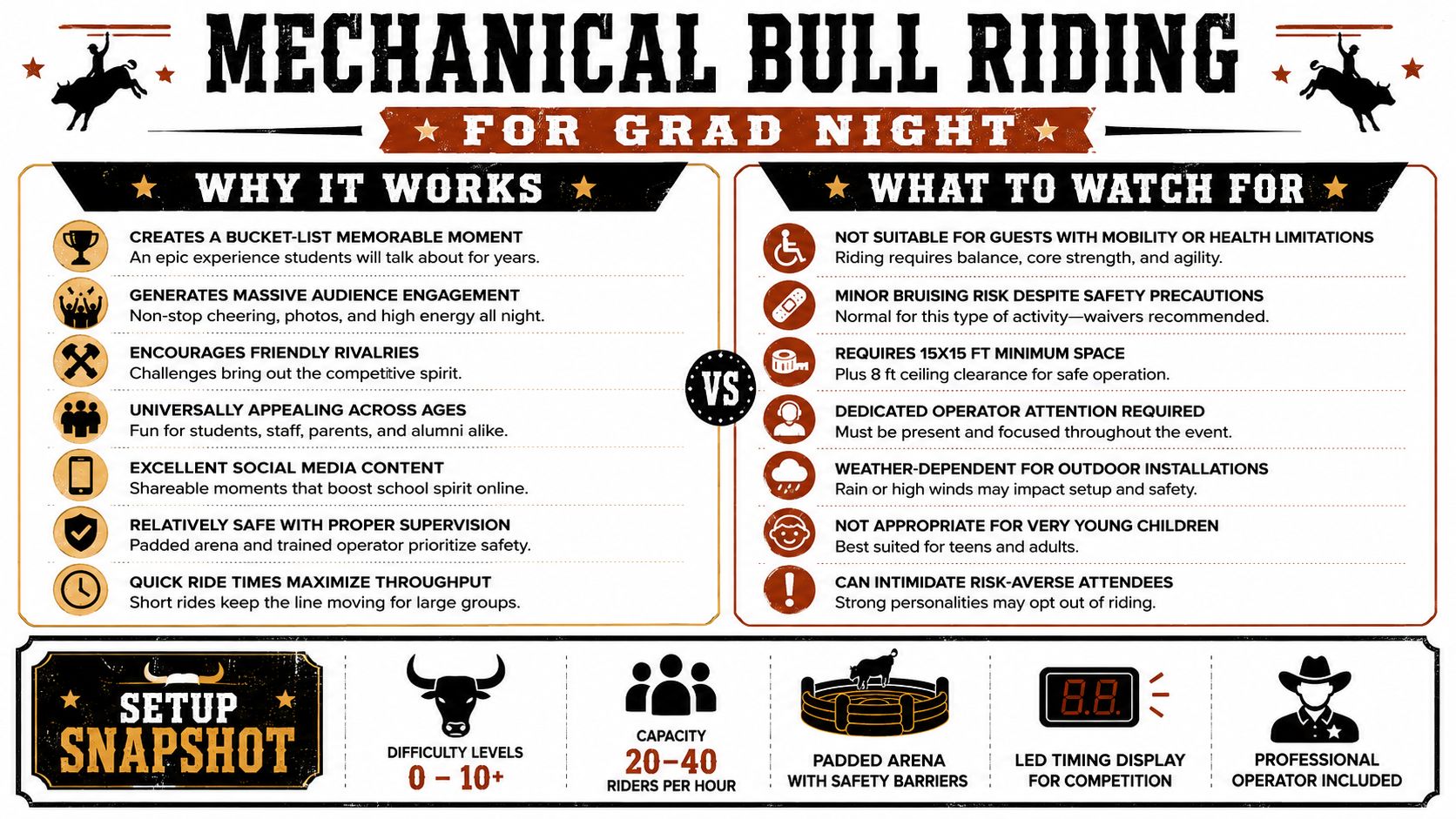
Mechanical bull riding creates an immediate spectator event. One student rides, classmates gather around the padded area, and the timer gives everyone a reason to cheer. That audience energy makes the attraction useful for a grad night that needs a central visual draw, especially during a peak period when students are already looking for something exciting to watch.
The attraction requires more than a machine and an open floor. The vendor should provide a trained operator, padded landing area, operating rules, participant screening, emergency procedures, and clear instructions for mounting and dismounting. Riders need a safety briefing before participation, and schools should confirm how waivers, supervision, sanitation, and incident reporting will be handled.
Use the bull as a managed feature
Start participants at a lower difficulty so they can understand the movement and build confidence. The operator can adjust speed and spin intensity within the approved operating procedure, but competition should never override safety. A visible timer helps spectators follow the ride, while a simple longest-ride recognition can motivate participation without turning the event into an aggressive tournament.
Place the bull where spectators can watch without crossing the attraction boundary. Keep the queue outside the landing zone, provide enough room for staff to assist riders, and avoid positioning the attraction beside a food service line or narrow exit. The crowd should be engaged, not compressed.
Capture notable rides only if the camera operator can work without distracting the attraction attendant. A short victory clip or class-themed photo can become a memorable keepsake, but it shouldn't interfere with participant privacy or the school's media policy.
Mechanical bulls are weather-sensitive and space-intensive, so they're best paired with indoor or covered venues that have adequate ceiling height and access. Ask for the exact footprint, required clearance, power, staffing, insurance, inspection records, and weather cancellation terms before approving the package.
5. Mobile Zip Line Experiences
A mobile zip line can transform an ordinary field, parking area, or venue exterior into an adventure zone. Participants wear harnesses, receive a safety briefing, ascend through the attraction's access system, and travel along a controlled cable before staff assist them at the landing area. It delivers novelty that students can't get from a normal dance or banquet, which is exactly what makes it a premium feature.
The trade-off is operational complexity. Zip lines require substantial clearance, a suitable surface, access for delivery vehicles, weather monitoring, trained crew, and a carefully protected launch and landing zone. The attraction should never be squeezed into a crowded site plan. Build the rest of the event around its boundaries, not through them.
Confirm the site before confirming the attraction
A site inspection should verify overhead clearance, ground conditions, spectator placement, electrical access, emergency access, and the venue's insurance requirements. Ask the vendor to identify the exact equipment, anchor system, harness process, staffing roles, inspection documentation, participant restrictions, and suspension criteria for wind or rain.
Schedule the zip line when graduates are alert and conditions are favorable. Avoid placing it at the end of an exhausting night, and provide seating, water, and a clear exit path nearby. A dual-line setup may support friendly racing, but only if the vendor's approved operating plan and site capacity allow it.
The attraction also works best as one component of a broader package. While one group rides, other graduates can use laser tag, arcade games, karaoke, photo booths, or food stations. That parallel design protects the overall experience from long waits and helps justify a larger-footprint attraction.
A videographer can capture a memorable flight, but the camera position must stay outside restricted areas. Review the school's consent rules before distributing images or posting them publicly.
6. Photo Novelty Booths
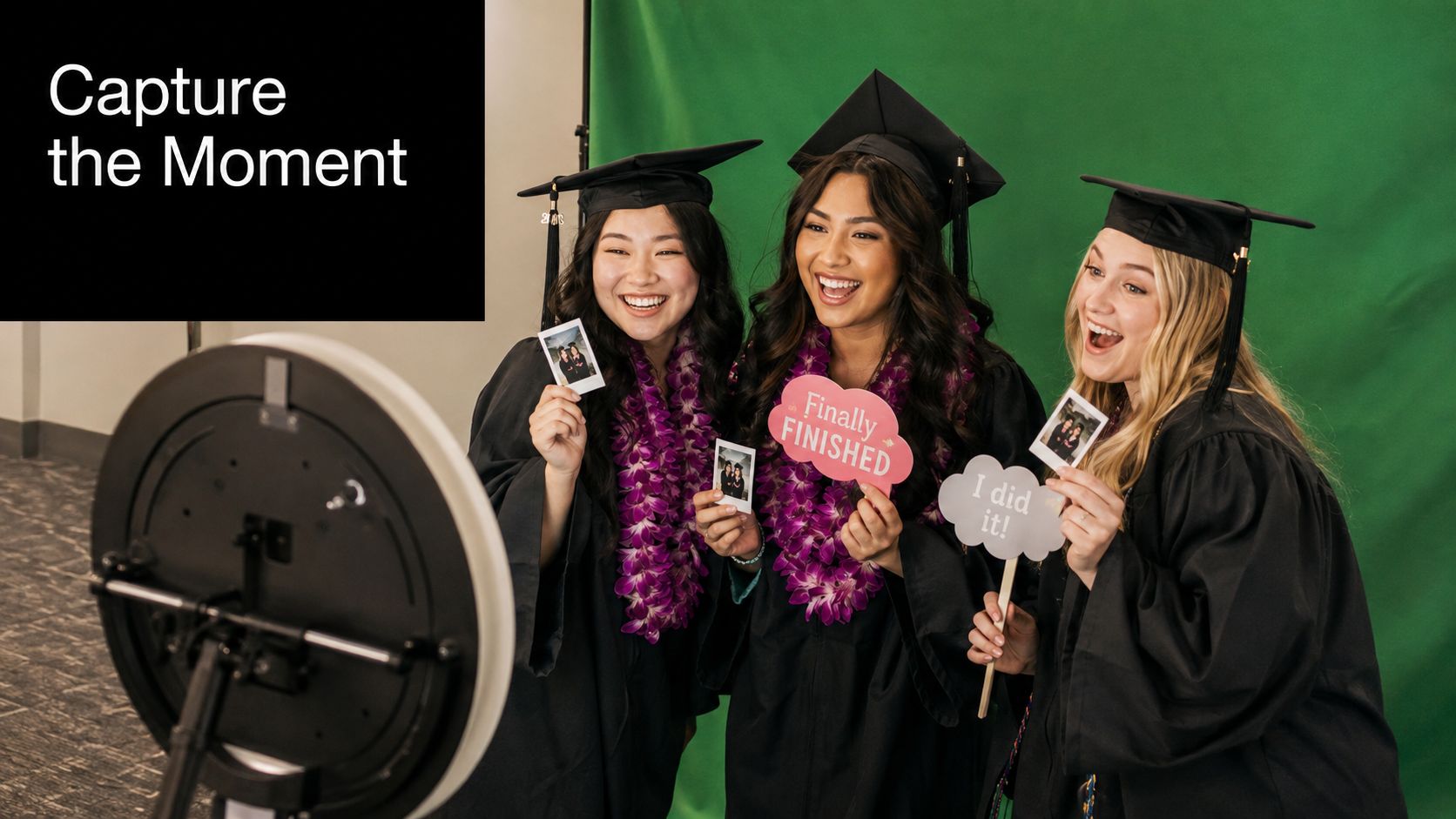
A photo booth serves a different function from a thrill attraction. It gives students a low-pressure reason to gather, creates a keepsake, and offers a natural pause between more demanding activities. A 360-degree booth can produce movement-based clips, while green screen technology can place classmates in school-themed, campus-inspired, or event-specific settings.
The strongest installations feel customized. Use a branded backdrop, class colors, props, or a visual theme that connects to the entrance and dance floor. Students should understand how to receive digital files, and the school should decide in advance whether it wants duplicate prints, an archive, a shared gallery, or no public posting at all.
Protect throughput and circulation
Photo booths can create an attractive queue, but they can also block a hallway if placed carelessly. Position the booth in a high-traffic area with enough waiting space, while keeping its line away from food service, emergency exits, and the entrance. An enthusiastic operator can encourage group poses and keep each session moving without making students feel rushed.
Build a simple queue rule into the plan. A group should know where to enter, where to pose, and where to collect prints or digital delivery information. Props should stay within the booth footprint, and the operator should reset the area quickly after each group.
For social sharing, publish the event hashtag and school-approved handles at the booth. Don't assume every graduate wants a public image, so make digital delivery available without requiring a public post. A school can also retain selected prints or images for a yearbook archive if its permissions process allows.
Review the Social Media Photo Booth option when comparing booth formats. Ask about camera equipment, printing, digital delivery, backdrop customization, operator staffing, lighting, power, setup time, and accessibility.
7. Arcade Games and Gaming Stations
Arcade games create a flexible engagement cluster for students who want competition without a formal group schedule. Classic cabinets, racing simulators, esports-style games, and virtual reality can sit together as a gaming zone, giving students several ways to participate. The range matters because some graduates want recognizable games, while others prefer newer, immersive formats.
A gaming area also helps absorb short gaps in the itinerary. Students can play while waiting for an escape room session, between dance blocks, or after eating. Unlike a single large attraction, individual stations let students arrive and leave without disrupting everyone else.
Design the gaming zone around flow
Cluster machines away from the dance floor and loudest speakers. Each station needs enough clearance for the player, spectators, cables, ventilation, and staff access. Racing simulators and VR equipment may require more space and closer supervision than a standard arcade cabinet, so separate premium or supervised experiences from casual play.
Use leaderboards, posted rules, and scheduled tournament windows to create structure. A tournament should have an obvious registration point, a bracket or score display, and a staff member who can settle disputes. Open play can continue around it, but don't allow tournament participants to hold machines indefinitely.
A gaming station should be easy to understand within moments. If students need a long explanation before they can play, the queue becomes the attraction.
Ask the vendor to identify which games are supplied, whether tokens or free play are included, how equipment is sanitized, who monitors the stations, and what happens if a machine fails. For VR, confirm age-appropriate content, hygiene procedures, flooring, cables, and an attendant who can manage both the headset and surrounding crowd.
Gaming doesn't replace active attractions, but it gives the event a reliable low-pressure option. That balance is valuable for graduates with different energy levels, sensory preferences, and social comfort.
8. Carnival Games and Prize Redemption
Carnival games deliver quick turns, visible prizes, and a familiar midway atmosphere. Ring toss, bean bag throws, knock-down games, balloon activities, and water-based challenges can attract students who don't want to commit to a long session. The games also give organizers a useful way to spread activity across a venue because each booth can operate independently.
The prize table changes the psychology of the area. Students see an immediate reason to try, but prize design must support the event budget and avoid creating conflict. Use a mix of achievable rewards and more distinctive items, then explain the redemption rules before play begins. A ticket or token system can work, but it adds another process for staff to manage.
Choose the right operating model
Free play is simple and welcoming. Ticket-based play can create repeat visits and a sense of progression, but it needs distribution, collection, counting, and clear redemption procedures. Either model can fail if graduates don't understand how they win or where they collect a prize.
Place carnival booths in a defined zone with clear signage and enough room behind each game for operators. Avoid setting them across a narrow corridor where players and spectators interrupt circulation. Operators should demonstrate the rules, celebrate success, and identify when a game needs a reset or prize refill.
Mixed-difficulty games help students with different skill levels participate. A class event shouldn't reward only experienced players, and operators should never pressure students to keep playing after a loss. Keep high-value prizes visible but secure, and assign one person to monitor inventory and redemption if the vendor doesn't handle it.
Use LED lighting and school colors to give the midway a unified identity. Carnival games are especially effective beside photo opportunities and snack stations, but keep food, prizes, and active throwing lanes separated. The attraction is low risk when properly operated, yet the layout still needs attention because loose lines and crowded booths can create avoidable conflicts.
9. Mini Golf Courses
Portable mini golf works as a social attraction because students can play at their own pace while talking, competing, and watching friends. Inflatable obstacles and themed holes can fit in a gym, parking area, or other event space, provided the surface is appropriate and the course doesn't obstruct circulation. The format feels active without demanding the intensity of an obstacle course or mechanical bull.
A nine-hole course can be a practical compromise between a complete experience and excessive dwell time. If the class is large, multiple course sections or parallel starting points can reduce queues. Don't place the course in the center of the venue where every crossing path cuts through play. Give it a dedicated footprint with a clear start, finish, and waiting area.
Make casual play easy to enter
A starter should explain the rules quickly and keep groups moving. Digital scorecards and a leaderboard can add competition, but they aren't necessary for every participant. Offer an open-play window alongside a scheduled tournament so students who dislike brackets can still enjoy the course.
The best themes connect to the class without making the design too narrow. School colors, local landmarks, future destinations, or lighthearted senior-year references can make the holes feel intentional. Add one or two photo-friendly features, but don't stop every group for a staged picture. A celebratory hole-in-one moment should happen naturally.
Mini golf needs less supervision than a zip line or bull, but it still benefits from an attendant who watches for damaged obstacles, misplaced clubs, unsafe running, and groups moving in the wrong direction. Ask about the course dimensions, surface requirements, lighting, indoor and outdoor use, sanitation, equipment quantity, staffing, and weather contingency.
It makes a useful mid-event station when students want to slow down without leaving the main celebration. Pair it with arcade games, photo booths, or a quiet lounge rather than placing it beside the loudest performance equipment.
10. Inflatable Obstacle Courses and Bounce House Experiences
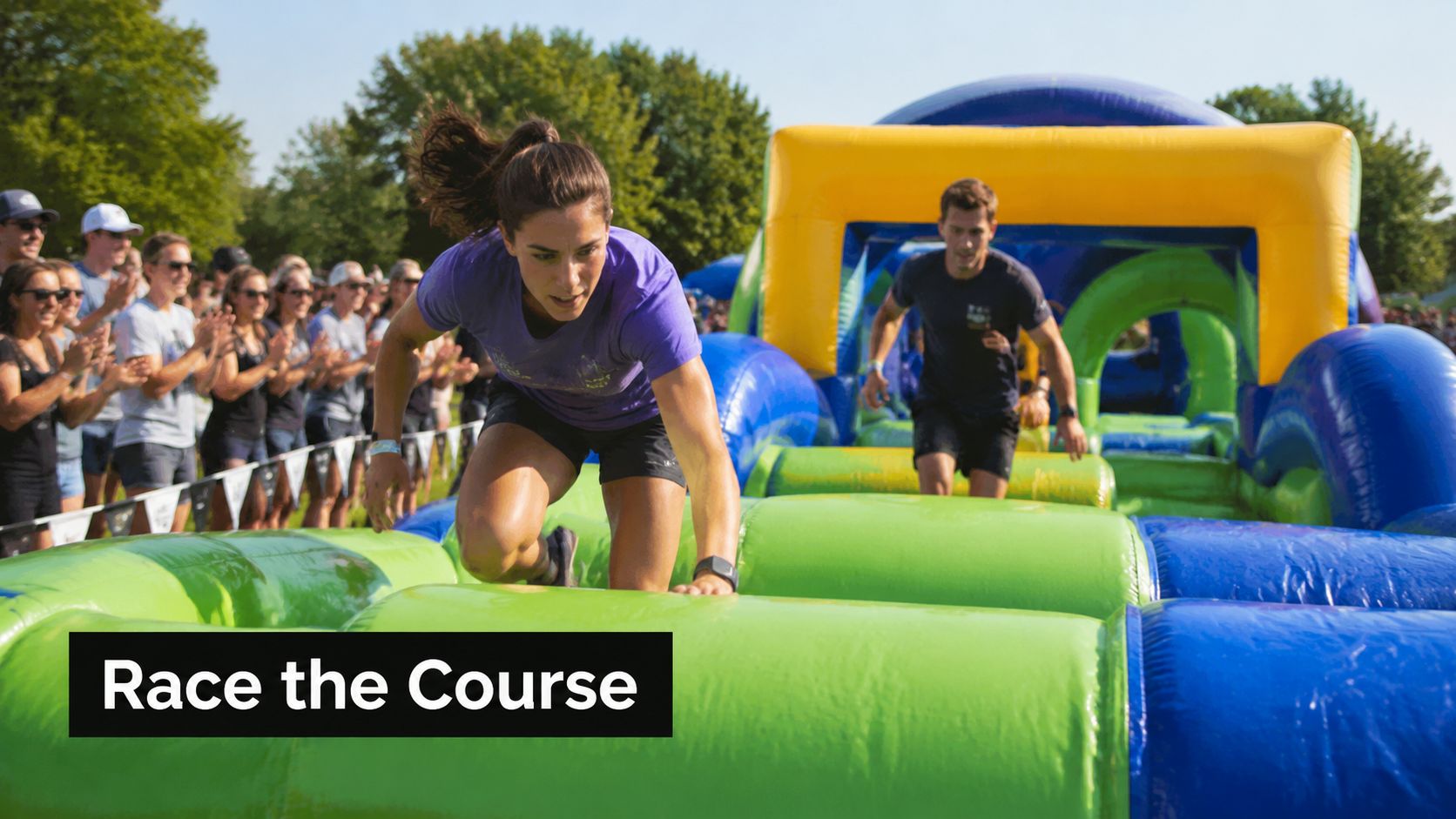
Commercial inflatables provide a visible, high-capacity activity that students can understand immediately. Obstacle courses support racing, cheering, and repeat attempts, while bounce house formats offer less structured movement. Their colorful footprint can also establish a visual centerpiece for an outdoor field day or school celebration.
The planning challenge is matching the attraction to the audience and venue. A crowded inflatable with unclear entry rules becomes difficult to supervise, especially when students are wearing unsuitable footwear or carrying phones and personal items. Use an attendant to control entry, explain participation rules, monitor the course, and stop unsafe behavior before it escalates.
Separate intensity from recovery
Place seating and water nearby, but keep the recovery area outside the course exit. Students need room to slow down, remove equipment, and move away from the next group. If the event runs after dark, provide adequate lighting around entrances, exits, walkways, and the surrounding queue. Don't rely on the attraction's internal lighting alone.
Multiple lanes can reduce waiting, but the vendor must confirm that the venue has enough space, power, anchoring capacity, and staff. A single course may be the better budget choice if the schedule includes several other active attractions. In that case, schedule defined competition windows and open-play periods rather than allowing an uncontrolled line to form.
Use leaderboards or simple recognition for fastest times, but keep the experience welcoming to students who aren't athletic. A course with varied obstacles can serve both casual and competitive participants. Before booking, request dimensions, anchoring requirements, blower and electrical needs, weather rules, sanitation procedures, attendant staffing, inspection documentation, and breakdown timing.
For additional planning context on inflatable event formats, review Phantom Entertainment's inflatable party guidance. The attraction can be a strong part of a turnkey package when the school has a suitable field, gym, or covered area and a clear plan for rotation.
Top 10 Grad Night Entertainment Comparison
| Item | 🔄 Implementation Complexity | ⚡ Resource Requirements | 📊 Expected Outcomes | 💡 Ideal Use Cases | ⭐ Key Advantages |
|---|---|---|---|---|---|
| Interactive Laser Tag Arenas | 🔄 High, arena layout, tech setup, sanitization, safety briefing | ⚡ Large space (3,000–5,000+ sq ft), vests/guns, staff; supports 20–100+ players | 📊 High engagement & teamwork; ⭐ Real-time scoring and spectacle | 💡 Large grad nights, tournaments, weather-independent indoor events | ⭐ Scalable excitement, strong photo/video moments |
| Mobile Escape Rooms | 🔄 Moderate, room setup/reset, staff to manage puzzles (1–2 hr breakdown) | ⚡ Small footprint per room (10x10–12x12 ft), 4–8 players/room, multiple rooms increase throughput | 📊 Strong bonding and problem-solving; ⭐ Immersive memorable experiences | 💡 Small-team bonding, ice-breakers, early-event programming | ⭐ Deep immersion, encourages collaboration |
| DJ and Karaoke Entertainment | 🔄 Low–Moderate, AV rigging, lighting, experienced DJ/operator | ⚡ AV gear (1,000–5,000W), mics/screens, stage/space; weather protection for outdoor | 📊 Immediate crowd energy & participation; ⭐ Highly adaptable to group size | 💡 Central dance floors, open-mic karaoke, large mixed crowds | ⭐ Controls event tone; high participation potential |
| Mechanical Bull Riding | 🔄 Moderate, operator, safety padding, waivers, dedicated space | ⚡ 15x15 ft min space, trained operator, safety mats; throughput ~20–40 riders/hr | 📊 High spectacle and social media content; ⭐ Viral, audience-driven energy | 💡 Mid-event peaks, spectacle centerpieces, friendly competitions | ⭐ Memorable bucket-list moment; strong spectator appeal |
| Mobile Zip Line Experiences | 🔄 High, complex build, certified crew, insurance (2–3 hr setup) | ⚡ Large footprint (75x50 ft+), harnesses, trained staff; higher cost per rider | 📊 Very high thrill and shareability; ⭐ Premium adrenaline attraction | 💡 Adventure-themed grad events or limited high-impact activities | ⭐ Exceptional visual/viral content; fear-facing milestone |
| Photo Novelty Booths (360° & Green Screen) | 🔄 Low, plug-and-play with operator recommended | ⚡ Small footprint (8x8 ft), camera/print/props, attendant; power required | 📊 Strong keepsakes & social shares; ⭐ Broad accessibility across attendees | 💡 Souvenirs, social media content, low-activity alternatives | ⭐ Instant prints/digital assets; highly customizable branding |
| Arcade Games and Gaming Stations | 🔄 Moderate, equipment delivery, layout, light maintenance | ⚡ Variable space & power, mix of cabinets/VR, moderate staffing for upkeep | 📊 Sustained engagement for gamers; ⭐ Long dwell time and tournament potential | 💡 Gaming zones, esports tournaments, mixed-interest crowds | ⭐ Appeals to niche & casual players; flexible offerings |
| Carnival Games & Prize Redemption | 🔄 Low–Moderate, multiple booths, staffing, prize logistics | ⚡ Multiple stations (30x50 ft typical), prize inventory, enthusiastic operators | 📊 Broad participation & nostalgia; ⭐ Tangible prizes drive repeat play | 💡 Family-friendly grad nights, casual competition zones, high-volume events | ⭐ Low barrier to entry; high spectator interaction |
| Mini Golf Courses (Portable/Inflatable) | 🔄 Moderate, course layout, inflatables setup (1–2 hrs) | ⚡ 1,500–3,000 sq ft, inflatable obstacles, scorecards/leaderboard | 📊 Skill-based friendly competition; ⭐ Accessible low-impact gameplay | 💡 Casual tournaments, small-group rivalry, mixed-ability participants | ⭐ Inclusive play, good photo moments, manageable upkeep |
| Inflatable Obstacle Courses & Bounce Houses | 🔄 High, large install, safety briefings, blower systems (2–3 hrs) | ⚡ Large footprint (50x100 ft typical), continuous power, staff, waivers; high throughput | 📊 High-energy physical engagement; ⭐ Visual spectacle and social buzz | 💡 Active grad festivals, daytime events, team races | ⭐ High throughput and dramatic spectator appeal |
Turn Ideas Into a Safe, Well-Paced Grad Night
A strong grad night starts with attendance, not attractions. Confirm the expected class size, arrival and departure rules, mobility needs, sensory considerations, dietary requirements, student interests, and whether the event is a lock-in or a defined evening celebration. That information determines whether you need high-throughput stations, scheduled groups, quiet alternatives, or more staff at entrances and activity boundaries.
Divide the venue before requesting a final package. Mark separate zones for active attractions, dining, quiet recovery, photos, performances, gaming, and circulation. Keep queues out of emergency paths, place louder equipment away from puzzle rooms and chill areas, and give every major attraction a visible entrance and exit. The simultaneous, multi-activity model is supported by an independent grad-night planning guide that recommends at least three different activities, mixing active and passive options so graduates can rotate instead of becoming bored or leaving early. Read the grad night planning manual for that planning principle.
Choose complementary throughput rather than collecting the most impressive attractions. A mobile zip line and mechanical bull may create excitement, but both require more space, staff coordination, and safety controls than photo booths, carnival games, or arcade stations. A practical package might combine one major active attraction, one team-based experience, one music or performance area, one gaming cluster, one keepsake station, and flexible low-pressure activities. That spread lets students participate without forcing everyone into the same line.
Your budget should separate attraction rental from the operational details that make the event function. Ask whether the quote includes delivery, setup, breakdown, operators, attendants, insurance certificates, state inspection records, power distribution, sanitation, waivers, branded elements, prizes, and weather contingencies. Use budgeting tips for graduation events as a general planning reference, then make the vendor identify every included and excluded service in writing.
A practical planning sequence
Start booking as soon as the date and venue are secure. The exact lead time depends on the season, location, attraction mix, and vendor availability, but schools shouldn't wait until the final weeks to confirm equipment, insurance, access, and weather plans. Build a run-of-show with arrival windows, food service, rotations, announcements, photo opportunities, and a final class-wide moment.
A sample evening flow could look like this:
- Check-in and food: Students receive credentials, review rules, eat, and enter the main activity zones.
- Early rotations: Puzzle rooms, arcade games, laser tag, mini golf, and photo booths take the first scheduled groups.
- Peak-energy block: Mechanical bull riding, inflatables, zip line activity, or another major attraction runs while graduates are most engaged.
- Music and performance: The DJ opens the dance floor, then introduces controlled karaoke blocks and class announcements.
- Memory capture: Photo booths, team photos, senior messages, and short video moments run before fatigue becomes a problem.
- Closing moment: Bring the class together for a final announcement, group photo, countdown, or school-approved celebration.
The plan should also include breaks. Students don't need every minute filled, and a quiet zone can reduce overstimulation, conflict, and walkouts. Recent nightlife research reported aggression, bystanding, and low reporting rates in entertainment spaces, which reinforces the need to design for safety perception as well as physical control. Read the Hear Me Play survey results when building policies around supervision, reporting, and staff visibility. The event layout can't eliminate every risk, but it can reduce crowd compression, blind spots, confusion, and unattended transitions.
Vendor questions to answer in writing
Before approving a turnkey package, confirm:
- Availability: Is every attraction reserved for the exact date, venue, and operating window?
- Equipment: What specific models, games, backdrops, inflatables, or systems will arrive?
- Dimensions: What are the operating footprint, clearance, queue area, and access requirements?
- Electrical needs: Does each attraction need dedicated circuits, generators, weather protection, or special distribution?
- Staffing: Who operates each attraction, who supervises queues, and who is the event-night contact?
- Documentation: Will the vendor provide certificates of insurance, inspection records, waivers, and safety procedures?
- Sanitation: How will shared equipment, helmets, harnesses, microphones, props, and controls be cleaned?
- Emergency response: What happens during an injury, power failure, evacuation, severe weather event, or equipment shutdown?
- Weather policy: What are the cancellation, postponement, relocation, and refund terms?
- Logistics: Who handles delivery, setup, breakdown, trash removal, equipment storage, and venue protection?
- Responsibility: Which named person from the school and which named person from the vendor make decisions during the event?
Phantom Entertainment can serve as one option for schools that want a single provider across multiple attraction types. The Carlisle-based company supplies delivery, setup, professional operation, certificates of insurance, and venue-ready safety documentation for state-inspected attractions, with packages that can include laser tag, mobile escape rooms, mechanical bulls, zip lines, inflatables, arcade games, mini golf, photo novelties, carnival games, DJs, karaoke, and more. Review the Phantom Entertainment website and compare the proposed equipment, staffing, documentation, and site plan against your school's requirements.
A memorable grad night isn't a collection of rentals. It's a controlled sequence of choices that gives active students a challenge, social students a place to gather, creative students a way to participate, and every graduate a reason to stay connected to the class. Confirm the site, document the operating plan, and make crowd flow part of the entertainment decision from the beginning.
Phantom Entertainment offers turnkey grad night packages with delivery, setup, professional operation, insured and state-inspected attractions, and venue-ready safety documentation across Pennsylvania and the Mid-Atlantic. Visit Phantom Entertainment to review attraction options and request planning support for a safe, well-paced graduation celebration.
Ready to Book Your Event?
PA state-inspected, fully insured since 1979. Call us or get a free quote today.