
Calling a giant Operation game an all-ages attraction skips the question that matters most: can your guests reach the pieces without leaning on the table? A familiar theme doesn't guarantee accessible play. Before you book the booth, plan who'll hold the tweezers, who'll take a meaningful supporting role, and what guests can play if this setup doesn't fit them.
What a Giant Operation Game Is
A giant Operation game is an oversized version of the familiar tabletop game, presented as a walk-up attraction with a patient-style table, removable pieces, and a precision tool. Guests try to lift the pieces from their cavities without touching the surrounding edges.
Say an employee approaches the booth at a company picnic. They recognize the patient, pick up the tweezers or tongs, and carefully reach for a piece. Their hand slips, the tool touches an edge, and the buzzer interrupts their attempt. Nearby guests can follow the challenge without reading a rulebook.
That familiarity has a long history. According to IEEE Spectrum's history of Operation, Milton Bradley commercially released the game in 1965, after developing John Spinello's original electrical game concept into the surgical-themed product; Hasbro later became the rights holder.
Familiar game, different equipment
The oversized attraction preserves the recognizable skill test, but it isn't a home game placed on taller legs. Rental builds can use different tools, piece sets, scoring systems, and power arrangements. A patient-shaped table doesn't tell you which rules or operating requirements apply.
Keep these distinctions clear when discussing a booking:
- The objective: Remove the selected pieces cleanly.
- The equipment: Confirm the actual rental unit, not a photograph of another build.
- The event format: Decide whether guests are playing casually, competing, or joining a demonstration.
The appeal is a small, visible challenge rather than strenuous activity. A careful player can still make a funny mistake, and spectators can enjoy the suspense. For planners, though, the important distinction is between recognizing the game and being physically able to operate it.
Who Can Reach the Table and Play
Who can play a giant Operation game
| Group | Solo play | Main limit | Role if they cannot reach |
|---|---|---|---|
| Younger children | Usually not without approved assistance | Far cavities may be inaccessible | Caller or prize helper with an adult |
| Shorter grade-schoolers | Only after a comfortable reach check | Arm reach across the playing surface | Name the next piece while a taller partner operates |
| Tweens and teens | Yes, if they pass the reach check | Must avoid leaning | Relay operator or caller |
| Adults | Yes, if they pass the reach check | Must avoid leaning | Booth demonstration or scoring |
| Wheelchair or seated guests | Only with a suitable seated approach and reachable build | Table height, clearance, and no-lean rule | Timer, caller, or scorekeeper |
| Mixed family or field day | Yes, with role rotation | Not every guest can operate | Rotate operator, coach, and scorer |
| Festival or expo line | Yes, as a supervised booth | Orderly turn-taking and reset | Operator, caller, or spectator by choice |
The Altitude Events Giant Operation listing describes a table approximately 4.5 feet high and requires players to reach all parts without leaning on it. That's a specification for that attraction, not a universal dimension for every giant build.
Height alone isn't a minimum-player-height rule. Arm length, cavity position, tool length, and the ability to maintain a stable stance all affect whether someone can play comfortably. Ask for the playing-surface height and the distance to the farthest cavity, then arrange a practical reach check before opening.
Assistance must be approved, not improvised
A chair borrowed from the refreshment area isn't an accessibility solution. Use a step platform only if the rental company explicitly permits that setup and provides suitable arrangements for stability and supervision. Don't lift a child toward the board or encourage someone to balance against it.
Seated guests also need more than a clear path to the booth. Ask about knee clearance, approach space, and whether a lower configuration is available. Don't assume a guest wants a supporting role because they use a wheelchair.
Participation rule: Offer a choice of roles, but don't describe scorekeeping as equivalent access to operating the game.
Cooperative play can still be satisfying. A caller chooses the target, an operator handles the tool, and a scorer records the result. Rotate those jobs rather than assigning shorter guests permanent helper status.
For an event with many children or guests with limited reach, provide an accessible companion activity with its own complete turn. Claims about the developmental benefits of tabletop games don't establish that an oversized rental is suitable for every child.
How One Turn Works from Pick to Buzzer
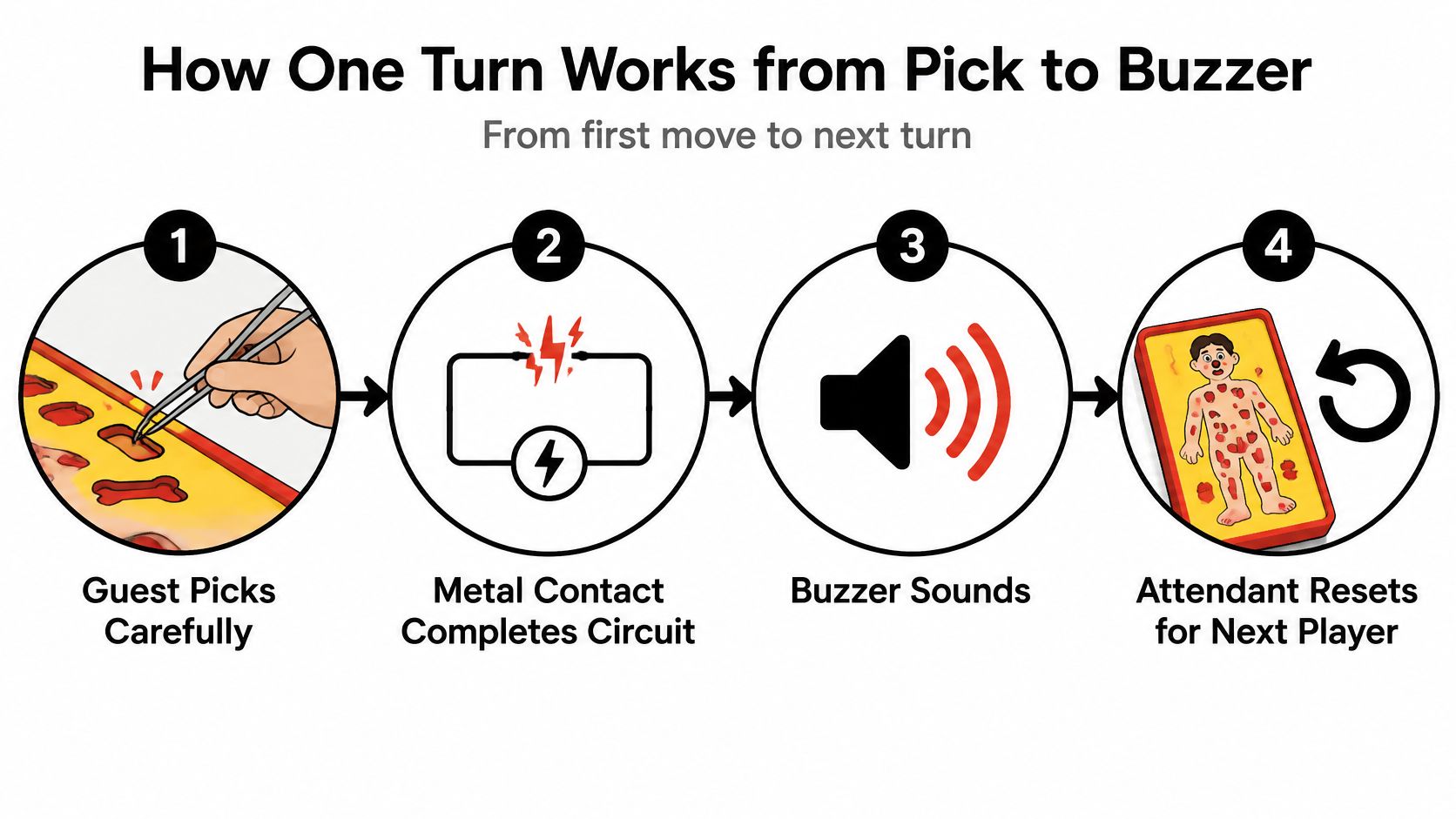
The player experiences a straightforward test: keep the tool steady, lift the piece, and avoid the edge. Understanding the electrical feedback helps the attendant distinguish a genuine mistake from equipment trouble.
In the classic electronic design, the circuit is normally open, meaning electricity doesn't flow through the contact path until the conductive tweezers touch a metal-lined cavity. The contact activates the buzzer and nose light. Hasbro's Operation instructions specify two 1.5-volt AA alkaline batteries for the referenced tabletop edition, not for every giant rental.
A rental attraction may have a different power supply. Confirm its actual requirements instead of copying the home-game battery specification onto your event worksheet.
The basic turn sequence looks like this:
Run the guest turn consistently
- Position the player. Invite them into the operating space and check that they can stand or sit securely. The tool stays down until the explanation is finished.
- State the target and stopping rule. Explain whether they may choose any piece or must follow a card or caller. Tell them whether the attempt ends at the buzzer, the time limit, or completion.
- Start the attempt. Have the player place successfully removed pieces in the designated tray. Keep spectators' hands away from the surface.
- Stop and record. At the stopping signal, ask the player to lower the tool. Count only pieces that meet the posted scoring rule.
- Reset before inviting the next guest. Return the pieces to their correct cavities, check the tool, and clear the tray.
For casual play, assign a dedicated attendant to supervise and reset. For a formal timed contest, separate timing and score recording from equipment supervision so the attendant isn't watching a stopwatch while someone climbs or reaches unsafely.
Test the feedback before opening
Have the trained operator check every cavity and confirm that the intended sound and light activate together. Inspect for a bent tool, loose connections, or dirty contact surfaces. Cleaning should follow the equipment supplier's method, without soaking electrical parts or applying abrasive products without approval.
If both outputs fail, check the approved power supply and accessible power contacts first. If only the light or sound fails, stop play and have the responsible technician inspect that component. Volunteers shouldn't open electrical housings or attempt wiring repairs.
A false trigger feels unfair, while a missing signal makes scoring ambiguous. Pause the line when feedback becomes unreliable. Guests should leave knowing whether their hand slipped, not wondering whether the equipment worked.
Game Formats for Parties and Festivals
Change the scoring, not the precision challenge. Guests should understand what counts before they touch the tool, and the attendant should know whether to celebrate an amusing attempt or record a competitive result.
An oversized board makes the action visible to people waiting nearby:
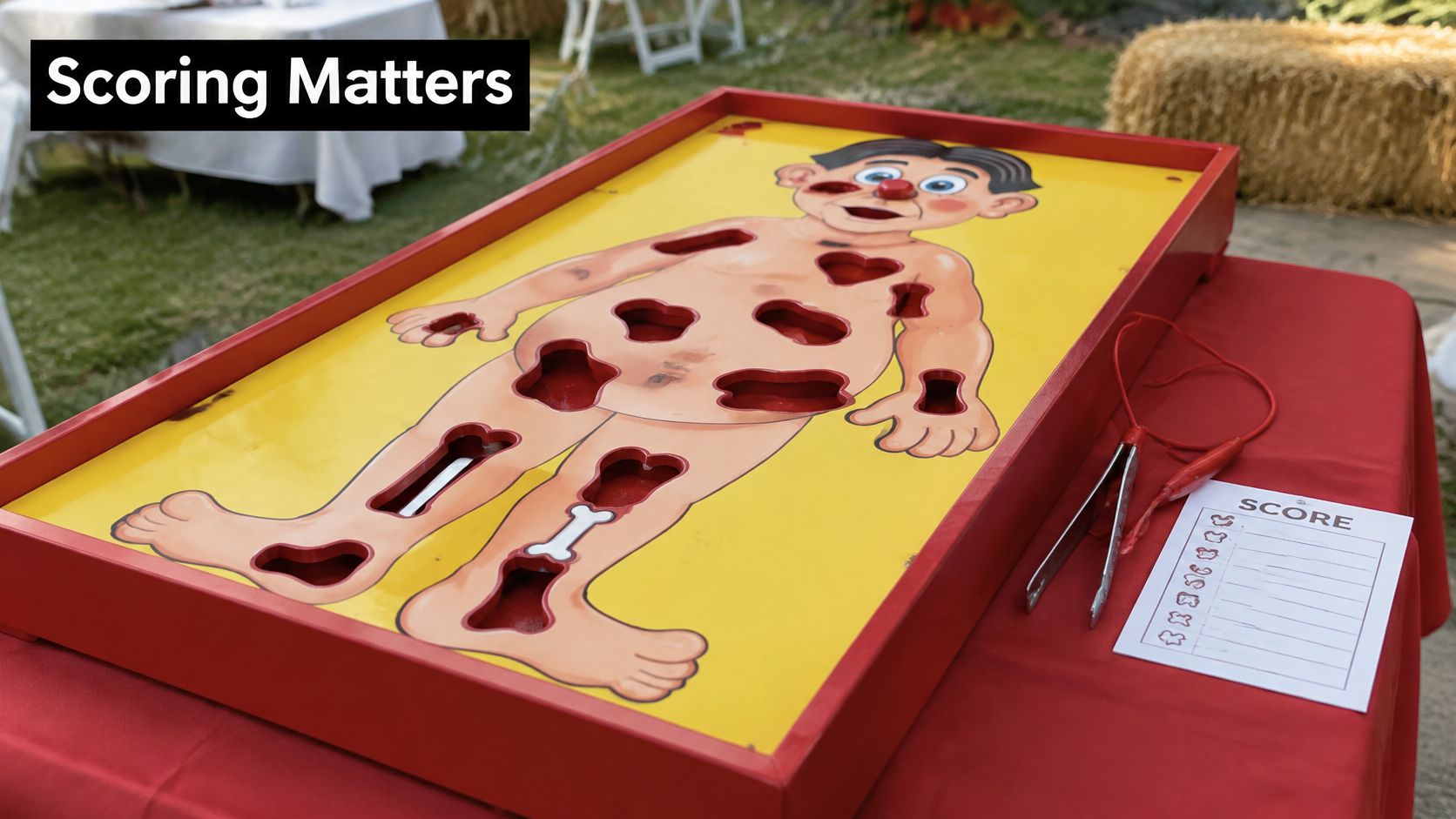
Scoring formats for giant Operation booths
| Format | How it runs | Players | Staff needed | Best crowd |
|---|---|---|---|---|
| Solo speed run | Count clean removals until the buzz or posted time limit | Solo operator | Attendant resets and scores | Walk-up festival line |
| Head-to-head | Alternating turns, higher count wins | Opponents take separate turns | Scorekeeper and attendant | Party or carnival duel |
| Relay | Change operator between team legs | Small team | Attendant supervises; coaches stay outside the operating space | Field day or company team event |
| Call-out round | Attempt only the named piece | Operator plus caller | Attendant checks the target | Mixed-height groups |
| Demo mode | Staff member plays slowly and explains | Staff demonstrator | Demonstrator with supervision duties covered | Trade show audience |
Choose a format before guests arrive
Operation's history includes themed editions and presentation changes, as Mental Floss's account of the game describes. The useful planning lesson is that you can adapt the story without making the physical task harder to explain.
For a hospital-themed company event, a caller might announce the next target. For a festival, a solo attempt may be easier to administer. When planning a broader carnival event, keep this booth's score rule compatible with your prize system rather than inventing exceptions during play.
Avoid elimination contests that leave guests sidelined because they couldn't operate the table. A team score can include calling and recording, but make those contributions explicit before the contest starts.
Watch the attraction in motion when considering how guests will gather around it:
Write the chosen format into the booking notes, including the stopping condition, tie rule, reset procedure, and prize eligibility. Consistency matters more than elaborate scoring.
Setup Staffing and On-Site Safety
Walk the route from delivery vehicle to playing position before approving the location. An open space on a floor plan may still have a narrow doorway, awkward turn, soft lawn, or queue that blocks a nearby entrance.
Use this checklist to organize the site walk:
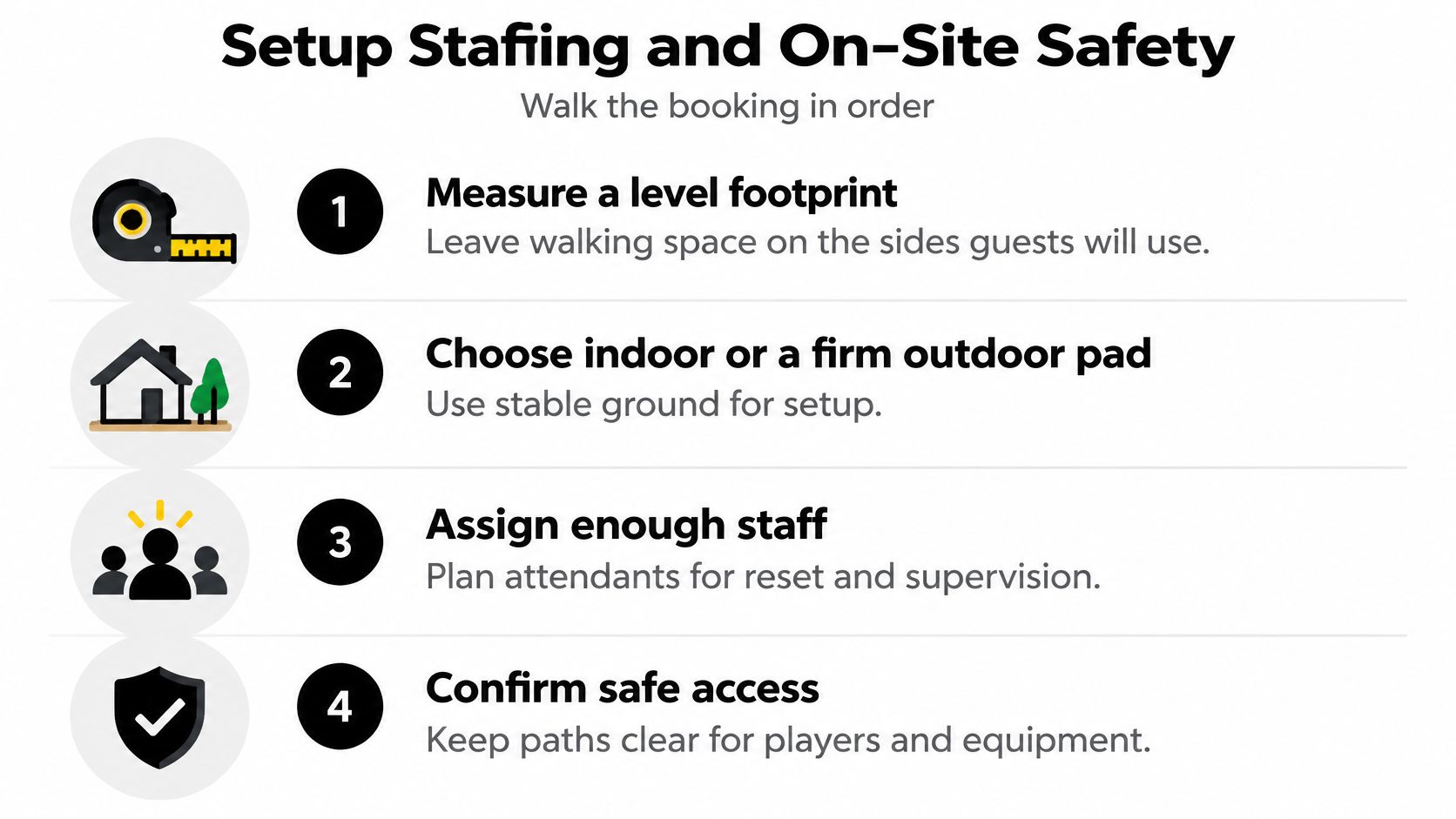
Check the site in operating order
- Measure the usable area. Include the equipment, guest approaches, attendant position, and waiting line. Don't treat the table's dimensions as the complete operating footprint.
- Choose a stable surface. Use a level indoor floor or an approved firm outdoor pad. Agree on relocation or cancellation procedures for unsuitable weather.
- Confirm load-in and power. Record doorway clearances, access restrictions, and the actual supply needed. Where cables are required, route and protect them away from guest approaches.
- Separate watching from operating. Mark where the next player waits. Keep drinks, bags, and prize containers off the playing surface.
- Assign supervision and relief. Name the person responsible for stopping unsafe play, plus whoever covers breaks. An unattended table shouldn't remain open.
- Prepare the operating kit. Include the approved cleaning materials, score sheet, target cards if used, and any supplier-approved spare tool.
- Post the guest rules. Make the stopping condition and scoring readable from the queue, not just from beside the attendant.
What to confirm before the giant game arrives
| Item | Planning default | Confirm with the vendor |
|---|---|---|
| Playing height | Use the actual unit's measurements | Reach across the full playing surface |
| Footprint and access | Level floor, clear side approaches | Exact size, doorways, and load-in path |
| Power | Don't assume a wall outlet is needed | Battery, low-voltage, or plug-in arrangement |
| Surface | Indoor floor or approved firm outdoor pad | Outdoor restrictions and rain policy |
| Players at the table | Solo operation | Whether a coach may stand beside the player |
| Staff on site | Dedicated supervision and reset | Whether the rental crew stays |
| Attempt length | Capped attempts for a waiting line | Suitable timing for the supplied piece set |
| Step or seated play | No improvised adaptation | Approved platforms or a lower configuration |
Give the attendant authority to pause
The attendant needs a clear instruction to stop play for climbing, leaning, crowding, spills, unstable positioning, or faulty feedback. Don't make them seek a manager's permission while a guest continues an unsafe attempt.
A shorter queue isn't worth keeping a booth open with a known equipment or supervision problem.
Add separate help when prize distribution, bracket administration, or crowd management would pull the attendant away. Staffing should follow the tasks, not a promise that the attraction requires almost no effort.
Schools, campuses, and corporate venues should request insurance documentation and relevant equipment inspection information before load-in. If you're comparing attractions through a mobile game rental planning guide, keep a separate confirmation sheet for each unit. Similar-looking games don't necessarily share operating requirements.
Events That Already Use the Giant Game
The strongest documented example isn't a children's birthday party. In 2024, 3M featured Giant Operation Deluxe at its booth during the AORN Global Surgical Conference & Expo in Nashville, according to Interactive Entertainment Group's account of the activation.
For surgical professionals, the familiar game can provide a playful contrast to their working environment. That documented appearance demonstrates a professional-event application, but it doesn't establish a guaranteed result for attendance, lead generation, or learning.
These scenes illustrate the attraction's booth-style presentation:
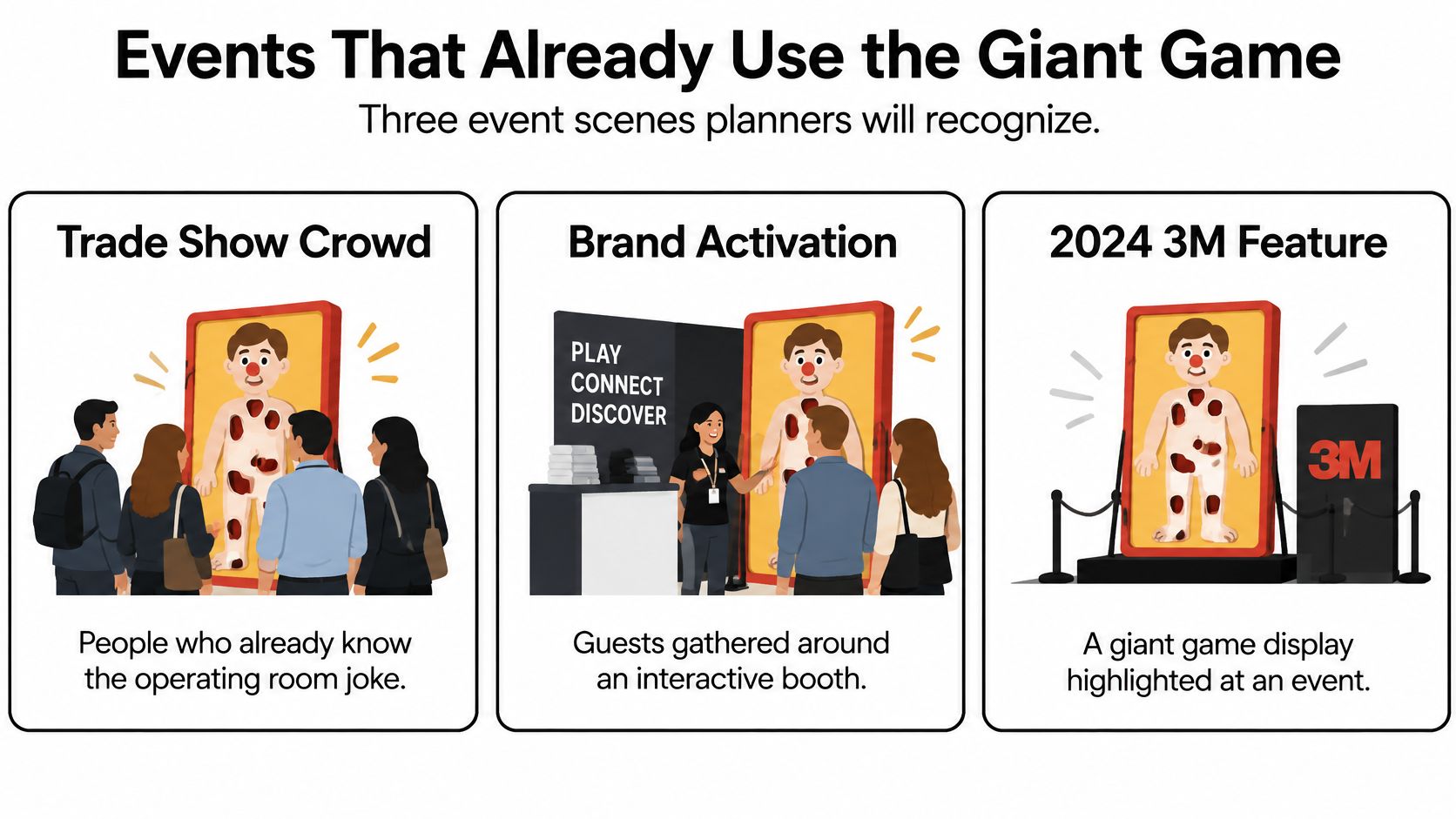
A professional audience with a shared reference
At a healthcare trade show, a host could invite a visitor to attempt a target while colleagues watch. After the attempt, another representative can continue the business conversation away from the playing position.
The useful distinction is between hosting the activity and handling the conversation. If the same person tries to reset pieces, explain a product, and greet passing visitors, someone will wait. This format fits a professional crowd that can appreciate the theme quickly.
A school station within a wider rotation
For a hypothetical campus field day, schedule the attraction alongside other activities rather than making it the destination for every student at once. Let teams choose their roles and give students an alternative station where they can participate directly.
Use a school party planning page to consider the wider activity mix, then assess each station's access requirements separately. This scene fits organized groups moving through a supervised program, not an unstructured crowd expecting identical access everywhere.
A community booth with visible handoffs
At a company picnic or community festival, an arriving family should be able to see where to join, what happens next, and where to leave after playing. Put prizes and general questions away from the tool handoff so finished players don't block incoming guests.
Shared equipment also needs a workable cleaning routine. WipesBlog.com's venue hygiene resources for event planners offer a place to organize broader venue hygiene planning; confirm equipment-compatible products and methods separately with the rental operator.
The best fit is a crowd that enjoys watching as well as playing. Treat that spectator appeal as a benefit, not an excuse to overlook guests who need another activity.
Choose Giant Operation for Your Next Event
Book the attraction for a defined job: giving guests a turn they can physically take. The giant build earns its floor space when you can provide suitable access, dedicated supervision, and a turn format that fits your schedule. Skip it as the sole entertainment when a substantial part of your audience would be limited to watching or helping.
A young birthday party shows the gap quickly. The oversized patient and the loud buzzer are easy to love, and children will laugh at them all afternoon. A seven-year-old who cannot reach the far cavities without leaning, though, gets a good view and nothing to do. Pair the station with activities those guests can operate themselves, since expecting every guest to enjoy the same challenge is how a popular booth still leaves people out.
A booking worth approving
A workable quote should identify the actual equipment and explain how it will operate at your venue. Read it the way you would read a floor plan: every element should have a place you can point to. You should be able to describe the guest experience to a colleague without filling gaps with assumptions.
Use these decision checks:
- Approve the fit: Your intended operators can reach the supplied build's work area under its no-lean rule, and other guests have appealing choices.
- Approve the operation: Someone owns supervision, reset, breaks, and the decision to pause a round.
- Approve the logistics: Site access, power, weather arrangements, and documentation are settled in writing.
- Approve the participation plan: Supporting roles are voluntary, and the booth isn't your only route to enjoyment.
Each check maps to a way the event can fail: a table guests cannot reach, a booth nobody is watching, a cable nobody planned for, a child with nothing to contribute. A quote that answers all four is a quote you can sign.
Request a unit-specific quote
Phantom Entertainment offers Medical Mania, so ask for its exact specifications before comparing it with a giant Operation build. Request written confirmation of the proposed unit's dimensions, power arrangement, operating coverage, and any approved access adaptations before committing.
Don't accept an all-ages description as a substitute for those answers. If a quote leaves the practical questions unresolved, keep the booking provisional.
Booking test: You're ready to commit when you know who can reach the table, who will supervise, and what happens when the planned setup doesn't work.
Choose the giant Operation game for a well-defined job: a watchable, hands-on skill station within an event that gives every guest a worthwhile way to participate.
Phantom Entertainment also lists a Multi Booth Carnival among its interactive, booth-style offerings. Visit Phantom Entertainment to request a written quote and discuss the equipment, staffing, and companion activities that fit your guests and venue.
Ready to Book Your Event?
PA state-inspected, fully insured since 1979. Call us or get a free quote today.