

You're hunched over a festival site map, moving tents, stages, food trucks, and activity stations around until there's barely room for one more attraction. The school coordinator wants something active, the church committee wants something easy to supervise, and the corporate family-day planner needs an activity that won't demand another complicated utility hookup.
A gaga ball pit rental can solve that planning problem, but only when you treat it as a logistics decision first and a game second. The right pit needs suitable ground, enough clearance, sensible supervision, and a clear rotation plan. Get those details right, and the attraction becomes a compact, energetic gathering point that works for schools, camps, festivals, church picnics, and family events.
Why a Gaga Ball Pit Is the Easiest Crowd-Pleaser to Add to Your Event
A gaga pit earns its space because it addresses several event-day problems at once. It gives children an active attraction, keeps the activity contained, and lets players rotate without rebuilding teams or handing out equipment. The structure is self-contained, and the game starts as soon as the site is ready.
For a planner, the practical requirements are straightforward:
- Ground: Choose a flat, dry surface that can support the pit securely.
- Space: Reserve the court plus open room around it for entry, exit, supervision, and spectators.
- Utilities: A non-inflatable pit generally avoids the power planning associated with attractions that need blowers.
- Schedule: Coordinate delivery, setup, briefing, operating time, and removal before the event begins.
That low-friction profile matters at crowded venues. A pit can sit beside a field-day station, near a festival lawn, or in a church picnic activity area without needing the same utility coordination as a powered attraction. It also gives children who've already had their turn on an inflatable somewhere else to keep moving instead of drifting toward food lines or parking areas.
Why the crowd keeps moving
Gaga ball naturally creates short rounds and immediate re-entry. A player who's eliminated steps out, while another participant can take that opening in the next round. There's no scoreboard to reset, no team roster to rebuild, and no long equipment handoff between turns.
Parents benefit from the layout, too. The walls contain the play zone, while the surrounding area gives adults a clear place to watch. That makes the pit useful at events where children need active supervision but families also want to talk, eat, or participate in other activities.
Practical rule: A compact attraction works only when the access lane, waiting area, and supervision position appear on the site map before the equipment arrives.
The pit isn't automatically easy because it's popular. A poor location creates problems quickly. Put it on a slope, squeeze it against a tent, or let too many players enter at once, and the operator spends the event managing preventable issues. Plan the footprint and operating method first, then choose the rental package that fits.
What a Gaga Ball Pit Actually Is and Where the Game Came From
A gaga ball pit is an enclosed court, commonly octagonal or hexagonal, with walls that surround a soft play surface. Players strike a lightweight ball with their hands, usually aiming to send it toward another player's lower legs. The walls keep the action in one defined area, which is why the activity translates well from camps and recreation programs to temporary event rentals.
Modern gaga ball history is commonly traced to Israel in the mid-20th century. One widely cited account places its invention in the 1950s and notes its spread to Australian Jewish communities by the 1980s, while another summary describes the game reaching the United States through Jewish summer camps and appearing in the northeastern United States as early as the 1950s before expanding nationally over later decades. This history of gaga ball helps explain why the game feels so natural at youth events. It grew from a tradition of simple, active group play rather than from a complicated sports system.
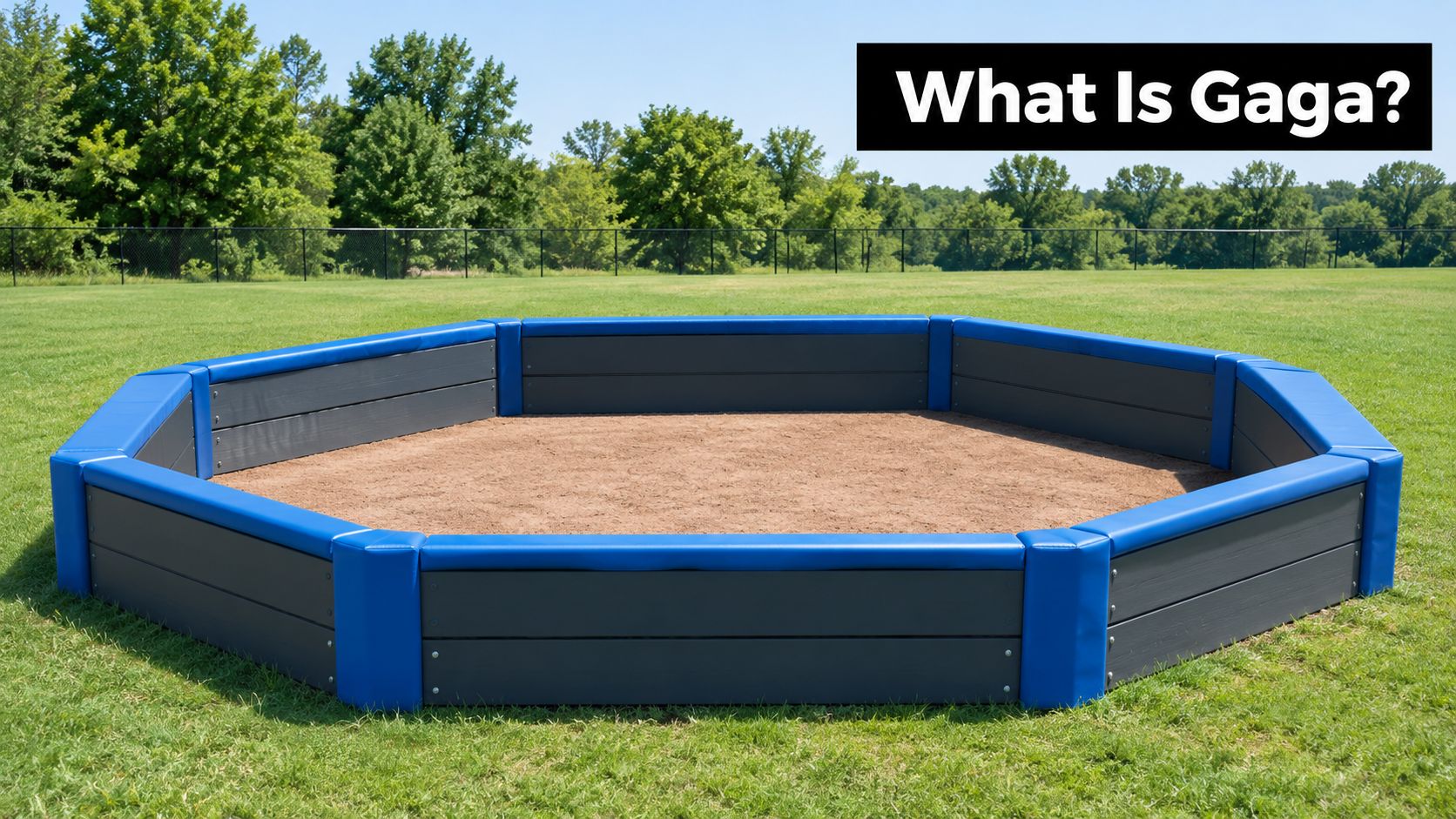
Why the format works for rentals
The game needs little beyond the court and a soft ball. Its basic rules can be explained quickly, and players can enter or leave between rounds without a complicated reset. That makes the activity practical when a volunteer is running a school station, a counselor is supervising a camp block, or an attendant is managing a festival queue.
Rental construction varies. Portable framed pits may use aluminum supports with vinyl or padded panels, while heavier models can use wood or other rigid wall systems. Lighter panel systems can make sense when crews need to move equipment across a lawn or through a building. More substantial walls may suit permanent recreation areas or venues that prioritize a sturdy, fixed-feeling enclosure.
There isn't a governing body that sets one official court size. Independent rental and recreation references describe manufactured pits from 10 to 25 feet across, with 15 feet often identified as the most common size, while another sizing reference describes standard pits in the 20- to 30-foot range. The Guinness World Records entry for the largest gaga ball game records a game with 481 participants at Briarwood Day Camp in Pennsylvania on 9 August 2010. The lesson for planners is simple: the game can serve a small backyard gathering or a very large youth program, but the court and operating plan must match the audience.
How Gaga Ball Is Played and Why the Rules Travel Well at Events
A volunteer can brief new players without turning the activity into a lecture. The standard flow is easy to remember:
- Players enter the pit and begin with their hands and backs against the wall.
- A ball is tossed into the center.
- After the ball bounces twice, the first player to touch it calls “Ga” to begin play.
- Players strike the ball downward with an open hand.
- A player is eliminated when the ball touches the player's legs below the knee.
- The last player remaining wins, and the next round begins.
Players don't throw or catch the ball. That distinction keeps the game moving along the floor and limits the temptation to launch the ball at someone's upper body. The operator should explain that participants need to watch their hands, feet, and nearby players rather than diving blindly into the wall.
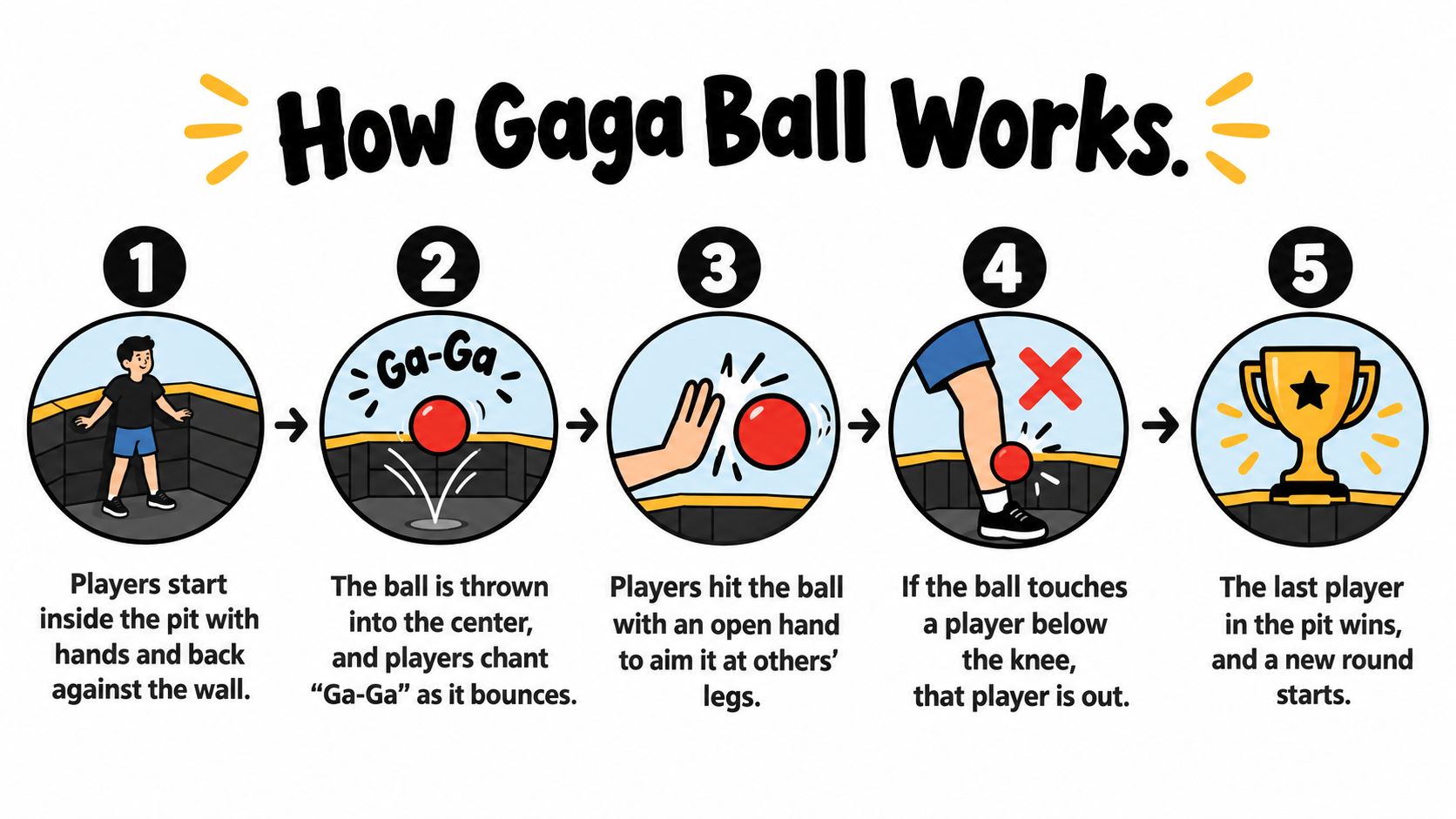
A clean operating rhythm
The game travels well because it doesn't require scorekeeping, team selection, or a supply table. Eliminated players step out immediately, and the winner doesn't need a trophy or a complicated result sheet to start another round. A monitor can focus on safe conduct, capacity, and fair entry instead of tracking a tournament bracket.
Rental operators often add house rules before play begins. They may limit the number of participants inside the pit, separate younger children from older players, or create timed sessions when a line forms. Those decisions matter more than trying to preserve one universal version of the game. A school field day may need calm age-group rotations, while a festival may need a visible queue and fast round turnover.
The briefing should also cover what happens when a player is out. Participants need to leave through the designated opening, avoid reaching back into the play area, and wait for the next round outside the active zone. Clear instructions at the start prevent most disputes and help younger players understand that elimination is part of the format, not a personal penalty.
Choosing the Right Pit Size for Your Group
Pit size is a balance between capacity, player age, and game quality. A smaller court can create quick contact and energetic rounds, but crowding becomes a problem when too many participants enter. A larger court gives players room to move, though younger children may find it harder to reach the ball or stay involved.
There's no official court dimension, but practical rental planning has converged around several useful benchmarks. One reference identifies 15 feet as a common manufactured size, with that size serving about 6 to 8 players, a 20-foot pit serving 8 to 12, and a 25-foot pit accommodating more than 12. These gaga ball sizing and operating benchmarks should be treated as planning guidance, not as a universal capacity rule. Manufacturer design, wall layout, age mix, and the operator's safety policy can change the final limit.
A separate institutional guide recommends an octagonal footprint of about 20 to 26 feet across for school-age and mixed-age programs. It identifies roughly 26 by 26 feet as a common standard, while smaller groups can function in the 15- to 18-foot range and larger groups may benefit from 26- to 36-foot courts to reduce congestion. The MEL Safety Institute gaga ball bulletin is useful when a school or institution needs a more formal planning benchmark.
| Pit Diameter | Recommended Players | Age Band | Footprint with Clearance |
|---|---|---|---|
| 15 feet | 6 to 8 | Younger children or small mixed-age groups | Allow the pit plus 4 to 6 feet of open clearance on every side |
| 20 feet | 8 to 12 | School-age and mixed-age groups | Allow the pit plus 4 to 6 feet of open clearance on every side |
| 25 feet | More than 12 | Older children, teens, or larger programs | Allow the pit plus 4 to 6 feet of open clearance on every side |
For a broader event-layout comparison, planners can also review bounce house size planning, since the same site-map discipline applies to access, clearance, and spectator flow. Don't select a pit solely by total event attendance. Ask how many people need to play at once, how quickly they must rotate, and whether the age groups should remain separate.
Venue Compliance, Safety, and Staffing You Need to Plan Around
The venue approval conversation should happen before the rental is finalized. Schools, parks, corporate campuses, and municipal spaces may each have different rules for surfaces, anchoring, insurance, access, and supervision. A pit that works perfectly on a dry lawn may need a different setup plan inside a gym or on pavement.
Start with the ground. Flat, dry grass, suitable turf, gym flooring, or pavement protected with appropriate matting can work depending on the equipment and operator. Sloped or wet surfaces are poor choices because they affect footing, ball movement, stability, and cleanup. Outdoor installations also need anchoring when the equipment design and site conditions require it. Inflatable units add blower and power planning, while framed or panel pits may avoid that requirement.
The pre-approval checklist
- Surface: Confirm the exact ground material and whether the operator accepts it.
- Clearance: Keep the court away from fences, tents, traffic lanes, and overhead lines. Expert guidance commonly recommends 4 to 6 feet of open clearance around the outside for supervision and entry and exit flow. Gaga ball safety guidance also addresses wall height, materials, soft balls, and avoiding hard surfaces such as concrete.
- Wall design: Guidance commonly places walls around 42 to 44 inches high, allowing children to see over the barrier while reducing the chance of falling out. The same operational guidance supports durable, non-splintering construction.
- Access: Check the delivery route, emergency access, participant entry, and whether the activity zone can accommodate guests with mobility needs.
- Weather: Establish a rain and wind policy before advertising the attraction. A backup indoor space can prevent a last-minute cancellation when the venue allows indoor use.
Staffing deserves more attention than it usually gets. A reviewed operating document suggests one supervisor per 30 participants and recommends keeping similar-age groups together. The infographic brief for this guide identifies one adult monitor per 10 players as a conservative safety checklist. Because these figures serve different operating contexts, the rental company and venue should agree on the actual ratio before event day, with younger groups receiving closer supervision.
Staffing is not just watching. The attendant controls entry, starts and stops rounds, manages the queue, explains the rules, separates incompatible age groups, and resolves disagreements before they become unsafe contact.
Schools and public venues often request insurance documentation or a certificate of insurance. Prepare the venue name, address, insured wording, and submission deadline so the operator can provide the correct paperwork. This certificate of insurance planning resource can help event teams understand what to request during the approval process. For a broader framework covering hazards, controls, and venue responsibilities, use this event risk assessment guide before the site walkthrough.
Best Events and Audiences for a Gaga Ball Pit Rental
A gaga pit works best where the organizer needs active play with simple administration. The strongest use cases aren't defined only by age. They're defined by whether participants need to rotate, whether volunteers need a clear activity format, and whether spectators can safely gather around the play zone.
School field days and physical education programs can use the pit as a station that teaches movement, reaction, turn-taking, and fair play without requiring specialized sports equipment. Younger groups benefit from short, structured sessions, while older students may handle more competitive rounds. For committees comparing activity options, this list of fun activities for school events can help place the pit within a wider field-day plan.
Match the format to the audience
- Camps and youth programs: Counselors can run repeated rounds during open recreation, provided they establish age grouping and a visible waiting area.
- Church picnics and VBS programs: The pit gives children a contained activity while families move between meals, fellowship, and other stations. Volunteers should receive the operating rules before children enter.
- Corporate family days: Children get a physical activity, and parents get a nearby attraction that doesn't require them to organize teams or keep score. That makes the pit a useful complement to food, music, and adult social time.
- Festivals, fairs, and HOA gatherings: The octagonal shape is easy to spot on a busy site, and the action creates spectator energy without requiring a stage or elaborate announcement system.
- University orientation and residence-life events: Older participants can use the pit as a quick social activity, though the operator still needs clear rules and limits on rough play.
A school may value predictability and quiet transitions more than maximum intensity. A festival may need faster rotations, a prominent queue, and an attendant who can repeat the briefing throughout the day. A company picnic may need the court positioned near family seating rather than deep inside a children's zone.
For broader sports-day programming ideas, the Vanta Sports sports day guide offers useful context for combining active stations into one event schedule. The gaga pit should fill a defined role in that schedule, not compete with every other attraction for the same participants.
Booking a Gaga Ball Pit From First Call to Event Day
The first call should answer operational questions, not just confirm that the game is available. Have the event date, venue address, expected attendance, player age range, event duration, surface type, and preferred delivery window ready. Those details let the rental company recommend a usable configuration rather than quoting a generic product.
Ask what the package includes. Confirm whether setup and takedown are included, how many balls arrive with the pit, whether an attendant is available, and whether the operator handles anchoring or matting when needed. Also ask about deposits, cancellation terms, weather decisions, travel charges, and the deadline for submitting insurance documents. A written quote should separate the equipment, staffing, delivery, and site requirements clearly.
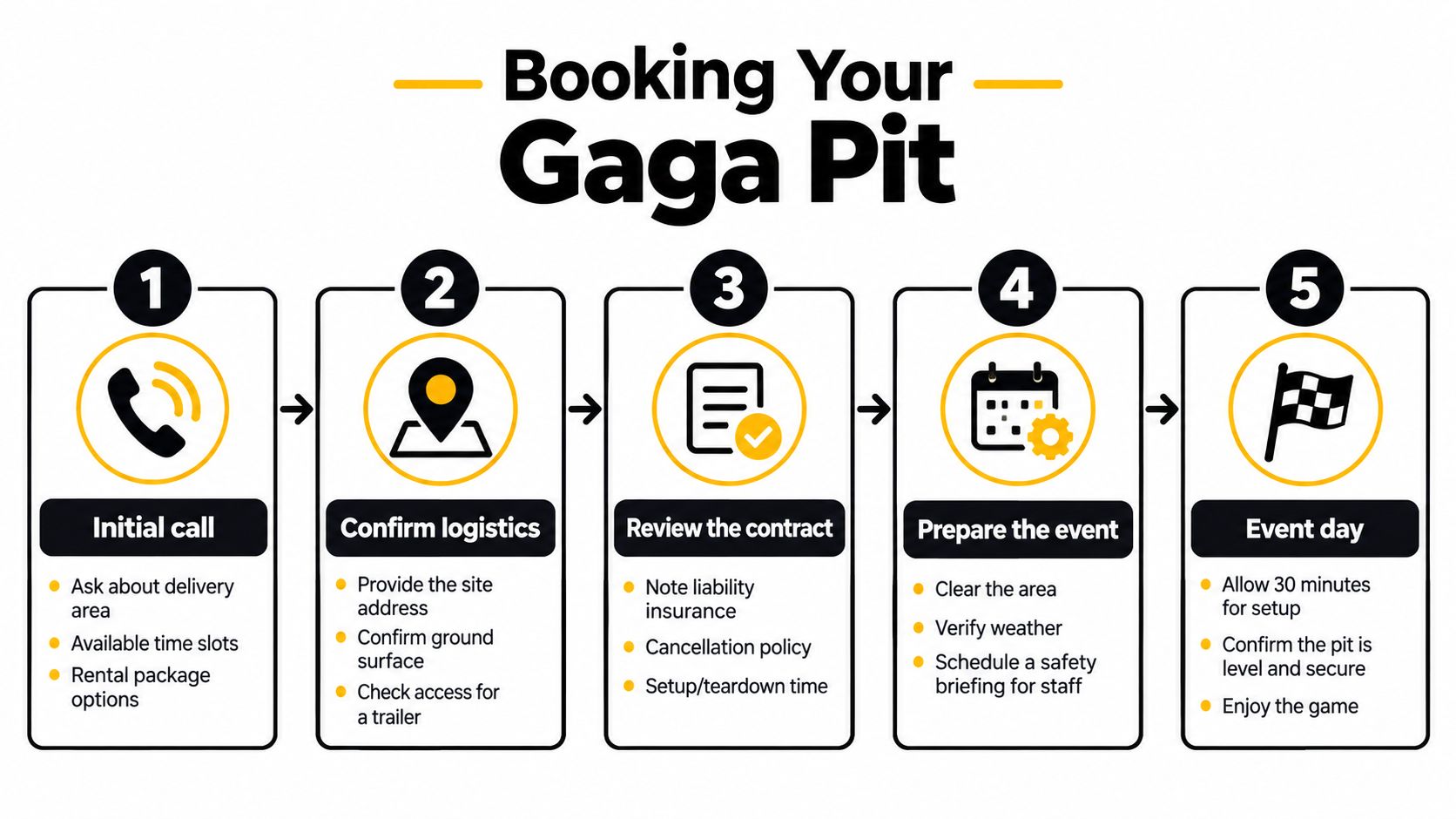
What the renter must prepare
The venue usually controls the site, but the event organizer must make the area usable. Mark the drop zone, clear the full operating footprint, identify the delivery route, and make sure the crew knows where to park or unload. If the selected equipment is inflatable or includes lighting, confirm the available power arrangement with the rental company rather than assuming a nearby outlet will work.
Schools and public venues should identify the person who will receive the crew, approve the setup, and handle questions during the event. Give that contact the final layout, weather plan, insurance status, and staffing assignment. A last-minute handoff to an uninformed volunteer creates delays and weakens accountability.
On event day, the crew should arrive within the confirmed delivery window, inspect the surface, verify level placement, and review the operating plan with the venue contact. The attendant should explain the rules, confirm capacity, and establish how players enter and exit. At takedown, the organizer should keep guests clear of the equipment and confirm that the crew has access to the loading route.
Phantom Entertainment is one regional option that provides event rentals with delivery, setup, professional operation, certificates of insurance, and venue-ready safety documentation for qualifying events across Pennsylvania and nearby Mid-Atlantic states. Those services are especially relevant when a school, campus, municipality, or corporate venue needs more than equipment dropped at the curb.
Your Quick Planning Recap Before You Book
Take these four clusters to your committee meeting or venue walkthrough.
Audience and attendance
- Expected event attendance
- Number of simultaneous players
- Age range and age grouping
- Whether younger and older participants need separate sessions
- Whether an attendant or trained volunteer will run rotations
Pit, surface, and layout
- Selected pit diameter
- Ground material, such as grass, turf, gym flooring, or protected pavement
- Flat and dry placement area
- Open clearance around the walls
- Spectator position, queue location, and accessible route
Compliance and staffing
- Venue approval requirements
- Weather and backup-space policy
- Anchoring or power needs for the selected equipment
- Agreed supervision ratio
- First-aid access and emergency contacts
- Certificate of insurance wording and delivery deadline
Booking logistics
- Delivery and pickup windows
- Truck or trailer access
- Setup and takedown responsibilities
- Included balls and equipment
- Attendant availability
- Deposit, cancellation, and weather terms
A gaga pit earns its place on a crowded event map because it scales from intimate gatherings to large group programs, keeps participants active, and uses few consumables. Once the audience, footprint, venue requirements, staffing, and contract details are confirmed, the right rental partner can handle the heavy lifting.
For a properly planned gaga ball pit rental, Phantom Entertainment can coordinate delivery, setup, operation, insurance documentation, and takedown for schools, corporate family days, church events, and community programs across the Mid-Atlantic. Visit Phantom Entertainment to discuss your venue, audience, and event layout with a rental team that understands event-day logistics.
Ready to Book Your Event?
PA state-inspected, fully insured since 1979. Call us or get a free quote today.