

The strongest fun field day games for high school combine high-throughput competitions, individual challenges, low-pressure activities, and a clear safety plan. That mix matters because 54.1% of U.S. children ages 6–17 participated in sports during the previous 12 months in 2020, while only 26.1% of U.S. high school students achieved 60 minutes of physical activity on every day of the previous week in 2017. CDC data puts the planning challenge in clear terms: students are familiar with organized activity, but they still need engaging formats that make movement easy to join.
A successful high school field day shouldn't feel like an elementary-school play period with bigger students. It should feel like a well-run festival with competition, autonomy, social energy, and enough activity variety that athletes, casual participants, and anxious students can all find a comfortable entry point. The ten ideas below pair each attraction with adaptable rules, competition formats, equipment needs, crowd-flow guidance, and a relevant Phantom Entertainment rental option.
Compare every choice against the realities of your venue. Does it need a large outdoor footprint, electricity, shade, or a specific surface? How many trained operators and volunteers will keep lines moving? Will students compete in heats, brackets, grade-level scoring, or free play? Can the activity continue if weather changes, and do you have the insurance and safety documentation your school requires?
The right mix can help schools increase class participation without forcing every student into the same kind of competition. Phantom Entertainment can support that approach with delivery, setup, professional operation, insured attractions, and venue-ready safety documentation.
1. Inflatable Obstacle Course Races
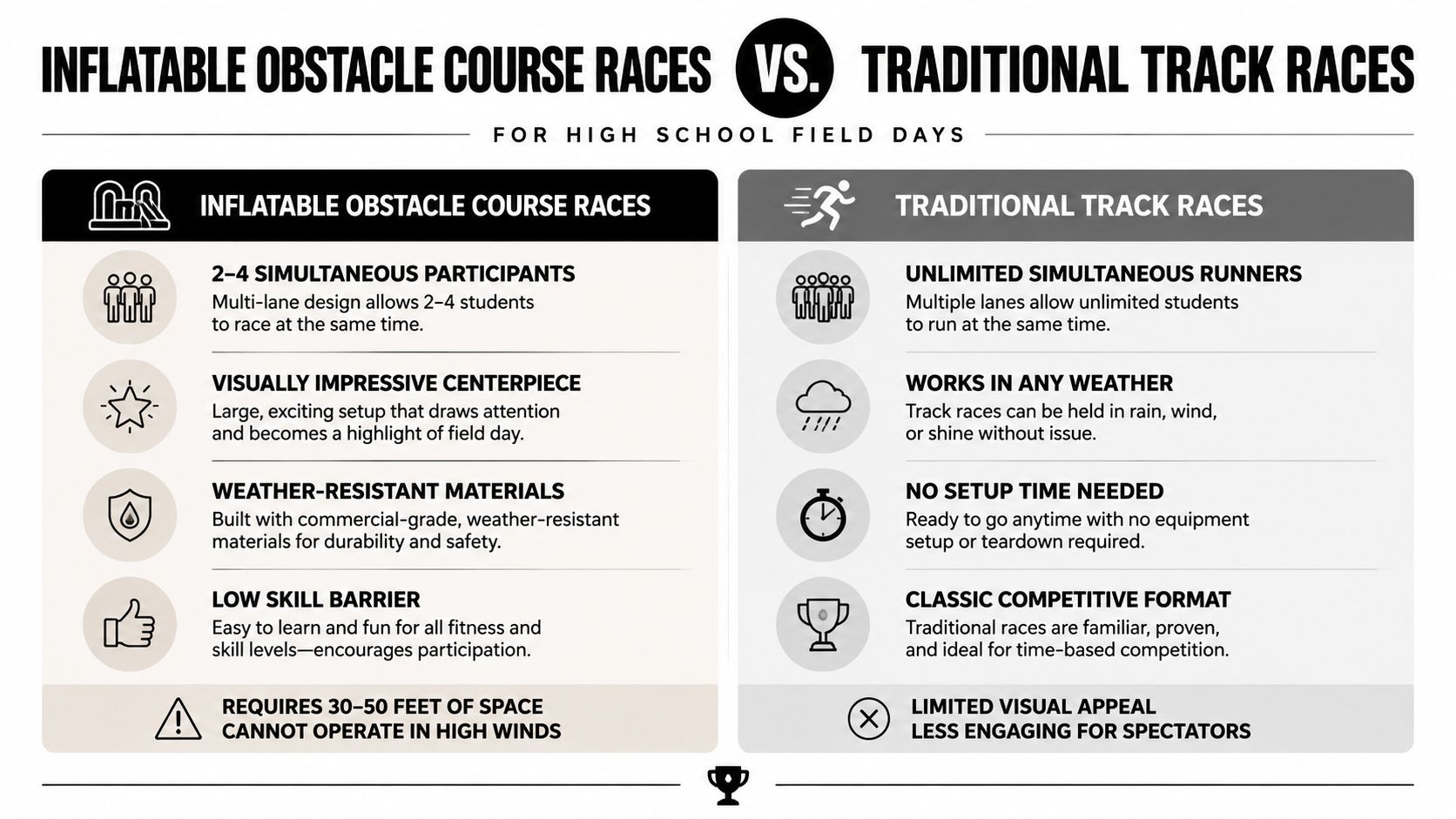
An inflatable obstacle course gives high school students a clear challenge without requiring the technical skill of a varsity sport. Multi-lane layouts can combine climbing walls, tunnels, jumping platforms, and slides, so participants must manage speed, balance, and decision-making rather than just sprinting from one end of a track to the other.
Use timed heats when you want predictable throughput. Grade-level or class brackets work better when school spirit and a final championship matter more than constant turnover. For a less intimidating format, let students race the clock individually and post the fastest completed times by division. Students who don't want to race can serve as announcers, timekeepers, scorekeepers, or cheer sections.
Practical rule: The course only works when the queue, briefing area, entry point, and exit are visibly separated.
Keep the course moving safely
Commercial certification, professional setup, anchoring, constant adult supervision, and weather monitoring belong in the event plan. University risk-management guidance recommends deflating inflatable equipment when winds reach the 20 mph range or higher, and school or campus guidance commonly calls for a flat, debris-free setup area, commercial-use tags, adequate clearance, and controlled occupancy. Inflatable safety guidance also emphasizes that staffing and per-unit capacity affect safe throughput.
Prepare a safety briefing that covers footwear, passing rules, contact expectations, and what happens if someone stops inside the course. Schedule heats tightly enough to hold attention, but leave time for reset and inspection between groups. A DJ can announce names, explain the bracket, and keep spectators engaged while a nearby photo station captures participation.
For schools comparing this attraction with a traditional track race, the visual inflatable obstacle course comparison can help staff discuss the trade-off between spectacle, staffing, and controlled lanes. Phantom's inflatable attraction collection gives planners a rental path when delivery, setup, and operation need to be handled by one provider.
2. Laser Tag Battle Arena
Laser tag is a strong choice when high school students want competition with more strategy and less emphasis on running speed. Inside an inflatable arena, teams can protect a base, control zones, or complete an objective while using infrared equipment to score hits. The result feels closer to a tactical game than a standard race, which helps attract students who enjoy planning, teamwork, and technology.
Don't run one long match for the entire event. Short rounds with rotating teams create more opportunities to participate and make it easier to keep a tournament moving. A bracket can produce a final, while a point system lets classes earn credit across several rounds. Students who aren't playing can work as scorekeepers, referees, commentators, or team captains.
Design for rotation, not elimination
Before the first match, explain boundaries, vest signals, equipment handling, and what counts as a legal hit. Assign an operator or trained station lead to reset equipment and monitor the arena. A visible waiting zone prevents students from crowding the entrance, and a hydration area nearby gives teams a place to recover between games.
The main trade-off is capacity. Laser tag can create a memorable centerpiece, but a single arena may process fewer students than a broad station such as carnival games. Solve that problem with simultaneous games where the equipment and layout allow it, or rotate teams through other attractions during the wait. Avoid an elimination format that leaves losing teams inactive for too long.
A school leadership team can also use the attraction to give older students meaningful responsibility. Let selected students help with score sheets and announcements under adult supervision, while professional staff retain control of equipment and safety decisions. Phantom's BattleDome Laser Tag experience fits a field-day plan built around team play, tournament rounds, and managed rotations.
3. Rock Climbing Wall Challenge
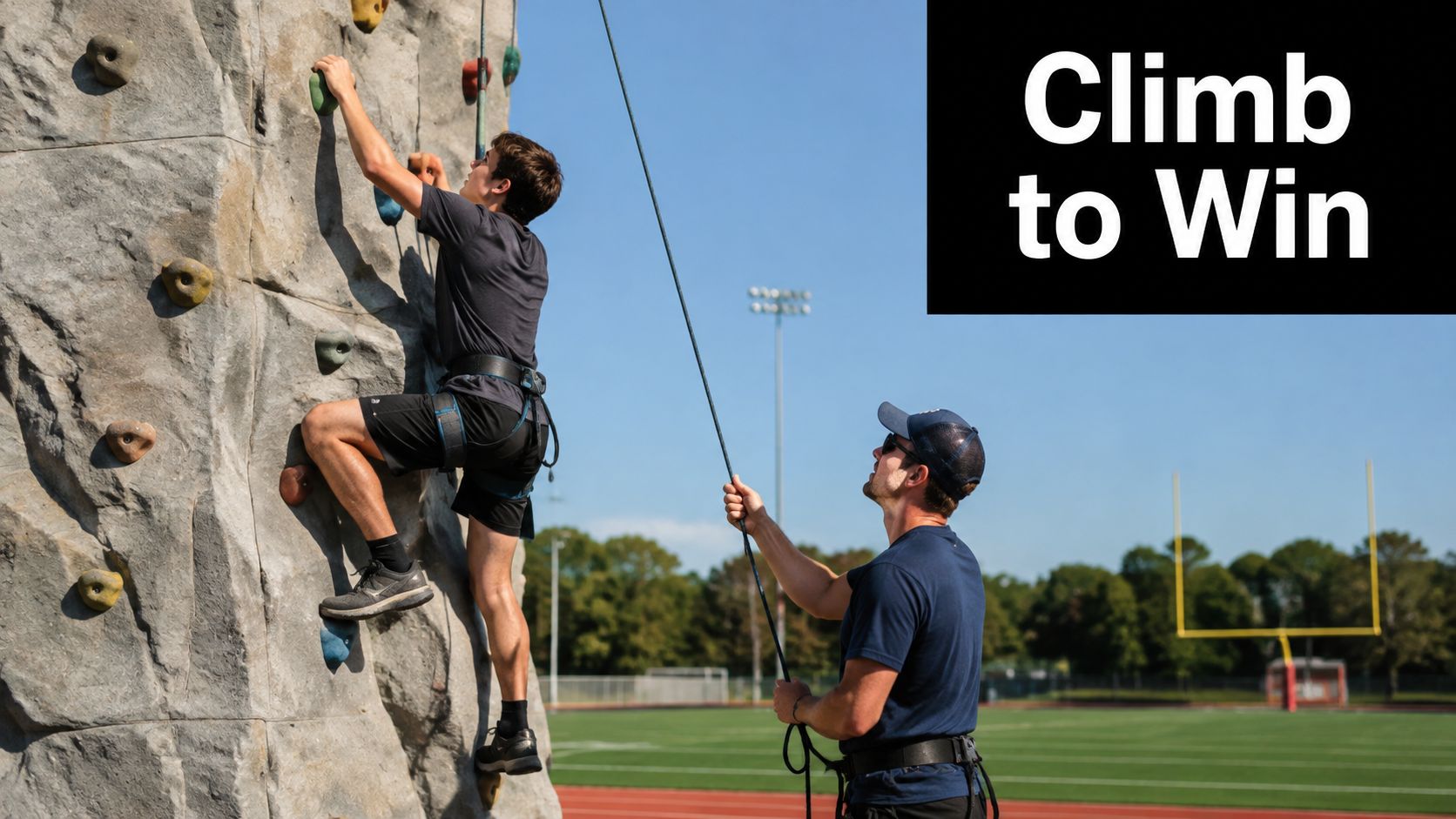
A portable rock climbing wall changes the emotional rhythm of a field day. Instead of asking students to beat an opponent, it gives each participant a visible personal target. Multiple routes can serve beginners and experienced climbers, while a harness and professional belay system provide the controlled structure the attraction requires.
This activity works well near the center of an event map, where spectators can watch attempts and encourage students. Track completed routes, route difficulty, or fastest ascent, but don't make speed the only measure of success. A student who reaches a higher route than expected may value that achievement more than a leaderboard position.
Give students more than one way to win
Offer a beginner route and a harder route during the same rotation so experienced students don't make the line feel inaccessible. Use a completion card, class score, or “summit goal” board to recognize persistence. Staff should explain harness procedures, body positioning, and stopping signals before anyone climbs. A hydration station and shaded waiting area are practical additions because participants may exert themselves even during a short attempt.
The wall needs a professional operator, a suitable surface, a defined queue, and enough room for the structure, landing area, and spectators. It also has a naturally limited throughput because each climber requires fitting, instruction, and belay attention. That makes it a poor choice as the only attraction, but an excellent individual challenge alongside high-volume stations.
A school can announce route completions over the PA system or recognize students during closing awards. This creates a public moment without requiring every student to compete head-to-head.
The format also suits orientation events and athletic fundraisers, where the climbing wall becomes a visual anchor that draws students toward the activity zone. A professional rental team can manage the technical operation while school staff focus on group flow and encouragement.
Here is a short look at the kind of climbing experience students can expect before you finalize the station layout.
4. Mobile Mechanical Bull Riding
A mechanical bull creates immediate spectator energy because every ride has a beginning, escalation, and finish. The operator controls the pace, so beginners can start gently while experienced riders face a more demanding challenge. That progression gives the attraction a carnival feel without requiring students to master a complex set of rules.
Run it as an individual challenge rather than a mass game. Record each student's ride time, create a class leaderboard, or award recognition for the strongest attempt in different experience categories. Keep the competition light. A student shouldn't feel pressured to ride, and the station should offer an equally visible role for announcers, photographers, cheerleaders, and scorekeepers.
Treat the ride as a managed attraction
Set participation parameters before the event and apply them consistently. Explain hand placement, rider posture, stop signals, and what students should do when the ride ends. The operator must control speed and intensity, while staff keep spectators outside the operating area. Place seating close enough for students to watch, but far enough to protect the ride zone and landing space.
The trade-off is throughput. Mechanical bull riding produces memorable moments, but each participant needs a fitting, briefing, controlled ride, and reset. It can become a bottleneck if the school promotes it as the only headline activity. Put it beside low-wait options, and use scheduled sign-ups or class rotations instead of allowing an uncontrolled line to dominate the event.
A DJ can introduce riders and build positive energy without turning the activity into a dare contest. Video capture may appeal to students, but schools should establish consent and sharing rules before recording. The best version feels exciting, not humiliating.
For a spring fling, graduation celebration, or country-themed field day, the bull can serve as the visual centerpiece while other stations absorb students waiting for a turn.
5. Arcade Game Stations and Competition
Arcade stations solve a common field-day problem: not every student wants to run, climb, or be publicly timed. Racing simulators, basketball shooters, claw machines, and skill games create a lower-pressure zone where students can compete through reaction time, precision, or decision-making. They also give students a place to participate while resting between more physical attractions.
Choose between free play and a formal tournament based on your event objective. Free play keeps the atmosphere casual and lets students sample different machines. A bracket, posted leaderboard, or class-versus-class scoring system creates a stronger reason to return. For a large event, run an opening period of free play and reserve a later championship round for the highest scores.
Make the games easy to understand
Post the scoring rules beside each station. If one student can occupy a machine for too long, use a turn limit or a station attendant who manages the queue. Team scoring can prevent the most experienced gamer from dominating the entire attraction. For example, award points for participation, high score, and sportsmanship so classes aren't judged only by one student's performance.
The physical setup needs electricity, stable placement, cable management, and a clear spectator area. Keep drinks away from the equipment and assign someone to handle resets or malfunctions. A visible leaderboard adds energy, while a DJ can announce round changes and finalists.
Arcades are especially useful in indoor field days, school carnivals, spring flings, and evening graduation events. Their main limitation is that a station may serve students one at a time, so the attraction needs enough machines or a strong rotation plan. Pair it with photo stations and carnival games to create a social entertainment zone rather than a row of isolated screens.
Small prizes can motivate participation, but recognition doesn't need to be expensive. Publicly announcing a new high score may be enough to keep the competition active throughout the day.
6. Virtual Reality Game Stations
Virtual reality gives a high school field day a technology-forward option, but it needs tighter session management than most physical stations. Students can choose competitive rhythm games, sports simulations, cooperative adventures, or individual experiences. That range makes VR useful for students who want novelty without committing to a full-contact or high-impact attraction.
Keep sessions short enough to preserve flow and reduce discomfort. The station lead should explain how to pause, remove the headset, and report dizziness or motion sickness. Provide a waiting area where students can watch demonstrations, review game choices, or support classmates rather than standing in an unstructured line.
Balance immersion with hygiene and access
Operators should clean headsets and controllers between users and keep the play area free of bags, chairs, and trip hazards. Phantom's VR Experience can support a professionally managed technology station, but the school still needs to confirm the room or tent layout, power access, and supervision plan.
Use a mix of competitive and non-competitive content. A leaderboard works for students who enjoy scores, while cooperative or exploratory experiences give anxious students a way to participate without public ranking. Students waiting for a turn can serve as commentators, vote on the next game, or follow a team challenge on a display.
The biggest trade-off is capacity. A headset station can attract substantial interest, yet only a limited number of students can play at the same moment. Multiple stations reduce waiting, but they also increase the need for operators, cleaning supplies, and equipment oversight. Don't place VR beside a loud DJ speaker or in direct sun if glare and heat will affect the experience.
VR works best as one part of a varied field day, not as the central activity for every group. It gives the event a modern edge while helping planners provide an alternative for students who prefer technology, cooperation, and controlled individual play.
7. Foam Pit Dodgeball and Inflatable Games
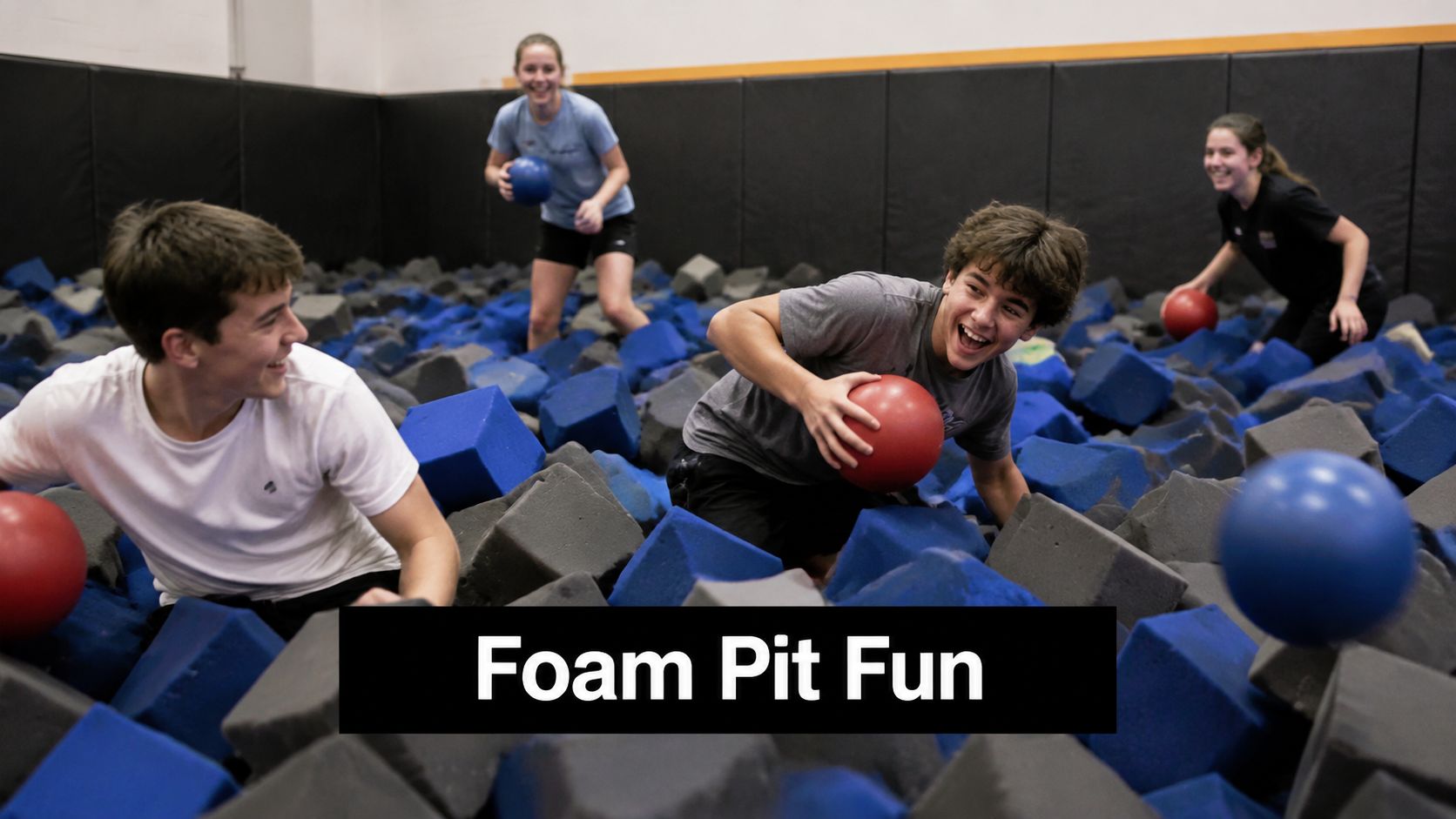
Foam pit dodgeball brings team competition into a padded environment and can feel more approachable than traditional dodgeball. Students throw soft balls, move around obstacles, and coordinate with teammates inside a defined arena. The format offers enough action for spectators to enjoy, while the foam setting changes the tone from fear of impact to playful competition.
Use short matches and rotate teams quickly. A bracket creates a clear tournament arc, but a continuous challenge can work better when attendance is unpredictable. Teams can earn points for wins, completed objectives, or fair play. Let students contribute as captains, referees, announcers, or strategy coaches if they don't want to enter the pit.
Set boundaries before the first throw
Explain where students may stand, what type of throw is allowed, and how staff will stop play. Foam reduces impact, but it doesn't remove every risk. Students still need to follow entry, exit, and movement instructions, and operators need to monitor crowding and fatigue.
A hydration area and rest zone should sit near the attraction, not across the venue. The station also needs an obvious spectator boundary so waiting students don't enter the play area. Use a DJ for match introductions and school-spirit announcements, but keep the volume low enough for staff to communicate safety instructions.
The main advantage is social participation. Students can play in teams without needing the speed or endurance expected in a race. The limitation is that the arena requires regular resets, cleaning, and controlled occupancy. A single match can also leave students waiting if the bracket is poorly planned, so publish rotation rules and keep alternate stations nearby.
Foam games pair naturally with obstacle courses, laser tag, and carnival stations because students can move between high-energy and low-pressure options without changing the event's overall tone.
8. Mobile Zip Line Experience
A mobile zip line gives students an individual achievement that feels adventurous without requiring them to learn a complicated sport. Participants receive a harness, follow body-position instructions, and travel along a controlled inclined cable system. The launch and landing areas create natural viewing points, so friends can cheer without entering the operating zone.
Schedule the zip line through class rotations or sign-up windows. A free-for-all queue can become difficult to manage because harness fitting and safety checks take time. Use a visible sign-up board, call groups by name, and direct students to a waiting area that doesn't interfere with launch or landing.
Build confidence into the format
Offer a progression that allows hesitant students to watch, ask questions, and decide when they're ready. Staff should explain the harness, braking or landing process, and required body position before each participant launches. Trained operators and spotters should control the attraction, while school volunteers handle the queue, score sheets, and spectators.
You can track completion, best time where the equipment and operator permit it, or participation by class. Avoid turning fear into entertainment. A “most dramatic” category should celebrate style only when students choose it, not pressure them to perform for a crowd.
The structure requires a suitable surface, clearance, weather review, and a footprint that may be larger than the visible cable. Confirm access for delivery vehicles and identify where students will wait under shade. Keep water nearby because students may combine the zip line with other strenuous attractions.
This is a strong headliner for a spring fling, grad night, or athletic fundraiser, but it shouldn't carry the whole event. Its limited throughput makes pairing essential. Put carnival games, arcade stations, or a photo booth near the exit so students have an immediate next activity after completing the ride.
9. Carnival Games and Prize Stations
Carnival games are the dependable low-pressure option in a field day lineup. Ring toss, cornhole, basketball shooters, bottle knockdowns, and other skill challenges let students compete without racing or being strapped into equipment. They also work for students who are tired, socially cautious, or waiting for a turn at a larger attraction.
Create a station menu with different difficulty levels. A beginner target can award participation points, while a harder target can earn more tickets or class credit. Clearly post the rules, number of attempts, scoring method, and prize system before students begin. Confusion at a prize table creates more complaints than a difficult game.
Use prizes to support participation
A tiered reward system can recognize consistent effort without making the most difficult game the only worthwhile choice. For a school-wide competition, assign points to classes or grades instead of relying only on individual prizes. A student who helps a teammate understand the rules or encourages another player can receive sportsmanship recognition.
Staffing matters more than the equipment. Operators need to reset games, explain rules, manage tickets, and keep the line moving. Give each station a defined queue and use signs to show whether students are waiting for a turn, collecting a prize, or moving to another activity. A photo booth nearby can capture winning moments, while a DJ can announce high scores and class standings.
Carnival stations are flexible on space and can often fit under a tent, in a gym, or along the edge of a larger field. Their limitation is that they may feel too familiar if every game looks elementary. Use school colors, student-designed signs, sports themes, or strategy-based challenges to make the zone feel appropriate for older students.
The attraction works particularly well as the connective tissue between major rentals. Students can step into a quick game while waiting, cool down after a race, or participate without entering a public competition.
10. Photo Novelty and Social Media Moment Stations
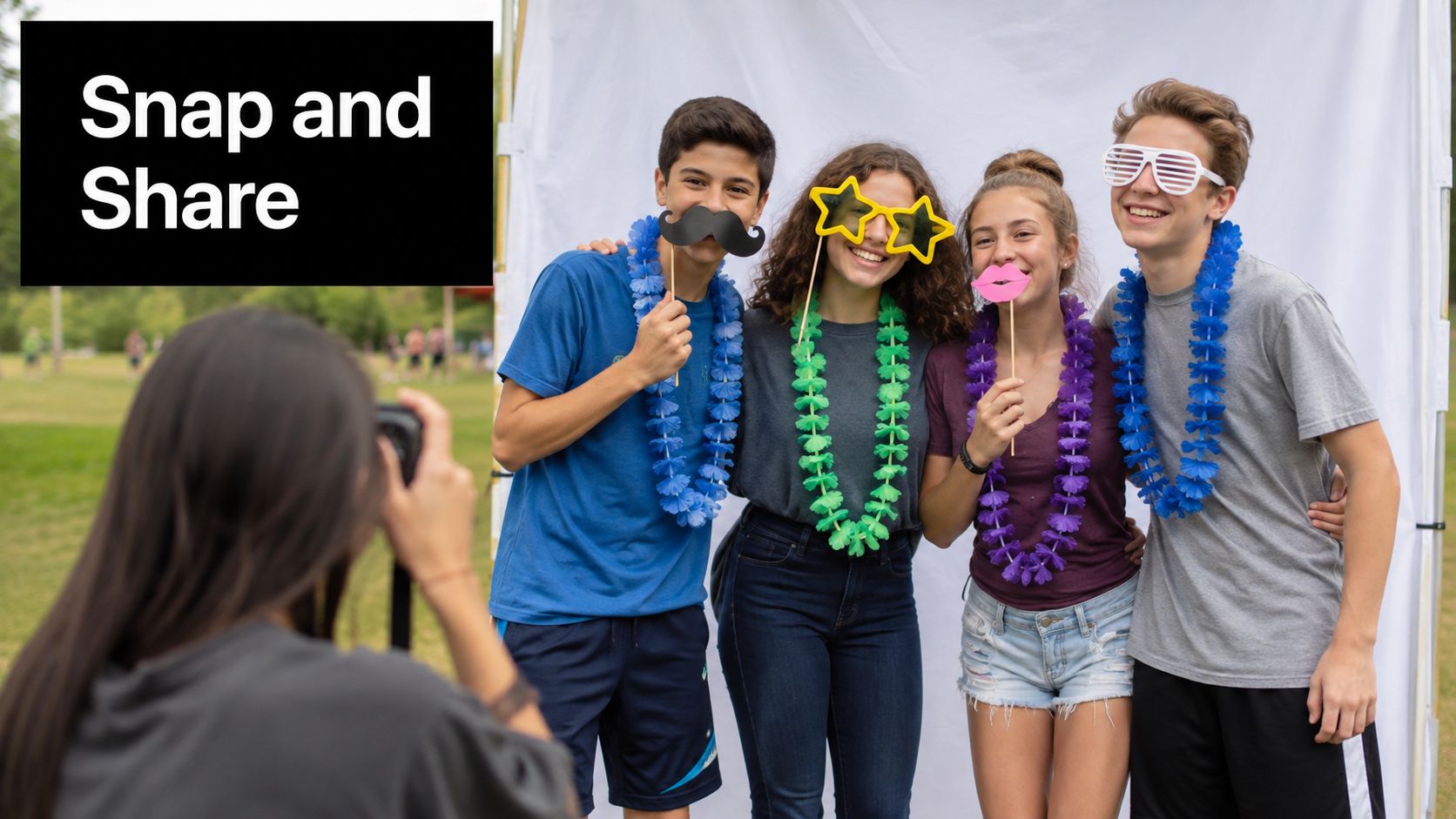
A photo station doesn't replace physical activity, but it helps a field day feel like a shared event rather than a sequence of disconnected games. Green-screen backgrounds, school-branded overlays, props, and themed backdrops give students a reason to gather with friends. It also creates a low-pressure participation path for students who prefer social interaction to athletic competition.
Place the station in a high-traffic area, but don't put it in the exit lane of an inflatable or ride. If the school wants digital delivery, confirm the process before the event and decide how students will access images. A QR-based delivery option can reduce paper handling, while instant prints may make the station feel more like a keepsake activity.
Turn photos into a participation tool
Create prompts that connect the station to the event. Students might pose with their class banner, recreate a team celebration, or submit a photo for a school-spirit contest. Keep the rules simple and publish consent expectations for student images, especially if the school plans to use submissions on official social channels.
The operational needs are modest compared with large attractions, but staffing still affects the experience. An attendant should manage props, guide groups, check image quality, and keep the line moving. Multiple backdrops can reduce waiting and give students a reason to return without creating a single congested queue.
The station's main value is inclusion. Students can participate in the event's identity and social energy even if they skip the highest-intensity games. It also gives organizers material for a post-event recap, provided the school has permission to share it.
Pair the photo station with a DJ, carnival games, or the exit of a climbing wall. Students have something to do while friends finish a challenge, and the resulting images reinforce class and school spirit.
Comparison of 10 High School Field Day Games
| Activity | 🔄 Implementation Complexity | ⚡ Resource Needs | 📊 Expected Outcomes & ⭐ | Ideal Use Cases | 💡 Key Tips |
|---|---|---|---|---|---|
| Inflatable Obstacle Course Races | Moderate, commercial setup, 1–2 hr, weather-dependent | Large footprint (30–50 ft), staff/operators, occasional power, safety inspections | High engagement, team competition, strong visual impact (⭐️⭐️⭐️⭐️) | Field days, fundraisers, orientation competitions | Schedule heats, use DJ/announcer, clear safety briefings |
| Laser Tag Battle Arena | Moderate, electronics setup and operator coordination | Power, flat surface, IR gear, trained refs, realtime scoring displays | Fast-paced competitive play; strong strategic/team engagement (⭐️⭐️⭐️) | Tournaments, indoor/outdoor competitive events, orientation | Run parallel games, rotate teams, brief rules and safety |
| Rock Climbing Wall Challenge | Moderate–High, certified belays, vertical setup | Vertical clearance (12–20 ft), harnesses, trained staff, auto-belays | Individual achievement, confidence-building, memorable moments (⭐️⭐️⭐️⭐️) | Confidence programs, fundraisers, skill challenges | Offer multiple routes, time challenges, highlight climbs over PA |
| Mobile Mechanical Bull Riding | Low–Moderate, operator-controlled, simple footprint | Ground space, electricity, padded mat, trained operator | High-energy spectacle and social-media moments (⭐️⭐️⭐️) | Headliner attraction, grad nights, party draw | Use weight/height limits, start slow for beginners, record rides |
| Arcade Game Stations and Competition | Low, straightforward setup, moderate tech support | Multiple electrical hookups, machines, tech support, space per station | Broad appeal, steady engagement, leaderboard-driven play (⭐️⭐️⭐️) | Indoor events, continuous-play areas, mixed-age crowds | Run brackets, rotate games, display leaderboards prominently |
| Virtual Reality Game Stations | High, technical setup, safety & hygiene protocols | High-end headsets, trained operators, power, cleaning supplies, limited stations | High "wow" factor and unique engagement; limited throughput (⭐️⭐️⭐️⭐️) | Tech-forward orientation, small-group demos, social media content | Keep sessions short, provide wipes, brief on motion sickness |
| Foam Pit Dodgeball and Inflatable Games | Moderate–High, extensive setup and maintenance | Large area, foam blocks, staff, indoor preferred, cleanup/maintenance | High-fun with low-impact safety; excellent group participation (⭐️⭐️⭐️⭐️) | Team-building, PE alternatives, high-energy activities | Pre-brief rules, manage rotations, bracket-style matches |
| Mobile Zip Line Experience | High, certified operators, complex rigging | Significant vertical space, harnesses, braking systems, trained crew, insurance | Thrilling, confidence-building, strong spectator draw (⭐️⭐️⭐️⭐️) | Headline attractions, fundraisers, adventure events | Provide multiple heights, trained spotters, photo opportunities |
| Carnival Games and Prize Stations | Low, many simple stations but easy to scale | Multiple booths, staff, prizes, space, optional electrical needs | Wide demographic appeal, continuous play, prize-driven engagement (⭐️⭐️⭐️) | School carnivals, family fun days, low-barrier entertainment | Mix classic/contemporary games, tiered prizes, enthusiastic staff |
| Photo Novelty & Social Media Moment Stations | Low–Moderate, tech & branding setup, printing | Power, green screen/booth tech, props, printer/digital delivery, operator | High shareability and marketing value; keepsake creation (⭐️⭐️⭐️⭐️) | Branding moments, downtime activities, social-media campaigns | Use multiple stations, instant digital delivery, event hashtag |
Turn Ten Activities Into One Smooth Event
A strong activity list still fails if students spend the day standing in lines. Start by dividing the student body into manageable groups and assigning each group a route. Give every route a mix of high-throughput attractions, individual challenges, and lower-intensity stations. An obstacle course or foam game can supply movement, while arcade stations, carnival games, and photo activities absorb students who need a break or prefer a different social setting.
Choose the event format before you finalize rentals. Station rotations provide structure and make it easier to distribute attendance. Brackets create a clear competitive story but require careful scheduling and scorekeeping. Grade-level scoring builds school identity, while free play reduces administrative work but can produce uneven lines and repeated participation by the most enthusiastic students.
Publish the rules before field day. Students and teachers should know whether points come from wins, completion, participation, time, or sportsmanship. Explain tie-break procedures, rotation signals, equipment boundaries, and what happens when weather interrupts a station. Visible signs at each attraction reduce the number of questions operators must answer during busy periods.
Build the operational plan around the venue
Walk the site with a map and mark every attraction's operating area, queue, exit, spectator zone, and staff position. Confirm power access for arcade games, VR, music, and inflatables. Review ground conditions and access routes for delivery vehicles. Large attractions need more than the space occupied by the equipment, because students also need safe waiting and movement areas.
Weather planning should be specific rather than optimistic. For inflatables and high attractions, identify the conditions that require a pause or shutdown, including the wind threshold recommended in institutional safety guidance. School activity guidance from the CDC supports a broader approach to movement by encouraging multiple ways for students to participate, not just one athletic pathway. That principle belongs in the schedule, with active, collaborative, self-paced, and quieter choices available throughout the event.
Design for the student who isn't first in line, fastest on the field, or comfortable in front of a crowd.
Create hydration and rest areas near the busiest activity clusters. Give staff clear roles for station operation, queue control, scoring, first aid communication, and transitions. Professional operators should control specialized attractions, while school personnel manage student groups and school policies.
Reserve buffer time between rotations. Students need time to leave one station, find the next location, refill water, and understand the new rules. A schedule with no transition space will run late from the first delay, especially when an attraction requires harness fitting, equipment cleaning, or a safety reset.
Finally, choose attractions based on your actual venue, student interests, weather plan, staffing capacity, accessibility needs, and desired competition format. Phantom Entertainment can help schools assemble turnkey field day packages with delivery, setup, professional operation, insurance documentation, and safety support. A professional rental partner is particularly useful when the school wants memorable attractions without asking teachers to manage technical equipment during the event.
The best field days don't force every student through the same experience. They create a well-marked network of opportunities, then give students enough choice to find challenge, connection, and confidence. That is what makes fun field day games for high school feel age-appropriate, organized, and worth joining.
Phantom Entertainment provides school-ready rentals including obstacle courses, laser tag, climbing walls, mechanical bulls, zip lines, arcade games, VR, carnival games, and photo novelties, with delivery, setup, operation, and safety documentation available. Visit Phantom Entertainment to explore field day options and request help building a package for your school, campus, or community event.
Ready to Book Your Event?
PA state-inspected, fully insured since 1979. Call us or get a free quote today.