
The room is ready, the schedule is tight, and the lighting operator has one concern: the beams look flat in the air. A little atmosphere could make the opening sequence feel cinematic, but the venue manager is asking whether the fire alarm system will tolerate it, whether guests will be comfortable, and who's responsible if the effect spreads through the HVAC system.
That's the fog-machine rental decision. You're not choosing the machine that produces the biggest cloud. You're matching an atmospheric effect to the room, the audience, the lighting design, the venue's approval process, and the operator's ability to control output. Fog and haze rentals can add drama to a school performance, corporate reception, dance floor, festival, or stage reveal, but they can also create problems when planners skip the site conversation.
This guide walks through the practical details, from the difference between fog, haze, and low-lying effects to output capacity, ventilation, detector coordination, power, placement, and rental support. A full-service provider such as Phantom Entertainment's event entertainment services can also help with delivery, setup, operation, and venue documentation when the effect needs to fit into a larger production.
Introduction to Fog Machines Rentals for Events
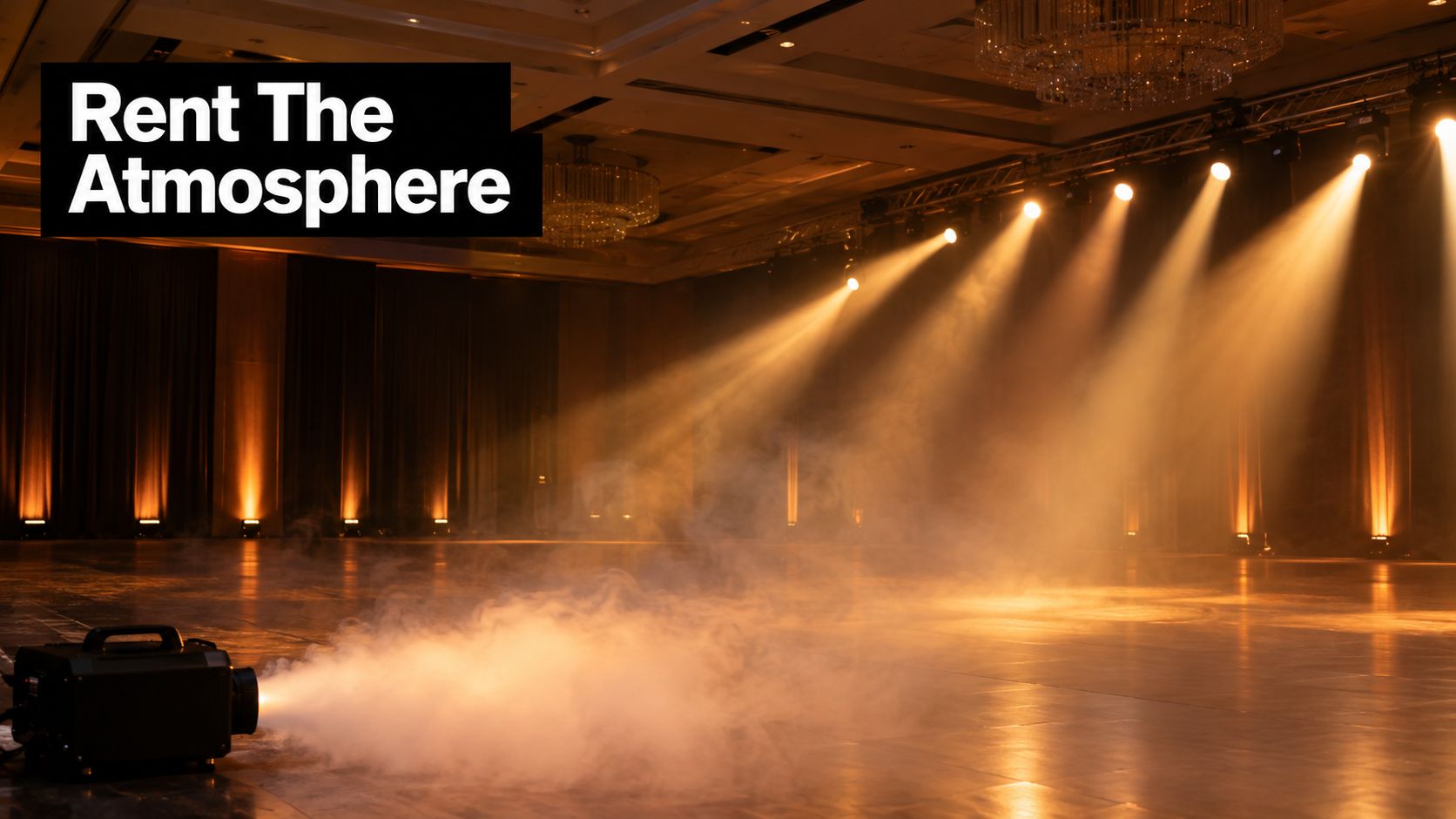
A fog machine doesn't create atmosphere by itself. It gives lighting something to work with. In a darkened gym, a moving beam can remain almost invisible without airborne particles to scatter the light. Add a controlled burst, and suddenly the audience can see the path of the beam, the entrance of a performer, or the shape of a dance-floor lighting cue.
That's why planners often rent rather than buy. A rental gives you access to the appropriate machine class, fresh event fluid, transportation, setup knowledge, and an operator who understands how quickly conditions change in a real venue. A school gym, hotel ballroom, outdoor stage, and small corporate room each behave differently because of ceiling height, airflow, HVAC operation, occupancy, and available power.
The broader market also supports the idea that atmospheric effects remain part of event and entertainment production. The fog machine market has been estimated at USD 0.4 billion in 2025 and projected to reach USD 0.6 billion by 2034, representing a 4.8% CAGR, according to Market Intelo's fog machine market report. For rental customers, that points to continued use of atmospheric equipment in live events, staging, and immersive entertainment.
The technology has changed considerably over time. One industry history traces fog effects to early twentieth-century theater and identifies the first mechanical fog machine as a 1920s invention by Friedrich Sorgel. It also describes a more portable electric glycol-fluid machine emerging in the 1950s, a shift that helped make stage atmosphere easier to operate, as documented by Spherical Insights' fogging machine market history.
Your first question, then, shouldn't be “Which machine makes the most fog?” Ask instead: What should guests see, how long should the effect last, and what will this venue approve?
How Fog and Haze Effects Actually Work
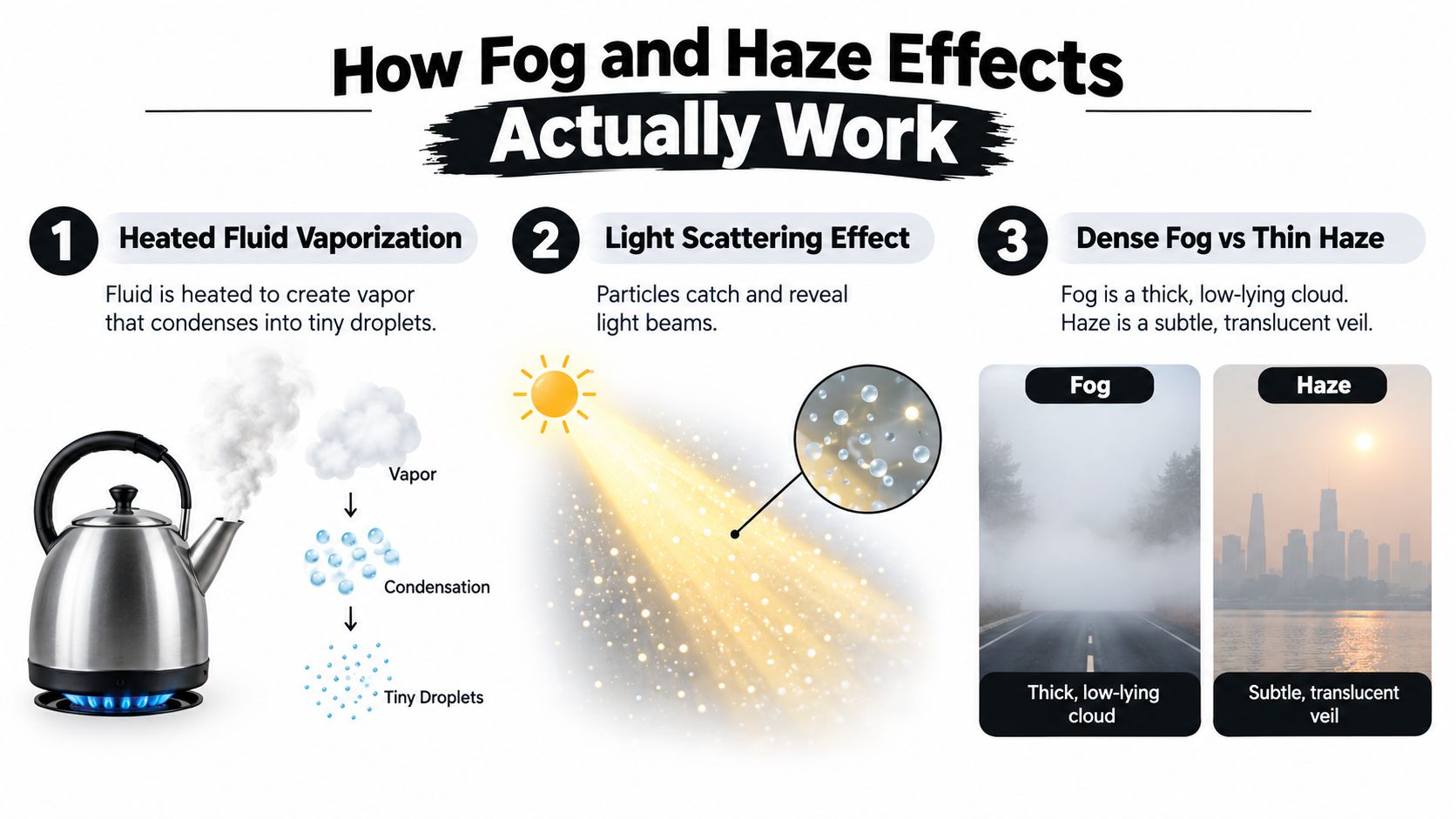
A typical theatrical fog machine heats a specially formulated fluid. The fluid becomes vapor, then condenses into very small airborne droplets. Those droplets do not create light. They scatter light already in the room, much like steam near a kettle or dust caught in a sunbeam.
That difference explains why fog can look dramatic under moving lights yet barely register beneath ordinary ceiling fixtures. The visible result depends on particle size, lighting angle, air movement, and how much fluid the operator releases. Before booking a rental, ask the venue whether it approves the fluid and effect, and how its detectors respond to airborne particles.
Core idea: Particle size and air movement determine how visible the atmosphere becomes.
Dense fog for dramatic moments
Dense fog is the effect many guests picture first. It arrives in a noticeable burst, gathers around a defined area, and can partly hide performers, entrances, props, or the rear of a stage. It suits a reveal, concert cue, haunted attraction, or short theatrical transition.
More output can create more problems in a confined room. A heavy release may block sightlines, drift toward guests, or reduce visibility near exits. Treat dense fog like a camera flash or sound cue. Time it to a specific moment, then stop it instead of leaving the machine running without a clear purpose.
Haze for visible light beams
Haze is lighter and more evenly spread. Rather than forming a thick cloud, it creates a translucent veil across the room. Lighting designers use it to make beams, gobos, lasers, and moving fixtures visible while keeping the audience from feeling surrounded by dense fog.
Haze rewards patience and small adjustments. The operator can release modest amounts and allow the room's air movement to distribute them. This often produces a steadier appearance, but the venue still needs to approve the fluid, operating method, ventilation arrangement, and detector response before the rental is confirmed.
Low-lying fog for floors and entrances
Low-lying fog is intended to stay close to the floor, forming a cloud-like layer around a dance floor, first dance, stage entrance, or theatrical scene. Unlike ordinary fog, it is designed to remain below waist level instead of filling the room.
That layer can move quickly if conditions change. Fans, open doors, supply vents, and guests crossing the floor may push it away from the intended area. A rental technician should check the floor surface, air currents, guest paths, and exit visibility before promising a stable effect.
A short demonstration helps planners distinguish a dense burst from a light haze or floor-level layer. It also gives the venue team a practical way to review the proposed effect before guests arrive.
Comparing Fog Machine Types and Output Power
Choose the machine by room volume, desired density, lighting position, and operating rhythm, then confirm that the venue can accommodate its electrical demand and airflow. A compact unit can work well in a classroom or small party room, yet become hard to see in a gymnasium. A high-output machine can cover a large stage, while producing an uncomfortable cloud in a confined venue if releases are too heavy or air movement is poorly controlled.
The word “power” can cause confusion. A heater's wattage describes electrical demand, not the visible size of the fog cloud. Output is commonly listed in cubic feet per minute, or CFM. Fluid consumption indicates how quickly the reservoir is used at a selected output, while duty cycle describes how long the unit can run continuously before recovery or reheating.
Professional event machines can range from about 12,000 to 54,000 cubic feet per minute, with heater power commonly between 1,000 W and 2,600 W, according to the published professional fog-machine manual. These figures help match equipment to the room. A large space may require greater output, more than one controlled release point, or repeated bursts with recovery time between cues.
Fog machine classes compared by output and power needs
| Machine Class | Typical Output | Power and Fluid Use | Best Event Fit |
|---|---|---|---|
| Compact fogger | Lower output for localized effects | Often built around a 1,000 W heater; fluid use varies by setting and model | Small rooms, parties, classrooms, short entrance cues |
| Mid-range fogger | Moderate coverage with stronger bursts | Often around 1,500 W; suited to controlled releases and regular cueing | Ballrooms, school stages, medium event spaces |
| High-output fogger | Broad coverage for large rooms or stages | Professional units may use 2,000 W or more, with some models reaching 2,600 W; consumption depends on output | Gymnasiums, large stages, outdoor production areas |
| Hazer | Thin, persistent atmosphere | Usually selected for controlled distribution rather than a dramatic blast; confirm the exact unit's power and fluid requirements | Beam visibility, corporate lighting, concerts |
| Low-lying unit | Floor-level visual layer | May require specialized fluid or cooling design; confirm the manufacturer's operating requirements | First dances, dance floors, stage entrances |
The same manual describes fluid behavior ranging from about 11 minutes per liter at full output to roughly 270 mL per minute on some high-output units. A rental provider therefore needs more than the event date. Share the room dimensions, ceiling height, lighting plan, desired effect, number of cues, and whether the machine will run continuously or in short bursts.
Use this matching rule: small room, localized cue, lower-output unit; large room, broad lighting design, higher-output equipment; subtle beam visibility, hazer; floor-level look, low-lying machine. The rental team should verify the choice against the venue's airflow and available circuits before booking.
Venue Approval and Fire Alarm Considerations
A fog machine rental should begin with venue approval, not equipment selection. A machine may operate as designed, yet the building can prohibit it because of detector technology, insurance requirements, HVAC configuration, emergency procedures, or facility policy. Confirm those limits before paying for equipment or promising an effect to your client.
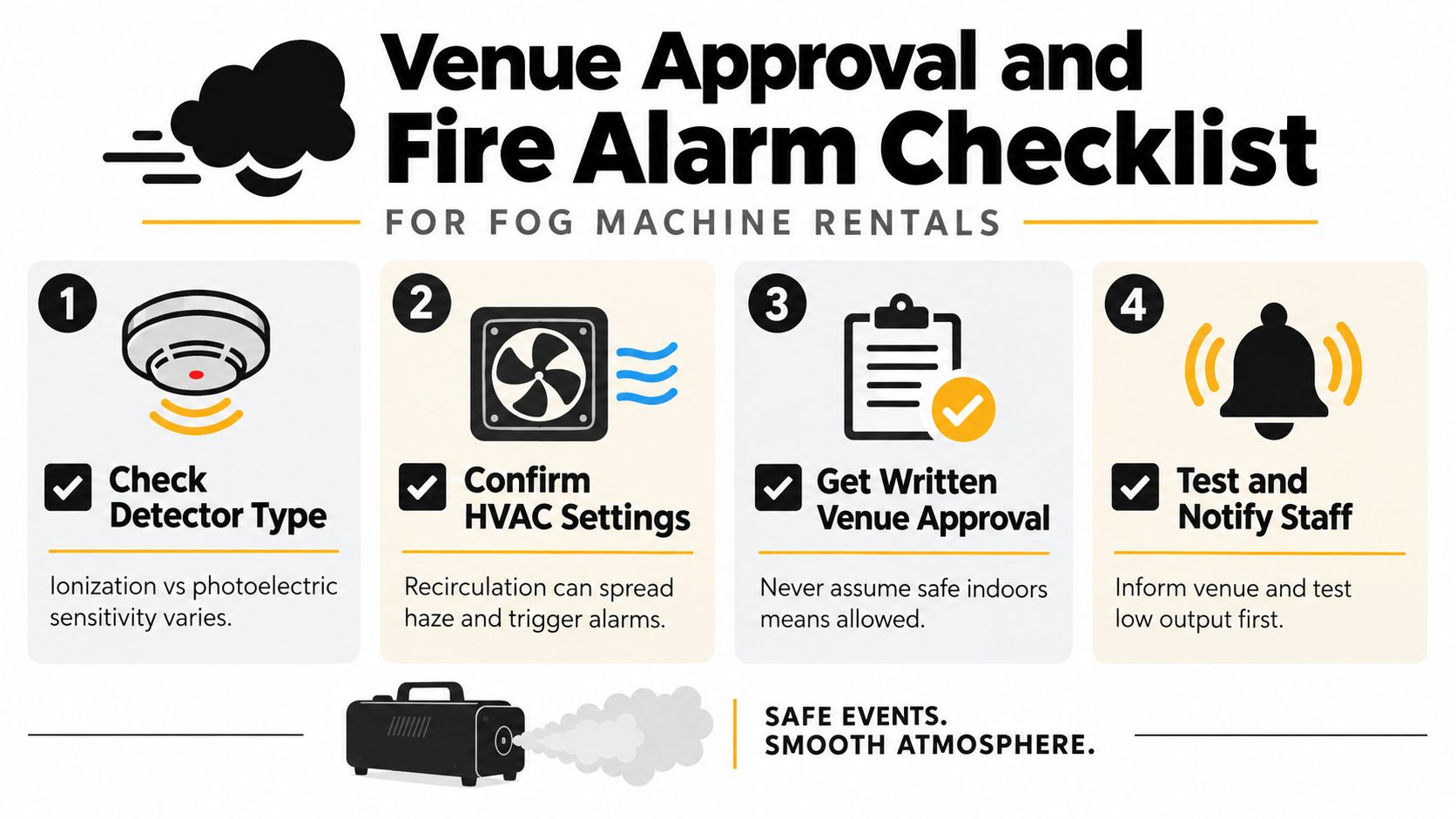
Smoke detectors do not all respond alike. Fog can cross a room, enter return-air paths, and travel beyond the intended performance area. Recirculating HVAC may distribute the atmosphere, while detectors above a stage, near an entrance, or along an air path can turn a visual cue into an avoidable alarm.
Use a written approval workflow
Start with the event manager, facilities department, fire-safety contact, or designated production representative. Ask who can approve atmospheric effects, then send that person a clear operating plan. Treat the approval like a route map: it should show what the effect is, where it will go, and how staff will respond if conditions change.
Your request should identify:
- Effect type: State whether you want dense fog, haze, or low-lying fog.
- Fluid information: Include the product name and manufacturer documentation supplied by the rental company.
- Operating plan: Explain whether the effect will use short bursts, scene-based cues, or ongoing low output.
- Equipment location: Mark the machine on a floor plan, including nearby detectors, exits, and HVAC intakes.
- Testing request: Ask whether the venue requires a pre-event test, staff notification, or inspection before guests arrive.
- Documentation: Confirm whether the venue needs an insurance certificate, operating paperwork, or safety forms.
The IATSE fog safety guidance emphasizes mechanical ventilation and warns against accumulation that obscures exits or causes respiratory distress. Approval therefore belongs in the booking process, not as a last-minute checkbox.
Position and test with venue staff
Keep the machine away from detectors, HVAC returns, exits, and pedestrian paths. Protect cables with approved covers or route them where guests will not cross them. Facilities staff can explain which systems are active, whether ventilation settings change during the event, and what procedure applies if an alarm activates.
Test before doors open, with venue staff informed and present. Use a controlled first release, then watch how the atmosphere travels through the actual room. Airflow can differ from the floor plan, especially after doors open or the HVAC schedule changes. For schools, hotels, and corporate campuses, record the approval, machine position, responsible operator, and test plan so the planner, rental company, and building team share the same instructions. A safety documentation guide for event production can help organize those records.
Ventilation Health and Comfort Guidance for Guests
A fog effect that looks soft from the stage can feel thick and irritating near the machine. Guest comfort depends on particle concentration, exposure time, room size, and air exchange. A crowded reception room with weak airflow needs a lighter plan than a ventilated theater where an operator can follow clear lighting cues.
The exact response varies by room and by guest. That uncertainty is why venue approval should include an airflow discussion before you book the equipment. Ask facilities staff how outdoor air enters the room, where supply vents and returns are located, and whether the building's settings change during the event. Guidance on ventilation maintenance strategies for facilities can provide useful background on outdoor-air exchange, filtration, and supply and return pathways.
Protect comfort through operating choices
Short bursts are easier to control than continuous output. Release the effect for a cue, pause, and watch where it travels before setting the next cue. Air can carry fog toward a seating area, linger beneath a low ceiling, or collect near a return vent. A small room with weak airflow may become visually dense before the operator notices from the stage.
For a family event, school program, or corporate networking reception, choose lighter haze or lower output when a dramatic cloud is unnecessary. Ask whether the venue can increase outdoor-air exchange through its normal systems. Opening a door may create uneven airflow, temperature problems, or security concerns.
- Check the audience: Ask whether children, older adults, or guests with asthma and other respiratory sensitivities will attend.
- Limit exposure: Tie the effect to specific moments instead of running it throughout the program.
- Watch visibility: Reduce or stop output if guests cannot comfortably see exits, stairs, signage, or one another.
- Use approved fluid: Do not substitute liquid, since the machine's heater and aerosol behavior depend on the fluid formulation.
- Coordinate with facilities: Confirm that HVAC and exhaust settings match the operating plan.

A facility manager may need to review the building's air-handling condition before the event. Good maintenance supports more predictable airflow, though it does not replace event-specific approval. Record the agreed output, timing, ventilation setting, and response plan so the venue team and operator can act consistently if guests report discomfort.
Power Placement and Rental Planning Tips
A ballroom may look ready for a fog effect until the machine, cables, and guests compete for the same floor space. Treat power and placement as one rental decision. Ask the venue which circuit can support the unit, what other equipment shares it, and whether the machine needs a dedicated connection. Have the rental technician confirm the plan before delivery.
Avoid daisy-chaining power strips or placing extension connections under carpets where staff cannot inspect them. Route cables along protected edges, add suitable cable covers where guests cross, and keep connections away from fluid containers and wet-cleaning areas. Confirm the nearest outlet before the stage is built.
Build the order around the room
Give the provider a floor plan or simple sketch showing:
- Stage and lighting positions: Place the machine where the haze or fog can meet the beams, rather than behind a curtain.
- Guest movement: Keep equipment clear of entrances, queues, dance-floor traffic, and accessible routes.
- HVAC locations: Mark supply vents and returns so the operator can anticipate airflow.
- Exit paths: Keep the machine, fluid, and cables from narrowing or blocking an exit.
- Control position: Put the operator where they can see the effect and communicate with the lighting or production team.
Ask about warm-up time, reheating between cues, and fluid handling during the program. Output and consumption vary by model and setting, so the provider should calculate fluid needs from the actual schedule instead of guessing from tank size.
A well-planned rental may include delivery, setup, operation, teardown, insurance documentation, and venue coordination. Phantom Entertainment is one option for planners seeking fog equipment with professional setup and operation. Its event setup and teardown guidance can help organize removal after a school, corporate, or community program.
Record the agreed circuit, placement, cable route, cue schedule, and responsible operator. That written plan gives venue staff a clear reference if the room layout changes before guests arrive.
Choosing the Right Fog Effect for Your Event
Return to the ballroom with flat lighting. If the goal is to reveal moving beams without changing the room's appearance, choose a light haze and coordinate its release with the lighting operator. If the opening moment needs a visible cloud around a performer or prop, a dense fogger may fit, provided the venue approves the plan and the operator can control the output.
For a first dance, stage entrance, or dance-floor image, ask about low-lying fog. It creates a floor-level layer rather than filling the room, but the venue still needs to confirm that airflow, flooring, guest movement, and visibility are suitable. For a school, family event, or networking reception, a lower-output effect may be more appropriate than a dramatic blast, especially when guests may include people sensitive to airborne irritants.
Use this decision sequence when speaking with a rental provider:
- Name the visual goal. Do you want visible beams, a dramatic reveal, a floor-level cloud, or a brief theatrical cue?
- Describe the venue. Share room dimensions, ceiling height, detector locations, HVAC behavior, exits, and available power.
- Describe the audience. Mention children, families, older guests, or anyone who may be sensitive to atmospheric effects.
- Confirm permission. Get written approval, identify the venue contact, and schedule a controlled test when required.
- Define operation. Agree on placement, cue timing, fluid, ventilation, staff notification, and shutdown procedures.
The best fog machines rentals decision is the one that survives the venue walkthrough. Once the effect, audience, airflow, approval, and operating plan align, the equipment becomes a reliable production tool rather than a last-minute gamble.
Phantom Entertainment can help planners coordinate fog-machine effects with delivery, setup, professional operation, and venue-ready documentation for events across the Mid-Atlantic. Share your venue details, audience, lighting goal, and approval requirements, then visit Phantom Entertainment to discuss a fog rental plan built around safe placement and controlled atmosphere.
Ready to Book Your Event?
PA state-inspected, fully insured since 1979. Call us or get a free quote today.