
You've booked the venue, lined up the music, and promised guests an unforgettable afternoon. Then the foam starts spreading faster than expected, shoes disappear under the surface, and nobody is quite sure who's watching the exit. The party can still be a success, but only if the foam is treated as an active event environment rather than a decorative effect.
A well-run foam pit party depends on the format, the equipment, the venue, trained supervision, and a cleanup plan that's agreed before guests arrive. The most important decision comes first: are you creating a shallow foam dance floor, or operating a deep pit designed for jumping and landing?
Operating Realities of a Foam Pit Party
A foam event starts looking complicated the moment guests walk in. Music and photos pull attention to the surface, but the operator is watching different things entirely. Staff are tracking where the foam is drifting, whether exits stay clear, how wet the surrounding floor is getting, what power cables are exposed, and whether the venue surface underneath is still behaving as expected. That is the gap DIY setups usually miss. A shallow foam dance floor and a deep pit do not create the same operating conditions, and they should not be managed the same way.
Small misses stack up fast. I've seen a temporary barrier shifted a few feet, an attendant pulled into answering guest questions, and a dropped phone disappear under fresh foam before anyone stopped the lane to check the area. The equipment was still working. The problem was control. Good rental crews handle this with staffing positions, entry pacing, surface checks, and clear stop points before the setup gets away from them.

Foam parties also have more history behind them than many organizers expect. The documented history of foam parties traces the nightclub format through Ibiza in the early 1990s, while an earlier entertainment use of suds appeared in the 1932 short film “A Rhapsody in Black and Blue,” featuring Louis Armstrong. At Amnesia, the Ibiza club that opened in 1976, early events used basic fire hoses before dedicated foam equipment made output more repeatable and easier to control. That matters because the format has always depended on operations as much as spectacle.
Practical rule: Foam changes the environment. Run it like an active attraction.
The risk level rises further when a party uses a deep enclosure for jumping or diving. Foam can hide hard edges, loose objects, uneven fill, and other guests, and that is why inspection and supervision standards tighten fast once the setup goes beyond a shallow dance layer. The biomechanics study on foam-pit entries found that at least one cervical-spine injury threshold was exceeded in every tested pit condition. The authors pointed to pit design and adequate foam depth working together, instead of assuming foam alone makes entry safe.
Foam Pit vs Foam Dance Party
The names are often used interchangeably, but the experiences are different. A foam pit is a contained, deeper area intended for jumping or landing. A foam dance party is generally a shallow, ground-level space where guests move through foam while standing or dancing.
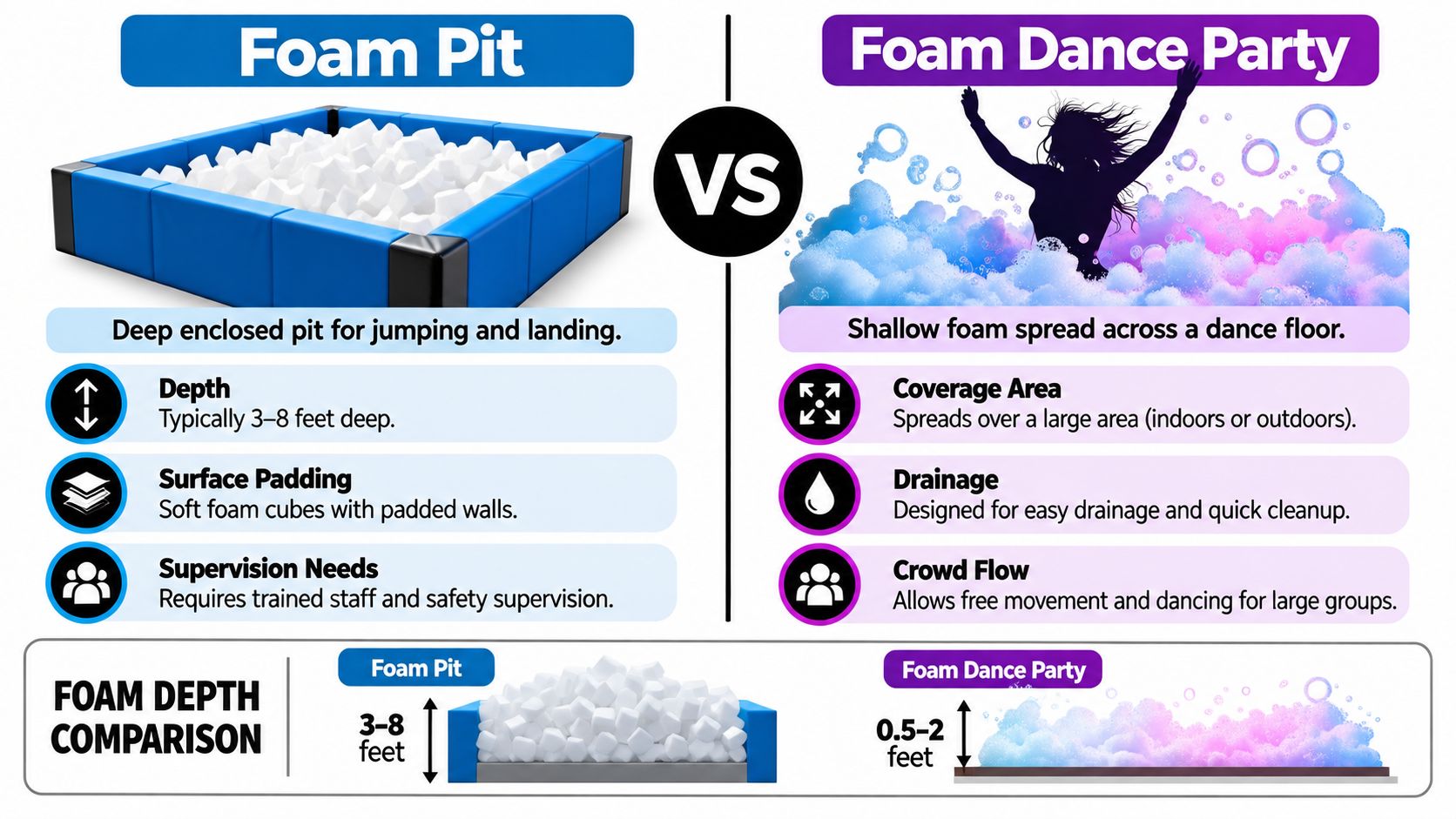
The choice should follow the audience and venue, not the event title. For a school field day, company picnic, community festival, or family celebration, a shallow foam dance area usually creates simpler crowd flow and easier exits. A deep jumping pit demands tighter control of entry behavior, participant ability, supervision, extraction, and signage.
| Feature | Foam Pit | Foam Dance Party |
|---|---|---|
| Primary activity | Jumping and landing inside a contained area | Dancing and moving through shallow foam |
| Surface | Padded enclosure with a defined landing zone | Ground-level wet surface or inflatable floor |
| Main control issue | Preventing head-first entry, collisions, and difficult exits | Managing slipping, visibility, crowd density, and drainage |
| Guest flow | One-at-a-time or tightly controlled access may be appropriate | Timed sessions and supervised entry help maintain space |
| Best planning question | How will guests enter, land, and get out? | How will guests remain visible and exit safely? |
A temporary foam dance floor shouldn't be presented as a trampoline-style pit. ASTM F2970-20 addresses containment, dimensions, depth, and signage for trampoline-court foam pits, including warnings about diving or head-first entry. Those specifications don't automatically make every temporary event setup equivalent. Organizers should ask the rental company to identify the attraction clearly and explain its operating rules.
For a more detailed look at the ground-level format, review this guide to foam dance parties. The practical decision is straightforward: choose shallow foam when accessibility, broad participation, and simple crowd movement matter most, and choose a true pit only when the equipment and operating plan are designed for jumping.
Selecting Venue and Equipment
Start with the site, not the foam machine. Confirm the usable footprint, overhead clearance, access for delivery vehicles, floor loading limitations, drainage, power placement, and a dry route for guests who leave the attraction. Grass, concrete, athletic surfaces, warehouse floors, and marquees each create different anchoring and cleanup requirements.
Evaluate the attraction before booking
Ask the rental company for equipment specifications, installation instructions, inspection records, insurance documentation, and the manufacturer's weather limits. A professional provider should explain how the unit is anchored, what protective ground cover is required, where barriers go, and who remains responsible for monitoring the attraction during operation.
If the event is outdoors, a marquee may solve weather and surface problems, but it introduces its own questions about flooring, ventilation, water management, and access. Organizers comparing covered options can use this resource on how to hire a marquee in London to understand the planning information a marquee supplier should provide.
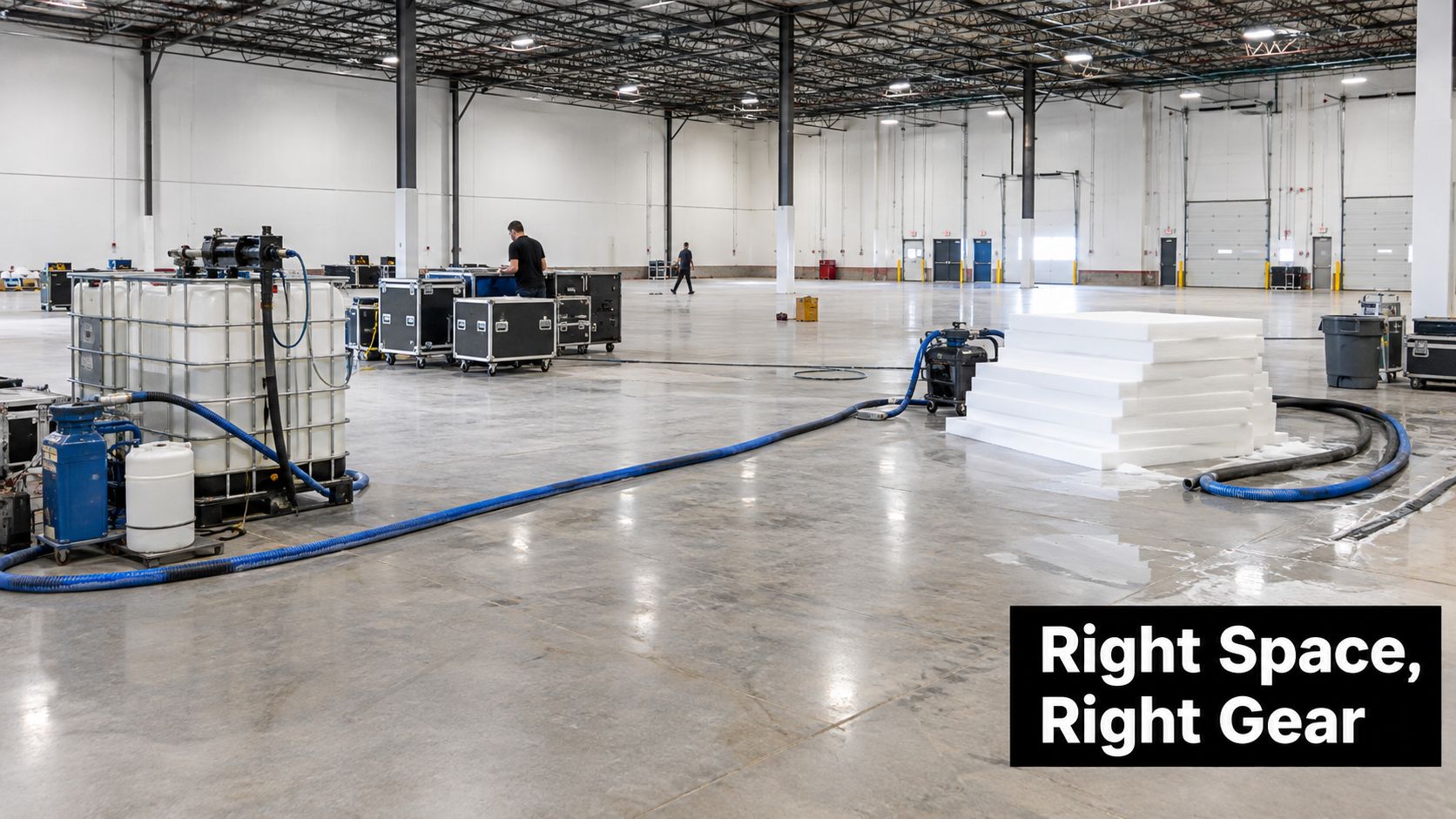
A quote that includes delivery only may leave you with the hardest work. Confirm whether the crew will install, anchor, test, supervise, drain, clean, dry, and remove the equipment. Setup and teardown are part of the safety plan, not optional conveniences.
Use this booking checklist:
- Venue fit: Measure the operating area and keep clear space around entrances, exits, equipment, and spectators.
- Surface protection: Confirm whether a tarp, mat, liner, or other ground cover is required.
- Power and water: Identify protected power locations and confirm the equipment's water requirements with the supplier.
- Access and inclusion: Plan an accessible route to the viewing area and ask how guests with mobility limitations can enter or enjoy the attraction.
- Documentation: Request certificates of insurance, manufacturer instructions, inspection records, and emergency contacts.
- Service scope: Confirm who controls the machine, manages guest access, handles incidents, and restores the venue.
The same discipline applies when you're considering other inflatable attractions. A practical overview of inflatable party rentals can help you compare space, supervision, and setup requirements before adding more equipment to the site.
Safety and Liability Protocols
A foam attraction needs a named operator. That person shouldn't also be responsible for music, registration, food service, or general guest questions. The attendant controls access, watches behavior, pauses the machine when visibility or safety deteriorates, and stops play after a fall, injury, illness, or equipment concern.
Before opening, complete and document a pre-opening inspection. ASTM F2374 covers installation, operation, maintenance, inspection, training, and auditing for commercial inflatable amusement devices. Its guidance also addresses anchoring, protective ground covers, barriers, and manufacturer-specified wind limits. ASTM F2374 guidance provides a sound framework for evaluating what the rental company should handle.
Build the operating plan around control points
The inspection should cover the unit, seams, anchoring, surrounding surface, drainage, barriers, power connections, foam equipment, and access paths. Confirm that prohibited items are removed, including shoes where the operator requires bare or suitably covered feet, sharp objects, jewelry, and anything that could damage the attraction or injure another guest.
Post rules where guests can see them, then repeat the critical points verbally:
- No diving or head-first entry: This applies especially to any deep pit or jumping area.
- One activity at a time: Don't combine jumping, running, throwing objects, and unrelated games in a confined space.
- Respect the boundary: Spectators stay outside the wet operating perimeter unless the attendant authorizes entry.
- Use the exit route: Guests should leave promptly when their session ends and must not obstruct the access point.
- Follow the attendant: The operator's stop signal takes priority over the music or event schedule.
Crowd density deserves its own decision. Timed sessions, controlled entry, and visible boundaries work better than asking guests to self-regulate once the foam becomes deep or visibility drops. For a corporate or school event, the organizer should also identify who can contact emergency services, where first aid is located, and how the machine will be shut down.
A waiver supports the plan, but it doesn't replace supervision, inspection, or a controlled environment.
Insurance requirements vary by venue and jurisdiction, so confirm them with the site owner and rental provider before signing the contract. This event liability insurance guide can help organizers identify questions about coverage, certificates, and waivers. Local rules may add specific obligations. Oklahoma, for example, requires written daily pre-operation inspections, an emergency action plan addressing accidents, severe weather, and guest illness, and trained operators.
Setup, Teardown, and Cleanup
Professional setup begins before the first guest arrives. The crew should inspect the area, remove debris, place specified protective cover, position the attraction, anchor it according to the manufacturer's instructions, and check the space around it. The foam machine, hoses, power connections, and drainage route should be tested before the attraction opens.
Keep spectators away while equipment is being installed. A unit can look ready while still needing anchoring, inflation checks, boundary placement, or an assessment of the surrounding surface. The pre-opening record should identify who inspected the equipment, what was checked, and whether any corrective action was required.
Treat cleanup as part of the rental
Foam solution should be used exactly as the product and equipment manufacturers specify. Ask for the concentrate's safety data sheet, confirm suitability for the intended audience, and find out how the venue wants residual foam and wash water handled.
Philadelphia's wastewater pretreatment guidance notes that foam can reduce wastewater-treatment efficiency and effluent quality, and technical guidance advises against sending used foam into stormwater systems without checking local requirements. Philadelphia wastewater pretreatment guidance makes environmental compliance a venue-management issue, not merely a question of whether a product is labeled biodegradable.
A responsible teardown includes:
- Pause and isolate: Stop the machine, close access, and keep guests away from the affected area.
- Remove visible debris: Collect objects, trash, and contaminated material before draining or wiping.
- Control discharge: Use an approved sanitary drain or collection method confirmed with the venue and municipality.
- Clean and dry: Remove residual foam, inspect seams and high-contact surfaces, and dry the inflatable before storage.
- Record the condition: Note damage, contamination, incidents, drainage issues, and any follow-up required.
Grass, parking areas, athletic fields, and spaces near streams need different runoff plans. Don't assume that water disappearing from view means the site is restored. For broader post-event cleaning considerations, these house cleaning articles offer useful context for coordinating venue restoration after a busy gathering.
Troubleshooting and Pro Tips
Foam rarely behaves exactly as guests expect. Wind can move it outdoors, a low area can collect water, and a crowded dance floor can become difficult to monitor. The operator should adjust output, pause sessions, and protect the exit rather than trying to maintain a visual effect at all costs.
Solve problems at the source
- Foam is spreading too far: Reduce output, redirect the machine, and keep spectators behind the boundary. Don't wait until walkways become slippery.
- Guests can't see their feet: Pause the effect or thin the foam so the operator can verify movement and exits.
- The floor feels excessively slippery: Stop access, inspect the surface, remove contamination, and restart only after the attendant confirms it's suitable.
- Guests crowd the entrance: Use timed sessions and a waiting line outside the wet zone. A visible attendant should control the release of each group.
- Music masks instructions: Give the operator a clear shutdown signal and make sure the DJ can lower the volume immediately.
- Weather changes: Follow the manufacturer's wind and weather limits. Move guests to a safe area before conditions become an emergency.
Lighting should improve visibility, not make the foam look thicker than it is. Use music with clear transitions between sessions so the operator can brief guests and reset the area without shouting over continuous sound.
Conclusion and Final Considerations
A foam pit party succeeds when the organizer chooses the right format and then operates it deliberately. A shallow foam dance area and a deep jumping pit aren't interchangeable attractions, and the difference affects equipment, supervision, accessibility, signage, crowd control, emergency procedures, and cleanup.
The strongest plans answer practical questions before contracts are signed. What exactly are guests entering? How deep is the foam? Who controls access? Where do people exit? What happens after a fall, illness, equipment fault, or weather change? How will the venue handle foam, water, residue, and drainage?
Professional support reduces uncertainty because the provider can manage delivery, installation, anchoring, inspection, operation, and teardown as one coordinated process. It also gives schools, universities, companies, municipalities, and family hosts a clearer record of what was checked and who was responsible.
The memorable part should be the energy of the event, not the scramble to solve preventable problems.
Choose a venue that can support the attraction, select equipment that matches the audience, keep a trained attendant at the foam zone, and document the opening and closing condition. Those habits preserve the fun while giving guests a controlled environment in which to enjoy it.
Phantom Entertainment provides foam dance party rentals with inflatable foam areas, foam generators, and optional DJ, lighting, and sound services, with professional delivery and operation available for events across the Mid-Atlantic. Review the available options and request planning support from Phantom Entertainment before you finalize your venue, guest rules, and cleanup plan.
Ready to Book Your Event?
PA state-inspected, fully insured since 1979. Call us or get a free quote today.