

You're staring at a vendor list, a fixed event budget, and a face-painting quote that says little more than “artist included.” The school field day, company picnic, or community festival needs an attraction that feels memorable, but you also need to know what goes on children's skin, how quickly guests will move through the station, and whether the vendor can produce the paperwork your venue requires.
That's the core decision behind face painting rentals. Designs matter, but they're only one part of a professional service. A reliable provider should also explain product controls, staffing, queue management, sanitation, sensory accommodations, weather planning, and cancellation terms before you sign.
Why Face Painting Rentals Belong on the Planning Checklist
Face painting has become a scheduled event service rather than an informal party extra. Schools use it at field days and fundraisers. HR teams add it to family days. Universities, municipalities, churches, and community groups use it to create a low-barrier activity that works across ages and fits naturally into an event zone.
The appeal is practical. Guests can participate without special skills, the activity creates a visible moment for photos, and the station gives attendees another reason to stay engaged between larger attractions. Face painting also pairs well with lower-energy activities, where guests can sit, watch, and rotate through without competing with a loud headliner.
The National Endowment for the Arts reports that U.S. households spent an average of $257 on arts and cultural fees and admissions in 2023. That benchmark covers many activities, not face painting specifically, so it isn't a rental-price guide. It does support a broader planning view: face painting belongs inside an overall entertainment and cultural-experience budget, alongside attractions, performers, and admission-driven programming. The NEA's household spending report makes that distinction clear.
Start with the operating decision
You have two immediate choices:
- Hire an artist-led service. The vendor supplies trained labor, products, equipment, sanitation procedures, and station management.
- Buy a kit and run it yourself. Volunteers or staff handle designs, product application, cleanup, and guest questions.
A third option, a hybrid service, can work when the host wants more control but still needs professional oversight. The rental company supplies a curated kit and trained operator, while the organizer manages scheduling or provides additional volunteers.
Treat face painting like any other staffed attraction. Ask who is responsible for setup, product documentation, queue control, cleanup, guest refusal, and incidents involving sensitive skin. If a vendor can only show you a design gallery, you haven't finished evaluating the service.
Planning rule: Book the operator and the operating process, not just the paint.
Hiring an Artist or Buying a DIY Kit
DIY face painting looks inexpensive because the kit sits on a table while volunteers provide the labor. That calculation changes quickly when a volunteer has to manage an unfamiliar product, answer an allergy question, sanitize tools, improvise designs, and keep a line moving.
A professional artist costs more than a box of supplies, but the vendor carries the operational burden. That matters at a school or corporate event, where the host's staff already have responsibilities for registration, food, supervision, accessibility, and emergency procedures.
Compare the three models
| Model | Best For | Throughput | Liability Burden | Typical Cost Range |
|---|---|---|---|---|
| Artist service | Schools, corporate events, festivals, universities | Managed by trained staff and design menu | Primarily handled through vendor documentation and contract terms | Varies by artist count, event duration, travel, and package |
| DIY kit | Small family gatherings with informal expectations | Depends on volunteer skill and queue discipline | Host carries product, sanitation, and application risk | Kit purchase plus staff or volunteer time |
| Hybrid | Hosts wanting a curated setup with professional oversight | Better than unsupervised DIY, but depends on staffing plan | Shared responsibilities must be written clearly | Varies by kit, operator, training, and event scope |
The artist-led model wins for high-attendance events because it separates guest service from host administration. A professional can keep designs consistent, explain what can and can't be applied, recognize when a guest should decline, and adjust the menu when the queue grows.
DIY makes sense for a small birthday where guests know one another and the organizer accepts a slower, less polished experience. It's a poor fit when a school has a long activity window, a corporate event has mixed ages, or a municipality needs documentation for risk management.
The hybrid model deserves careful scrutiny. Ask whether the operator is trained by the vendor, who owns the products, who handles sanitation, and whether the host is expected to provide additional applicators or cleaning supplies. A vague hybrid contract can leave the organizer with the disadvantages of both models.
For a broader look at how children's attractions can be combined into a coordinated package, review kids party entertainment packages. The same principle applies to institutional events: the package should define responsibilities, not merely list equipment.
Make the recommendation by event type
Choose professional artist service for schools, universities, corporate family days, festivals, and public events. Choose DIY only when the guest list is small, the host accepts slower service, and no formal venue or insurance process requires vendor documentation. Choose hybrid when you have a specific reason to control the menu or schedule, and the contract assigns every safety and staffing duty.
The cheapest purchase price isn't the same as the lowest event cost. If staff spend the day managing a line, cleaning tools, and resolving product questions, the DIY option has already consumed part of the event budget.
Pricing, Staffing, and Throughput Models
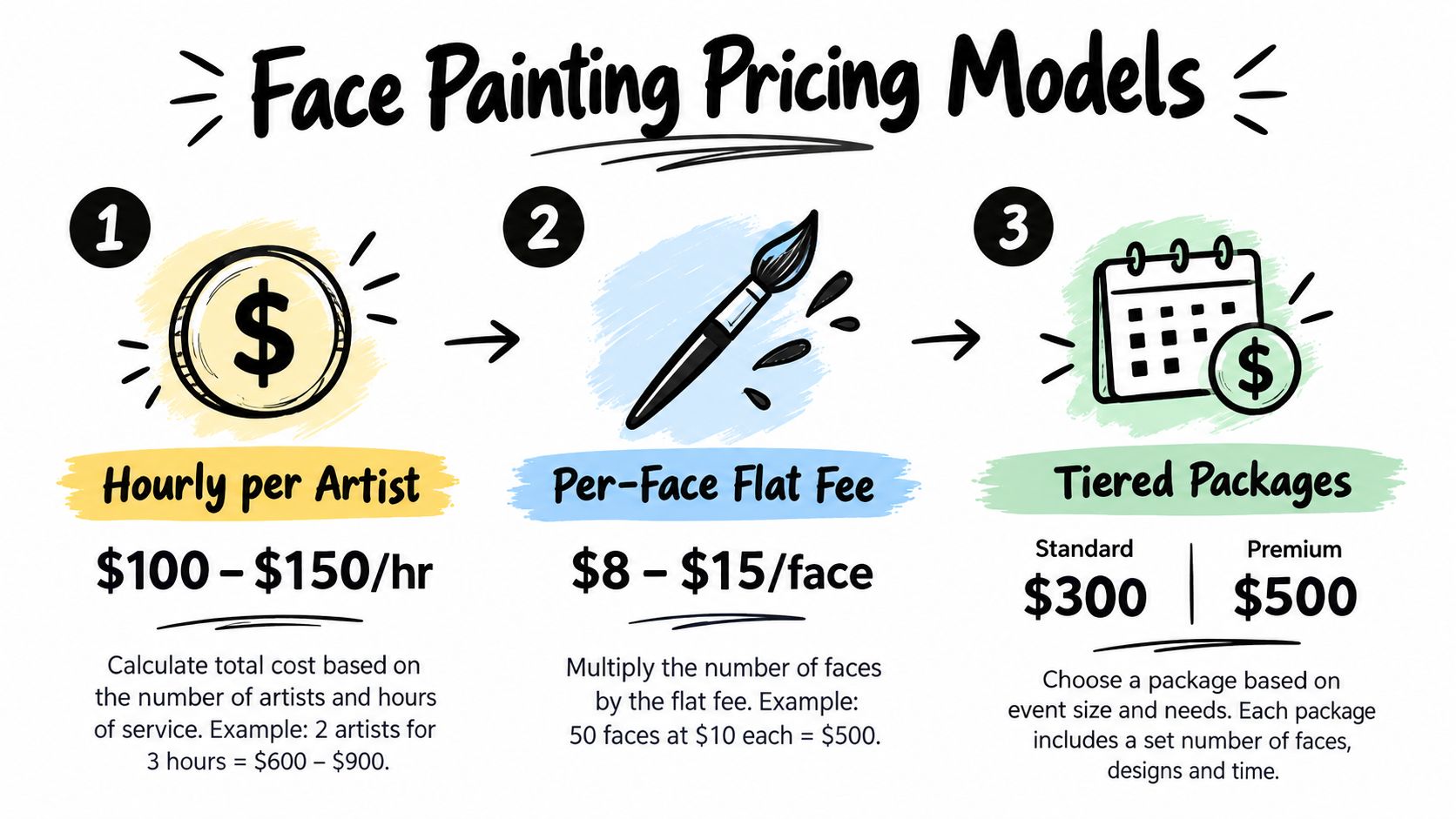
A face-painting quote should tell you how the vendor charges and how that structure affects the guest experience. The three common models are hourly per artist, per-face pricing, and bundled packages with adjacent attractions such as balloon artists or caricature booths.
Hourly pricing is easiest for schools and corporate planners. You reserve an artist for a defined service window, then agree on the design menu and staffing plan. The trade-off is that the final number of completed faces depends on design complexity, breaks, late arrivals, guest questions, and queue behavior.
Understand what each structure rewards
Per-face pricing can work for a controlled station where guests pay individually or where the host wants a defined service allowance. It creates a clear connection between use and cost, but it can encourage guests to request elaborate work that slows the line. Put design limits and eligible applications in writing.
Bundled packages work when face painting is one part of a larger activity plan. A balloon artist, photo activity, or caricature station can absorb guests who don't want paint or who are waiting for a preferred design. The package is valuable only if each attraction receives enough staffing and space.
Capacity is never just an artist-count issue. A simple cheek design, a forehead symbol, and a full-face character require different amounts of time. A queue with visual design cards moves faster than a queue where every guest negotiates from scratch. A station with shade, seating, and a clear exit works better than one placed beside a loud speaker or in a narrow walkway.
Budget from the station backward
Ask the vendor for a capacity estimate by design category, not one universal guest number. Request separate assumptions for express designs, standard cheek or forehead work, and more detailed designs. Then ask what happens when demand exceeds the estimate.
Use this planning sequence:
- Define the audience: Separate children, teens, adults, and guests who may want quick designs.
- Set the menu: Decide which designs are express, standard, or unavailable during peak periods.
- Choose the station count: Add artists when the event can't tolerate a long line, rather than assuming one artist can serve everyone.
- Design the queue: Provide a waiting area, menu cards, shade, and an obvious exit.
- Write the limit: State whether service ends at a scheduled time, after a set number of guests, or when the reserved labor period concludes.
Don't accept “we can paint everyone” as a capacity plan. Ask what designs, staffing, queue, and service window make that promise possible.
Safety, Hygiene, and Allergy Protocols That Matter
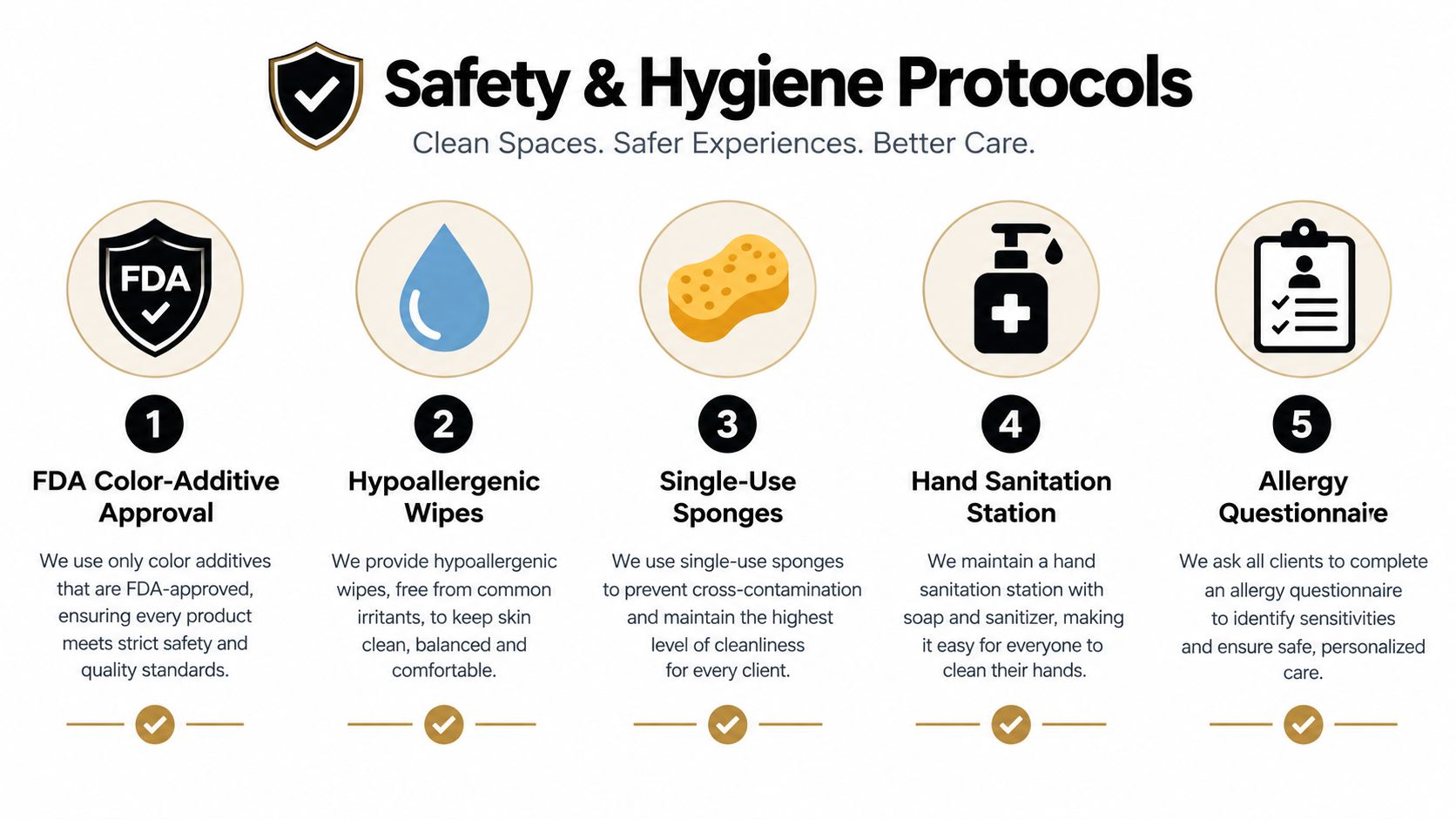
Face paint is applied directly to skin, often to children, so product selection is a safety control and a regulatory issue. In the United States, the FDA explains that cosmetic color additives must be approved for their specific intended use. A pigment approved for hair or fingernails isn't automatically suitable for facial skin, and a color permitted for general skin use may have restrictions around the eyes.
That distinction should change the vendor conversation. “Cosmetic grade” is not enough by itself. Ask for the manufacturer's ingredient information, permitted application areas, and any relevant batch or packaging documentation.
Safety concerns have a documented history. The FDA reported recalls in March 2005 and May 2009 involving some face-paint products linked to rashes, irritation, itching, or minor swelling. A 2009 Campaign for Safe Cosmetics investigation tested 10 face paints sold in the United States and detected lead in all 10 samples. The Environmental Working Group's summary also reported nickel, cobalt, and chromium in the tested samples, with arsenic detected in nine of the 10. These findings don't prove that every face paint is unsafe or evaluate every rental provider. They do explain why a responsible operator needs a documented product policy. The Environmental Working Group's safety guidance provides the relevant history.
Request documentation before the event
A serious provider should be able to explain:
- Product selection: Brand names, ingredient labels, color-additive status, and permitted application areas.
- Application boundaries: No paint over irritated or broken skin, and no products used near the eyes or mouth unless specifically permitted for that area.
- Applicator control: Single-use sponges where appropriate, or a clearly documented cleaning and sanitation process for reusable tools.
- Allergen communication: Known ingredients, available latex- or fragrance-free options, and a process for guests with sensitive skin.
- Patch testing: A practical option for unfamiliar products or guests with a history of reactions.
The American Academy of Pediatrics guidance on children's face paints warns that face paints can expose children to substances including lead, mercury, asbestos, latex, nickel, and cobalt. It also notes that U.S. cosmetics generally don't require premarket FDA approval, while color additives do. That's why the operator's product documentation matters.
Don't rely on “hypoallergenic” or “non-toxic” as a complete answer. “Hypoallergenic” has no standardized legal definition, and a product using that term can still contain an allergen. Build your venue file around specific ingredients, use restrictions, sanitation steps, and guest choice.
A handwashing arrangement should also be visible and practical. If your venue lacks suitable facilities, coordinate the station with a portable hand-washing station for rent, or require the vendor to explain its alternative sanitation setup.
Queue Design, Scheduling, and Sensory Accommodations
A face-painting station fails when the queue becomes the event. The artist may be talented, but guests still need to know where to wait, how to choose a design, and whether they can leave without losing their place.
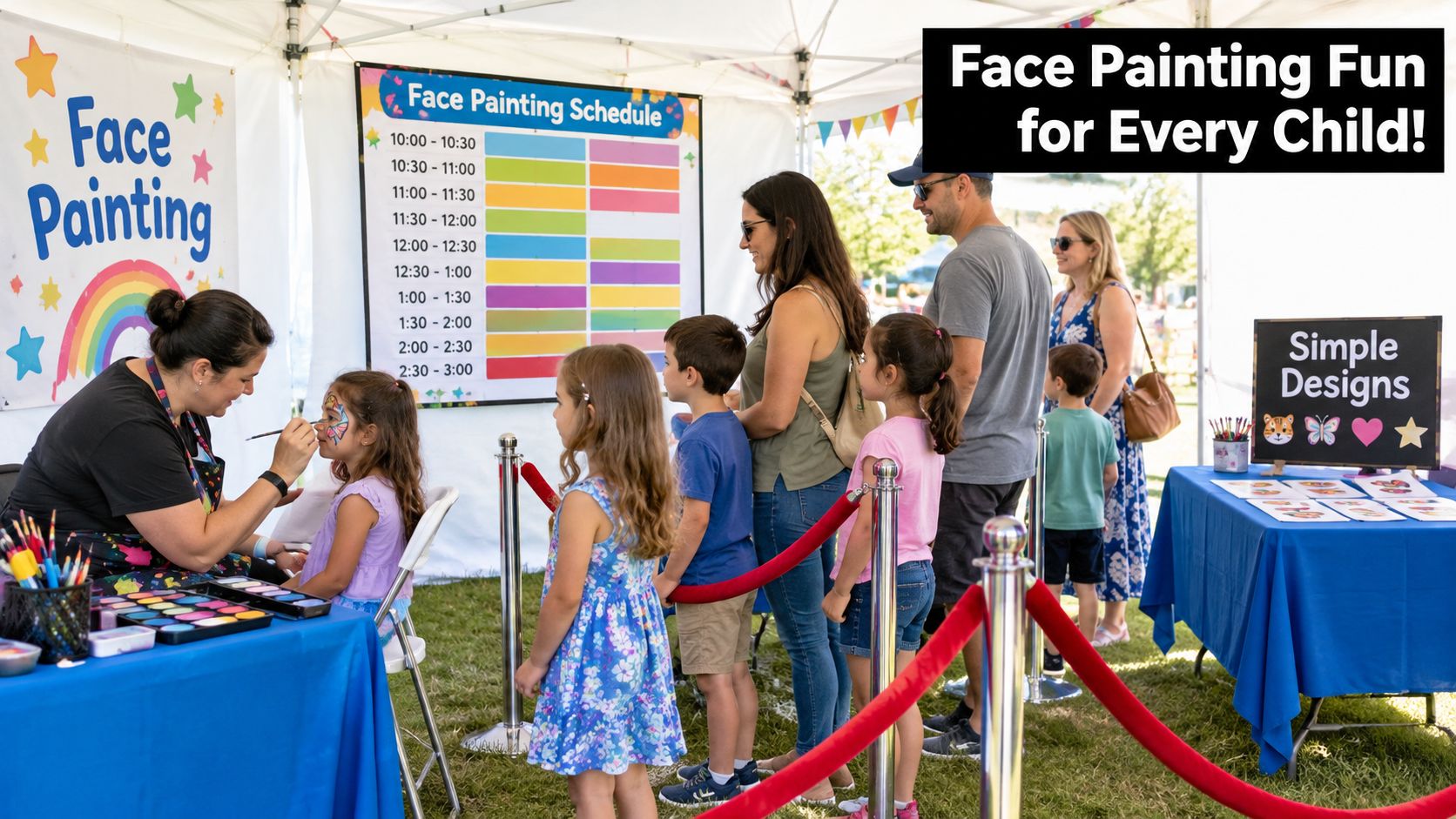
For a large school field day, use a visible menu with an express section. Guests who want a small cheek design shouldn't have to wait behind someone choosing a detailed full-face concept. For a smaller birthday, open-ended choices may be fine because the queue is part of the social activity.
Use three service modes
Standard is the default station. It offers a curated menu, clear design boundaries, and a normal waiting area.
Express uses small, repeatable designs that reduce decision time and application time. It's the right mode for field days, orientation events, and company picnics where participation matters more than intricate detail.
Sensory-considerate gives guests more control. Offer visual design cards, hand or cheek alternatives, fragrance-sensitive procedures where available, a quiet waiting space, and permission to stop or decline without pressure.
Accessibility belongs in the service specification. A recent autism-focused festival advertised nine sensory-friendly zones, illustrating how event organizers increasingly use dedicated low-stimulation areas and controlled environments. The festival's sensory-friendly information supports a practical conclusion for face-painting bookings: accommodations need a location, a process, and assigned responsibility.
Place the station away from speakers, food smells, and high-traffic crossings. Schedule timed slots when the audience is large or includes guests who may struggle with unpredictable waiting. Use simple visual cards for non-readers and guests who prefer to point rather than explain.
The central trade-off is straightforward. More elaborate designs create impressive individual results, but they reduce participation when the queue grows. A shorter design menu often produces a better event because more guests can take part without spending the entire program in line.
What Schools, Corporates, and Families Should Request Before Booking
Give the vendor a short written brief and require written answers. A phone conversation is useful, but it won't protect the organizer when the event team changes or the artist arrives with different assumptions.
Schools and universities
Request a certificate of insurance, product and ingredient information, an allergen policy, sanitation procedures, and a record or log format for cleaning practices. Confirm who handles parental questions, whether the artist can offer no-touch alternatives, and what happens when a student arrives with irritated skin.
Universities should also clarify whether the service is for a fixed audience, an open campus event, or a scheduled student-activities program. Those formats need different queue controls and staffing plans.
Corporate HR teams
Ask for staffing recommendations based on design type, not merely guest count. Confirm outdoor shade, weather relocation, power or table requirements, breaks, and the process for handling employees' children with sensitivities or sensory needs.
Require a capacity estimate that states its assumptions. If the vendor won't explain how the estimate changes between express and detailed designs, the number isn't useful.
Families and community hosts
Families need plain-language deposit, cancellation, travel, arrival, and overtime terms. Ask whether the vendor supplies the table, chair, shade, lighting, cleanup materials, and design menu, or whether the host must provide them.
A contract should address weather cancellation, force majeure, and substitution of an artist with equivalent training. A replacement artist shouldn't be an unqualified stand-in, and an outdoor event shouldn't leave both parties guessing after rain or extreme heat.
Walk away when the vendor:
- Promises universal capacity: No artist can guarantee the same output under every design menu and queue.
- Avoids product questions: Refusal to identify products is a serious warning.
- Won't provide a COI when required: Schools, campuses, and municipalities often need venue-ready documentation.
- Dismisses accommodations: A provider who treats sensory needs as an inconvenience won't manage them well.
- Uses vague cancellation language: If the weather and deposit rules aren't clear before payment, they won't become clearer later.
Booking Face Painting With Other Event Rentals
Face painting works best as part of a deliberately sequenced event plan. Place it near seating, shade, photo activities, or concessions, not directly beside the loudest attraction. Guests can rotate through a lower-energy station while others use bounce houses, carnival games, or the dance area.
Avoid scheduling the station against the headliner. If the DJ announces a major contest while guests are waiting for paint, the line will either disappear or become frustrated. Give the station its own active window and use a simple menu during the busiest period.
Before booking a package, answer four questions:
- Who operates each attraction?
- How will guests move between zones?
- What documentation does the venue require?
- What happens if weather, staffing, or attendance changes?
A bundled event should simplify compliance, not hide it. Ask for certificates of insurance, venue-ready safety documentation, and any inspection records required for larger attractions. For planning ideas that connect multiple services, review event entertainment services.
Questions Organizers Ask After Reading the Guide
How early should we book?
Book as soon as the date and venue are confirmed, especially for school calendars, graduation events, spring programs, and corporate family days. Popular dates narrow the artist and staffing choices first, so waiting usually forces a compromise on service model or design menu.
What happens if an outdoor event has bad weather?
Put the answer in the contract. Require a shade plan, a relocation option, or a clearly defined cancellation policy. Face paint and wet weather don't mix well, and artists shouldn't be expected to improvise under unsafe conditions.
How does face painting fit into a larger package?
Treat it as a timed station, not filler between headline attractions. Place it near other low-energy activities, give it enough seating and queue space, and prevent major announcements from competing with the line.
What deposit and cancellation terms are reasonable?
The vendor should state the deposit amount, payment deadline, cancellation window, weather policy, and substitution terms in plain language. Don't pay until those conditions are written and the vendor has answered your product, staffing, and documentation questions.
Phantom Entertainment can help build a turnkey event plan that combines professional entertainment, staffed attractions, venue-ready documentation, and practical guest-flow planning. For face painting rentals and coordinated school, corporate, university, or community events, visit Phantom Entertainment to discuss your date and requirements.
Ready to Book Your Event?
PA state-inspected, fully insured since 1979. Call us or get a free quote today.