
The strongest events are rarely saved by last-minute improvisation. They're built by assigning the right decision to the right point in the timeline, then connecting every handoff, from budget approval to vendor load-in, safety documents, guest flow, and post-event review. Modern event planning checklists increasingly work as milestone-based workflows, with major guidance starting as early as 16 weeks before the event for goals, team formation, venue selection, headliner confirmation, budgeting, operations, and volunteer briefings (SurveyMonkey's event planning checklist).
The ten steps below turn that approach into a practical event planning checklist for corporate picnics, school field days, community festivals, private parties, university events, and nonprofit gatherings. You'll move from purpose and spending controls through venue selection, vendors, attractions, transportation, promotion, operations, compliance, and evaluation. Each step includes timeline prompts, vendor questions, contingency reminders, and details you can transfer into a printable day-of run sheet.
1. Define Event Goals and Objectives
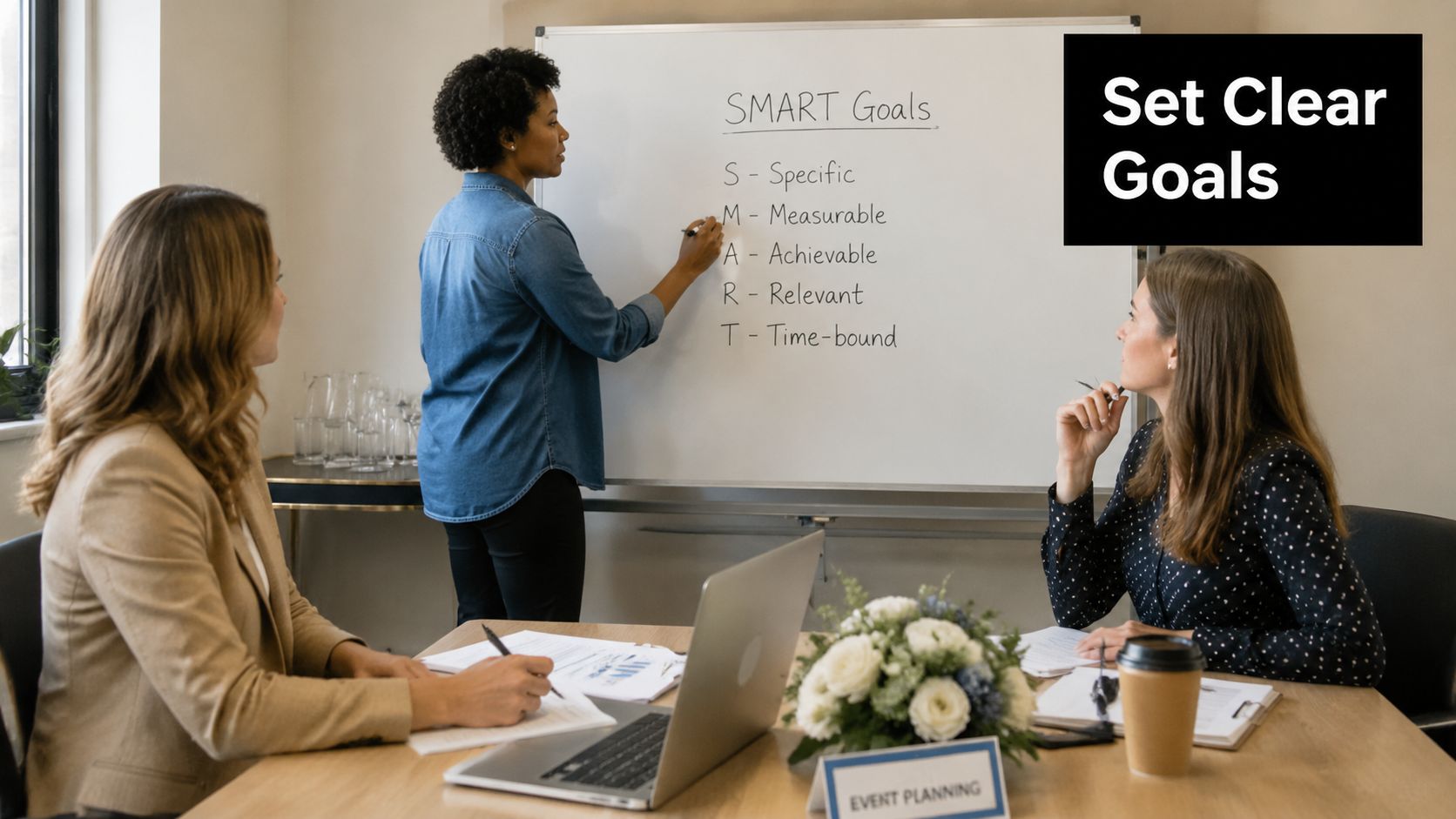
A clear event purpose prevents expensive decisions from pulling in different directions. A corporate family day may prioritize employee participation and informal connection. A school field day may focus on inclusive student involvement and safe movement between activities. A community festival may need to balance attendance, fundraising, local visibility, and an enjoyable experience for families.
Write the purpose in one sentence, then convert it into outcomes your team can measure. Use attendance, registration completion, participation by activity, satisfaction feedback, fundraising, lead generation, or stakeholder approval as appropriate. The point isn't to create a complicated scorecard. It's to give the venue, entertainment, marketing, and operations teams a shared definition of success.
Put decisions in writing
Bring the people who control budget, safety, communications, and attendee experience into the initial conversation. A planning committee can't make consistent choices if the event director wants a relaxed picnic while the finance lead expects a tightly controlled employee engagement program.
Record the following before requesting quotes:
- Primary purpose: Decide whether the event supports team building, celebration, fundraising, recruitment, orientation, outreach, or another defined outcome.
- Audience: Note ages, mobility needs, expected participation patterns, supervision requirements, and whether guests include employees, students, families, or the general public.
- Success measures: Choose a small set of meaningful indicators, such as attendance, activity participation, feedback quality, or funds raised.
- Experience priorities: Identify whether the event should feel competitive, social, educational, energetic, quiet, premium, or family-oriented.
- Decision owners: Name who approves the budget, signs contracts, confirms safety documentation, and makes weather or cancellation calls.
A family fun day, for example, may need attractions that appeal across age groups rather than a single high-intensity centerpiece. Phantom Entertainment can help match attraction packages to event types such as family fun days, school field days, and corporate picnics. Revisit the written objectives at every major planning checkpoint, especially before committing to vendors.
2. Establish Budget and Financial Planning
Budgeting should define what the event can deliver before supplier commitments are made. List fixed costs first, then flexible categories such as entertainment, catering, décor, staffing, marketing, transportation, insurance, permits, and contingency funds. Add expenses that often surface late, including cleaning, overtime, electrical support, security, deposits, cancellation terms, and replacement equipment.
Build three versions of the plan: a minimum option that protects the core objective, an optimal option that delivers the intended experience, and a premium option with added attractions or services. Stakeholders can then choose deliberately when quotes arrive, rather than forcing the team to remove items at random.
A useful test is whether the budget accounts for coordination, not only purchases. Separate providers may each handle delivery, setup, attraction operation, insurance paperwork, and breakdown, leaving your team to manage every handoff. A turnkey partner may carry a higher line-item cost while reducing internal coordination and event-day risk.
For each attraction quote, confirm the following before approval:
- Included services: Check delivery, setup, professional operation, breakdown, travel, and supervision.
- Equipment scope: Record attraction dimensions, power requirements, operating conditions, and included accessories.
- Documentation: Confirm certificates of insurance, inspection records, waivers, and venue requirements.
- Payment terms: Record deposits, balance dates, cancellation policies, weather provisions, and overtime charges.
- Package options: Ask whether combining attractions or services changes the total price.
Budget decisions also vary by event type. A school may need insurance and documentation reviewed alongside the attraction itself. A corporate picnic may benefit from one coordinated entertainment partner and fewer event-day contacts. Use Phantom Entertainment's pricing information to create the attraction line item, then confirm the final scope, setup responsibilities, operation plan, and compliance documents directly with the provider.
Keep quotes, actual spend, approval status, and outstanding commitments in a shared budget file. Review it at each major planning checkpoint and again before issuing the printable day-of run sheet, so staffing, vendor payments, and contingency decisions match the approved plan.
3. Select and Book Venue or Location
A venue sets the limits for safety, guest comfort, and event delivery. Judge each option against the actual program, not its appearance. Check accessible routes, restrooms, parking, electrical capacity, weather cover, clear ground, and vehicle access. A less distinctive site may work better if vendors can load in predictably and the event has a usable backup space.
Start the site review with a rough scaled layout or equipment map. Place entrances, exits, registration, food service, restrooms, first aid, quiet areas, parking, emergency access, vendor staging, queues, and attraction zones. For outdoor events, inspect drainage, ground conditions, overhead obstructions, anchoring points, shade, and the path from the delivery vehicle to the setup area.
Reserve the date only after the operating details are documented. Ask the venue manager to confirm:
- Access windows: arrival, unloading, setup, equipment testing, guest entry, breakdown, and departure times.
- Usable capacity: space for the layout, queues, staff positions, accessible routes, and emergency movement.
- Utilities: outlet locations, water, lighting, restrooms, and backup power.
- Restrictions: noise, stakes, generators, food service, signage, vehicles, and operating hours.
- Weather plan: available indoor or covered space and the deadline for a weather decision.
- Contract terms: cancellation, postponement, overtime, damage, cleaning, and insurance requirements.
Put these answers in the venue file and share them with the event lead and relevant attraction provider. The same assumptions should appear in the vendor schedule, safety documentation, and printable day-of run sheet.
Schools and municipalities may request venue-specific safety documents before approving equipment. Phantom Entertainment supplies venue-ready documentation and safety certifications for its attractions, which can help a venue, school, or institutional risk manager review the plan. Its service area includes Pennsylvania, Maryland, New York, Virginia, and West Virginia. Confirm availability for the actual event location before finalizing the venue or date.
4. Identify and Hire Key Service Providers
Reliable vendors protect the guest experience and the event schedule. Start with the services required for delivery: catering, entertainment, photography, audiovisual production, security, registration, first aid, transportation, waste removal, and event-day staffing. Mark the providers that must follow one operating plan, such as catering, attractions, venue operations, and security.
Require a written proposal from every shortlisted vendor. Check the scope, arrival and departure times, staffing, equipment, insurance, payment terms, cancellation policy, and escalation contact. A caterer should state service windows and power needs. A photographer should confirm arrival, coverage, image delivery, and consent expectations. An attraction provider should document setup conditions, operator duties, weather rules, and equipment requirements.
Reduce handoffs where they create risk
Phantom Entertainment can serve as a single-source attraction partner for inflatable bounce houses, obstacle courses, mechanical bulls, zip lines, rock walls, laser tag, arcade games, DJs, and karaoke. Its turnkey service may combine delivery, setup, operation, and insurance, reducing the attraction-related handoffs that staff must coordinate.
Consolidation still involves a trade-off. Multiple providers can offer more creative variety or different pricing. One attraction partner can simplify scheduling, setup communication, operating responsibilities, insurance records, and compliance documentation. Choose based on the event type, venue requirements, staffing capacity, and the number of vendors your team can actively manage.
Use these checks before signing:
- Relevant experience: Has the provider delivered a similar school, corporate, festival, church, or private event?
- Operational capacity: Can it supply staff and meet the required setup window?
- Documentation: Can it provide certificates of insurance, inspections, permits, and waivers?
- Communication: Who handles urgent questions before and during the event?
- Contingency: What happens if a staff member, vehicle, performer, or equipment becomes unavailable?
- Contract clarity: Are deliverables, dates, fees, cancellation terms, and responsibility boundaries written down?
Book providers that affect the critical path early. A planning framework from SurveyMonkey places major preparation, including team formation, venue and date selection, headliner confirmation, budgeting, operations, and volunteer briefing, 16 weeks before event day. Review Phantom Entertainment's DJ services with the entertainment scope, then record confirmed arrival times, contacts, insurance documents, and backup procedures in the vendor schedule and printable day-of run sheet.
5. Plan Attractions, Entertainment, and Activities
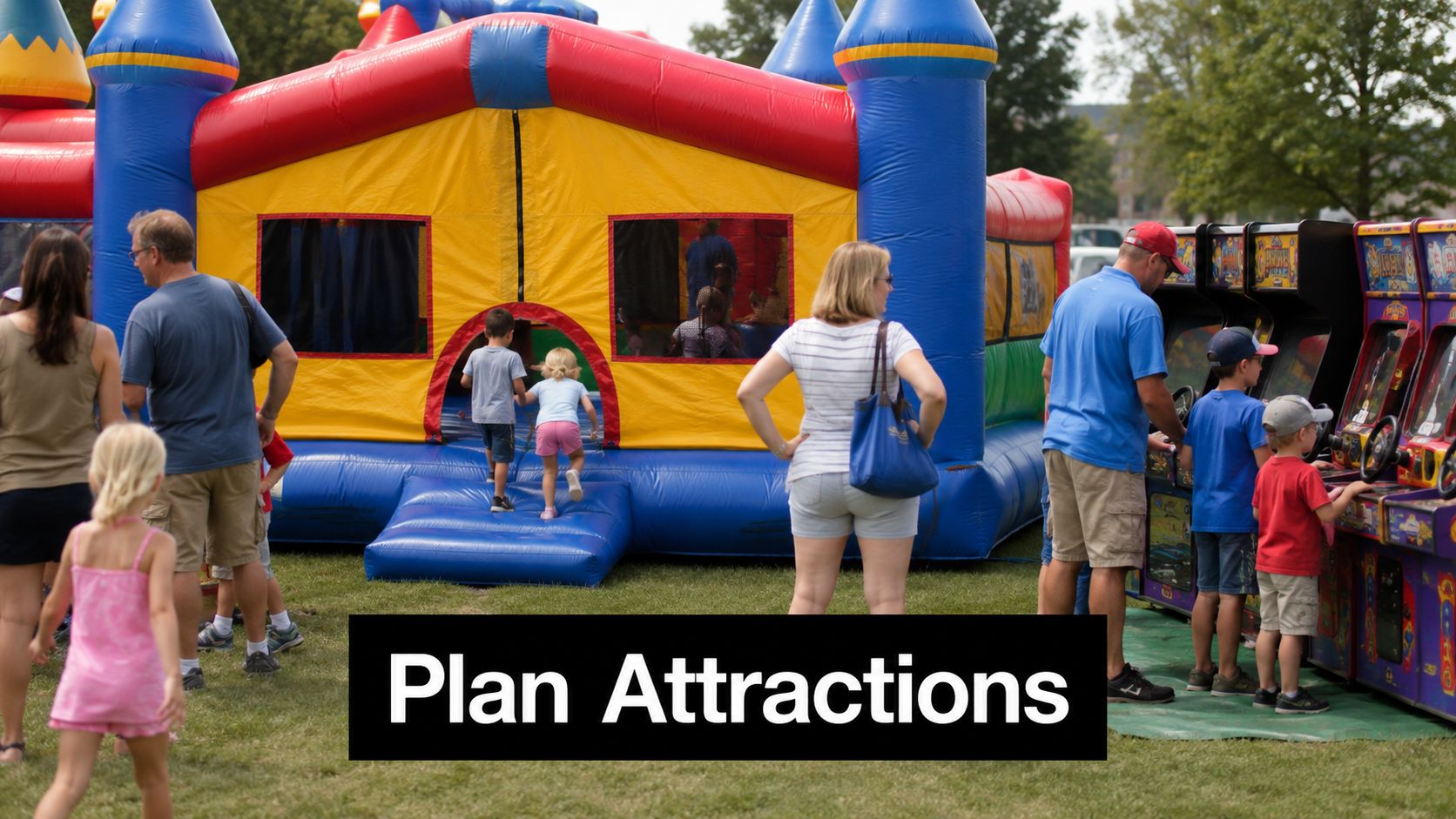
Attractions should support the event's purpose and schedule. Match each activity to audience age, ability, space, supervision, and expected demand. A corporate picnic may need options for several generations. A school field day may work better with timed rotations. A community festival needs active attractions, food, conversation areas, and quieter activities placed so guests can choose without crowding one zone.
Map the site before booking the package. Keep high-energy equipment away from food service and narrow walkways. Reserve queue space without blocking registration or emergency access. Include low-impact alternatives, seating, shade, and clear routes for guests who cannot or do not want to use physical attractions. The number of rentals matters less than whether guests can reach, understand, and safely use them.
Build the run sheet around movement and demand. Stagger DJ announcements, meal periods, activity rotations, and breaks so every group does not arrive at one attraction simultaneously. Mark each zone's opening time, operator, queue limit, inspection check, and weather response.
- Family zone: Choose broad age appeal and maintain visible supervision.
- Adventure zone: Place mechanical bulls, rock walls, zip lines, or obstacle courses where queues and safety staff have clear sightlines.
- Social zone: Use arcade games, karaoke, photo novelties, or low-pressure group activities.
- Quiet or accessible zone: Provide seating, shade, clear routes, and alternatives to high-intensity attractions.
- Food and refreshment zone: Keep service lines away from equipment entrances and exit paths.
Before confirming a vendor, record dimensions, power, anchoring, surface requirements, operator staffing, age or height rules, and weather limitations. Phantom's inflatable attraction options can support themed zones, while the venue and safety plan determine whether each setup is workable. Confirm who delivers, installs, operates, inspects, and removes the equipment, then place those responsibilities and documents in the event file.
Coordinate shirts and other event apparel with the guest experience using this guide to branded event apparel.
6. Arrange Transportation, Parking, and Logistics
Guests judge an event before they reach the registration desk. Confusing parking, unclear entrances, blocked access routes, or late equipment delivery can create pressure that spreads across the whole schedule. Treat arrival, loading, setup, guest movement, and departure as one connected logistics plan.
Create a site logistics map that shows vendor access, parking, accessible spaces, drop-off points, emergency lanes, staff parking, equipment placement, waste collection, and exit routes. Share it with the venue, vendors, security team, parking attendants, and event director. For a school field day, separate bus or staff arrival from student movement. For a festival, plan for multiple lots, volunteer parking, pedestrian crossings, and possible shuttle operations.
Build the load-in plan
A delivery window should include more than the arrival time. Record the vehicle type, unloading route, contact at the venue, equipment staging area, setup sequence, power access, inspection point, and release time. Phantom Entertainment's delivery, setup, and operation service can remove several coordination tasks, but your team still needs to reserve access and confirm ground conditions with the venue.
Send attendees practical arrival information through registration confirmations, email, the event website, and signage. State where to enter, where to park, what to bring, and how guests with accessibility needs can request assistance. Assign named staff to the busiest arrival points rather than expecting volunteers to improvise.
Practical rule: If an equipment vehicle can't reach the setup area without crossing attendee paths, change the load-in route before event day.
Prepare for wet ground, blocked roads, late vendors, and parking overflow. Don't rely on a single verbal instruction. Put the route, timing, and contact details into the run sheet, then print copies for the venue manager and event director.
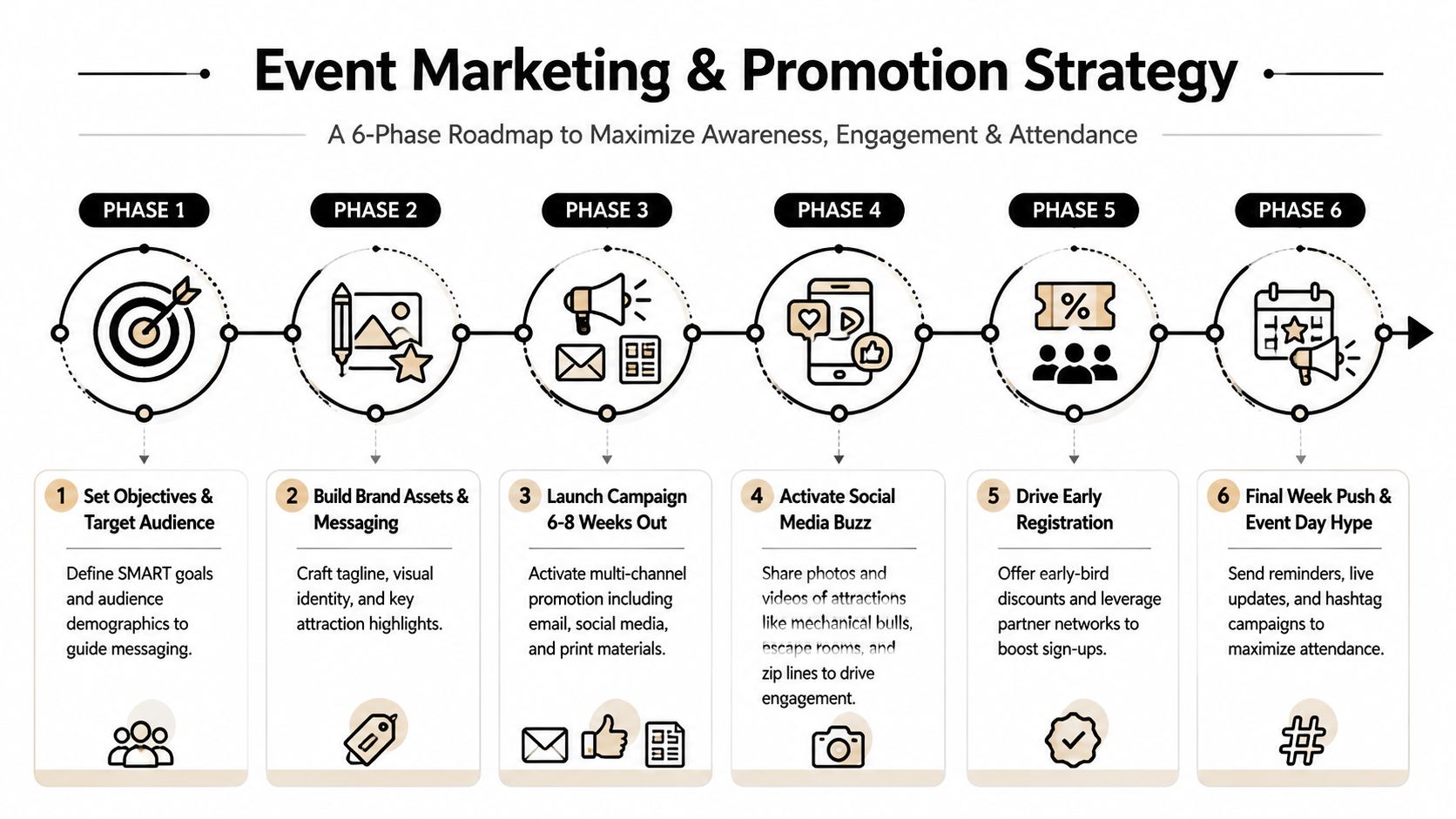
7. Develop Marketing and Promotion Strategy
Promotion works best when it explains the experience, not just the date and location. Start with a clear audience promise. Employees may respond to family-friendly attractions and an easy registration process. Parents need practical information about supervision, activities, parking, and timing. Community attendees need to understand what makes the festival worth attending and how admission, food, fundraising, or activities work.
Build one core message, then adapt it for email, social media, newsletters, printed materials, partner communications, and internal channels. Feature confirmed attractions accurately. Don't advertise a mechanical bull, escape room, zip line, or DJ until the provider and schedule are locked.
Create a promotion calendar
A broad-reach event may need promotional activity beginning 6 to 8 weeks before the event, as outlined in the planning brief. Use that period to move from awareness to registration, then from registration to attendance preparation.
- Launch: Publish the event purpose, date, location, audience benefits, and registration path.
- Proof: Share approved attraction photos, activity descriptions, partner announcements, and practical venue information.
- Reminder: Repeat the schedule, parking details, weather policy, accessibility information, and registration deadline.
- Final briefing: Send a concise confirmation with arrival instructions, what to expect, and contact information.
- Live coverage: Assign someone to capture approved photos, announcements, and attendee moments without distracting from operations.
- Follow-up: Share highlights and feedback instructions after the event.
Connect each channel to a measurable action, such as registration completion, email response, partner referrals, or attendance check-in. Schools can use parent emails, newsletters, student announcements, and approved social channels. Corporate teams can use intranet posts and internal email. Community organizers can combine local partners, bulletin boards, press outreach, and social media. Personalization, accessible technology, and contactless processes are among the expectations highlighted in recent venue and event trend coverage (HITEC's 2025 event trends), so make the registration and information experience easy for different audiences to use.
8. Create Event Timeline, Coordinate Operations, and Staffing
A reliable event timeline exposes dependencies before they become delays. Assign an owner to each task, record the prerequisite, and define the response if the deadline slips. A late venue contract, for example, can delay attraction booking, insurance review, signage, marketing, and staff instructions at once.
Work backward from the event date. Set milestones for goals, team assignments, venue confirmation, headliner or attraction booking, budget, operating plans, and volunteer briefing. A smaller school activity may need a shorter lead time than a public festival, while a corporate event may require earlier approval from facilities and security. Adjust the pace to the event type and scale, but keep the order visible. SurveyMonkey's milestone checklist offers a useful reference for mapping these dependencies.
Build the run sheet
The printable day-of run sheet should help staff make decisions under pressure. Each line needs a time, action, location, owner, and escalation contact. Include:
- Vendor arrival, load-in, and departure windows
- Equipment setup, inspection, and opening approval
- Registration opening and attendee entry
- Attraction rotations, performances, meals, announcements, and breaks
- Staff shifts, radio or phone channels, and relief coverage
- First aid, security, emergency exits, and incident-reporting points
- Weather decision times and substitute activities
- Breakdown, waste removal, final venue inspection, and departure
Coordinate the run sheet with vendor agreements, site access rules, staffing limits, and the safety documents prepared for the event. Phantom Entertainment's professional operators can handle attraction setup and operation, reducing the staffing load, but the event director still coordinates the venue and other providers. Confirm setup duration, electrical requirements, operating hours, operator coverage, insurance documentation, and breakdown timing before finalizing the schedule.
Add buffers around major segments, mark peak periods, and brief staff on the fallback plan. Give the event director authority to pause an activity, redirect guests, or activate the weather response.
9. Manage Permits, Insurance, and Legal Compliance
Treat compliance as a workstream with owners and deadlines, not as paperwork saved for event week. A school, municipality, campus, corporate property, or public venue may request different permits, insurance certificates, equipment inspections, participant waivers, contracts, or emergency procedures. Confirm requirements with the venue, local authority, insurer, and each provider before contracts and schedules are final.
Build one safety-document folder with consistent file names. Include the venue agreement, event permit, certificates of insurance, attraction inspection records, vendor contracts, participant waivers, emergency contacts, site map, weather policy, and incident forms. Keep a printed set onsite, and tell the event director and venue manager exactly where it is.
Assign compliance ownership
Name one person to track missing documents and approval dates. The event director still needs authority to pause an activity or reject incomplete paperwork. Ask the venue who reviews insurance and equipment records, then ask each attraction provider what it supplies and which conditions must be met before opening.
For physical attractions, confirm:
- Inspection status: Request current state-inspection or safety documentation where applicable.
- Insurance: Obtain certificates that meet venue or institutional requirements.
- Waivers: Determine whether participants need waivers and how staff will collect them.
- Supervision: Confirm operator duties, age or height rules, queue control, and stoppage procedures.
- Emergency access: Keep routes clear for first aid, medical response, evacuation, and equipment removal.
- Weather rules: Document wind, rain, lightning, heat, ground, or visibility conditions that require a pause.
Phantom Entertainment provides certificates of insurance and venue-ready safety documentation. A turnkey attraction partner can also clarify setup, operation, insurance, and compliance responsibilities before delivery, while the event team retains control of the wider site. For a broader risk review, see event risk guide from Overton Security, then convert relevant concerns into named owners, deadlines, and response actions.
Before opening, check that the folder is complete, the onsite copy is accessible, and staff know whom to contact when conditions change. A document that no one can locate or interpret will not protect the event.
10. Plan Post-Event Evaluation and Follow-Up
The event closes operationally when the last guest leaves, but planning work continues. Reconcile the budget, confirm vendor closeout, record incidents, collect feedback, and capture lessons while details remain clear. Compare findings with the objectives set in step one, so the review produces decisions rather than vague comments such as “the event went well.”
Use separate feedback routes for each group. Attendees can report on check-in, activity access, food, comfort, and entertainment. Staff often identify queue pressure, unclear instructions, coverage gaps, and communication failures. Vendors can flag late access, difficult ground conditions, power issues, or layout problems that guests may never see.
Review within the full lifecycle
Review the full event record, from early site assessment and budget approval through delivery and closeout. Institutional templates cover communication schedules, survey design, and after-action review as part of lifecycle management (institutional event management checklist). The same institutional checklist resource recommends sending attendee feedback within 24 to 48 hours and keeping the survey open for about 5 to 7 days. Use those timings when response quality matters, then set a firm review date before the planning team disperses.
Record the decisions that can improve the next event:
- Results: Attendance, registrations, activity participation, fundraising, satisfaction, and stakeholder outcomes.
- Operations: Peak queues, downtime, late arrivals, staffing gaps, signage problems, and guest-service requests.
- Safety: Incidents, near misses, pauses, medical responses, and corrective actions.
- Finance: Actual spend, unpaid invoices, refunds, deposits, and variance from the approved budget.
- Relationships: Vendor performance, venue cooperation, sponsor deliverables, and follow-up commitments.
Assign an owner and deadline to each corrective action. For a corporate family day, that might mean changing the arrival flow. For a school field day, it may mean revising staff coverage or activity rotations. For an attraction delivered by Phantom Entertainment, record setup time, operating handoff, guest response, and any venue coordination issue so the partner brief becomes more useful next time.
Send thank-you messages promptly, request formal vendor feedback, share approved highlights, and store the final review with the next event's planning files. The strongest outcome is a clearer starting point for the next run.
10-Point Event Planning Checklist Comparison
| Task | Implementation Complexity 🔄 | Resource Requirements ⚡ | Expected Outcomes ⭐📊 | Ideal Use Cases 💡 | Key Advantages |
|---|---|---|---|---|---|
| Define Event Goals and Objectives | Medium 🔄🔄, stakeholder alignment and KPI definition | Low–Medium ⚡⚡, time, data analysis | Clear scope, measurable KPIs, focused vendor decisions ⭐📊 | All events (corporate family days, school field days, fundraisers) 💡 | Provides direction; reduces scope creep; enables ROI measurement |
| Establish Budget and Financial Planning | Medium–High 🔄🔄🔄, detailed costing and forecasting | High ⚡⚡⚡, vendor quotes, contingency funds, tracking tools | Realistic cost control, funding clarity, sponsor alignment ⭐📊 | Events with paid vendors or sponsorship (festivals, large corporate events) 💡 | Prevents overspend; improves vendor negotiation; forecasts financial gaps |
| Select and Book Venue or Location | Medium 🔄🔄, site visits, contract negotiation | Medium–High ⚡⚡⚡, deposits, permits, utilities checks | Suitable capacity and compliance; fewer logistical surprises ⭐📊 | Outdoor/indoor events requiring specific space (parks, gyms, estates) 💡 | Ensures logistics fit attractions; improves attendee experience |
| Identify and Hire Key Service Providers | High 🔄🔄🔄, vetting, contracts, backups | High ⚡⚡⚡, vendor fees, insurance verification, coordination | Reliable delivery of services; mitigated vendor risk ⭐📊 | Events needing specialized services (entertainment, catering, security) 💡 | Professional quality; reduces organizer burden; single-source simplifies coordination |
| Plan Attractions, Entertainment, and Activities | High 🔄🔄🔄, sequencing, safety planning, variety | High ⚡⚡⚡, attraction rentals, staffing, safety equipment | High engagement, varied attendee satisfaction, social content ⭐📊 | Family fun days, festivals, orientations, school activities 💡 | Increases engagement; tailored experiences; social media appeal |
| Arrange Transportation, Parking, and Logistics | Medium 🔄🔄, traffic flow, load-in scheduling | Medium ⚡⚡, signage, volunteers/shuttles, ADA accommodations | Smooth arrival/egress, efficient load-in/out, improved accessibility ⭐📊 | Events with large attendance or remote venues (festivals, corporate sites) 💡 | Reduces congestion; improves attendee experience; enables timely setup |
| Develop Marketing and Promotion Strategy | Medium 🔄🔄, multi-channel planning and timing | Medium ⚡⚡, creative assets, ad spend, platform tools | Increased attendance, stronger awareness, ticket sales boost ⭐📊 | Public-facing events and ticketed functions (community festivals, orientation) 💡 | Drives attendance; leverages attractions as hooks; builds momentum |
| Create Event Timeline, Coordinate Operations, and Staffing | High 🔄🔄🔄, detailed scheduling and role assignment | High ⚡⚡⚡, staffing, training, communication tools | Smooth execution, reduced conflicts, clear accountability ⭐📊 | All multi-vendor or multi-activity events (large festivals, corporate events) 💡 | Keeps planning on track; enables quick issue resolution; defines roles |
| Manage Permits, Insurance, and Legal Compliance | Medium–High 🔄🔄🔄, jurisdictional research and documentation | Medium ⚡⚡⚡, insurance premiums, permit fees, legal review | Legal clearance, reduced liability, institutional approval ⭐📊 | Public events, municipal spaces, high-risk attractions (mechanical bull, zip line) 💡 | Protects organizers; simplifies approvals with vendor certificates |
| Plan Post-Event Evaluation and Follow-Up | Low–Medium 🔄🔄, surveys, debriefs, reconciliation | Low ⚡⚡, survey tools, time for analysis, reporting | Lessons learned, ROI evidence, improved future planning ⭐📊 | Any event seeking improvement and stakeholder retention 💡 | Captures feedback; documents improvements; sustains relationships |
Make the Next Event Easier to Run
A completed event planning checklist becomes valuable when you reuse it as a system rather than treating it as a one-time document. Keep the master version broad enough for corporate picnics, school field days, community festivals, private parties, and campus programs, then create event-specific copies for the venue, audience, activities, and approval requirements.
The most important handoffs deserve a final review before event day. Confirm goals before spending. Reserve the venue before committing to attractions. Document delivery routes, setup conditions, electrical needs, operator requirements, and breakdown timing with every relevant vendor. Secure permits, insurance certificates, inspections, waivers, and emergency contacts early enough for the venue or institution to review them.
Turn the plan into an operating file
Don't distribute one oversized document and assume everyone will read it. Give each responsible person the information needed for their role, while keeping a complete master file with the event director.
Your reusable event system should include:
- Months-out timeline: Track goals, approvals, venue booking, vendor contracts, promotion, staffing, documentation, confirmations, and review dates.
- Vendor coordination sheet: List each provider, primary contact, arrival time, load-in route, equipment, power needs, operator requirements, insurance status, payment terms, and backup plan.
- Safety-document folder checklist: Confirm permits, certificates of insurance, inspection records, waivers, emergency procedures, site maps, and weather rules.
- Staffing roster: Assign registration, guest services, parking, activity monitoring, first aid coordination, security, vendor liaison, event direction, and relief coverage.
- Day-of run sheet: Show times, actions, locations, owners, contact channels, announcements, rotations, meals, pauses, breakdown, and venue closeout.
- Incident log: Record time, location, people involved, action taken, witnesses, follow-up owner, and whether the event plan needs revision.
- Post-event review page: Compare objectives with outcomes, summarize feedback, reconcile spending, document risks, and list next actions.
Event software is already a mainstream planning tool. Reported adoption data says 80% of professional event planners use some form of event-management software, while 52% of organizations use more event technology than they did two years ago (event-management software industry statistics). Use software when it improves ownership, dependencies, registration, communications, and reporting. A shared spreadsheet and clearly named folders can work when the event is smaller, provided someone maintains them.
The commercial focus of the category also reflects this operational reality. In a 2025 projection, event planning and operations software is estimated to represent 27.8% of the event-management software market, while event-planning applications are reported to account for 38.03% of revenue (MarketsandMarkets event management software market). The lesson isn't to buy software for its own sake. It's to build a control system that connects actions to owners, dependencies, documents, and failure points.
Phantom Entertainment can fit into that system when you want one attraction partner to coordinate delivery, setup, professional operation, insurance, and safety documentation. That can simplify the entertainment portion of the run sheet, especially for schools, corporate venues, campuses, and community organizers that need clear compliance records and fewer vendor handoffs. Confirm the exact package, site requirements, staffing, weather terms, and documentation before adding it to the final plan.
Start your next event file with the objective page, the venue map, the vendor coordination sheet, and the day-of run sheet. Then assign every open item to a named person with a due date. That small discipline turns a checklist from a pile of reminders into a plan your team can run.
Phantom Entertainment provides turnkey attractions and event support, including delivery, setup, professional operation, insurance, and venue-ready safety documentation for gatherings across Pennsylvania and the Mid-Atlantic. Build a clearer event planning checklist for your next corporate picnic, school field day, festival, or private celebration by visiting Phantom Entertainment and reviewing the available options with its team.
Ready to Book Your Event?
PA state-inspected, fully insured since 1979. Call us or get a free quote today.