
Casino party rentals range from about $700 for a small package to $3,250 for a large one, depending on the setup. But tables and dealers typically account for only 25%–45% of the total event budget, so the rental quote is a starting point, not the final bill.
That gap is where planners get caught. A low table rate can leave delivery, setup, venue costs, food, prizes, and other essentials out of view. Before accepting a quote, get clear on four things: how many guests are coming, how many will play at once, how long the games will run, and how far the crew needs to travel.
What Casino Party Rentals Cost in 2026
$700 can cover a small casino package, while large packages reach $3,250. Current U.S. benchmarks place midsize packages at $1,050–$1,750. One published small-package example includes two casino tables, two professional dealers, four hours of play, and one complimentary slot machine. The national average range for casino party rentals is approximately $740–$1,000. Use these figures to compare package tiers, not to assume the full event will cost the same amount. (Thumbtack's casino party rental pricing guide)
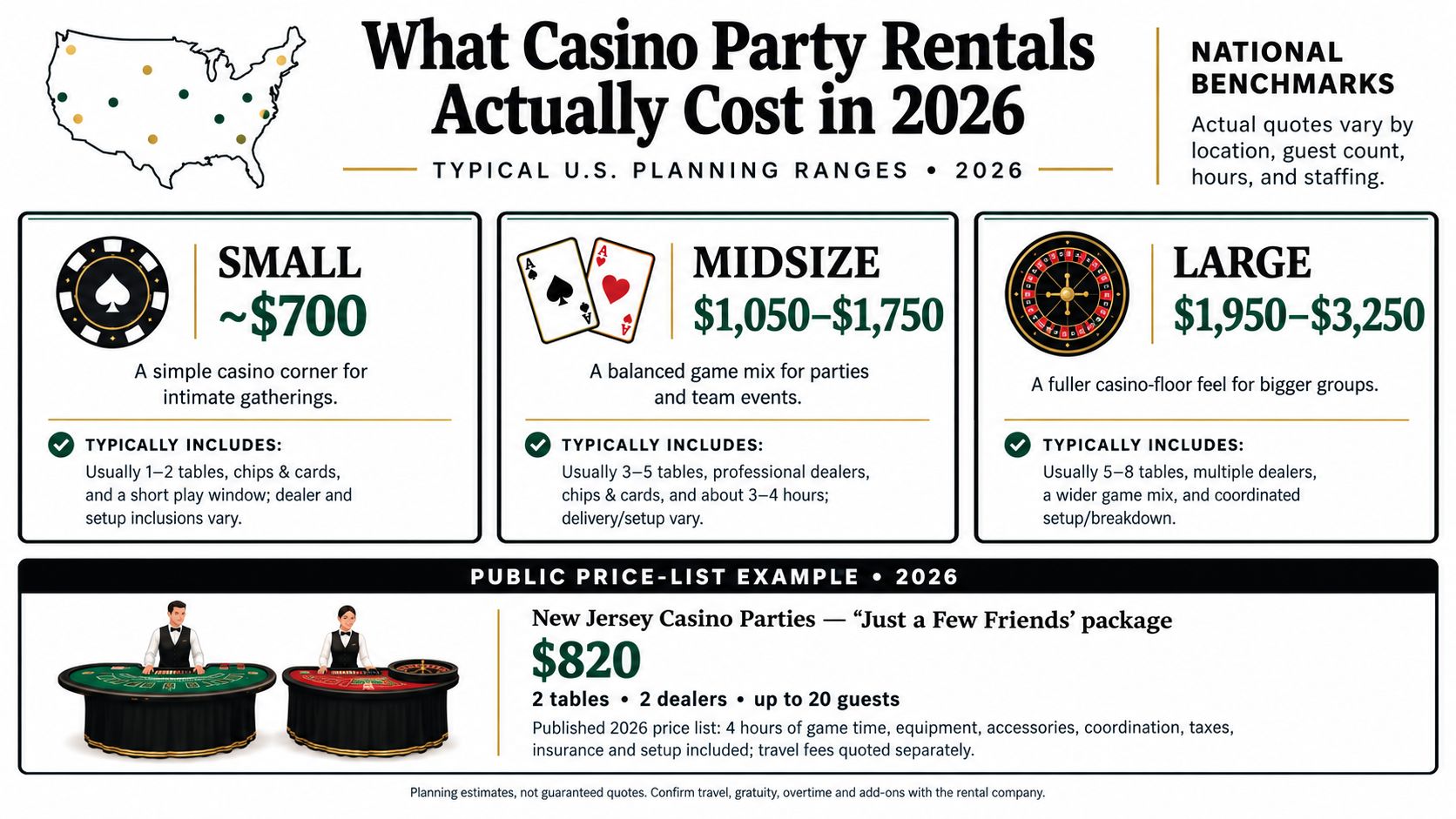
Build your budget around the total landed cost, not the table quote alone. The gaming setup and dealers commonly account for 25%–45% of a casino-night budget. The remaining costs can include the venue, food and beverages, décor, entertainment, prizes, and contingency. (Casino party planning budget guidance) A quote for gaming can be accurate while leaving much of the event bill unaccounted for.
Four questions to choose a starting tier
Start with guest count, then estimate how many people will play at the same time. Simultaneous players are a better guide to active table needs than the total invitation list. Paying for tables that sit idle adds cost without improving the night.
Next, set the gaming hours. Longer play means more dealer time, so match the schedule to when guests will be ready to play. Then confirm travel distance and venue conditions. Delivery, setup, breakdown, and access requirements can change the landed cost even when the package stays the same. Ask the operator to spell out what transportation and venue access include.
A $700 package can fit a compact event. A $1,500 midsize build gives you more room to match tables and staffing to a larger crowd. For a broad table mix or a more involved event, a $3,000-plus production is a more realistic starting point. Choose a tier only after answering all four questions: guest count, simultaneous players, gaming hours, and travel and venue conditions.
The Cost Drivers That Move a Quote Up or Down
A casino rental quote isn't a black box. Its largest controllable inputs are table count, game mix, dealer staffing, and play duration. Adjust those deliberately, and you can reduce cost without stripping out the parts guests came to enjoy.
Tables and games
Each active table needs equipment and dealer coverage. That makes the table count one of the clearest ways to move the price up or down. Blackjack is often the most cost-efficient anchor: its setup is comparatively compact, and one dealer can run a table. Roulette, craps, and poker can call for more specialized equipment, floor space, or staffing assumptions. (Casino-night planning and game setup guidance)
Pick games around the experience you want, not just a wish list. A focused mix with blackjack as the core can feel lively without putting a specialty table in every corner. Add a game because your audience will use it, not because a longer menu looks impressive.
Dealer hours and fixed logistics
Dealer labor rises with the number of active tables and the length of the event. A longer play window may be worthwhile if guests are arriving throughout the evening, but it can be wasted spend if the room empties early. Set the gaming schedule around the event's actual flow, including when guests will eat or listen to presentations.
Some costs are less sensitive to attendance. Delivery, setup, breakdown, and insurance may still be necessary for a small gathering, so they don't shrink in proportion to the guest list. That's why a 25-person event can have a higher per-person cost than a 100-person event using the same core equipment.
Practical rule: Ask for the table count, game types, dealer hours, delivery zone, and setup and teardown windows as separate quote details. That's the information you need to compare operators fairly and right-size the package.
The strongest negotiation is often a better scope, not a lower rate: fewer tables, a simpler game mix, or a shorter play window. If you want a quote reduced, ask which change would lower the cost without weakening the guest experience.
Matching Packages to Guest Count and Event Type
Start with simultaneous play, not the invitation count. A package for a crowd that arrives in waves may need fewer tables than one for the same number of guests playing at once. Use the tiers below to compare likely scope, then confirm the final inclusions in writing.
| Package Tier | Typical Guest Count | Price Range | Tables Included | Dealers / Hours | Slot Machines |
|---|---|---|---|---|---|
| Small | Roughly 25–50 | About $700 | Two tables | Two dealers, four hours of play | One complimentary machine in a published example |
| Midsize | Roughly 50–150 | $1,050–$1,750 | Typically three to five | Typically four hours of play | Up to two |
| Large | 150-plus | $1,950–$3,250 | Commonly six to ten | Commonly four hours of play | Up to four |
Treat these figures as package examples, not guaranteed inclusions. Ask the operator to spell out table count, dealer coverage, play hours, and any slot machines in the quote. Confirm whether delivery, setup, and other charges are included before comparing the total landed cost.
The listed table rates suggest a modest scale benefit: midsize tables run about $350 each, compared with about $325 each in large packages. Chairs may add $1.50–$2.50 or more per guest. Check whether seating is part of the package, since a low equipment quote can leave important event costs outside the total.
Match the package to the event
For a corporate family day, a midsize setup can accommodate guests arriving in waves while leaving room for other activities. A school fundraiser may need only a small or midsize package, depending on how many guests will play at once and whether tables stay open throughout the event. A black-tie corporate gala can justify a large setup when casino games are a main attraction and the program includes premium décor or prizes.
For company-event planning, Phantom Entertainment's corporate party options can help you assess how casino tables fit into the wider program. Choose a larger tier when you expect several tables to stay busy or need more game variety. Otherwise, book the smallest package that can comfortably serve the expected simultaneous players.
Why the Equipment Quote Is Only 25 to 45 Percent of Your Budget
Casino rentals and dealers may account for 25%–45% of total event spending. The rest goes to the venue, food, décor, entertainment, prizes, and contingency. Build your budget around the full event cost, not the equipment quote alone.
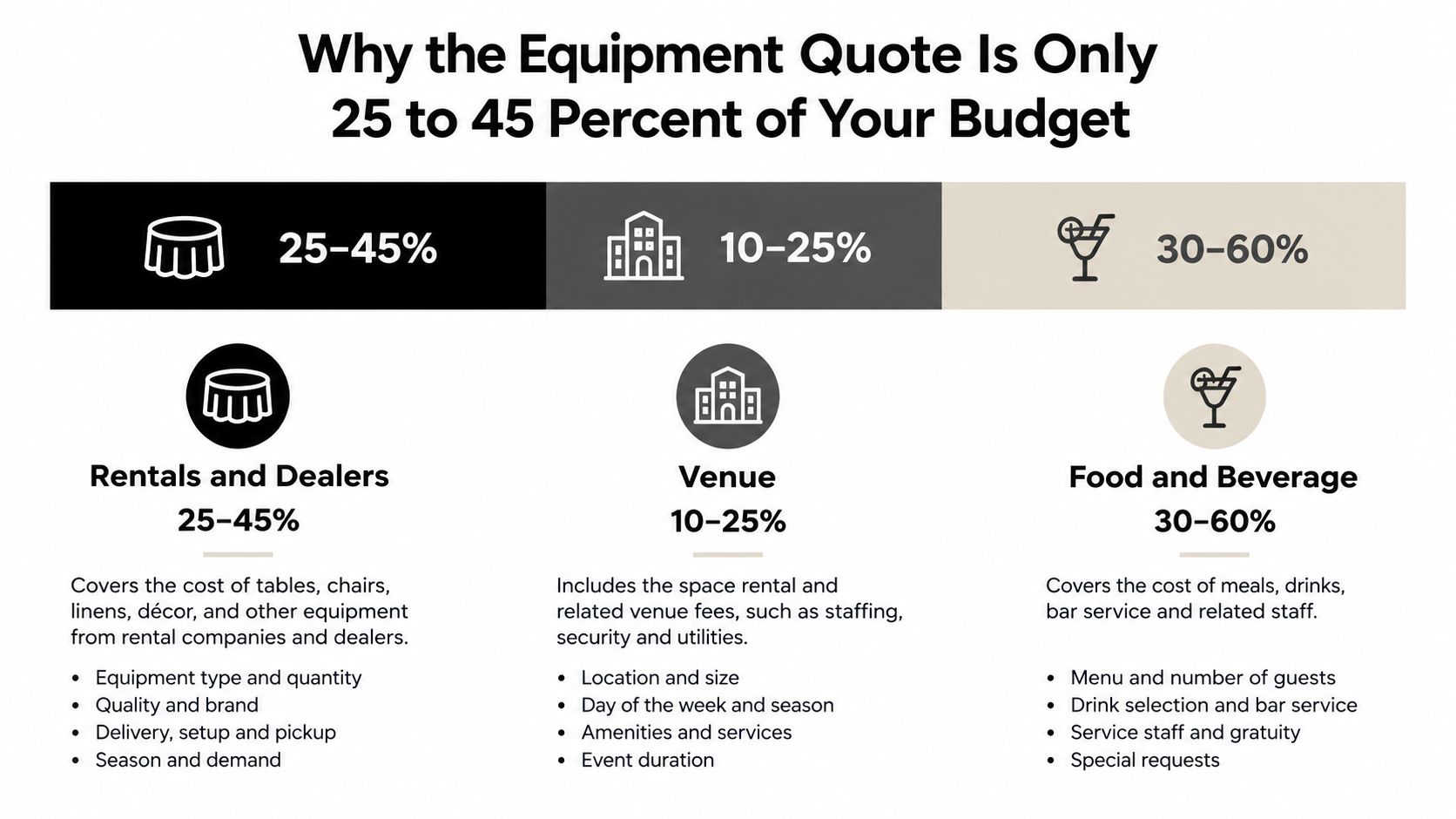
Use these category ranges as planning estimates, not fixed rules:
- Casino rentals and dealers: 25%–45%. This covers the tables, equipment, and staffing.
- Venue: 10%–25%. The cost depends on the space and event requirements.
- Food and beverage: 20%–35%. Catering and refreshments can take a sizable share.
- Décor and branding: 5%–15%. Include visual styling and branded elements.
- Entertainment or audiovisual services: 5%–15%. Sound, lighting, and added programming can increase the total.
- Prizes: 5%–15%. Your prize choices affect both spending and the guest experience.
- Contingency: 5%–10%. Reserve funds for unexpected costs instead of assigning the entire budget upfront.
Put the rental price in context
For example, if a midsize casino package costs $1,400 and takes roughly a third of the budget, the overall event would total about $4,200. This is a planning calculation, not a vendor quote. Venue, menu, décor, prizes, and other services will change the final figure.
Guest count alone does not determine the total. Food trucks and simple signage can keep one event's costs restrained, while a catered dinner, branded chips, and a full audiovisual stage can push another event much higher. The table package may be similar, but the complete program budget will not be.
Ask four questions before accepting a quote: What does the casino package include? What will the venue and catering cost? Which extras are necessary for the event? How much should remain in reserve? Put each answer on one worksheet alongside the rental price, then compare quotes by total landed cost rather than equipment alone.
If your casino night is part of a larger weekend program, list separate activities on their own budget lines. For example, keep Miami matcha bike event dates distinct from the casino-night expenses so side-program costs do not blur the event total. A clear worksheet gives the rental operator a realistic picture of your needs and keeps a low equipment quote from creating a misleading budget expectation.
Sample Budgets for Three Common Events
A useful sample budget shows the shape of the spending, not a guaranteed invoice. The figures below are planning examples built around the event types and package assumptions described here; actual vendor quotes will vary with staffing, travel, venue, and selected services.
Corporate family fun day
For a family day with 120 employees and family members, start with a midsize casino package at around $1,500. Food trucks, soft drinks, modest décor, and small prizes can put the overall plan in the $4,500–$6,500 range.
The casino package is the anchor; food and beverages are the main flexible line, followed by prizes and décor. Delivery, setup, and the agreed dealer schedule are comparatively fixed once the package and venue are confirmed. For additional activities between games, planners can browse these adult party games from Very Special Games.
School fundraiser
For a fundraiser serving 200 guests, a large package near $2,500 may be a reasonable starting assumption. With sponsored prizes and volunteer support, a total budget around $7,000–$9,500 gives the committee room to plan the wider event rather than spend the entire allocation on the casino floor.
Prizes are particularly flexible when local businesses or families can contribute. The venue, rental footprint, and professional dealer coverage are harder to reduce once the event format is set. Don't count volunteer support as a substitute for confirming who handles supervision, venue rules, and prize procedures.
Private birthday party
A 75-person birthday might use a small-to-midsize setup around $1,200, paired with more generous food and décor for a total budget of roughly $3,500–$5,000. Menu choices, décor, and prize scale can flex; the equipment footprint and operating period anchor the casino part of the spend.
For a celebration that's part of a larger wedding weekend, Phantom Entertainment's wedding services may help with related event planning. To present any of these examples to a committee or client, divide the planned total by the attendee count and label it as an estimate. Then show which costs are fixed and which can change.
Smart Ways to Reduce Casino Party Costs
Cut waste before you cut the parts guests notice. The strongest savings come from matching game mix, hours, and logistics to the event, rather than stripping out staff and hoping the night still runs smoothly.
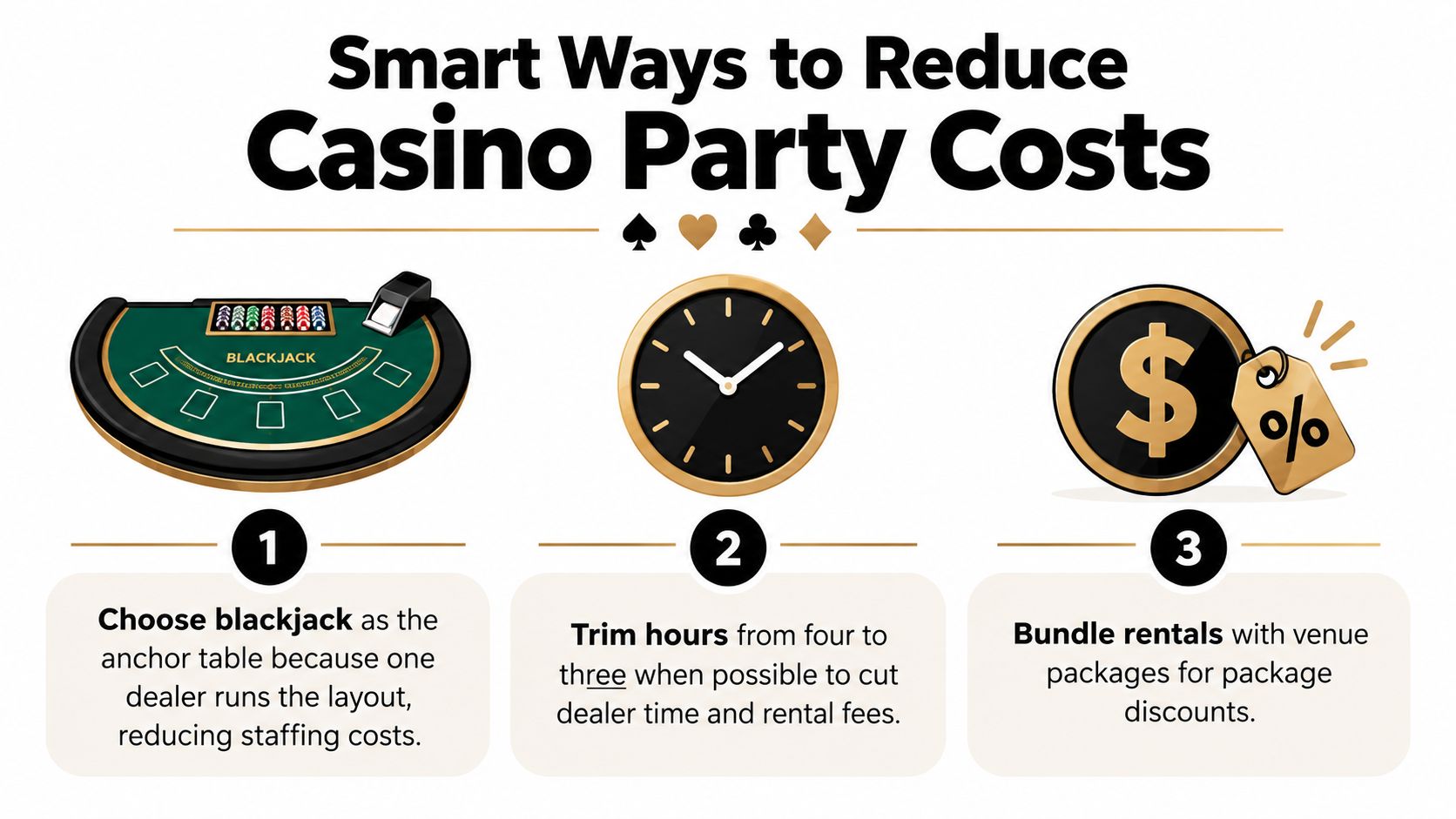
- Anchor the setup with blackjack. It's a compact, practical choice when you want a staffed table without a more complex game setup. Keep specialty games only if your guests will use them.
- Trim play time to match the schedule. If guests are likely to be most engaged early, ask whether a shorter operating window can reduce dealer time and rental costs.
- Ask about off-peak dates and bundled logistics. A slower date may make a more favorable package possible. If you're already renting other attractions, ask whether shared delivery and setup can be priced as a bundle.
Cutting a slot machine may free up floor space without guests noticing much. Removing a poker dealer can be felt immediately if that table is part of the draw. Make savings decisions based on what your guests will experience.
Event planners also have to balance budgets with the quality of the program. A survey summarized in a BizBash and Czarnowski report found that 89% of event professionals ranked budget constraints first, ahead of audience engagement at 48%; the report also says average corporate event spend per attendee increased about 19.4% between 2022 and 2025. (BizBash and Czarnowski event-planning report)
The cheapest advertised package isn't always the lowest-cost option once unstaffed gaps, supervision, and compliance needs are accounted for.
Negotiate with a clear request: ask for a sample package on a slower date or for a bundling credit if you're combining rentals. That gives the operator something practical to solve without asking them to compromise staffing or service.
Contracts, Deposits, Insurance, and Venue Requirements
A verbal price isn't enough to book a casino night. Get the full scope in writing, including the equipment, labor, logistics, and paperwork the venue expects. Deposit terms vary by operator, so confirm the amount due to reserve the date and when the remaining balance is payable.
Make the quote itemized
Ask the operator to specify table count, game types, dealer hours, event duration, delivery zone, setup and teardown windows, chips, cards, prizes, and insurance documentation. If anything is excluded, ask what it costs or who is responsible for providing it. This is how you catch a quote that looks low because it leaves out an essential service.
Schools, universities, corporate venues, and public locations may require a certificate of insurance or an additional insured endorsement. Confirm the venue's exact wording and deadlines with its coordinator before booking. Don't assume a standard certificate satisfies every location's requirements.
Confirm the rules before announcing prizes
Age limits and prize rules deserve special attention for youth events, fundraisers, and employee programs. U.S. gaming laws can turn on the combination of prize, chance, and consideration, and requirements differ by jurisdiction. The International Masters of Gaming Law notes that Connecticut, Montana, New Jersey, California, and New York enacted measures in 2025 targeting certain sweepstakes casinos or similar models. That doesn't automatically prohibit a professionally run entertainment casino at a private event, but it does make blanket claims that play-money events are always unrestricted unreliable. (U.S. gaming-law overview)
Write down how play money works, whether prizes are offered, who can participate, and what venue or local rules apply. If the event involves charitable fundraising, youth participation, or a public venue, get guidance from the venue and, where appropriate, local counsel or regulators. Phantom Entertainment's frequently asked questions can help planners identify practical questions to raise before booking.
Before you sign, hand this checklist to the venue coordinator or attorney:
- Scope: Confirm tables, games, dealers, hours, and included materials.
- Logistics: Verify access, delivery, setup, breakdown, and venue schedule.
- Insurance: Confirm certificate wording and any additional insured requirements.
- Rules: Agree on age limits, play money, prizes, and any fundraising procedures.
- Payment: Record the deposit, balance due, and cancellation terms.
For casino party rentals across Pennsylvania and the Mid-Atlantic, Phantom Entertainment offers casino-night setups alongside other event attractions, with delivery, setup, and professional operation. Share your guest count, expected simultaneous players, event hours, venue location, and prize plan to get a quote that reflects the full scope rather than just the table rate.
Ready to Book Your Event?
PA state-inspected, fully insured since 1979. Call us or get a free quote today.