
You've found a room, started the guest list, and saved a few casino decorations. Then the practical questions arrive: Who'll explain the games? Will the grandparents enjoy it? What happens when children want to join, and can you give away prizes?
A successful casino night birthday party starts with those decisions, not the felt tablecloths. Choose a format your guests can enjoy, confirm what the venue allows, and build an evening where playing is optional and nobody needs gambling experience.
Choosing a Casino Night Theme That Fits Your Guests
An adult milestone birthday in a rented hall and a children's backyard celebration can share playing-card decorations without sharing the same atmosphere. For the adult gathering, you might want cocktail attire and lounge music. For the backyard, bright signs, casual clothes, and activity stations make more sense.
Start with the guest list, then choose the look. Otherwise, you risk creating an elegant room that feels unwelcoming to children or a noisy carnival that overwhelms guests who came to socialize.

Match the atmosphere to the invitation
Choose a direction guests can understand without buying a costume:
- Vegas-style lounge: Use black and gold linens, a personalized marquee, and conversational music. Suggest dressy casual clothing rather than making formalwear a condition of participation.
- Retro supper club: Pair jazz with dinner seating, bow ties for staff, and warm lighting. Keep the game surfaces bright enough to read comfortably.
- Playful carnival casino: Choose colorful signs, upbeat background music, and relaxed clothing. Make the decorations theatrical rather than financially realistic.
Browse party theme options before ordering supplies so the room, entertainment, and invitations follow the same direction.
Spend on details guests will notice
Playing-card table markers, dealer vests, and coordinated tablecloths can carry the theme without decorating every wall. Give the room a personal name, such as Club Avery, and repeat it on the welcome sign and invitations.
Include the dress code, activity format, and whether children are welcome. Guests shouldn't have to guess whether they're attending dinner with optional games or an evening centered on playing.
The theme draws on an established entertainment culture: U.S. commercial gaming revenue reached approximately $72.04 billion in 2024, according to the American Gaming Association's State of the States report. Familiar symbols such as cards, roulette wheels, and chips give parents and grandparents an immediate visual reference without requiring an authentic gambling experience.
Picking Games and Mock Chips for Your Tables
Choose games by how guests will participate, not by how impressive the equipment looks. A poker table isn't useful if everyone needs a lengthy explanation. A wheel can look inviting, but it still needs someone to manage turns and explain what happens after each spin.
Build variety into the lineup so guests can choose between conversation, observation, and active participation.
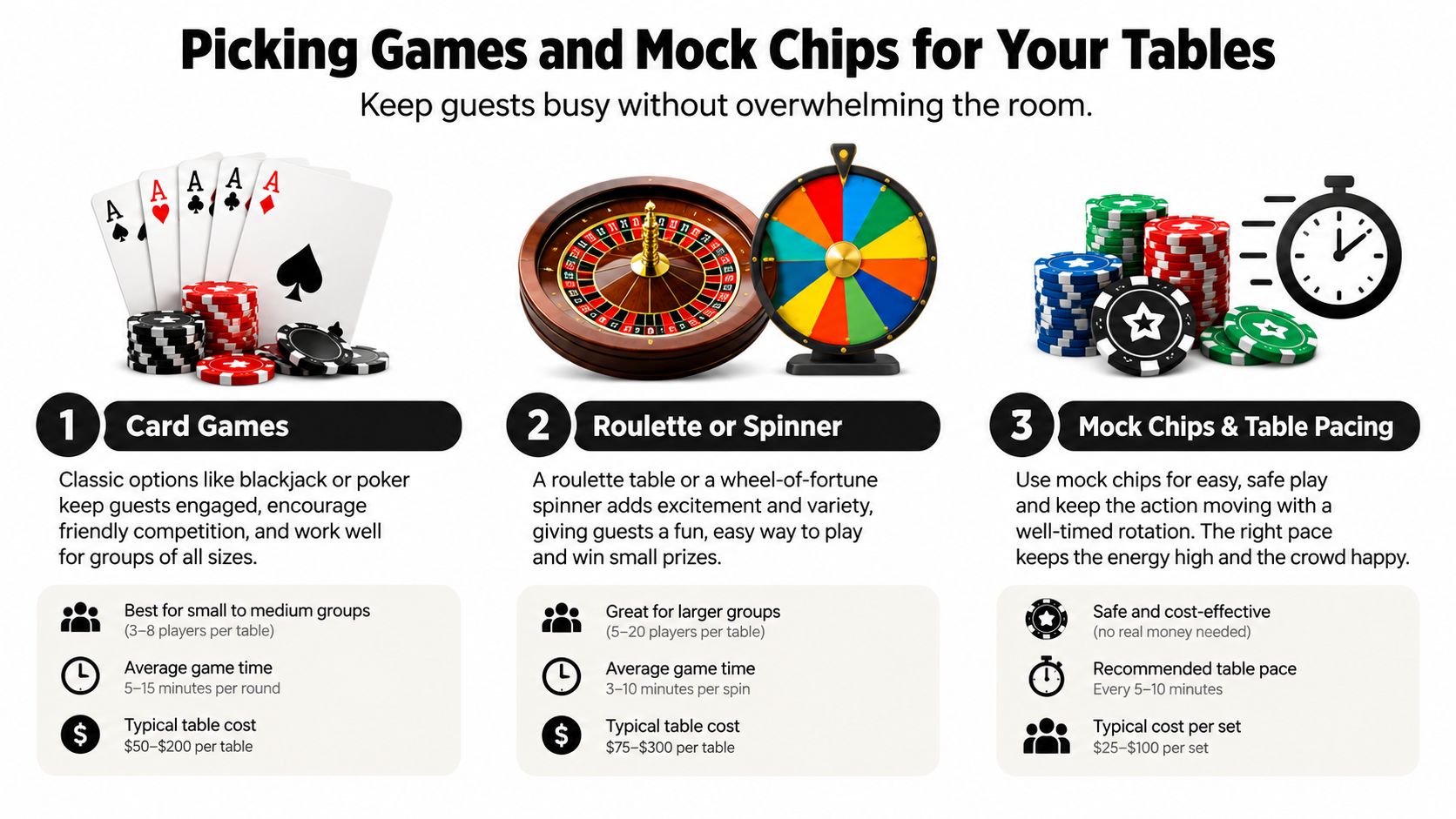
Compare the work behind each station
| Game format | Setup and staffing considerations | Guest experience |
|---|---|---|
| Blackjack or poker | Cards, a readable layout, and a dealer who can explain the chosen rules consistently | Suits guests who enjoy decisions and table conversation |
| Roulette or a themed spinner | A stable wheel, clear result markings, and someone managing turns | Offers a visible focal point and a simple way to join |
| Dice toss or ring toss | Marked play boundaries, accessible equipment, and a clear scoring method | Provides a non-card alternative with adjustable difficulty |
Poker asks more of guests who don't know the game. Blackjack can be a more approachable card option if the dealer teaches without rushing. A simplified spinner avoids a complicated betting layout, while skill stations let you adjust participation for different abilities.
For a mixed group, start with a staffed card attraction, a wheel, and a non-card activity, then adjust after reviewing the room. Treat that as a planning concept, not a universal table-count formula. Extra tables also mean extra equipment, supervision, and circulation space.
Practical rule: Don't add a game unless someone is responsible for teaching it, running it, and resetting it.
Keep mock chips simple
Use identical non-cash chips or a straightforward points sheet, with the same starting allocation for each participant. Uniform chips simplify counting, but they don't conceal who has accumulated more, so avoid turning chip totals into a public status contest.
Publish a written no cash, no cash-equivalent prizes, no borrowing, and no rebuys policy. This entertainment-focused approach adapts principles from the American Gaming Association's responsible-gaming guidance, rather than establishing that a private party is legally exempt.
If local requirements permit redemption, announce the complete prize list before play. Trinkets, themed favors, or recognition may suit the mood, but don't assume inexpensive prizes are automatically allowed.
Keep alcohol service physically separate from the gaming area. Guests should be able to approach a table without joining the bar queue, and dealers shouldn't need to manage drinks while explaining play.
Keeping Your Party on the Right Side of Gambling Law
Play money isn't a legal exemption. The safest planning position is entertainment-only activity, followed by confirmation of the rules that apply at your location.
A private birthday, a school-connected celebration, and a fundraiser may face different requirements. Don't copy another host's format and assume their approval applies to your event.
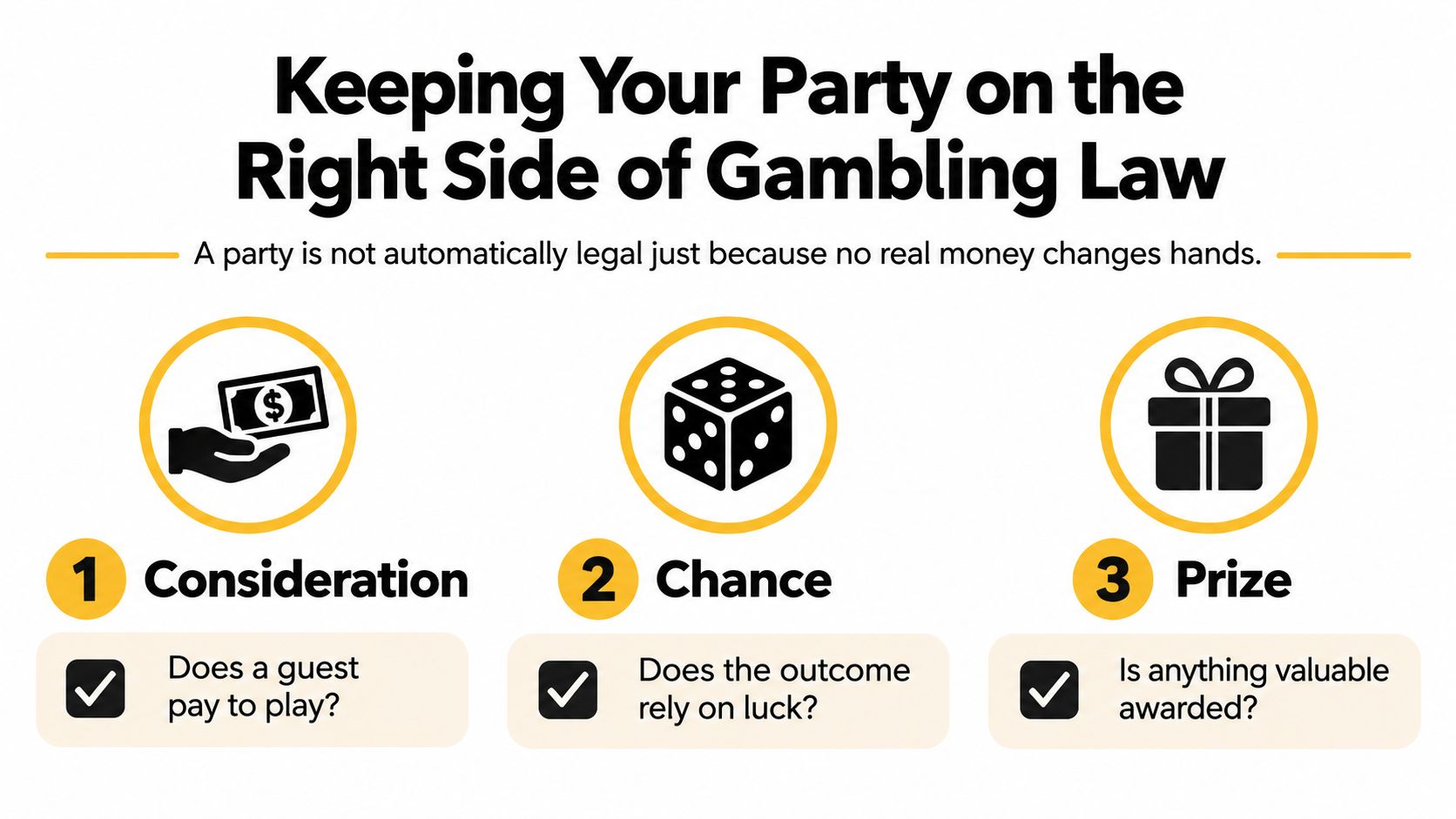
Understand what needs checking
Use these concepts to describe the event accurately when speaking with the venue or regulator:
- Consideration: Does participation require payment, a purchased chip allocation, or another required contribution?
- Chance: Does luck determine the outcome?
- Prize: Can participants receive something valuable because of that outcome?
These are screening questions, not a substitute for jurisdiction-specific advice. Moving from decorative chips to gift cards or valuable awards changes the proposal you're asking someone to approve.
Texas provides a useful warning against assumptions about charitable status. The Texas Attorney General's guidance on charitable raffles and casino or poker nights states that gambling law applies to nonprofit and for-profit organizations alike, with no nonprofit exception for casino-night fundraising.
Get answers before committing
Describe the actual format, including entry arrangements, chip distribution, and any proposed awards. Calling an event recreational doesn't resolve questions about how it operates.
- Ask the venue: Confirm its written position on simulated casino games, age restrictions, alcohol, and outside operators.
- Contact the relevant authority: Ask whether the proposed activities require permission, registration, or a permit.
- Label the materials: State that chips have no monetary value. Treat that statement as clear communication, not legal protection.
- Check insurance requirements: Ask the insurer about coverage for the activity and obtain any certificate the venue requires.
Removing financial stakes is a sensible design choice. Confirming the applicable rules is still necessary.
If prizes complicate approval, keep the visual theme and remove outcome-linked rewards. A birthday can still feel festive with hosted games, a photo area, and freely distributed party favors, subject to the venue's requirements.
Adapting Casino Night for Kids, Teens, and Mixed Ages
Casino night doesn't have to mean an adults-only room, but adding children requires more than replacing cocktails with juice. Separate the casino look from wagering behavior, and give guests ways to participate without pretending they're winning money.
Accessibility belongs in those early choices. Event-industry coverage of diversity, equality, and inclusion identifies inclusive design as a consideration across communications, food and beverage, and the wider event experience.
Offer participation without pressure
For a family birthday, use missions, trivia, or shared activity goals instead of individual betting. A group might complete a picture-matching challenge or solve a themed puzzle together, with the host celebrating participation rather than ranking players.
Teen guests may enjoy more complex decisions, but don't assume they want public competition. Offer a choice between cooperative and competitive formats, within the participation rules already confirmed for the event.
- For guests who prefer not to handle cards: Let them answer verbally, point to a selection, or work with a willing partner.
- For different reading needs: Provide large-print instructions with clear contrast and a spoken explanation.
- For mobility needs: Check the approach to each station, seating options, and reach to the playing surface.
- For sensory needs: Provide a quiet seating area away from speakers, flashing effects, and the busiest activities.
When considering children's party entertainment, look for an alternative attraction that belongs at the same celebration without requiring casino-style play. Guests shouldn't have to leave the social experience just because card games aren't comfortable for them.
Make opting out feel ordinary
Avoid announcements about getting rich, recovering losses, or chasing a bigger win. Invite guests to try an activity, watch, or take a break without explanation.
If approved rewards are part of the event, design the arrangement so reading speed, dexterity, and prior game knowledge don't determine who feels included. Keep the process transparent and participation optional.
Guest-list test: Can someone join without reading quickly, handling chips, or competing for cash-style prizes?
Also ask about needs privately before the party. A broad invitation to share access or dietary requirements is more useful than guessing from a guest's age or appearance.
Staffing Your Tables and Managing Crowd Flow
A room can be below its permitted capacity and still feel blocked around a popular table. Guests playing, watching, and waiting occupy different positions, so a layout based only on chairs will miss part of the crowd.
Plan for simultaneous occupancy and local congestion, not just the number of people invited.
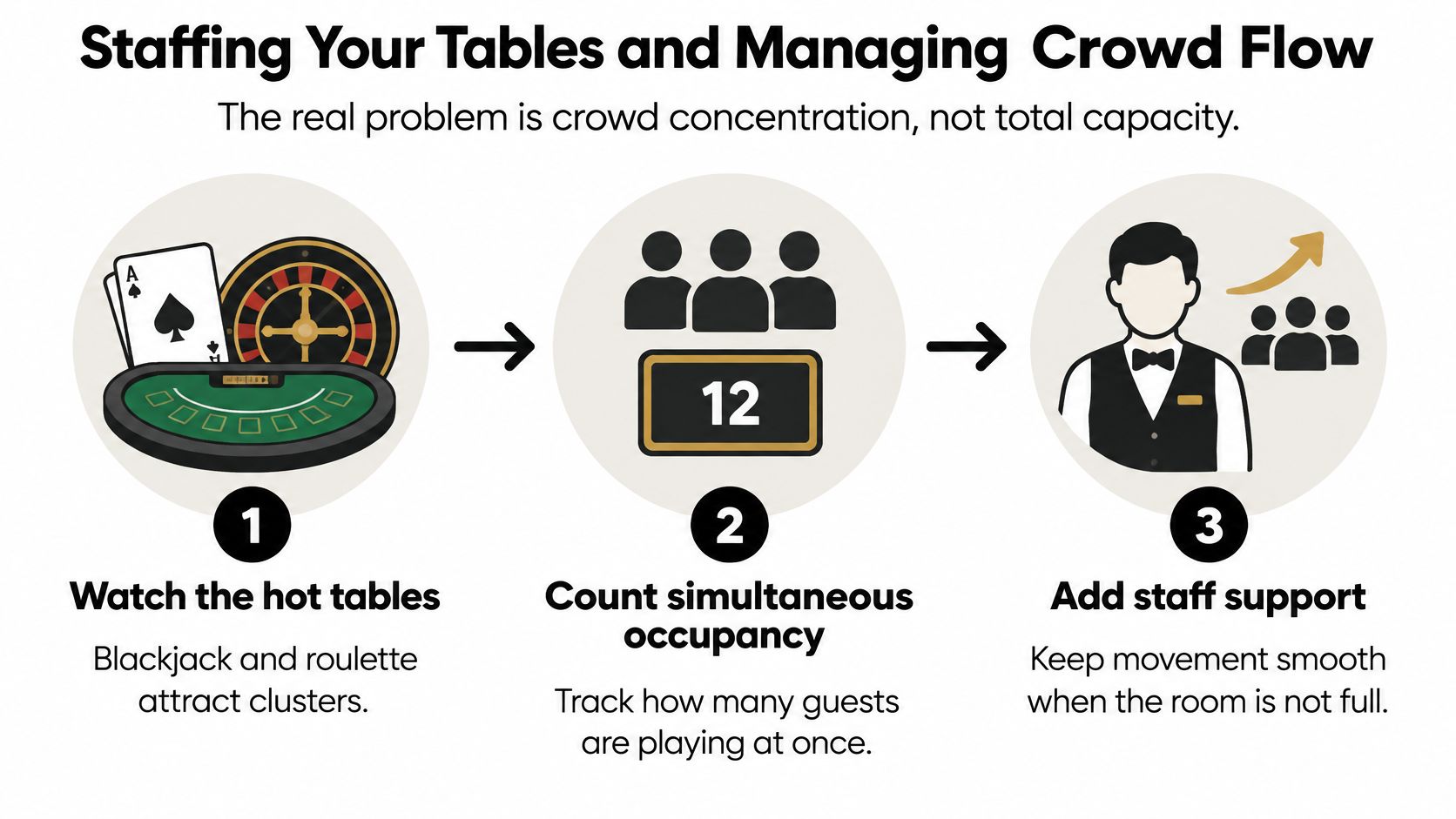
Survey, confirm, and monitor
Follow the three-stage approach described in the Canadian Centre for Occupational Health and Safety's event crowd-management guidance: survey the site, establish the permitted occupant load, and monitor attendance and bottlenecks. That guidance also identifies at least one trained crowd manager per 250 attendees where the applicable code or venue policy adopts that ratio.
Begin with a room plan showing entrances, exits, emergency routes, activity footprints, and likely queues. Ask the venue or fire authority to confirm capacity and egress requirements, and keep aisles and exits unobstructed.
Place popular attractions away from doorways, cake service, and food stations. When deciding where to serve refreshments, Lost Boy Entertainment's guidance can help you plan food for game night; use the menu plan to establish a separate serving area rather than letting plates accumulate on playing surfaces.
Give staff distinct jobs
A dealer concentrating on a game can't reliably supervise the whole room. For a smaller gathering, consider a dedicated roaming host alongside table staff, subject to the venue's requirements and the actual layout.
- At arrival: Count admissions using a check-in list or tickets.
- During play: Watch queue length, blocked approaches, and clusters of spectators.
- After transitions: Recheck the room when food, cake, or another attraction changes where guests gather.
- When movement deteriorates: Redirect guests, add staff support, or pause access to the affected area.
Give dealers a consistent explanation covering the objective, turn sequence, and how guests can stop playing. Brief everyone on emergency announcements and evacuation responsibilities before guests arrive.
Log peak attendance and problem locations. That gives the host something actionable to adjust, rather than relying on whether the room generally feels busy.
Turnkey Rentals Versus DIY and How to Book Yours
DIY works when the games are simple, the equipment is manageable, and the host has dependable help. It becomes less appealing when that same host must collect tables, teach dealers, check paperwork, and supervise the room while celebrating a birthday.
A turnkey rental shifts agreed tasks to an operator, but the word turnkey needs defining. Don't assume a package includes staffing, delivery access, overtime, or teardown just because it includes casino equipment.
DIY Setup Versus Turnkey Casino Night Rental
| Planning Factor | DIY Setup | Turnkey Rental Package |
|---|---|---|
| Planning time | You source supplies and coordinate every contributor | The operator coordinates the contracted equipment and services |
| Insurance paperwork | You clarify your coverage and collect documents from separate suppliers | Ask for the operator's certificate and any venue-required documents |
| Staffing | You recruit, brief, and supervise helpers | Confirm which tables include trained staff and who manages them |
| Delivery and setup | You arrange transport, carrying, assembly, and testing | Establish access requirements and included setup responsibilities |
| Event risk | You manage equipment issues and operational gaps | Responsibilities can be assigned contractually, but host obligations remain |
| Teardown | Your helpers pack, load, and return equipment | Confirm removal timing, cleanup boundaries, and venue access |
The useful comparison isn't merely equipment cost against package price. It's the work you retain versus the work someone else agrees to handle.
A borrowed table may suit an informal gathering. A staffed rental can be a better fit when guests expect guided play or a rented venue requires coordinated load-in and documentation.
Request a scope, not just a price
For the Carlisle-based provider behind this site, casino nights sit alongside options such as DJs, karaoke, arcade games, and carnival games. Delivery, setup, professional operation, insurance certificates, and venue-ready safety documentation are relevant services to discuss, but have the quote identify what applies to your booking.
Review the rental pricing and package information with a room plan beside you. Equipment names alone won't tell you whether the proposed activities fit the usable space or leave room for seated guests and circulation.
Send the provider the details that affect the recommendation:
- Event information: Date, venue address, guest count, and age range.
- Room constraints: Access route, available playing area, power arrangements, and venue restrictions.
- Guest requirements: Seated participation, quieter activities, readable instructions, and non-card alternatives.
- Service expectations: Dealer provision, operating period, setup, removal, and required insurance documents.
Ask who will be your contact on the day and what happens if the planned layout needs changing. A clear written scope lets you compare alternatives fairly and spend the birthday with your guests instead of troubleshooting equipment.
Phantom Entertainment offers casino-night rentals and professionally operated party attractions for birthday celebrations. Visit Phantom Entertainment with your event date, guest count, age range, venue address, and venue restrictions to request a package matched to your room and guests.
Ready to Book Your Event?
PA state-inspected, fully insured since 1979. Call us or get a free quote today.