
The most popular advice about a carnival basketball hoop is also the least useful: “It's just a simple game, so set it up and let people shoot.” That approach overlooks the two issues that determine whether guests enjoy the attraction, fairness and actual play access.
A hoop can look familiar while behaving very differently from a recreational basketball setup. Rim shape, ball inflation, backboard angle, shooting distance, target height, and prize rules all affect the outcome. At a school, corporate, or community event, guests won't judge the booth only by how colorful it looks. They'll judge whether the rules were clear, the challenge felt honest, and staff treated every participant with respect.
Designing a Fair Carnival Basketball Hoop Experience
Carnival basketball games aren't automatically unfair, but planners shouldn't assume that a familiar-looking hoop follows regulation basketball standards. The modern midway tradition is commonly traced to the World's Columbian Exposition in Chicago, held from May 1 to October 31, 1893. Its dedicated Midway Plaisance separated amusements, food, games, and attractions from the main exhibition halls, helping establish the commercial setting where skill games became central to fairs and traveling carnivals. Atlas Obscura's history of carnival games places basketball tosses within that broader tradition.
Basketball had only recently been invented when carnival operators adapted it for public entertainment. The appeal was immediate: pay for a limited number of attempts, throw a ball at a raised target, and try to win a prize. The rules are easy to understand, the play cycle is quick, and spectators can see the challenge from a distance.
Traditional midway operators sometimes made the game harder without changing its familiar appearance. Reported tactics include oval rims, higher baskets, unusual shooting distances, and overinflated balls that rebound unpredictably. In one field observation described by Steven D. Levitt and Stephen J. Dubner, an investigator recorded 316 shots during four hours, with only one successful attempt in every 40 attempts, an observed success rate of approximately 2.5%. The Economics of Everyday Things discusses that observation, while also making clear that the result isn't a universal industry average.
Questions to ask before booking
Ask the rental provider for written answers, not general assurances:
- Rim dimensions: Is the target regulation-sized, reduced, or intentionally altered?
- Ball condition: What ball size will guests use, and how will staff check inflation during the event?
- Backboard angle: Is the board vertical and consistent across lanes?
- Shooting distance: Is the line clearly marked, and does it remain the same for every participant in the same mode?
- Prize conditions: How many attempts does each player receive, and what qualifies as a win?
- Lane calibration: If there are multiple hoops, are they set up with identical equipment and distances?
Practical rule: A challenging game is acceptable when guests understand the challenge before they pay or take their first shot.
For corporate and school events, transparency is more valuable than preserving an old “rigged carnival game” gimmick. Publish the attempt limit, winning score, prize requirements, and any age-based adjustments at the booth. If the attraction uses a smaller target, describe it as a specialty challenge rather than implying that it performs like a normal basketball hoop.
Space Requirements and Equipment Setup
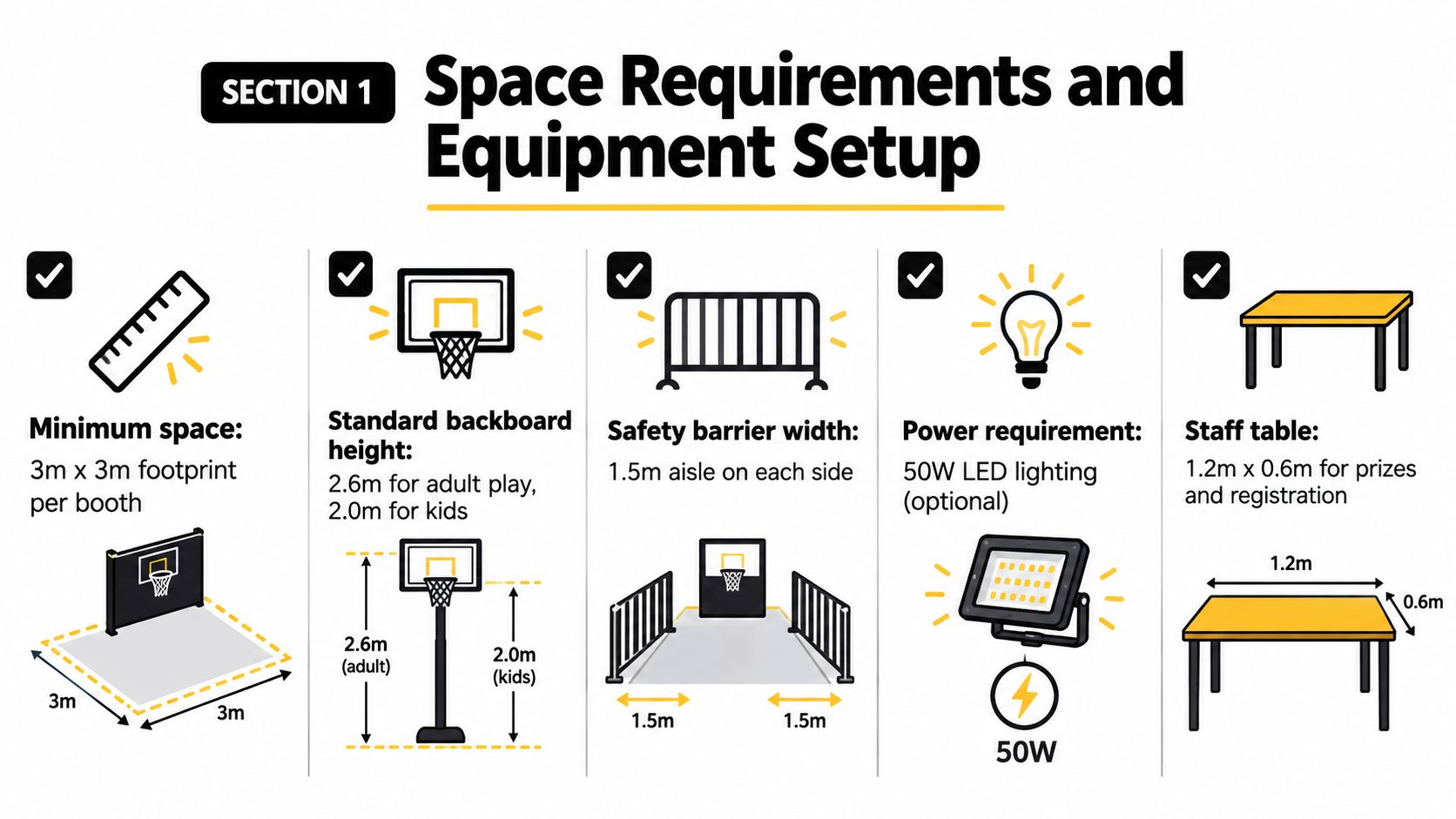
A smooth basketball booth starts with the site, not the equipment. Before delivery, walk the proposed location with the rental provider and identify the shooting lane, queue, staff position, prize area, and route used by people who aren't playing. A setup that fits physically can still create congestion if the line crosses a walkway or spectators stand behind the shooter.
The surface needs to be level, firm, and stable. Grass can work when it's even and dry, but soft ground may allow a portable frame to shift as guests move around it. Pavement is often easier to inspect, though staff should check for cracks, loose gravel, puddles, and trip points around anchors or cables. Indoor venues require the same inspection, especially where polished floors can become slippery.
Build the layout around movement
Measure more than the equipment's advertised footprint. Leave room behind the shooting line so a player can step back without colliding with the next person. Keep the queue outside the active lane, and prevent spectators from standing where a rebounding ball can strike them. A table for prizes should sit beside, not behind, the shooter.
Use a clear visual boundary around the play area. Low barriers, stanchions, cones, or floor markings can tell guests where to wait without making the booth feel closed off. Mark the shooting line with a material that stays visible under event lighting and remains secure under foot traffic.
Review the frame before guests arrive. Staff should confirm that:
- The backboard is firmly attached and free from cracks.
- The rim has no sharp edges, loose fasteners, or visible distortion beyond the advertised design.
- The support structure doesn't rock when lightly tested.
- Balls are clean, dry, and consistent in condition.
- Anchoring and ballast match the supplier's instructions and the venue's surface.
- The prize table and queue don't obstruct emergency routes.
Weather deserves its own decision, particularly outdoors. A large backboard can catch wind, and a sudden gust can turn an otherwise stable attraction into a hazard. Establish a wind and weather procedure before delivery, including who can pause play, who can authorize a shutdown, and where equipment or guests will move if conditions change.
For delivery planning, provide the rental company with gate access, loading restrictions, surface details, stairs, elevators, and the exact setup window. A practical party rental delivery checklist can help planners collect those details before event day.
Game Variations and Prize Strategy
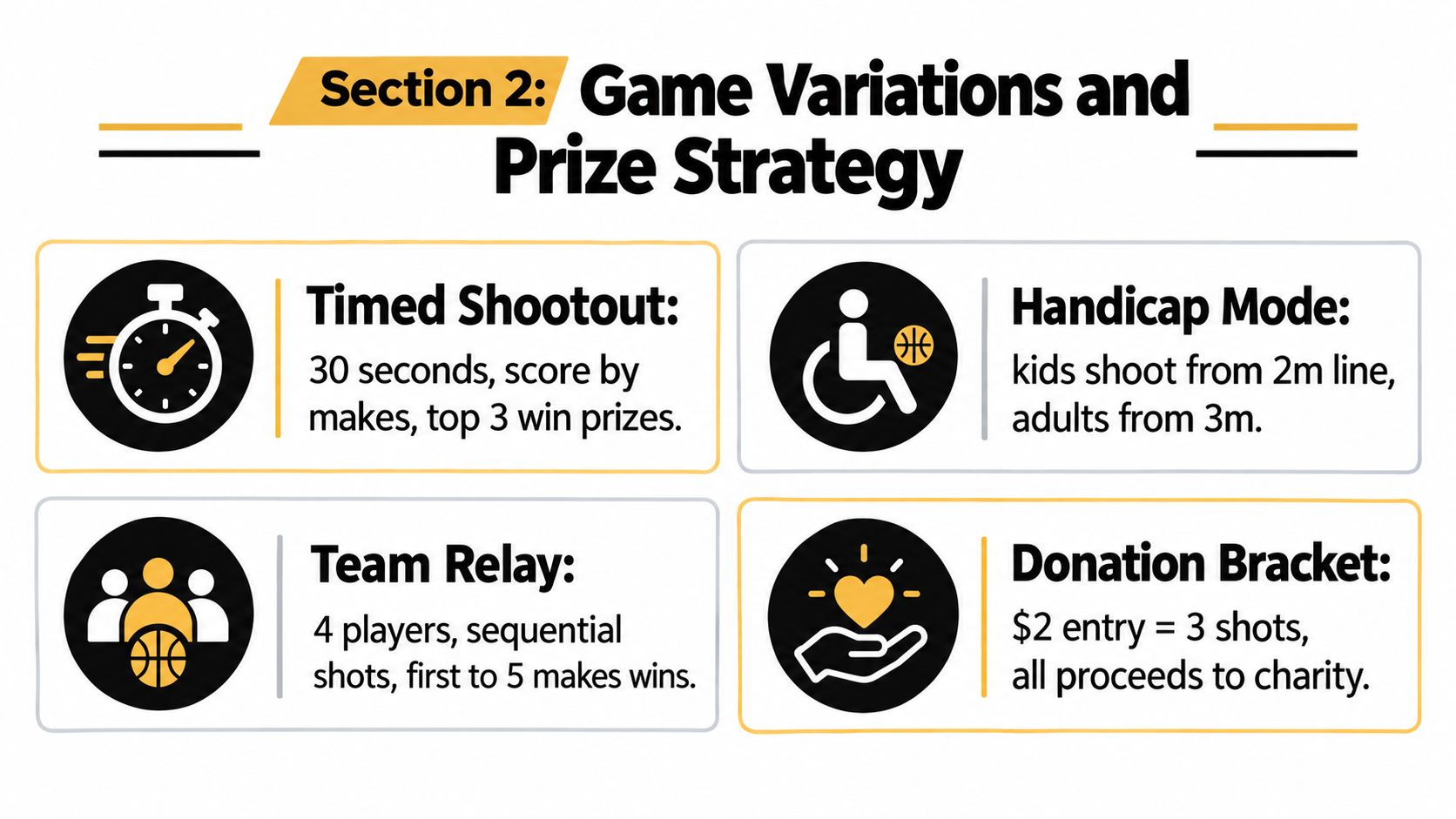
A single scoring format rarely works for every audience. Young children may need a shorter distance or a lower target, while experienced adult players may prefer a more demanding challenge. The important decision is not to make every participant use identical physical conditions. It's to make each format clear, consistent, and winnable within its own rules.
A timed shootout creates energy because spectators can immediately understand the pressure. A team relay adds conversation and cooperation, which suits company picnics, school groups, and family events. A target-score challenge works well when the booth needs a simple line, quick turns, and a visible winner.
Match the format to the crowd
Use separate modes rather than switching the rules from player to player:
- Timed shootout: Players score as many baskets as they can during a clearly announced period. Display the current top score and explain whether ties are settled by a playoff or shared prize.
- Team relay: Each player takes a turn before the next teammate steps forward. This keeps one strong shooter from dominating every attempt and gives spectators a reason to cheer.
- Age-adjusted play: Mark different shooting lines or provide a secondary target, then state the adjustment before the player begins.
- Cooperative challenge: A group works toward a shared score, which suits guests who aren't interested in head-to-head competition.
A variation only improves the experience when the equipment supports it. Don't advertise a lower target if staff can't adjust it safely. Don't offer multiple lanes if the rims, balls, or distances differ without telling participants. And don't use an age adjustment as a way to make a player's prize less valuable. The goal is equal opportunity within clearly defined formats.
Make prizes support participation
Prize planning should reward success without making casual players feel that the booth was a waste of time. A practical structure might include a small participation token, a modest reward for reaching the posted score, and a reserved premium prize for the top result in a competitive mode. The exact items depend on the audience, event budget, and venue policy.
Keep the prize language simple. “Make the posted score to choose from this group” is easier to enforce than a complicated chart that staff interpret differently throughout the day. Display examples of each prize tier, but don't promise a specific item if inventory may change.
Track inventory as the event runs. Set aside premium prizes before opening, record every award, and keep replacement items available for popular age groups. If the top prizes disappear early, the attraction can lose credibility even when the game itself is well managed.
For fundraising events, separate the entry mechanism from the game's winning conditions. Guests should know whether their payment buys attempts, supports a donation, or qualifies them for a prize. A booth that combines basketball with other classic formats can benefit from the same transparent approach described in this carnival fish bowl game guide.
Making the Game Genuinely Inclusive
A ramp to the booth doesn't automatically make the game accessible. Route access answers whether a guest can reach the attraction. Play access answers whether that guest can participate, understand the rules, control the equipment, and compete for the same type of reward.
The U.S. Access Board emphasizes accessible routes that connect areas of sport activity. That principle matters for portable attractions, but organizers should apply it beyond the path leading to the booth. A wheelchair user may reach the line and still be unable to shoot if the rim is fixed too high, the floor is unstable, or the player cannot position their chair comfortably.
Reported event-industry research says 52% of disabled people struggle to attend live events because of accessibility barriers, as cited by EventUp Planner's event trends coverage. That figure should prompt planners to examine the entire participation process, not just check whether the attraction sits near an accessible entrance.
Design multiple ways to play
Ask the rental provider whether the setup can include:
- A seated shooting position with enough space for a wheelchair and a clear approach to the ball.
- Lightweight balls for children and guests with limited upper-body strength.
- A lower target or adjustable rim that preserves a meaningful chance of winning.
- High-contrast shooting lines, backboard markings, and score displays.
- Verbal explanations and visual instructions for guests who process information differently.
- A quieter participation period for people who find loud music, cheering, or crowded lines overwhelming.
The adaptation must apply to the outcome as well as the equipment. Offering a lightweight ball while keeping the winning target impossible to reach isn't inclusion. Neither is allowing a participant to shoot from a shorter distance while secretly placing them in a lower prize category. Staff should explain the available formats and let the player choose the option that works for them.
Avoid forcing guests to disclose a disability to receive an adjustment. Post the options for everyone, train staff to offer them naturally, and protect the player's privacy. A family event works better when adaptations feel like normal game choices rather than special exceptions.
Accessibility succeeds when the guest can enter, understand, play, and win without asking for permission at every stage.
Staffing Operations and Crowd Management
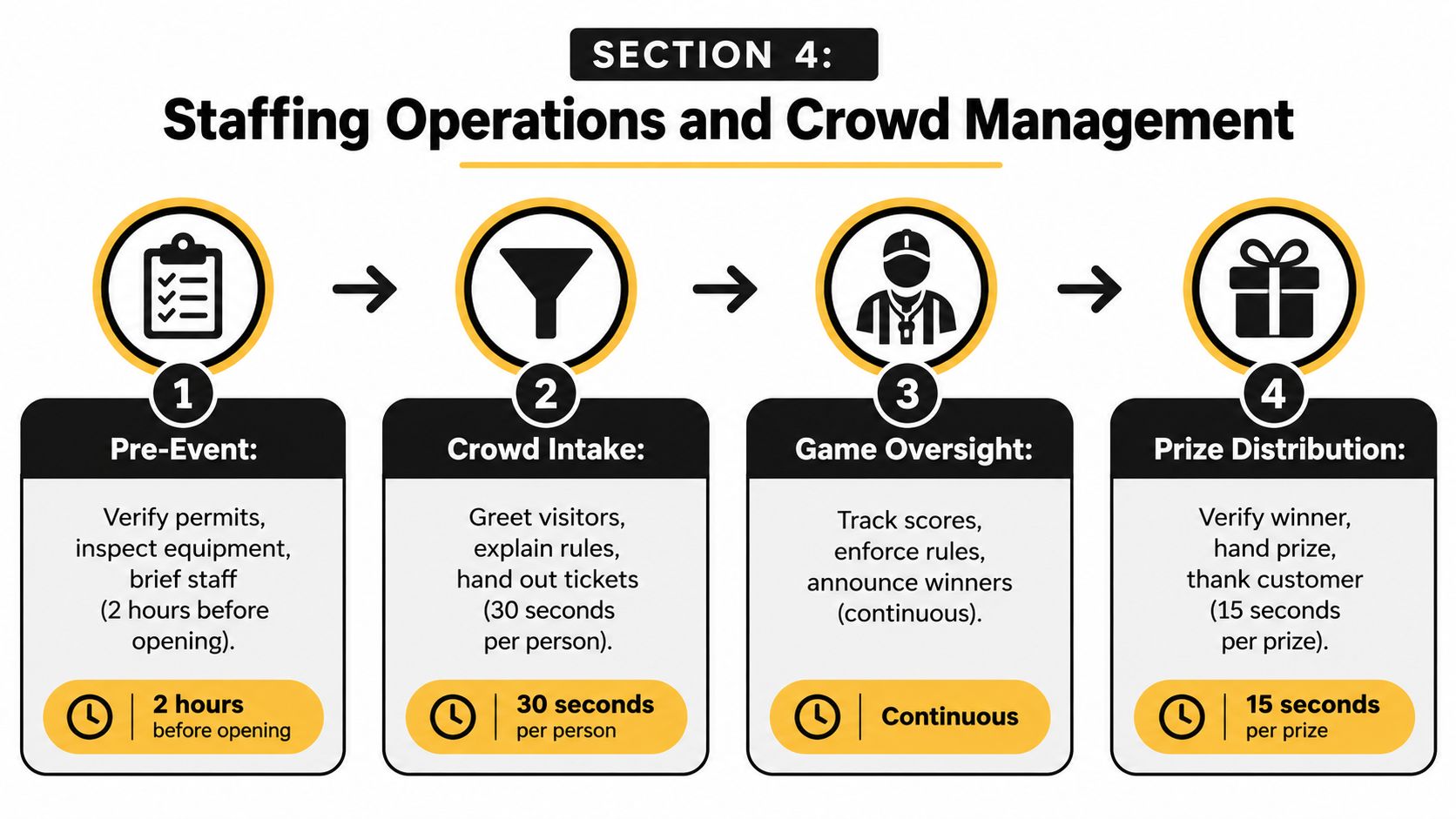
The booth needs an operator, not just an attendant standing nearby. Staff control the pace of play, protect the queue, explain the rules, retrieve balls, record scores, handle prizes, and pause the attraction when conditions become unsafe. At a busy event, one person trying to do everything will eventually miss a rule question or allow the line to spill into a pedestrian route.
Assign responsibilities before opening. One staff member can greet players and explain the format. Another can monitor the active lane, retrieve balls, and watch for unsafe behavior. A third person, when attendance warrants it, can record scores and distribute prizes. For smaller events, combine roles, but make sure one person remains focused on the shooter while play is active.
Keep the queue predictable
Place the entrance to the line where staff can see it from the booth. Use a sign that states the game mode, attempt limit, prize conditions, and any age or accessibility options. If demand rises, use tickets, wristbands, or scheduled turns so guests don't have to stand in an uncertain queue.
A visible queue is also a safety tool. It stops spectators from gathering behind the backboard, keeps bags away from the shooting lane, and gives staff room to retrieve rebounds. If the line blocks an emergency route or another attraction, pause admissions before the problem becomes a dispute.
Staff should announce each player's rules before handing over the ball. A short script works well:
- Explain the number of attempts and the winning score.
- Point out the shooting line and permitted ball format.
- Confirm whether the player wants an available alternate mode.
- Start play only after the lane is clear.
- Announce the result and prize choice immediately.
Handle disputes without damaging the mood
Close calls are inevitable. Decide in advance whether a basket must pass cleanly through the rim, whether a staff member's ruling is final, and how ties are handled. Apply the same standard to every player. Don't change a rule because a confident adult challenges it, and don't embarrass a child who misunderstood the instructions.
Safety rules need an upbeat delivery. “Please keep both feet on the floor” and “The rim isn't a handhold” are clearer and friendlier than a general warning shouted after someone climbs. Staff should stop play for hanging on the rim, throwing the ball toward spectators, entering another player's lane, or reaching into a moving rebound area.
Encouragement matters, but staff shouldn't promise a win or imply that a miss resulted from poor ability. Celebrate effort, explain the result plainly, and invite the guest to try another approved format if one is available. That tone keeps competition lively without turning a simple game into a public judgment.
Safety Documentation and Insurance Compliance
Institutional venues rarely approve an interactive attraction based on appearance alone. Schools, universities, municipalities, and corporate campuses typically want evidence that the vendor can deliver, install, inspect, operate, and remove the equipment responsibly.
Request the documentation during the booking process. Waiting until delivery day can create a preventable delay, especially when a venue needs time to review insurance wording or send certificates to its risk-management team.
Build a venue-ready file
Ask for:
- A current certificate of insurance naming additional insured parties when the venue requires it.
- Commercial general liability coverage appropriate to the attraction.
- Equipment inspection and maintenance records.
- State or local inspection documents where applicable.
- Setup, anchoring, weather, and shutdown procedures.
- Staff qualifications and operating instructions.
- Emergency contacts and an incident-reporting process.
- Written rules for participants, spectators, and prize play.
A standard vendor policy may not answer every concern about a physical amusement attraction. The venue may ask whether the policy covers operation, participant injury, equipment failure, and the specific location. Insurance requirements also vary by jurisdiction and facility type, so planners should ask the venue for its exact wording rather than relying on a generic checklist.
For organizers working with Australian venues or vendors, Australian venue liability essentials offers useful context on the role of liability insurance in venue planning. It isn't a substitute for the requirements issued by your own venue, insurer, or local authority.
Keep the approved documents accessible on event day, either in a printed binder or through a reliable digital system. Pair the paperwork with a physical inspection before opening. Documentation supports compliance, but it doesn't replace checking the rim, frame, surface, queue, weather, and staff readiness.
A practical safety documentation checklist can help planners organize certificates, inspection records, operating procedures, and venue approvals in one place. The strongest process ends with a short pre-opening briefing, where every operator knows who can stop play and how the team will respond.
Phantom Entertainment provides carnival basketball hoops and other interactive attractions with delivery, setup, professional operation, and venue-ready safety documentation across Pennsylvania and the Mid-Atlantic. For a transparent, inclusive game plan for your school, company event, or community festival, visit Phantom Entertainment and request event guidance.
Ready to Book Your Event?
PA state-inspected, fully insured since 1979. Call us or get a free quote today.