
You've booked a bounce house for a school field day, company picnic, or birthday party. The crew arrives, rolls out the inflatable, connects a tube, and switches on a blower. Within minutes, the structure stands upright. Then you notice something unexpected: the blower keeps running the entire time.
That isn't a flaw. A bounce house with blower isn't a sealed balloon that gets filled once and left alone. It's a continuous-airflow system, and understanding that system helps you plan safer power, better placement, stronger supervision, and a more reliable response if the electricity fails.
Introduction to Bounce Houses With Blowers
A school field day is ready to begin when the bounce house suddenly softens after a power interruption. That response makes sense once you understand the equipment: the blower is not filling a sealed balloon. It continuously pushes air into the inflatable while air leaves through seams, stitching, vents, and other designed openings. Firmness depends on keeping that airflow running.
The rental therefore includes more than a colorful play surface. Planners must confirm a suitable power source, protect electrical connections, route cords away from traffic, anchor the unit correctly, monitor weather, and know what to do if inflation drops. Blower capacity and the venue's electrical rules also need to fit the specific inflatable, rather than being treated as afterthoughts.
A professional setup should follow a clear sequence. The crew inspects the surface, positions the unit, secures its anchor points, connects the inflation tube, places the blower beyond children's reach, and checks full inflation before opening the attraction. If power fails during play, the supervisor should stop use and clear the inflatable according to the rental provider's instructions.
For schools, campuses, municipalities, and corporate properties, approval may also require insurance documentation and safety records before arrival.
The practical mindset: Treat the inflatable, blower, anchors, power supply, and supervisor as one operating system.
The product's history also explains why careful operation matters. Engineer John Spurlock's invention of the inflatable bounce house in 1958 helped move inflatable play structures toward mainstream event use, according to meteorological analysis published by the American Meteorological Society (background on inflatable amusements and wind incidents). That analysis describes a durable, popular product category that remains sensitive to wind, anchoring, and operating conditions.
This guide examines the details first-time planners often miss, including blower matching, power-loss response, surface-specific anchoring, and venue compliance questions to answer before booking.
How a Bounce House With Blower Stays Inflated
Think of a parachute held open by a steady stream of air. The fabric doesn't become a rigid container. Moving air keeps pressing against the material, and the shape remains stable as long as the airflow continues at the required level.
A bounce house works on the same basic principle. The blower sends air through an inflation tube into the inflatable body. Air fills the walls, floor, roof, and internal chambers, while small amounts escape through intentionally permeable seams and openings. The incoming airflow must be greater than the escaping airflow, or the structure begins to soften.
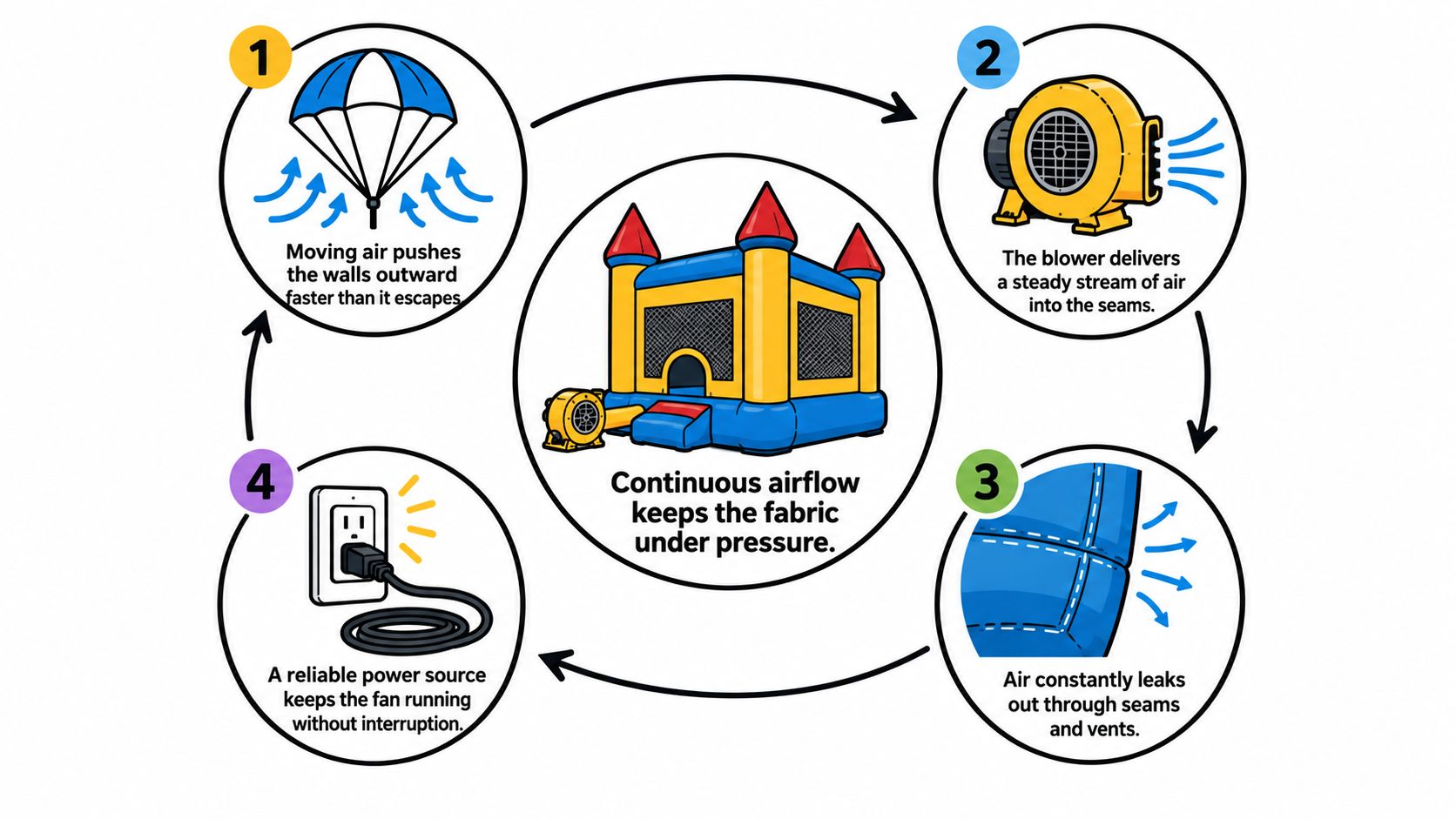
The airflow loop
The operating sequence is straightforward:
- The blower draws air through its intake.
- Its motor and impeller push that air into the inflation tube.
- The tube delivers air into the bounce house.
- Internal pressure pushes the walls and floor outward.
- Some air escapes through seams and vents.
- The blower replaces the escaped air continuously.
That last step is the one planners often overlook. Turning off the blower during active play isn't like switching off a lamp. The structure can lose pressure, soften, and collapse quickly. If children are inside, the operator should clear the unit immediately and keep it closed until it has fully reinflated.
Commercial units also use a non-return airflow valve. It helps limit rapid reverse airflow if the blower stops briefly, but it doesn't turn the bounce house into a sealed structure or guarantee that the unit will remain inflated during a prolonged outage.
Why the blower is safety-critical
Commercial bounce houses with blowers are governed by ASTM F2374-22. The standard requires blower designs to keep moving components from being easily accessible, include a non-return airflow valve, and carry permanent markings for horsepower, static pressure, and volume flow (ASTM F2374-22 blower requirements).
Those markings give an operator the information needed to match the blower to the inflatable. Horsepower alone doesn't tell the full story. Static pressure and airflow also matter because the blower must overcome the resistance created by the tube, seams, and structure.
If the power fails, don't try to keep play going while the unit deflates. Move children away, keep them clear of the blower and intake, and investigate only after the area is empty. A bounce house with blower is safe to operate only when it has the required pressure and the operator can maintain control.
Blower Types Sizing and Power Requirements
Choosing a blower starts with the manufacturer's specifications, not the visual size of the castle. A compact bounce house may need a different airflow profile from a large combo unit with a slide, climbing feature, or enclosed sections.
Market guidance commonly places standard commercial bounce houses in the range of 700 to 1,800 CFM, with many manuals recommending approximately 1.0 to 3.0 HP, depending on the unit (inflatable criteria and blower guidance). These are planning ranges, not permission to substitute any blower that seems powerful enough. The rated horsepower, static pressure, and airflow must match the inflatable's requirements.
Compare the operating choices
| Bounce House Size | Typical Blower HP and CFM | Power Setup Notes |
|---|---|---|
| Smaller commercial unit | Lower end of the 700 to 1,800 CFM range, often near the lower end of the 1.0 to 3.0 HP guidance | Use the manufacturer's specified blower, a protected outdoor connection, and cords rated for the load |
| Mid-size bounce house or combo | Middle portion of the commercial airflow range, with horsepower selected for the structure and tube length | Confirm circuit capacity before event day and avoid sharing a circuit with demanding equipment |
| Large combo or feature-heavy unit | Upper portion of the airflow range, potentially requiring the stronger end of the manufacturer's horsepower guidance | Ask whether the venue permits generator use and confirm the blower's exact ratings before delivery |
A blower that's too small may leave the floor or walls soft. That can create sagging and instability, especially when the unit is busy. A larger blower isn't automatically the answer either. The correct equipment is the model specified for the inflatable, with compatible pressure and volume ratings.
For a closer look at how footprint and features affect selection, review Phantom's guide to bounce house sizes.
Build the power plan before setup
Outdoor use should rely on GFCI-protected power and correctly rated extension cords, as reflected in the cited state guidance. Keep connections away from standing water, protect cords from vehicle paths and walkways, and route them so guests can't trip over them or pull the blower out of position.
Ask the venue whether you'll have a suitable outlet, whether outlet-powered inflatables are allowed, and whether a generator is required. A generator introduces its own operating needs, including placement, fuel management, noise, ventilation, and cord protection. Never wait until delivery to discover that the event site has limited circuits or prohibits the planned power source.
Setup Anchoring and Safe Placement
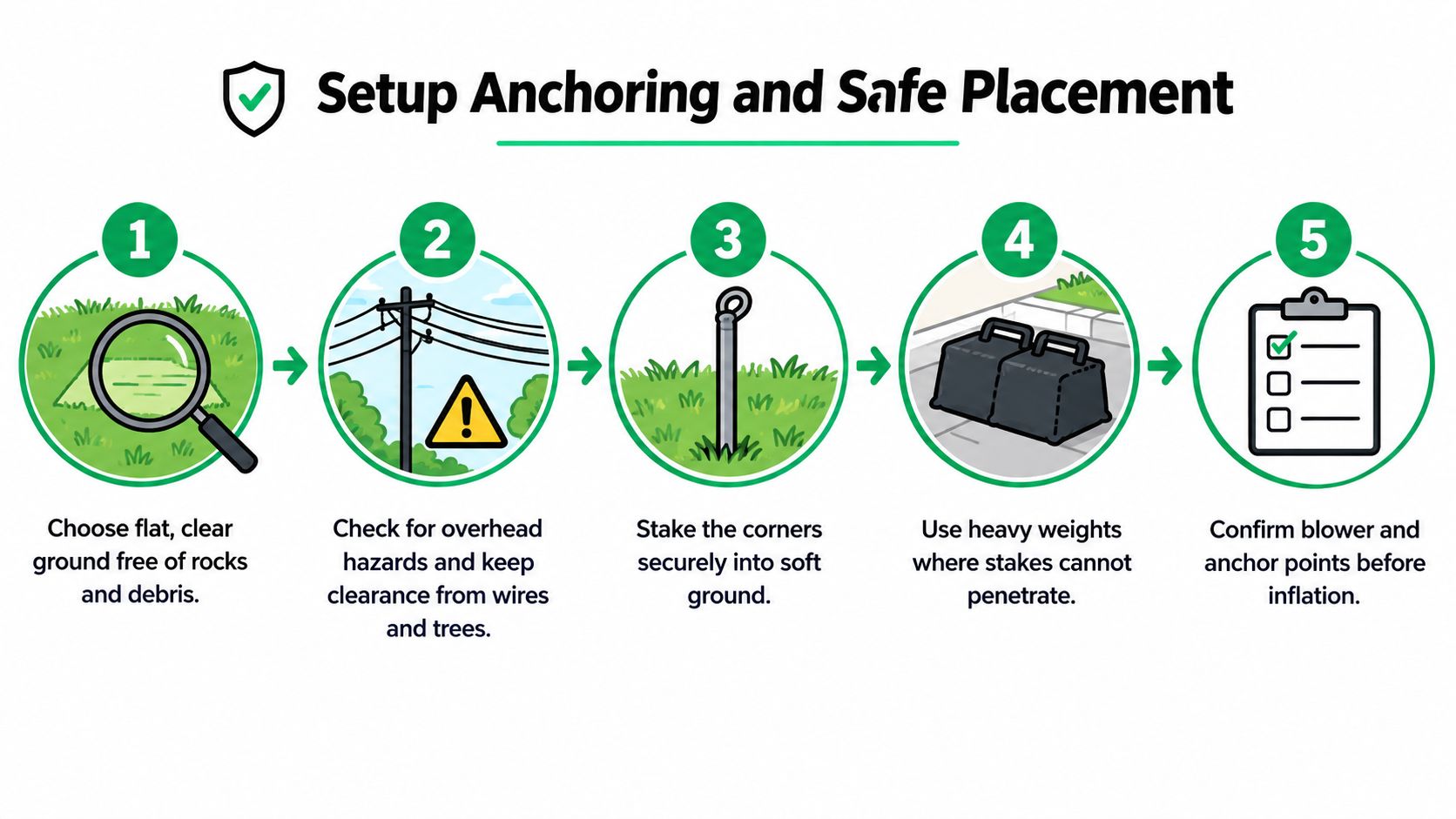
A busy event can expose setup problems quickly. Before connecting the blower, walk the full footprint, including entry and exit paths, anchor locations, and the space guests will use around the inflatable. Choose level ground that is clear of rocks, debris, holes, standing water, and sharp edges. The area must also fit the unit and leave room for safe access.
Keep the bounce house away from overhead wires, low branches, fences, walls, irrigation hardware, and other hazards. Plan the blower location at the same time. It needs protection from children, water, vehicles, and foot traffic, while its intake must have open airflow. A continuous-airflow inflatable is not a sealed balloon. The blower keeps supplying air, so a power interruption or blocked intake requires an immediate response.
Match the anchor to the surface
On suitable soft ground, use approved stakes through the inflatable's designated anchor points. Concrete, asphalt, and other hard surfaces require an approved weighted anchoring method. Random objects can shift, damage the vinyl, or leave the anchor points unsecured. Confirm the rental operator's method before delivery, especially when the venue restricts staking or has strict surface-protection rules.
The inflation tube should connect fully and remain attached during operation. Avoid sharp bends that restrict airflow. Keep the blower intake clear, and position the motor housing, moving components, and electrical connection beyond children's reach. If the unit loses firmness, stop entry and follow the operator's shutdown and evacuation instructions rather than treating the blower as a minor accessory.
A useful arrival sequence
- Inspect the ground. Remove debris and identify slopes, holes, wet areas, and hard edges.
- Check the airspace. Look for wires, trees, rooflines, and overhead obstructions.
- Lay out protection. Use suitable ground cover where the surface could abrade or contaminate the vinyl.
- Secure the unit. Stake on suitable turf or use properly rated weights on hard surfaces.
- Manage the power route. Protect cords, keep connections dry, and place the blower outside children's reach.
- Inflate and verify. Check the shape, floor firmness, seams, tube connection, and anchors before opening.
Weather belongs in the same inspection. Wind can press against the inflatable like a sail, while rain can make the surface slippery and complicate electrical safety. If conditions change, pause play and reassess the anchors, power, and site before restarting.
Site rule: If the operator cannot verify the anchors, surface, airflow path, power route, and weather conditions, the unit is not ready for guests.
Safety Guidelines Capacity and Supervision
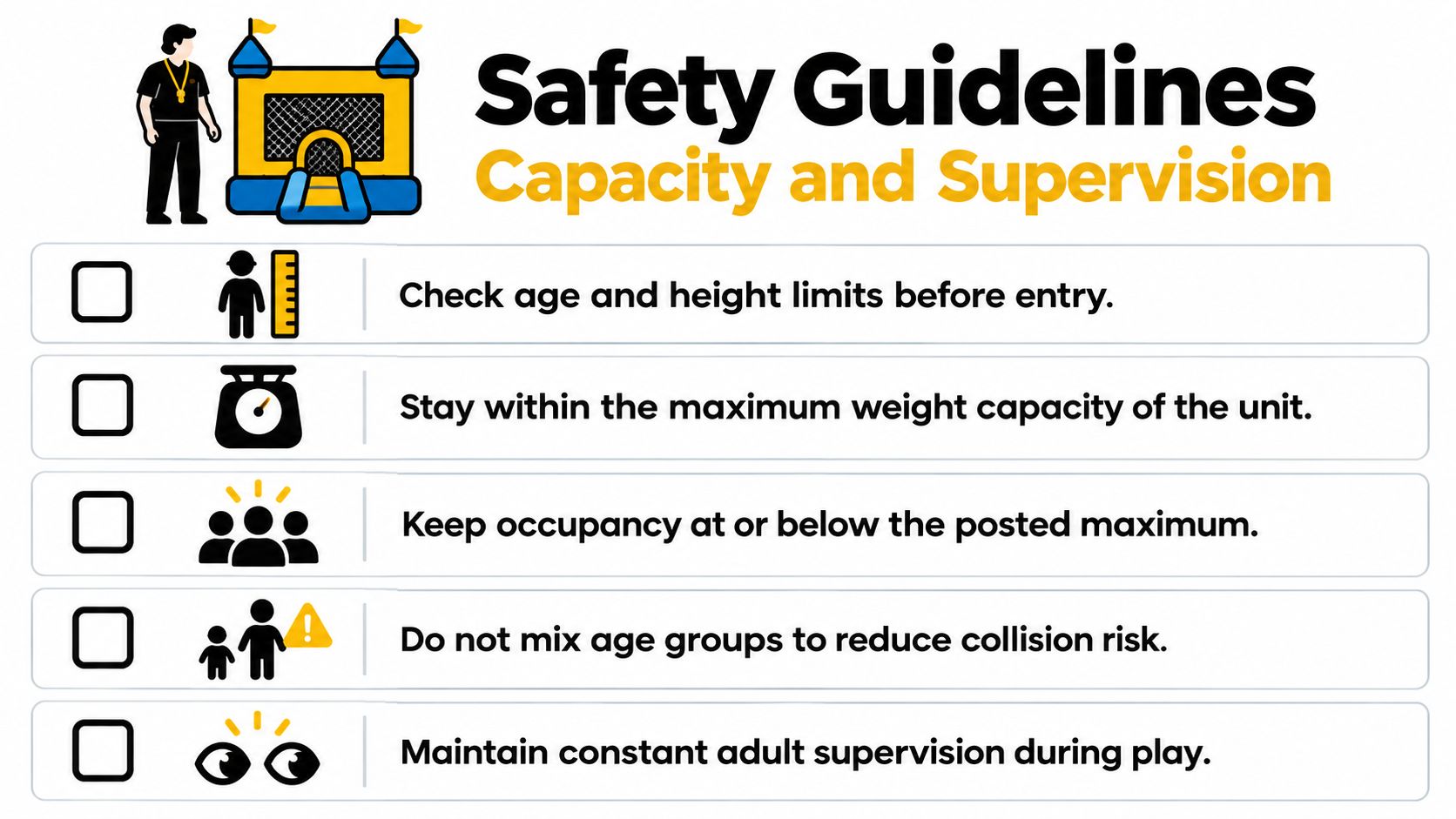
A bounce house can look ready while still creating unsafe conditions. Capacity limits, age separation, and active supervision work together because children share a moving floor and limited space. The posted capacity reflects the unit's design, including available room, impact forces, and how participants move around one another. Treat it as an operating limit, not a flexible suggestion.
Before the event, read the manufacturer's instructions and brief every supervising adult. Cover age or height limits, individual weight restrictions, total occupancy, footwear, acceptable behavior, and whether children may use slides, climbing areas, or other features. These rules should be explained before entry, not after a problem begins.
Control the play environment
The supervisor should stand where the entrance, exit, and active play area remain visible. Their role goes beyond counting children. They must pause entry, correct unsafe behavior, separate participants when needed, and stop play if the structure softens or conditions change.
Use short rules children can follow:
- Check entry limits: Confirm age, height, and weight requirements before entry.
- Control occupancy: Keep participation at or below the posted maximum.
- Separate age groups: Give younger children and larger, more active children separate play periods when necessary.
- Remove hazards: Follow the operator's sock policy, and remove shoes, food, toys, jewelry, and sharp objects.
- Stop rough behavior: Prohibit flips, wrestling, climbing exterior walls, pushing, diving, and jumping from high areas.
- Keep exits clear: Do not let children sit or gather at the entrance or exit.
Consistent enforcement matters because inflatable injuries can be serious. Pediatrics research reported a 15-fold increase in inflatable bouncer-related injuries from 1995 to 2010. In 2010, more than 30 children per day, approximately one every 45 minutes, received emergency department treatment for these injuries (injury context reported by PBS NewsHour). The same report described a Consumer Product Safety Commission estimate of more than 18,000 bounce-house-related injuries in 2018, along with a CPSC record of 12 deaths across inflatable amusements from 2003 through 2013.
Respond immediately to power loss
A blower-powered bounce house relies on continuous airflow. It works more like a tent held up by a steady air stream than a sealed balloon. If the blower stops, pressure can fall quickly even when the structure still appears partly inflated. The supervisor should:
- Clear every child from the unit immediately.
- Keep children away from the blower, intake, and cord.
- After the area is clear, check for a blocked intake, disconnected tube, or tripped breaker.
- Stop use until the cause is corrected and the unit fully reinflates.
The Health and Safety Executive guidance for inflatables emphasizes keeping users away from blower equipment and stopping use during deflation. Do not reopen the entrance based on appearance alone. Wait for the operator to confirm normal operating pressure and safe conditions before play resumes.
Venue Requirements Insurance and Weather Planning
A venue can approve your event while rejecting the inflatable plan. Schools, universities, parks, municipalities, and corporate campuses may ask for a certificate of insurance, inspection documentation, an operating plan, or proof that the equipment meets local requirements.
Ask these questions before you sign the rental agreement:
- Does the venue allow inflatables indoors, outdoors, or both?
- Is a permit required?
- Does the site require a shelter rental or specific event approval?
- Are stakes allowed on the selected surface?
- If stakes aren't allowed, what weighting method does the venue accept?
- Can the provider use an outlet, or must the event use a generator?
- Who monitors wind and rain, and who has authority to stop the attraction?
Documentation belongs in the booking process
Insurance and inspection paperwork should be exchanged early, not during delivery. If a school or municipality has a vendor portal, its staff may need time to review certificates and operating documents. A rental provider that routinely works with institutional venues can help identify those requirements before the event date.
For planners comparing coverage expectations, this guide to bounce house rental insurance can help frame the questions for both the provider and the venue.
Weather planning also needs a named decision-maker. The operator should monitor conditions, communicate with the event lead, and stop use when wind or rain creates an unsafe situation. Don't rely on a last-minute judgment from a volunteer who hasn't been trained on the equipment.
Local rules vary sharply. Government guidance described in the Irish Inflatable Hirers Federation safety certificate update notes that Irish law makes hiring out inflatables without a valid safety certificate an offense beginning in October 2025. That requirement applies in Ireland, not automatically to every U.S. venue, but it illustrates the larger planning issue: compliance depends on the jurisdiction and site.
For events across Pennsylvania and the Mid-Atlantic, Phantom Entertainment offers insured, state-inspected attractions and venue-ready documentation, including certificates of insurance. Treat that as one possible way to simplify coordination, while still confirming the specific requirements of your location.
Rental Planning Checklist and Next Steps
Start with the site and power plan, then choose the inflatable. Record guest ages, expected age groups, available footprint, surface type, outlet locations, weather backup, and the adults assigned to supervision. A suitable theme cannot correct an undersized circuit, a blocked access route, or an unsuitable floor.
Use this checklist before booking:
- Guest profile: Confirm age ranges, size differences, and whether separate play periods are needed.
- Space: Measure the area and check overhead clearance, perimeter hazards, and delivery access.
- Surface: Tell the provider whether the unit will sit on grass, pavement, asphalt, concrete, or an indoor floor.
- Anchoring: Ask whether staking is allowed and which approved weighting method applies if it is not.
- Power: Confirm the outlet, GFCI protection, cord route, circuit availability, and generator policy.
- Weather: Establish who monitors conditions and when use must stop.
- Supervision: Assign adults to control entry, occupancy, behavior, and emergency clearing.
- Operations: Confirm delivery, setup, inflation checks, active operation, cleaning, takedown, and documentation.
- Emergency response: Ask what to do during unplugging, breaker trips, blower failure, or power loss.
A bounce house is a continuous-airflow system, not a sealed balloon. If power stops, the structure can soften quickly, so the event briefing should require immediate clearing, a blower and intake check, and no reuse until the unit is fully reinflated. Confirm that the blower matches the unit and that its circuit can support uninterrupted operation.
For several vendors, audit your AV provider with the same discipline. Request clear responsibilities, setup requirements, and an emergency contact for each technical service. For birthday or family events, compare the footprint and operating plan with a moon bounce rental package.
Phantom Entertainment provides bounce houses and other inflatable attractions with delivery, setup, professional operation, insurance documentation, and venue-ready safety support across Pennsylvania and the Mid-Atlantic. Before booking, discuss the site, power, anchoring, guest mix, and weather plan with Phantom Entertainment.
Ready to Book Your Event?
PA state-inspected, fully insured since 1979. Call us or get a free quote today.