
A bounce house becomes far more than a free-play attraction when guests have a reason to enter, a clear challenge to complete, and a short round that keeps the line moving. That structure matters because inflatable play carries real operational risks. Federal reporting has cited about 6,000 bounce-house injuries annually in the United States, while another review estimated 47,446 emergency-department-treated injuries from inflatable amusements during 2011–2013 in pediatric safety guidance from Nationwide Children's Hospital.
The eight bounce house games below cover distinct event experiences, from large-group races and athletic contests to novelty entertainment and interactive technology. The right fit depends on participant age, available space, event goals, throughput, staffing, weather exposure, and whether you're booking a standard inflatable or a specialized setup.
Keep the operating framework simple. Follow the rental operator's capacity and equipment instructions, separate incompatible age groups, remove shoes and sharp objects, monitor weather and equipment, and keep entrances and exits clear. For commercial events, ASTM F2374 safety guidance referenced by the U.S. Consumer Product Safety Commission treats trained supervision, weather monitoring, anchoring, and operating procedures as core controls. Phantom Entertainment can support turnkey events with delivery, setup, professional operation, and venue-ready safety documentation, but the activity still needs a format that matches your crowd.
1. Bounce House Obstacle Course Races
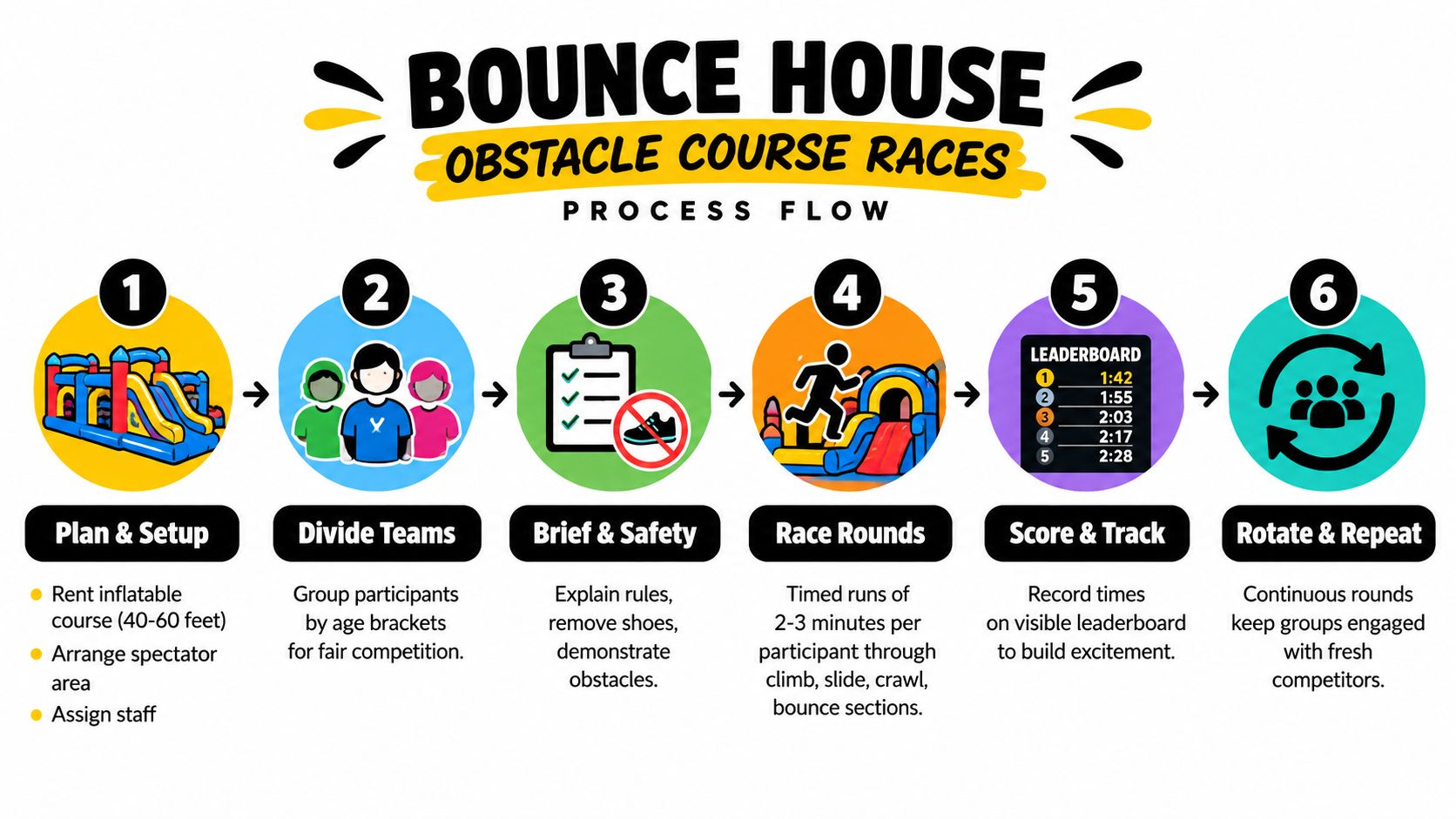
Obstacle course races create the strongest large-group competition because each participant has a clear start, a sequence of physical challenges, and a finish worth cheering. A commercial course can combine bounce sections with crawl-throughs, tunnels, climbing walls, and slides. That mix works especially well for school field days, corporate picnics, university orientation events, and community festivals where guests want an active centerpiece rather than an open jumping area.
Use timed runs for individual participation or head-to-head lanes for a tournament format. Large schools can divide competitors by age group, while a company picnic might organize departments into team brackets. A visible leaderboard gives spectators a reason to stay engaged, but it should record results without encouraging unsafe rushing or contact.
Make throughput part of the game design
Short runs keep the attraction moving and prevent one competitive format from creating a long, frustrated queue. Assign staff to the entrance, finish area, and any section where participants climb, slide, or change direction. The operator should control starts, pause the course when a participant falls or stops, and confirm that the route is clear before releasing the next runner.
- Age brackets: Group participants by age and approximate size so competition stays fair and collisions are less likely.
- Run format: Use brief rounds, then reset quickly rather than allowing unstructured crowding inside the course.
- Hydration: Place water nearby because repeated obstacle runs can be more strenuous than ordinary bouncing.
- Site preparation: Set the unit on flat, even ground, away from trees and power lines, following the operator's setup requirements. Nationwide Children's Hospital's bounce-house safety guidance emphasizes appropriate supervision, controlled participation, and avoiding rough play.
The trade-off is staffing. An obstacle course can handle an energetic crowd, but it needs more active management than a basic bounce house. It's a strong choice when the event wants competition, spectators, and repeat participation, not when the organizer has no one available to run starts and enforce capacity.
2. Bounce House Sumo Wrestling
Sumo wrestling is novelty entertainment built around short, funny matches. Participants wear oversized padded suits and try to push an opponent down or out of a marked circle inside a soft inflatable arena. The spectacle works for college grad nights, corporate summer picnics, teen birthdays, bar and bat mitzvahs, and community festivals because spectators understand the objective immediately and can enjoy the match even when they aren't competing.
The best setup feels more like a hosted attraction than casual play. An enthusiastic announcer can introduce contestants, explain the rules, and keep the audience involved. For a larger event, create a tournament bracket and offer recognition to the winner, but keep the emphasis on controlled, good-humored contact rather than force.
Keep matches brief and inclusive
A match should end before fatigue turns into awkward falls or reckless pushing. Staff should help contestants put on and remove the suits, check that each participant can move comfortably, and demonstrate how to fall without striking another person. Multiple suit sizes make the attraction more welcoming for mixed groups, although the operator still needs to confirm the equipment's approved user limits.
Practical rule: The contest is pushing within the marked area, not tackling, grabbing, striking, or continuing after someone falls.
Use a designated photo area outside the active arena so guests can capture the oversized costumes without blocking the entrance or exit. This works particularly well at a corporate event, where employees may want a memorable team photo even if they don't want to enter a match.
The main trade-off is throughput. Sumo produces strong spectator energy, but only a small number of people compete at once. Brief matches, an orderly queue, and a host who keeps the bracket moving prevent the attraction from becoming a bottleneck. It's less suitable for a young children's free-play zone or a crowd that needs continuous access, and more suitable when comedy and audience reaction are part of the event's purpose.
3. Inflatable Laser Tag Arena
An inflatable laser tag arena creates a structured team competition rather than open-ended bouncing. Players move around padded barriers, hiding spots, targets, and raised sections while tagging opponents or completing objectives. The format suits middle and high school field days, university orientation programs, technology-themed birthdays, corporate team-building, and community festivals serving older children, teens, and adults.
Team play generally produces a better event experience than an individual free-for-all. Divide players into recognizable groups, explain the objective before handing out equipment, and run short rounds with planned rotations. This gives less athletic participants useful roles and makes communication part of the challenge, rather than rewarding only the fastest runner.
Run the arena as a managed competition
The operator must control the inflatable and the technology at the same time. Each briefing should cover boundaries, equipment handling, tagging rules, and what to do when a device stops working. Check vest and equipment sizing before play begins, since loose straps or uncomfortable gear can restrict movement and distract participants.
- Team modes: Use capture, target, or score-based objectives to promote communication.
- Rotation plan: Keep the next teams ready outside, while leaving the entrance clear.
- Scoring: A simple leaderboard can maintain interest across several rounds without making every match high pressure.
- Staffing: Assign one operator to manage setup, equipment, rounds, and troubleshooting. Do not leave the system unattended.
The trade-off is operational complexity. Laser tag offers more strategic depth than open bouncing, but it depends on a reliable operator, charged equipment, and clear instructions. Match players by age and ability where possible. Fast games with crowded teams can become chaotic even inside a padded arena, so staff should pause play when participants ignore boundaries or equipment rules.
For a technology-focused event, combine the arena with Phantom Entertainment's mobile laser tag or another complementary gaming station only if the site can support the additional staffing and equipment. A strong package can offer active competition alongside a lower-pressure interactive attraction, giving guests a choice without creating an unmanaged queue.
4. Bounce House Dunk Tank Challenge
A dunk tank challenge turns a bounce house into a spectator event. Participants bounce, jump, and aim for a trigger that drops a volunteer or staff member into a water tank. The visible result creates suspense and crowd reaction, making the format suitable for school fundraisers, church youth events, community festivals, corporate picnics, and graduation celebrations.
Choose the volunteer carefully. A principal, coach, manager, or community leader gives spectators a reason to watch and participants a clear target. Announce the volunteer beforehand, then mark a queue away from the inflatable, tank, and wet areas. This keeps the attraction active without allowing the audience to crowd the equipment.
Plan the wet zone before opening
Water affects the entire site plan. Position spectators where spray will not create a slipping hazard, keep towels and dry clothing available, and assign staff to check the water level and surrounding surface. The operator should explain who can enter, how many attempts each participant receives, and when play stops for resetting or cleanup.
For a fundraiser, post the attempt format before guests join the line. Event staff should handle payments and queue flow rather than leaving those tasks to the volunteer. Confirm that the volunteer accepts repeated dunking and has a private place to change or warm up.
Weather also determines whether the activity can run. Follow the rental operator's shutdown instructions and stop participation when conditions make the unit or water unsafe. Keep children away from the tank, trigger mechanism, and wet edges unless the equipment is specifically designed for their use.
The format creates strong engagement, but it requires more coordination than a dry inflatable. Plan water access or an approved filling method, a suitable surface, cleanup supplies, and a rotation of willing volunteers. For warm-weather fundraising, the added work can pay off because every attempt produces a visible outcome and encourages repeat participation. A controlled queue, clear boundaries, and an attentive operator keep that excitement manageable.
5. Inflatable Bounce House Dodgeball Arena
Dodgeball creates a clear team contest without requiring every participant to master a complicated course. In a specialized inflatable arena, players compete on a soft, bouncy surface surrounded by padded walls and divided into team areas. Foam balls, marked boundaries, and a neutral referee give the game enough structure for school field days, summer camps, university orientation programs, corporate team competitions, and youth athletic events.
The bouncy floor changes the rhythm. Players need to control their footing before throwing, and a quick sprint can become an unstable landing. That's why the referee should stop rough play, enforce the approved rules, and remove balls that are damaged or unsuitable. Participants should be grouped by age, size, and ability rather than using one open match for an entire mixed crowd.
Build safety into every round
Start each match with a short explanation of boundaries, throws, outs, resets, and acceptable conduct. A neutral staff member should remain focused on the game instead of running another attraction at the same time. Frequent rotations give waiting teams a defined place in the schedule and keep the same players from dominating the activity.
A soft arena reduces hard-surface impact, but it doesn't remove the need for supervision, capacity control, age separation, and rules against rough play.
Use colored foam balls or clearly marked team equipment so players can identify possession quickly. Schedule rest and water breaks, especially for outdoor events in warm weather. Organizers should also ask participants or guardians to identify physical limitations or health concerns before play, then provide a non-playing role when appropriate.
The trade-off is intensity. Dodgeball can involve more simultaneous participants than a one-on-one novelty game, but it also creates more moving objects and rapid direction changes. It works best with an assertive referee and matched teams. It won't suit every child, so pair it with a quieter activity or spectator-friendly station at family events.
6. Bounce House Basketball Hoop Challenge
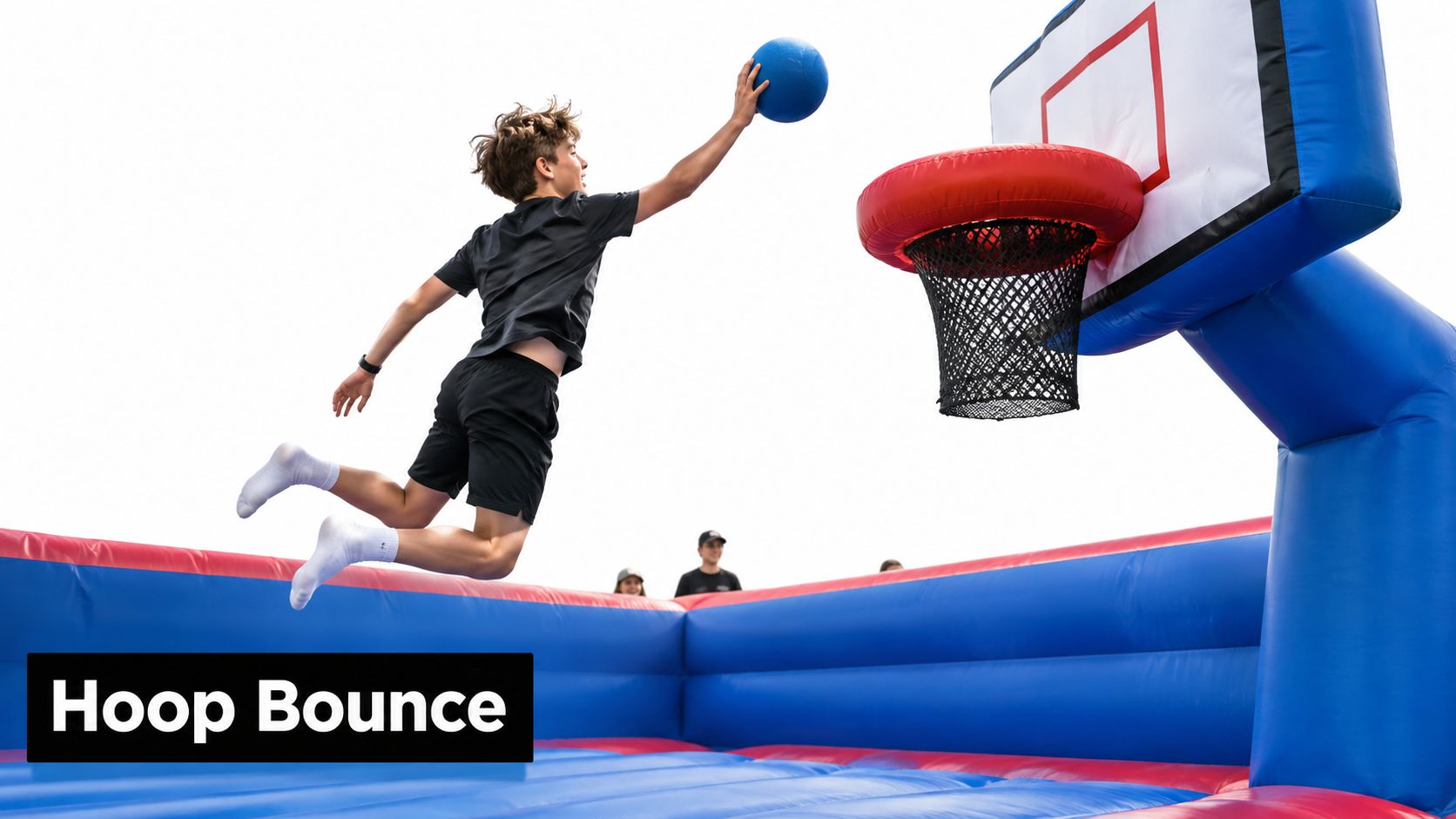
Basketball creates steady participation with little explanation. Guests bounce across an inflatable court, then shoot or dunk at hoops set for different heights. The format suits school field days, sports-themed events, company picnics, community recreation programs, basketball parties, and university athletic events. It also works well as a high-capacity station beside a more theatrical attraction.
Set the experience by audience. Younger children can use a lower hoop and count made baskets. Older players may prefer timed scoring, a personal-best challenge, or a friendly knockout round. Keep the court from becoming crowded by releasing players in small groups and limiting each turn to a defined number of shots.
A simple rotation keeps the queue fair. One staff member should control entry and exit, retrieve balls, and assist younger participants. That person should also pause play when a player falls, equipment shifts, or loose balls collect near the landing area.
Make the scoring fit the crowd
An individual challenge can become a group event with a visible leaderboard. Keep the rules easy to understand, then recognize accuracy, improvement, or team totals alongside raw scores. This gives less athletic guests a reason to return for another attempt.
Choose the format before opening the station:
- Target height: Begin with an achievable hoop, then adjust by age group when the equipment allows it.
- Ball management: Provide enough balls to limit waiting, but remove extras before they create trip or collision hazards.
- Court access: Keep the entrance and exit clear, and admit the next player only when the landing and shooting areas are ready.
- Rotation style: Alternate free shots, timed attempts, team totals, and knockout rounds to maintain interest.
The trade-off is reach versus spectacle. Basketball is easy to explain and supports regular participation, though it usually creates less drama than sumo or jousting. At a school field day, it can absorb guests between organized races. At a corporate picnic, it offers a competitive option for people who would rather shoot than wrestle or sprint. For mixed-age events, separate rounds by size and ability, and schedule water breaks when the attraction runs outdoors in warm conditions.
7. Inflatable Bounce House Jousting Tournament
Jousting delivers a themed event experience before the first match begins. Participants wear padded equipment, take foam lances into an inflatable ring, and try to knock an opponent down or out of the marked area while maintaining balance. It's a strong choice for medieval festivals, Renaissance events, fantasy-themed parties, corporate entertainment programs, bar and bat mitzvahs, and college celebrations.
The format benefits from theatrical presentation. Give the announcer a playful role, create a viewing area that feels like a royal court, and use tournament brackets so spectators know who will compete next. A short demonstration is essential because participants need to understand where to stand, how to hold the lance, and when the match ends.
Let the theme support safe behavior
Theme should reinforce the rules rather than encourage aggressive play. Staff must provide and remove equipment safely, check that participants are properly fitted, and stop a match when someone loses balance or drops their lance. Matches should stay short enough to preserve control and keep the queue active.
Use different suit and lance sizes when available, but don't treat costume fit as a minor detail. Oversized equipment can affect balance, visibility, and movement. Match participants thoughtfully and make the competition optional for guests who prefer to watch, announce, photograph, or help with the bracket.
The trade-off is high entertainment value with lower simultaneous capacity. Jousting is excellent for memorable photos, commentary, and spectator involvement, but it isn't the best stand-alone solution for a large crowd that needs constant movement. Pair it with basketball, target games, or another station that can accept guests continuously.
8. Bounce House Interactive Target Game System
Interactive target systems turn inflatable play into a physical arcade challenge. Light-up panels, touch-sensitive targets, and timed sequences direct participants to tap, hit, or jump toward specific zones. They suit technology-focused school events, STEM recruitment programs, corporate gaming themes, family festivals, youth centers, and recreation programs, especially when guests want structured play rather than open bouncing.
Start with a demonstration round. Show where players stand, how targets register contact, and what ends the turn. The operator should also explain whether the score rewards speed, accuracy, pattern completion, teamwork, or several objectives. Choose the difficulty for the audience. A sequence that engages teens may overwhelm younger children, while a simple setting can lose their attention quickly.
Build the rotation around the experience
Short, timed turns keep the system moving through a school or festival schedule. Individual rounds suit guests who want a leaderboard. Cooperative modes give families and mixed-age groups a reason to play together, while demonstration rounds help hesitant guests understand the controls without pressure.
Use the setup as an interactive station, not a single-player showcase. Keep music and sound at a level that supports the atmosphere without masking instructions. One trained operator should handle scoring, resets, troubleshooting, and safe entry and exit. That role matters because technical delays can create a queue faster than the game itself.
Before guests arrive, test the target sequence, touch points, power supply, and weather protection. Confirm that the inflatable surface is clear and that participants can enter and leave without crossing an active play zone. Pause the system whenever a player needs assistance.
A brief demonstration helps guests understand the scoring before their turn.
The main trade-off is reliance on technology and power. Interactive targets can attract guests who would skip a basic bounce house, but the experience weakens if staff cannot reset the system, protect components from weather, or explain the rules quickly. Pair it with a physical course, laser tag, or arcade-style station so the event still has steady activity during resets or technical interruptions.
Bounce House Games: 8-Item Comparison
| Attraction | Implementation 🔄 | Resources ⚡ | Expected Outcomes ⭐📊 | Ideal Use Cases | Key Advantages 💡 |
|---|---|---|---|---|---|
| Bounce House Obstacle Course Races | High 🔄, long setup, multi-point staffing, bracket coordination | Large footprint (40–60 ft), multiple modules, scoreboards, 3–6 staff, power | Very high engagement ⭐⭐⭐; competitive content, spectator excitement 📊 | School field days, corporate team-building, uni orientations, festivals | Scalable for large groups; spectator-friendly; tournament format |
| Bounce House Sumo Wrestling | Moderate 🔄, arena setup, suit handling, match officiating | Moderate space, 2–6 suits, padded arena, MC/ref, cleaning supplies | High entertainment ⭐⭐; quick rotations, social media appeal 📊 | College events, parties, corporate picnics, festivals | High laugh factor; low injury risk; fast participant turnover |
| Inflatable Laser Tag Arena in Bounce House | High 🔄, tech integration, power and operator required | Specialized inflatable, laser guns, electronic targets, power source, trained staff | Very high immersion ⭐⭐⭐; tech-savvy appeal, competitive scoring 📊 | School/uni events, teen parties, tech-focused corporate events | Blends physical play with digital scoring; immersive experience |
| Bounce House Dunk Tank Challenge | Moderate 🔄, water system, safety checks, seasonal limits | Water tank, plumbing/drainage, bounce area, towels, volunteer dunkers | Strong fundraising & spectator appeal ⭐⭐; humorous engagement 📊 | Fundraisers, PTA events, community festivals, summer picnics | Excellent for donations; highly photogenic; community engagement |
| Inflatable Bounce House Dodgeball Arena | High 🔄, large enclosure, strict safety enforcement | Large padded arena, many foam balls, multiple staff, scoreboard | High physical/team impact ⭐⭐⭐; sustained play with rounds 📊 | Field days, corporate team-building, camps, university events | Safer dodgeball alternative; supports large teams; competitive |
| Bounce House Basketball Hoop Challenge | Low–Moderate 🔄, hoop mounting, ball management, simple scoring | Moderate space, adjustable hoops, soft balls, ball-return/collection, 1–2 staff | Good engagement ⭐⭐; inclusive and repeatable play 📊 | Sports events, birthdays, rec centers, athletic recruitment | Accessible to wide ages/skill levels; easy to run and rotate |
| Inflatable Bounce House Jousting Tournament | Moderate 🔄, arena, protective gear, match brackets | Arena, foam lances, padded suits, referee, spectator area | High novelty and visual appeal ⭐⭐; memorable moments 📊 | Renaissance fairs, themed festivals, college events, parties | Thematic/photogenic; tournament-ready; appeals to fantasy fans |
| Bounce House Interactive Target Game System | High 🔄, electronics, programming, operator, weather protection | Light-up targets, control system, power, sound/LEDs, trained operator | Very high replay value ⭐⭐⭐; measurable scores and leaderboards 📊 | STEM events, corporate tech gatherings, family fun days, schools | Adaptable difficulty, strong replayability, clear scoring feedback |
Choose the Right Game for Your Crowd
Start with the event experience, not the inflatable's appearance. Obstacle courses and dodgeball are the strongest choices when a school, company, university, or municipality wants large-group competition. They create teams, brackets, and repeat rounds, but they also require staff who can control entrances, enforce rules, and manage rest periods.
Choose basketball when you need simple continuous play. Guests can understand the objective quickly, and the operator can vary hoop height, scoring, and round length for different ages. Sumo and jousting work better when the event wants novelty, laughter, photos, and spectators. Their short matches create memorable moments, but they won't move an entire crowd through the attraction at once.
Technology-focused audiences often respond well to interactive target systems and laser tag. Both formats provide more than bouncing, but they depend on equipment checks, operator support, clear briefings, and a workable power plan. Laser tag adds team strategy and movement, while target systems offer faster individual turns and more flexible difficulty.
The dunk tank challenge belongs in the warm-weather fundraising and community-event category. A recognizable volunteer gives the activity a social hook, and the audience can watch every attempt. Water access, wet-surface management, volunteer comfort, and weather controls make it more operationally involved than a dry game.
Whatever you choose, confirm the site before booking. Check available space, surface condition, access routes, power, weather exposure, staffing, participant ages, expected throughput, and the operator's capacity and shutdown requirements. Commercial inflatables should be set up on flat, even ground away from trees and power lines, with anchoring and supervision handled according to the governing operating guidance. The CPSC's ASTM F2374 reference identifies an operational wind threshold of at least 25 mph for sustained gusts over a three-second period, and it describes trained attendants as responsible for monitoring weather and sustained wind speed. Treat that as a planning input, not an afterthought. Wind-related reporting identified 479 injuries and 28 deaths worldwide in more than 130 bounce-house accidents since 2000, according to the same CPSC-referenced safety material.
Age separation deserves equal attention. Pediatric guidance recommends similar-age and similar-size participants when multiple children use an inflatable, while rough play, flips, and crowding should be prohibited. For inclusive participation, look for equipment and game formats with wide, low entrances, flat stable floors, non-slip surfaces, and trained adult assistance, as described in this accessible inflatable-use guide. Inclusion works best when the organizer adapts the game, entry method, rotation, and supervision model before the event begins.
A practical event plan pairs one high-capacity game with one spectator-friendly or lower-intensity activity. For example, combine an obstacle course with basketball, dodgeball with an interactive target system, or a dunk tank challenge with a quieter carnival station. If delivery, setup, professional operation, insurance documentation, and safety coordination need to be handled together, work with a rental provider that can support the complete plan. For more ideas beyond inflatables, review this Lounge Wagon guide to outdoor fun.
Phantom Entertainment provides bounce houses, obstacle courses, sports inflatables, laser tag, arcade games, and other event attractions with delivery, setup, professional operation, and venue-ready safety documentation. Match your crowd to the right bounce house games, then visit Phantom Entertainment to discuss a practical package for your school, corporate, family, nonprofit, or community event.
Ready to Book Your Event?
PA state-inspected, fully insured since 1979. Call us or get a free quote today.