
Your event schedule has a familiar problem. A school field day, company picnic, campus orientation, or community festival needs flexible entertainment that can engage small groups between larger activities, fit indoors or inside a quiet pavilion, and work for different ages and confidence levels. A mobile escape game can fill that gap, but only if the format matches the way people move through your event.
This roundup ranks the best mobile escape room games as event stations, team-building activities, and themed entertainment. The ranking considers theme, group flow, run time, difficulty, device setup, space, audience fit, strengths, limitations, and booking decisions. Digital games can complement professionally delivered attractions rather than replace them, especially when you're building a broader package with turnkey rentals from Phantom Entertainment.
The best mobile escape room depends on attendee flow and venue conditions, not simply the game's rating.
Escape rooms perform well when puzzles, atmosphere, story, and challenge balance work together. A TripAdvisor-based study of 6,203 reviews found that 88.47% received five-star ratings, with players frequently praising puzzles, storyline, game master quality, ambience, theme, and value in the published customer-experience study. Use that insight practically: choose games people can understand quickly, watch together, and revisit through a well-managed schedule. For broader team-building planning, the Pebb guide to team building offers useful context on collaborative event design.
1. The Room Old Sins
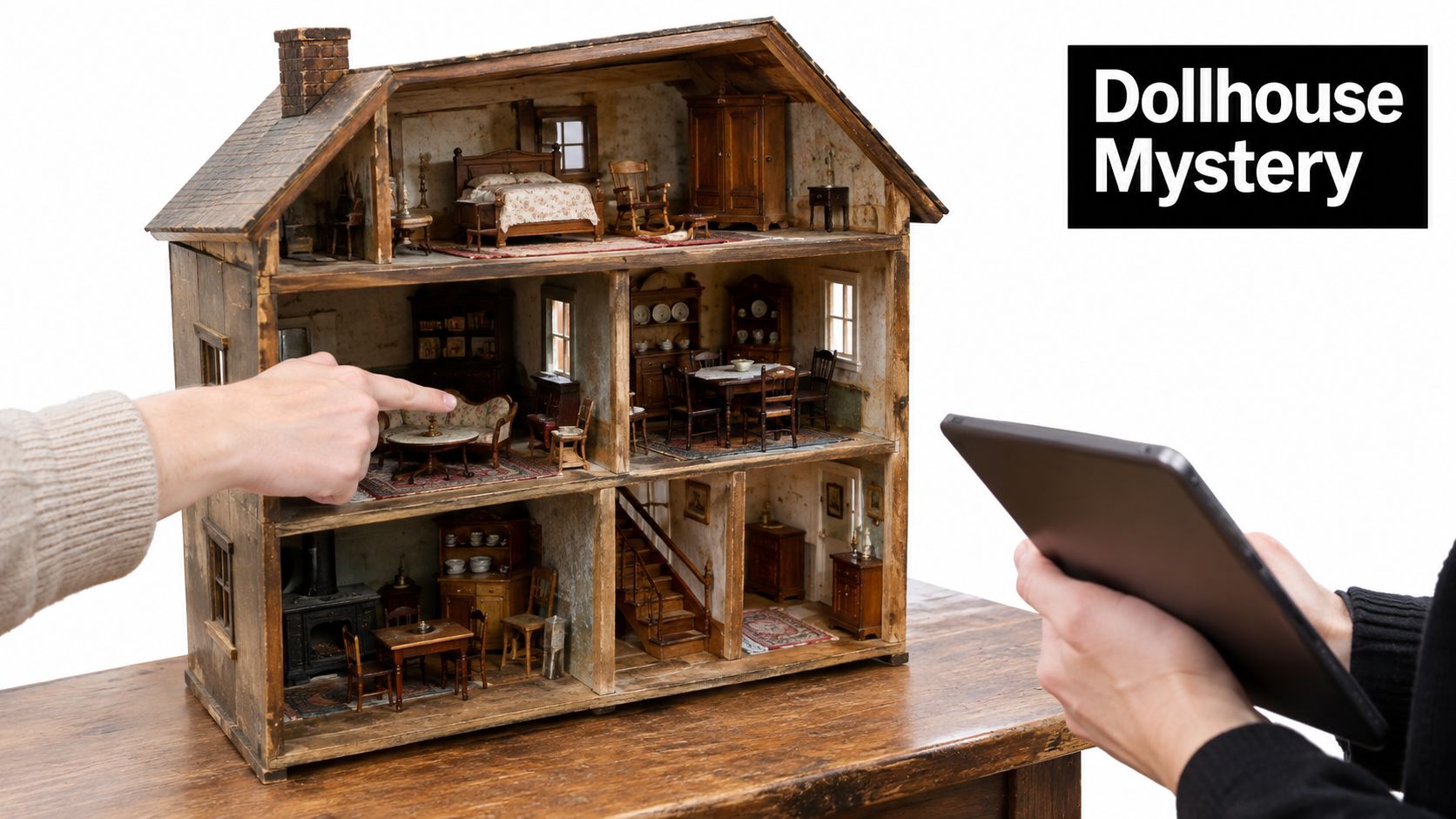
The Room: Old Sins is the strongest premium choice when you want a mobile station to feel like a miniature attraction. Its beautifully constructed dollhouse setting draws players into an investigation involving a mysterious disappearance, while interconnected rooms reward careful observation, tactile interaction, and logical thinking. The production quality gives the game more presence than a basic app, which matters when attendees are deciding whether to stop at your station.
The challenge is scale. Its full experience offers 8 to 10 hours of gameplay, so it isn't a sensible single-session activity for a busy festival. Treat it as a modular event feature instead. Run selected sections, invite teams to continue from a shared save point, or use a short challenge window that measures progress rather than completion.
Best event setup
Display the game on large tablets so several players can inspect the dollhouse and discuss discoveries together. A 15 to 20 minute slot works well during lunch or transition periods, especially when you're measuring progress instead of promising a complete finish. Put the station somewhere with controlled foot traffic and enough table space for people to gather without blocking the queue.
Old Sins suits corporate groups, university technology showcases, and educational programs focused on logic and reasoning. It also pairs naturally with Phantom's VR stations, creating a progression from screen-based investigation to immersive digital entertainment.
Planning advantage: Use progress, not completion, as the scoring method when a premium game is too long for your event schedule.
2. Escape Room The Game
Escape Room: The Game offers the most adaptable scenario structure on this list. Adapted from the board game, it presents 12 scenarios that move between detective mysteries and supernatural investigations. Each scenario provides a self-contained session of 45 to 60 minutes, combining visual puzzles, codes, and story objectives.
That structure makes it useful for corporate team-building, school programming, and university orientation events. It has enough narrative to feel like an activity rather than a random collection of brainteasers, but the scenario format also lets planners match the content to the audience. Families can start with a beginner scenario, while college groups or experienced teams can handle a more demanding option.
Turn a scenario into an event competition
A full scenario is better for a dedicated workshop than a walk-up station. For a larger event, demonstrate individual puzzles in 15-minute rotations, then reserve complete sessions for preassigned teams. Track completion times or puzzle progress across teams, but explain the scoring rules before play begins so the competition stays friendly.
Device preparation matters. Test the app, load the selected scenario, confirm audio levels, and provide a stable viewing position for each group. If you're comparing rental options, the mobile escape room rental guide can help you think through how a digital game fits beside physical attractions.
For a full event package, combine the game with laser tag or arcade activities. That pairing gives guests a change of pace after concentrated puzzle work and keeps the entertainment schedule moving.
3. Mystery Adventures: The Card Game
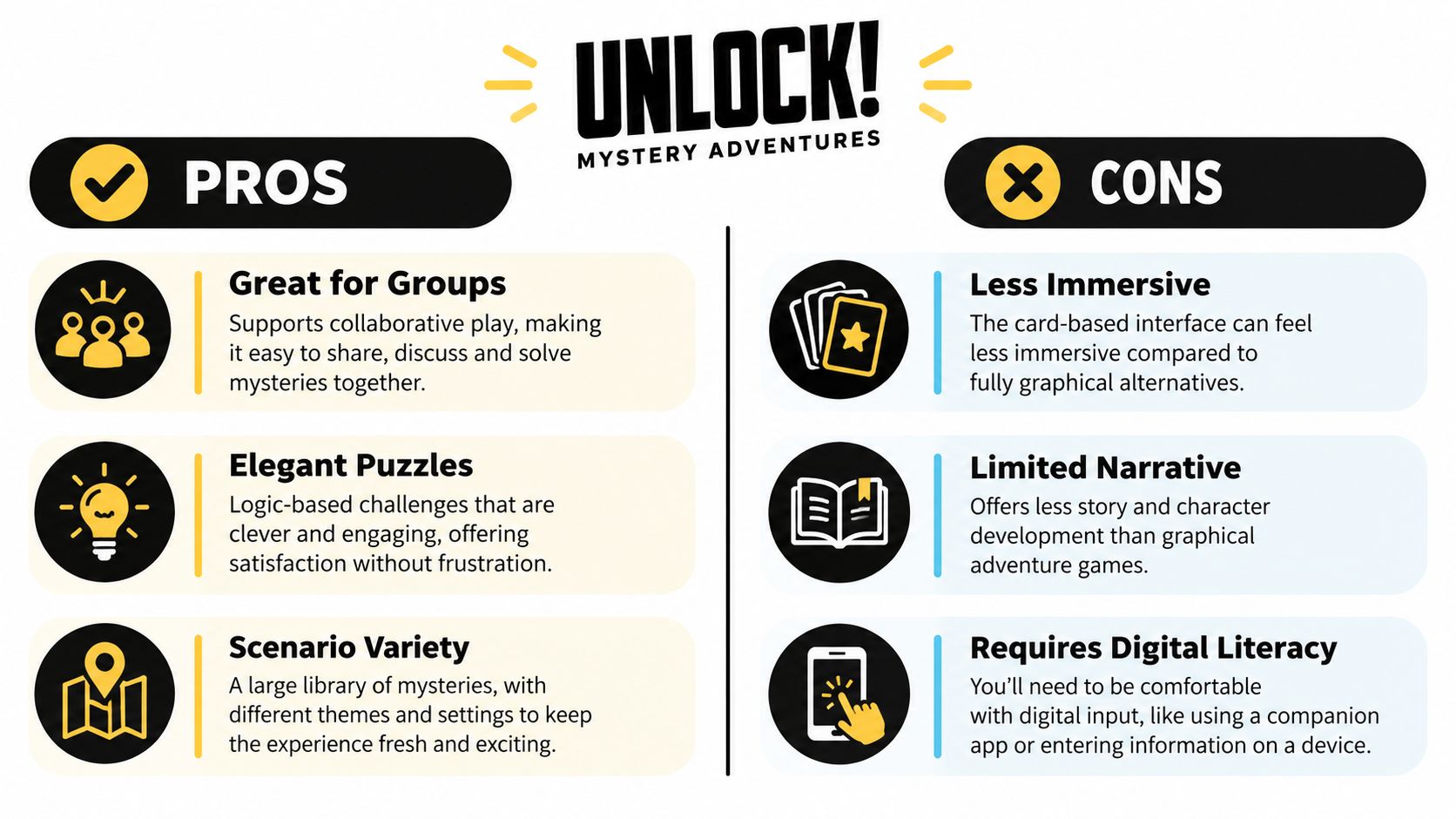
Mystery Adventures suits event planners who need social puzzle play without a visually elaborate setup. The digital version of this card-based mystery series uses symbols, codes, and layered clues. Players interpret information, enter solutions, and progress through more than 35 mystery scenarios, with individual adventures lasting 45 to 90 minutes.
Its strongest event role is a staffed table station for several groups playing in parallel. Place tablets at separate tables, then assign scenarios by age or experience. Younger players can choose accessible adventures, while adults and experienced students handle more complex missions. A projected screen can support larger-group voting, but keep controls with a small team to prevent confusion.
Where this game fits
This series is a strong choice for church youth programs, bar and bat mitzvah entertainment, community festivals, and family events. It creates conversation and teamwork without requiring a dedicated room or theatrical environment. A quiet pavilion, library room, classroom, or side area near food service can all work.
Run four or five simultaneous groups only when enough tablets and facilitators are available. Test each device, label stations clearly, display the scenario instructions, and set a simple rotation schedule. The longer sessions need protected time, so schedule them as booked activities rather than casual drop-in play.
Pair the game with a photo novelty booth, giving guests a low-pressure break between puzzle sessions. For corporate planners, the escape room corporate team-building resource offers guidance for connecting puzzle play with communication-focused programming.
Give every table one visible mission objective. Players collaborate better when they know what they're trying to accomplish next.
4. Mystery Escape Room Adventures
Mystery Escape Room Adventures is the practical budget-friendly option for events that need variety. The collection offers more than 50 scenarios, ranging from detective stories to science-fiction adventures, and includes real-time multiplayer play. That breadth helps planners avoid forcing every group into the same theme, especially at family days or orientation events where interests vary sharply.
The free-to-play structure can reduce the barrier to testing the format, but it also shifts responsibility to the organizer. Download scenarios before the event, verify that saved progress works, and test every device under the conditions you expect onsite. Don't assume a venue's Wi-Fi will support a crowded activity area.
Build a multiplayer leaderboard
Assign mixed-department teams for a corporate picnic or summer event, then record completion progress or fastest finishes. For school field days, rotate groups through scenarios hourly and use beginner content for younger participants. University events can use more challenging missions and remote participation when some students can't attend in person.
The best pairing is another competitive attraction, such as laser tag or arcade games. Puzzle teams get a quieter, analytical activity, then move to something more physical. That contrast makes the overall program feel more balanced. For planners assembling a larger package, these corporate event entertainment ideas can help place a mobile puzzle station within the full schedule.
5. 100 Doors Room Escape
100 Doors: Room Escape is the best filler activity for tight schedules. Its minimalist design presents a sequence of door-based puzzles that increase in complexity. Players focus on observation, logic, and creative interaction without needing to follow a long narrative or learn an elaborate interface.
That simplicity gives the game a clear event advantage. You can invite someone to try a challenge, explain the controls quickly, and move the person along without disrupting the rest of the program. It's particularly effective at school field days, family fun days, university waiting areas, and meal periods when guests have only a few free minutes.
Keep the line moving
Set a 10-minute limit per player and publish it at the station. A high-score board can turn short sessions into a tournament, but record results consistently. Decide whether you're measuring fastest completion, highest door reached, or best team performance. Changing the scoring method midway will create unnecessary arguments.
Use several tablets if the event attracts steady traffic. Place the score display where people can see it while waiting, and keep chargers or power banks out of walking paths. The clean interface also makes it a useful transition activity beside physical attractions from Phantom Entertainment, including larger rides or competitive stations.
The trade-off is atmosphere. This game won't carry a themed pavilion by itself. Add signage, a timer display, or a simple mission prompt if you need the station to feel more like branded entertainment.
6. Escape Room Mystery Word
Escape Room: Mystery Word is a smart pick when your audience includes strong readers, word-game fans, or participants who prefer language-based puzzles to visual searching. The game combines hidden words, anagrams, cryptic clues, and mystery narratives. Its collection includes more than 100 themed cases, with difficulty that can suit casual players or more experienced puzzle groups.
The strongest event use is team communication. One player may spot a word pattern, another may recognize an anagram, and a third may understand the story clue. Mixed-skill teams usually make better use of the format than groups built around identical abilities, so assign teams intentionally at corporate events or educational programs.
Match the audience to the puzzle style
Mystery Word works well for corporate team-building programs that emphasize communication, language arts activities, senior community events, church gatherings, and community-center programming. It's also a useful counterpoint to action-oriented attractions. Place it near arcade games or a family activity area so guests can choose between verbal reasoning and fast-paced play.
Don't market it as a universal replacement for an escape room. Younger children or guests with limited reading confidence may disengage if the clues feel too dense. Provide an easy entry challenge, allow teams to ask for clarification, and avoid placing the station in a loud area where players can't discuss clues.
A strong facilitator can keep the game welcoming by asking teams to explain their reasoning instead of just announcing answers. That turns the activity into a shared problem-solving exercise instead of a test of spelling speed.
7. Escape Room Submarine
Escape Room: Submarine is the best atmospheric selection for a retreat or workshop with protected time. Its underwater setting uses audio and visual cues, interconnected systems, and cinematic storytelling to make players feel responsible for navigating a mysterious facility. The game offers approximately two to three hours of gameplay, which immediately separates it from quick festival stations.
Schedule a dedicated 2.5-hour block rather than trying to squeeze it between lunch and another attraction. The venue should provide a quiet pavilion, conference room, classroom, or private area away from loud music and competing announcements. Sound is part of the puzzle experience, so a noisy event floor will weaken the game even if the devices run perfectly.
Use it as a leadership activity
Submarine suits university leadership workshops, corporate off-sites, and team-building sessions centered on communication. Assign roles within each group, give teams a clear briefing, and let a facilitator monitor progress without solving every problem for them. The longer run time gives participants space to practice listening, delegation, and shared decision-making.
It pairs well with Phantom's VR experiences when you're creating an extended immersive block. The two formats share a technology-driven feel, but they produce different behaviors. Submarine emphasizes group coordination around a common environment, while VR can give participants more individual immersion.
The main limitation is throughput. A long session serves fewer rotating attendees than a short game, and the atmosphere depends heavily on sound control. Choose it because you have protected time and an appropriate room, not because the theme sounds impressive on a general activity list.
8. Escape Room Lost City
Escape Room: Lost City favors exploration over rapid trial and error. Players investigate an ancient temple, search for clues, decipher scripts, and solve location-based puzzles. The environmental storytelling rewards teams that divide observation tasks and share discoveries, which makes it a natural fit for educational and family programming.
The theme gives planners an easy connection to school field trips, history programs, anthropology events, and adventure-themed family days. A teacher can frame the activity around evidence gathering and interpretation without pretending that the game replaces curriculum. Students still get a playful reason to examine details, discuss possibilities, and explain how they reached a conclusion.
Design the station for group viewing
Use large tablets or a shared display so players can see the environment together. A 45 to 60 minute slot works for field trips and dedicated educational sessions, but it's too long for a casual queue unless you run a demonstration version. Assign a facilitator to keep groups from crowding around one device and to remind players which areas they've already searched.
Lost City pairs well with outdoor attractions when the broader event has an adventure theme. Guests can move from digital archaeological discovery to physical activities without the transition feeling random. At a birthday or family day, encourage adults and children to search together rather than letting one experienced player control the entire device.
Its limitation is pacing. Thorough exploration can frustrate guests who expect constant action, so explain the game's investigative style before play begins. Choose it for audiences that enjoy discovery, not for a high-speed competition where every group needs a quick finish.
9. Brain It On Physics Puzzles
Brain It On! isn't a traditional escape room, but it belongs on this list because it creates the same core behavior: teams analyze a problem, test a solution, and revise their approach. Players draw shapes and structures to connect objects, avoid obstacles, and reach objectives in interactive physics environments. The game includes more than 300 levels and community-created content, giving organizers plenty of material for repeat challenges.
This is the strongest option for STEM events, science fairs, school field days, engineering demonstrations, and corporate innovation workshops. It also broadens the audience beyond people who already enjoy mystery narratives. A participant who doesn't care about coded doors may still want to design the most efficient bridge or invent the most creative solution.
Score more than speed
Set separate categories for fastest solution, most elegant solution, and most creative approach. That prevents one quick solver from dominating every round and gives different types of thinkers a reason to participate. In a classroom, ask teams to explain why their structure worked. In a corporate workshop, use the discussion to explore iteration, communication, and tolerance for failed attempts.
Run short challenge rounds at tablets placed near arcade or technology attractions. Give each team the same objective and reset devices between attempts. Make sure the facilitator understands the level before presenting it, because some puzzles invite multiple successful solutions while others depend on a narrower interaction.
The game's lack of an escape narrative is both its strength and its limitation. It's excellent for problem-solving, but it won't deliver a haunted-room or archaeological adventure. Use it when the event's identity centers on creativity, science, or innovation.
10. Crimson Room Escape Room Crimson
Crimson Room is the classic introductory choice. Its minimalist locked-room design asks players to inspect objects, recognize relationships, solve mechanical puzzles, and enter codes. Updated versions preserve the elegant logic of the original while refining controls and presentation.
That simplicity makes it useful for family fun days, gaming communities, design classes, and educational technology discussions. New players can understand the basic escape-room loop without first learning a complicated narrative system. Place the game on several tablets and let attendees compare progress, then use a visible leaderboard for a light competition.
Make the classic feel intentional
Use Crimson Room as a short orientation activity before a physical escape-room installation. Participants can learn to search, share observations, and test solutions digitally, then apply those habits in a larger attraction. It also works as a discussion prompt in game-design or interface-design classes because every interaction has to communicate clearly through a restrained visual system.
The trade-off is presentation. A minimalist room won't create the same visual impact as a premium dollhouse, submarine, or temple environment. Add a short facilitator introduction, a themed sign, and a clear mission statement if the station needs to compete with louder attractions.
Crimson Room is best when you want accessibility, recognition, and quick onboarding. It's less suitable as the centerpiece of a large themed event unless you deliberately frame it as a historical or design-focused experience.
Top 10 Mobile Escape Room Games Comparison
| Product | 🔄 Implementation Complexity | ⚡ Resource Requirements | 📊 Expected Outcomes | ⭐ Key Advantages | 💡 Ideal Use Cases |
|---|---|---|---|---|---|
| The Room: Old Sins | Medium, intricate, multi-layered puzzles | Tablets/phones (large tablets recommended); offline; premium purchase | Deep engagement; 8–10 hrs play; strong collaborative problem-solving | Exceptional production & atmosphere ⭐⭐⭐⭐ | Corporate team-building, university showcases, small group stations |
| Escape Room: The Game | Low–Medium, scenario-driven, progressive difficulty | Phones/tablets; stable internet for some features; optional IAPs | Multiple 45–60 min sessions; replayable across scenarios | Wide scenario variety; built-in hint system ⭐⭐⭐ | School field days, family events, timed competitions |
| Unlock!: Mystery Adventures | Low, card-based, logic-focused design | Tablets/phones; minimal graphics; automatic hint progression | 45–90 min scenarios; smooth group collaboration | Elegant puzzle design and large scenario library ⭐⭐⭐ | Family nights, birthday/teen stations, rotating group play |
| Mystery Escape Room Adventures (Free) | Low–Medium, many scenarios with multiplayer | Devices + reliable internet for real-time multiplayer; free model | High accessibility; ongoing engagement via daily challenges | Large library and multiplayer access (cost barrier removed) ⭐⭐ | Budget events, remote team-building, university orientations |
| 100 Doors - Room Escape | Low, bite-sized, progressive door puzzles | Any mobile device; offline optional; free with IAPs | Short plays (5–15 min); ideal for high-rotation stations | Quick, minimalist puzzles with large content bank ⭐⭐ | Quick-rotation event stations, waiting areas, casual players |
| Escape Room: Mystery Word | Low, hybrid word/escape mechanics | Devices; offline available; free with premium opts | Accessible verbal problem-solving; reliable offline play | Appeals to word-game audiences; hybrid mechanics ⭐⭐ | Language/educational events, senior/community gatherings, corporate verbal-skills |
| Escape Room: Submarine | High, interconnected systems and real-time management | Tablets/phones; quiet/dedicated space; premium purchase | Deep immersion; 2–3 hr sessions; intensive team engagement | Cinematic atmosphere and unique theme ⭐⭐⭐⭐ | Corporate retreats, university workshops, dedicated demo spaces |
| Escape Room: Lost City | Medium, exploration-heavy with multiple solution paths | Tablets/phones; moderate session time; premium purchase | Exploratory engagement; educational discovery value | Rich visuals, multiple solution paths ⭐⭐⭐ | School field trips, family adventure days, history-themed events |
| Brain It On! - Physics Puzzles | Medium, drawing-based mechanics with creative solutions | Touch devices (stylus optional); free with optional premium content | Encourages creative STEM problem-solving; many levels & user content | Open-ended solutions; strong STEM/creative appeal ⭐⭐⭐ | STEM events, engineering demos, creativity competitions |
| Crimson Room / Escape Room: Crimson | Low, classic point-and-click elegance | Any device; low resource footprint; free/premium versions | Quick 30–45 min plays; instructive for game design | Genre-defining elegant puzzles and simplicity ⭐⭐⭐ | Introductions to escape rooms, quick rotation stations, educational demos |
Choose the Game That Fits Your Event Flow
Start with the schedule, not the app store. If guests will arrive and leave continuously, choose short, repeatable formats such as 100 Doors: Room Escape or Crimson Room. These games work as waiting-area entertainment, meal-period activities, and rotating school stations because players can understand the objective quickly and leave without disrupting a long narrative.
For festivals and family fun days, prioritize games that tolerate interruptions and mixed experience levels. Mystery Escape Room Adventures offers scenario variety and multiplayer flexibility, while Escape Room: Mystery Word gives language-oriented guests a different way to participate. Brain It On! adds a STEM angle for science fairs, engineering events, and innovation-focused programs. These options work best when the station has clear instructions, a visible time limit, and a facilitator who can reset devices between groups.
Corporate events need a different structure. For a team competition, choose modular scenarios from Escape Room: The Game, assign balanced teams, and use completion progress or puzzle performance as the scoring basis. Unlock!: Mystery Adventures also works well when several groups need different scenarios, particularly if you can provide enough tablets and table space. If your event is a retreat with protected time, Escape Room: Submarine creates a more concentrated group experience, but its long session and sound requirements make it unsuitable for casual drop-in traffic.
Audience interest should guide the theme. Select Lost City for family exploration and history-connected programs, Mystery Word for language and communication, Brain It On! for creative problem-solving, and Old Sins when premium visual atmosphere matters. Market growth also supports taking portable formats seriously. Independent research values the global escape room market at USD 2.5 billion in 2025 and projects USD 4.9 billion by 2032, with mobile escape rooms identified as the fastest-growing category at a 10.5% CAGR from 2026 to 2032 in the cited market research. For event planners, that points toward products designed for quick setup, fast resets, flexible themes, and high-throughput use.
Before booking, confirm the practical details:
- Devices: Decide whether the organizer, venue, or rental provider supplies tablets, chargers, stands, and backup equipment.
- Connectivity: Ask whether each game works offline, and download content before guests arrive.
- Sound: Check whether audio is essential and reserve a quieter room or pavilion when it is.
- Group size: Confirm how many people can collaborate comfortably around each screen.
- Accessibility: Ask about readable text, touch controls, seating, visual complexity, and alternatives for guests who don't want to use a device.
- Schedule: Match session length to the event's actual transitions, not an idealized timetable.
- Content access: Verify that the selected scenarios are available on the required devices and operating systems.
- Staffing: Assign someone to explain rules, track turns, troubleshoot, and protect the queue from bottlenecks.
Digital gameplay works best as one layer of a broader event plan. A mobile puzzle station can fill transition time while guests wait for laser tag, arcade games, VR, photo novelties, outdoor attractions, or a meal service. It shouldn't be expected to carry every entertainment need, particularly when the event includes large crowds, young children, or guests with different comfort levels.
Phantom Entertainment can help planners build a broader turnkey package around digital gameplay, with delivery, setup, and professional operation for eligible attractions. The company serves events across Pennsylvania and the Mid-Atlantic, including school field days, university programs, corporate gatherings, birthdays, church events, and community festivals. Visit Phantom Entertainment to review current planning details and discuss how a mobile escape room can fit into your venue, audience, and schedule.
Phantom Entertainment offers mobile escape rooms alongside laser tag, arcade games, virtual reality, photo novelties, inflatables, and other event attractions. Visit Phantom Entertainment to request planning support and build a coordinated entertainment package around your mobile escape room station.
Ready to Book Your Event?
PA state-inspected, fully insured since 1979. Call us or get a free quote today.