
You're standing at the back door, trying to work out whether the lawn can hold a bounce house, a popcorn stand, and enough games to keep children busy. On Saturday afternoon, you want a cheerful midway. Right now, you've got a sloping patch of grass, an outdoor outlet, and a gate you haven't measured.
The best backyard carnival party ideas start with those details. A ticket booth needs somewhere for arriving guests to gather. Ring toss needs room behind the players. A bounce house needs its approved setup area, not just enough grass to squeeze it in.
Think of the yard as connected activity zones rather than a collection of rentals. Put simple games where an adult can see the players, keep food queues out of walking routes, and give operator-run attractions their own space. These fresh backyard party setup ideas can help you arrange seating, shade, and gathering areas around the entertainment.
Start with staffing: An adult who can see the whole yard still can't supervise a ride, serve hot food, and manage game prizes at the same time.
Choose the attractions you can run comfortably. Then add the stripes, tickets, and carnival signs.
1. Classic Carnival Game Midway
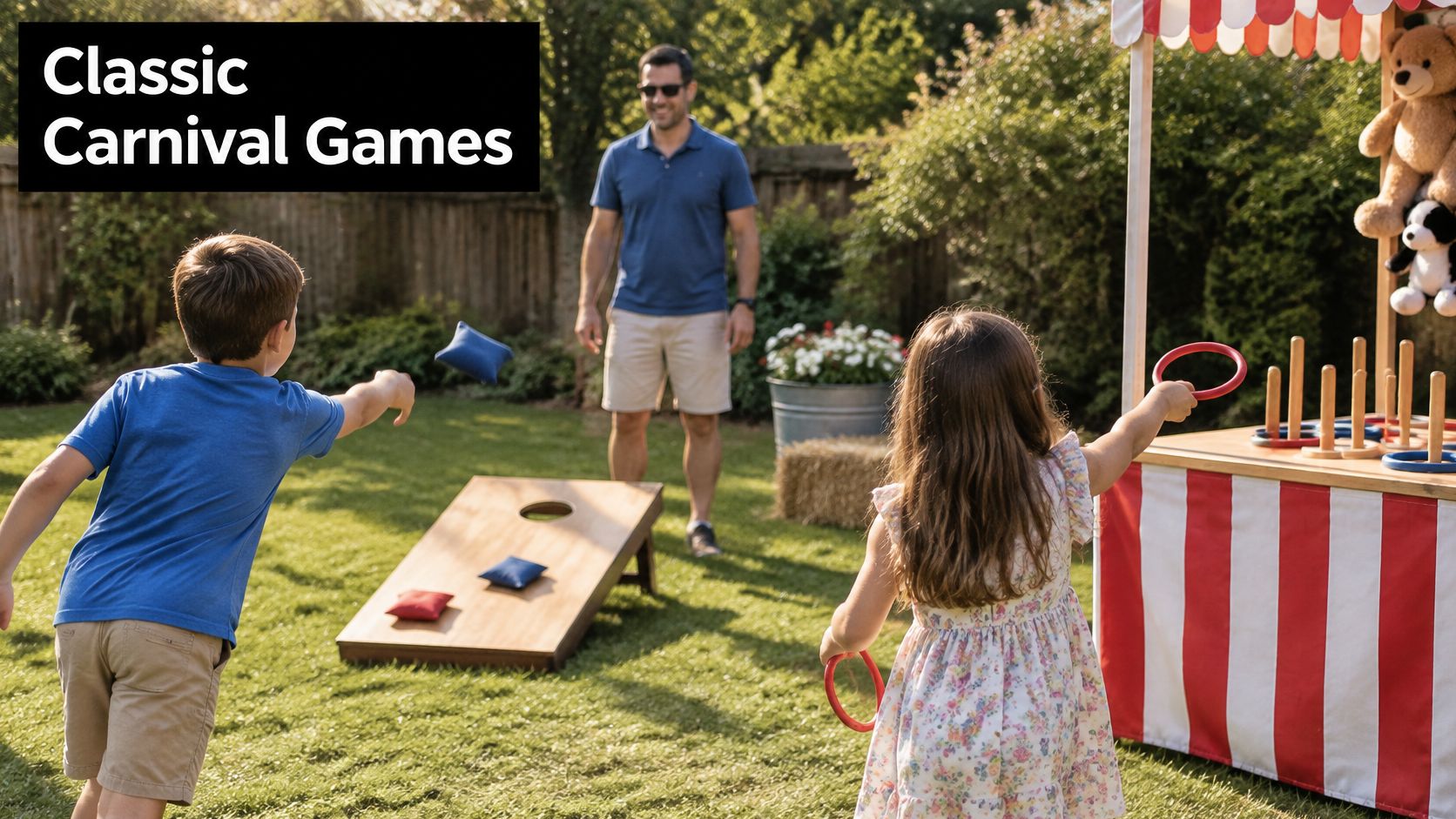
Ring toss, bean bag toss, and milk can knockdown make a practical starting point because they don't need power. Arrange them along the yard's edge, with players facing away from food, windows, and passing guests. Leave retrieval space behind each target.
For a family birthday, place the throwing lines beside each other so an adult can watch the players without turning away from another game. That arrangement works for low-risk tabletop and tossing activities. It doesn't make that adult available to supervise an inflatable too.
Size the midway around the game cycle
Count how many people can actively play, not how many can stand near a booth. A game that needs constant resetting will move guests more slowly than a ring toss with a basket of rings ready to use. Test your homemade games before deciding how many to include.
- Short turns: Give players a clearly defined set of throws, then let the next guest step forward.
- Adjustable difficulty: Mark nearer throwing positions for younger children and offer a seated option.
- Separate prizes: Put redemption beside the midway rather than at a busy game counter.
- Safe retrieval: Stop play before anyone walks forward to collect bags, balls, or rings.
DIY works well for painted targets and sturdy bean bag boards. Compare the setup of combined carnival games when you want a coordinated arrangement without building separate booths.
Skip sharp balloon darts for an open, mixed-age backyard. A soft throwing game is easier to manage, and it avoids scattered balloon fragments. Keep shade and a first-aid kit close without blocking the playing area.
2. Inflatable Bounce House and Obstacle Course Zone
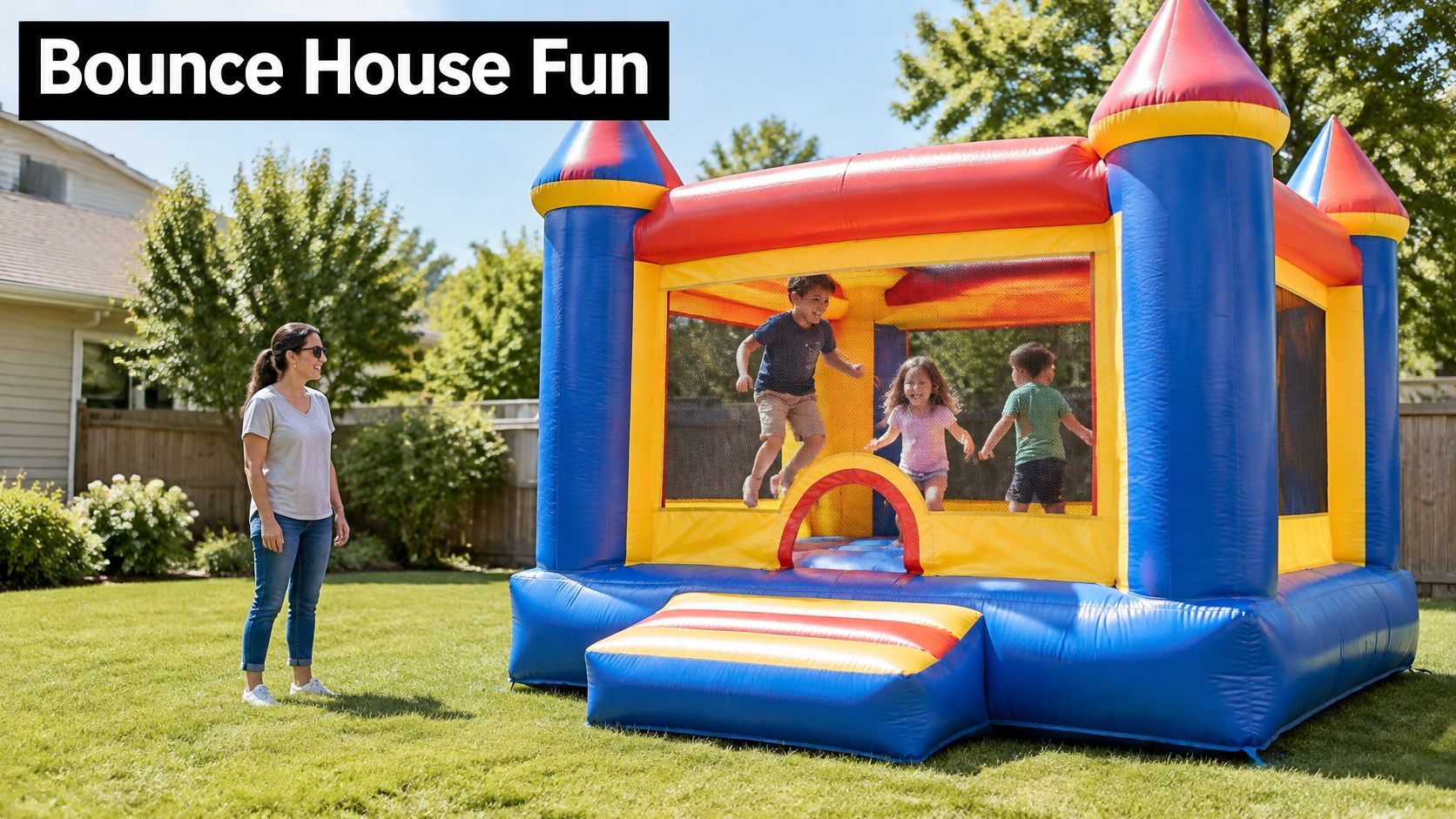
The inflatable's advertised dimensions aren't its complete operating footprint. You also need the specified clearances, blower space, anchoring area, and an entrance where children can remove shoes without blocking the queue.
For a school family gathering, separate younger children from larger, more active participants through scheduled turns or suitable separate equipment. Don't assume a tall child and a small child belong in the same session because they arrived together. The equipment's rider limits control admission.
The Consumer Product Safety Commission's amusement-attraction guidance calls for following manufacturer instructions on anchoring, rider capacity, rider size, electrical requirements, and inspection. Build those requirements into the layout before booking.
Give this zone dedicated supervision
Review inflatable attraction options against the usable yard, delivery route, and available electrical supply. A long obstacle course may suit active guests but leave too little room for seating and accessible circulation.
- Ground: Remove sharp debris and identify slopes, irrigation components, and underground services before planning anchoring.
- Power: Confirm the equipment's electrical load and approved cable arrangement. Don't assume nearby outlets use separate circuits.
- Queue: Keep waiting children away from blowers, anchors, and the exit.
- Weather: Record the equipment-specific shutdown conditions and who has authority to close the attraction.
We provide delivery, setup, professional operation, and venue-ready safety documentation. Those services don't eliminate the host's job of keeping the surrounding routes clear.
If you can't staff this zone properly, leave it out. A busy inflatable isn't a self-service activity, even when parents are sitting nearby.
3. Mechanical Bull Challenge
A mechanical bull makes sense when your guest list leans toward eligible teens and adults who enjoy being watched. It makes less sense when most guests are young children or when the only suitable surface sits directly across the route to the bathroom.
Plan it as an operated attraction, not an oversized lawn game. The operator controls the ride, admission, and shutdown. The host keeps spectators, drinks, and unrelated activities outside the designated operating area.
For a graduation party, use a voluntary riding session while friends watch from the approved spectator boundary. Let guests decline without turning it into a dare. Don't make riding a condition of joining a team or winning the main party prize.
A waiver doesn't replace trained operation, suitable equipment, or a clear spectator boundary.
Check the operating arrangement
The ASTM amusement-ride standards program covers design, testing, operation, maintenance, and other attraction-specific practices. For your event, the useful question is whether the selected equipment has a documented inspection and operating process, not whether someone describes it as commercial grade.
When considering mechanical bull rentals, reserve space for the entire padded area, controls, access, and spectators. Confirm the approved setup surface and electrical requirements before committing that part of the yard.
Post the equipment-specific eligibility rules where guests can read them before queuing. Any competition should use an operator-approved format that doesn't encourage riders to ignore instructions or push beyond their comfort.
Keep alcohol service away from the riding queue and let the operator make admission decisions. If the attraction consumes nearly all your usable space, choose a smaller activity rather than squeezing seating and food into its clearance area.
4. Mobile Zip Line and Rock Wall Adventure Zone
A mobile zip line or climbing wall belongs on your shortlist only after you've checked delivery access and operating clearance. A large lawn behind a narrow gate may still be unsuitable. Tree branches, overhead wires, slopes, and the approach from the street all matter.
For a company family day on a spacious property, a climbing wall can serve eligible older children and adults while younger guests use nearby ground-level games. Keep those games outside the attraction's controlled area. Nearby shouldn't mean underneath climbers or across a landing route.
Measure the complete attraction area
Use a tape measure and photographs to document the entrance, turns, surface changes, and overhead obstructions. Request equipment-specific layout confirmation before treating the booking as settled.
- Zip line: Allow for the launch structure, travel path, landing or braking area, and controlled access.
- Climbing wall: Include the base, climber movement, belay operation, harness fitting, and waiting area.
- Staffing: Leave harness checks and operation to trained attraction staff.
- Guest suitability: Communicate the applicable age, size, weight, and clothing requirements before guests join the queue.
This mobile zip line video gives a visual reference for the attraction style.
Harness fitting and instruction affect how quickly guests move through the activity. Don't promise everyone an immediate turn, and don't schedule a group meal while much of the guest list is waiting to participate.
Plan operation during good visibility and within the equipment's weather limits. If your yard can't accommodate the full setup, don't improvise a shorter route or tighter boundary. Choose an attraction that fits the property instead.
5. Classic Carnival Concession Stands
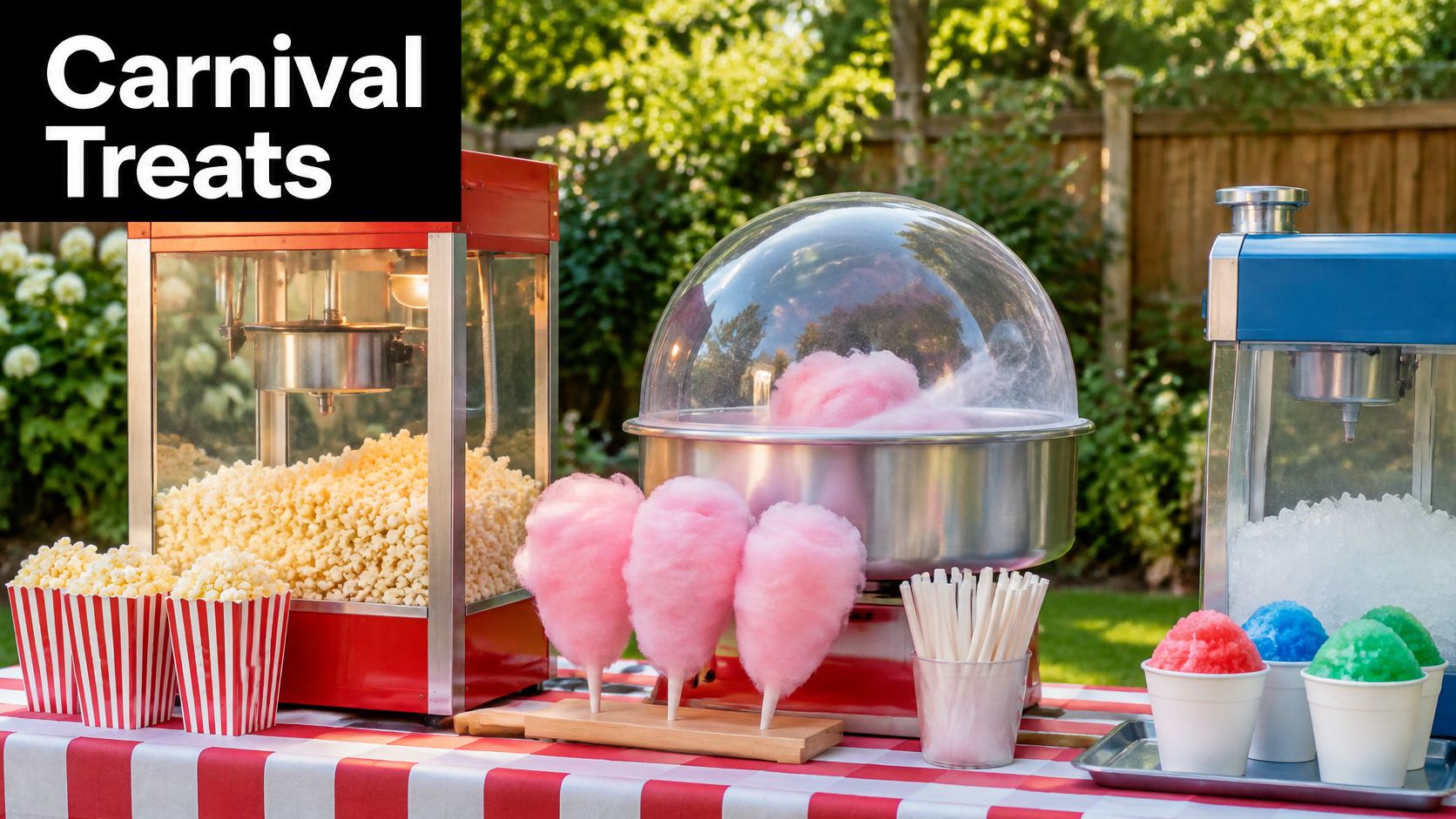
Popcorn, cotton candy, and snow cones create the carnival atmosphere without an elaborate menu. The trade-off is labor. Making treats live is entertainment, but it also creates a service job.
At a neighborhood birthday, serve prepared savory food separately and make a fresh carnival treat the concession feature. A host trying to fry funnel cakes, refill drinks, and greet arrivals will struggle to keep the counter moving. Keep hot oil out of guest-accessible areas, and skip live frying unless you have a properly managed cooking setup.
Design the counter from the staff side
Draw the working arrangement before dressing the table. Ingredients, serving containers, handwashing access, waste, and finished orders all need places that don't overlap. If the operator crosses the queue to reach napkins, the layout is wrong.
- Power: Check each machine's requirements and map the supply with the other powered attractions. Two machines on one household circuit may not run together.
- Food information: Keep ingredient packaging available and identify allergen concerns without promising an allergen-free setup.
- Queue direction: Put ordering at the approach and collection farther along the counter so guests with their orders step aside.
- Cold storage: Separate food storage ice from ice intended for drinks or snow cones.
Use a timed practice run to judge service capacity. Make one serving, hand it over, and time it. Multiply by your guest count for a realistic queue estimate. If preparation takes longer than guests will wait, simplify the menu, prepare suitable portions ahead, or add a dedicated server. A decorative stall doesn't increase output.
Waste needs its own plan. Servingware, packaging, and leftovers pile up quickly even at a modest gathering. Position a bin at the counter exit so used cups and sticks leave with the guests who finished them.
Choose reusable items where washing is practical. Use compostable alternatives only when your disposal service accepts them.
6. Arcade and Mini Golf Corner
Not every guest wants to bounce, climb, or compete in front of a crowd. Mini golf and arcade games provide a lower-pressure activity zone, especially when children, grandparents, and coworkers share the same event.
A birthday-preference survey published by Chuck E. Cheese found that 65% of children ages 6–7 preferred an elaborate celebration, compared with 56% of tweens ages 10–12, according to their parents. That doesn't prescribe your activity list. It does reinforce why you should ask about preferences rather than assume every age group wants the same party.
Separate relaxed play from quiet rest
Arcade sound and conversation can still be busy. Put quiet seating elsewhere, away from speakers, blower noise, and flashing screens.
For a multigenerational family party, arrange mini golf so players move forward without crossing another hole's putting line. Leave room for a seated player to approach suitable holes, and don't make keeping score compulsory. Provide a place to set down clubs before guests leave the course.
Arcade cabinets need a suitable level surface and protection from moisture. A lawn that looks flat can still leave equipment unstable, while a tent alone doesn't make indoor equipment appropriate for outdoor use.
Layout judgment: Put the waiting space beside the activity, not across the route everyone else needs to use.
DIY mini golf works when you can secure the playing surfaces and test the obstacles. Loose household objects may move during play and create trips. Rentals make more sense when you need consistent equipment without spending the preparation period building a course.
Count active players and allow somewhere comfortable to wait. A relaxed attraction stops feeling relaxed when spectators crowd the controls or putting area.
7. Photo Novelty Booth
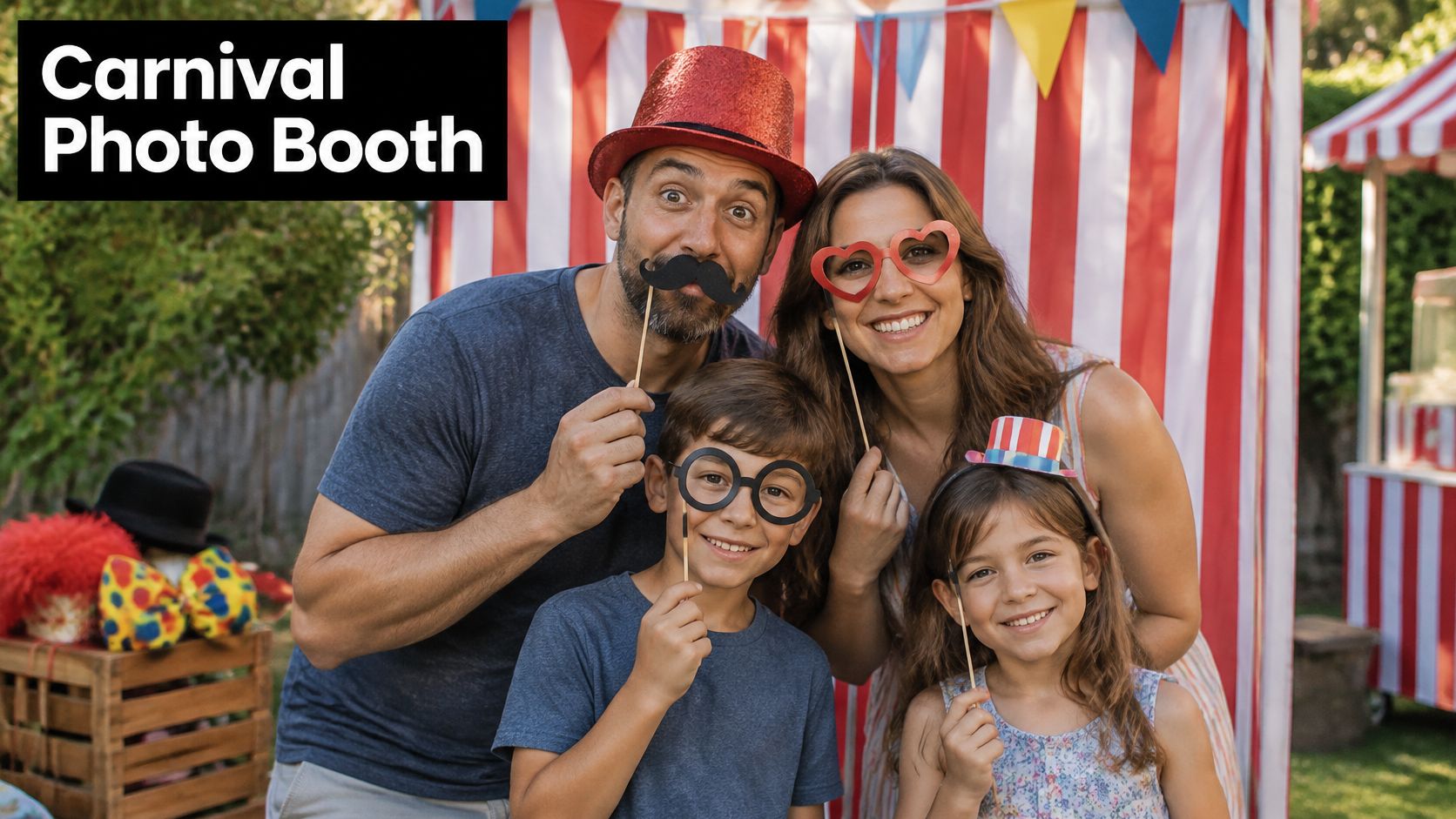
A photo station fits a small yard, but its queue can spread farther than the backdrop. Put it near a social area, not beside the entrance or across the food counter. Guests need space to choose props, arrange themselves, and step away after the picture.
For a graduation carnival, use a striped backdrop, a school-color frame, and handheld signs. Keep the prop selection manageable. A crowded table of tangled hats and glasses slows each group and gives the attendant more resetting work.
Choose DIY or staffed service
A phone stand and secured backdrop can work for an informal family party. Test the framing with seated and standing guests, and check the light at the planned event time. Shade is useful only if it remains in the right place as the sun moves.
A staffed setup makes more sense when guests need help with group photos, printing, or digital delivery. Those tasks compete with queue management, so define what the attendant will handle.
- Stable equipment: Secure the backdrop using a suitable support system and approved ballast.
- Clear access: Leave an approach that doesn't require stepping over supports or cables.
- Guest consent: Ask before sharing images, especially photographs of children.
- Simple sharing: Test any event album or QR code before displaying it.
Don't place a public-upload code where guests could mistake it for a private delivery service. Explain who can view the album and whether photos will be used beyond the party.
Keep paper or handheld props that guests can use without wearing them. They're easier to rotate than shared costume pieces, and guests who don't want props can still join the photograph.
8. DJ, Karaoke, and Dance Party Stage
Music can tie the carnival together, but a stage isn't always necessary. A protected DJ position, a clearly marked dance area, and suitable sound coverage may fit a backyard better than a raised platform.
For a company picnic, use background music while guests eat and play, then schedule karaoke or a dance session as a shared activity. Announce the change before increasing the volume. Guests who came to talk should still have somewhere comfortable to sit.
Treat sound and power as layout decisions
Aim speakers toward the event area rather than neighboring properties. Check applicable local noise rules and agree on an end time before sending invitations. Tell nearby neighbors what you're planning instead of waiting for a complaint.
- Electrical supply: Include audio equipment in the power plan alongside concessions and inflatable blowers.
- Cable routes: Keep cables out of paths where possible and protect unavoidable crossings with suitable cable covers.
- Weather protection: Keep equipment dry and follow its operating requirements.
- Program control: Give a named person responsibility for announcements and schedule changes.
Karaoke needs more management than a playlist. Someone must collect requests, choose appropriate versions, adjust microphones, and move between singers. A self-service machine can become a bottleneck when guests need help finding songs.
If you add a foam dance activity, give it a separate suitable area with its own operating plan. Don't direct foam toward electrical equipment, food service, or the main walking route.
Use music for clear transitions, such as opening prize redemption or announcing the final activity. Constant announcements interrupt conversation and make important instructions easier to miss.
How the 8 Backyard Carnival Ideas Compare on Space, Power, and Staffing
Read this table as a load check before you book anything. The Power Needed column tells you how many outlets and circuits the layout has to reach. The Staffing Level column tells you how many adults the day requires.
| Item | Best For | Space Needed | Power Needed | Staffing Level |
|---|---|---|---|---|
| Classic Carnival Game Midway | All ages and casual competition | Booths along a walking path | None; hand-powered games | Minimal supervision per booth |
| Inflatable Bounce House and Obstacle Course Zone | Active kids and teens | Flat, open area with clearance | Power for blowers | Adult supervision or operator monitoring |
| Mechanical Bull Challenge | Teens and adults seeking a challenge | Level, open area with padding | Power connection | Trained operator and spotter |
| Mobile Zip Line and Rock Wall Adventure Zone | Older kids, teens, and adults seeking adventure | Significant open space with runway and clearance | Depends on the operator's equipment; confirm the supply before booking | Trained operators |
| Classic Carnival Concession Stands | Carnival treats and guest gathering | Food-safe prep and serving area | Power for machines | Staff to serve and manage food safety |
| Arcade and Mini Golf Corner | Relaxed, multi-generational play | Level ground and space for the course | Power for arcade units | Low supervision |
| Photo Novelty Booth | Themed photos and guest keepsakes | Shaded area with good lighting | Phone charging and optional lighting only | Low; one staff member can manage the queue |
| DJ, Karaoke, and Dance Party Stage | Group entertainment and dancing | Stage and dance area | Power for sound and lighting equipment | DJ or entertainment operator |
Two patterns matter here. The rows requiring a trained operator usually mean staff arrive with the rental, so they add less to your volunteer count than the table suggests. The midway, arcade corner, and photo booth draw little or no power, which makes them the attractions one adult can realistically watch while the staffed rentals run themselves.
Your Carnival Plan, Start to Finish
Start with a measured sketch of the yard. Mark the gate, delivery route, trees, slopes, outlets, water access, and bathroom route. Then draw each attraction's complete operating footprint, including queues, anchors, controls, and spectator space. A booth that looks small on paper can need twice its footprint once the line forms.
Keep high-energy attractions together where their boundaries can be managed. Put concessions near suitable services, simple games within clear sightlines, and quieter seating away from speakers and blowers. Maintain an unobstructed route through the event for guests and emergency access.
Give every zone an owner and a budget
Write a named person beside each staffed activity. Include breaks and a backup contact, particularly when the host is also greeting guests or managing food.
Visibility across the yard helps coordination, but it doesn't replace dedicated attraction supervision. One adult watching the whole layout can spot a wandering toddler near a blower faster than three adults each guessing who covers what.
Set the budget around your priorities rather than trying to reproduce a fairground. In a 2024 What to Expect survey of 404 U.S. women who were pregnant or had a young child, respondents spent an average of $314 on a child's birthday party, excluding gifts. Treat that as context, not a rental allowance or a promise of what your event should cost.
Separate essential spending from optional entertainment. Food, suitable power, safe setup, staffing, and weather arrangements come before elaborate decorations. DIY signs and simple games are sensible savings; improvised ride operation isn't.
Make the weather decision before guests arrive
Choose a deadline for deciding whether to proceed, postpone, or use a reduced indoor plan. Record the attraction-specific weather limits and identify suitable shelter for guests. A canopy isn't a substitute for a safe lightning plan.
Walk the fallback layout as carefully as the outdoor version. Don't move hot equipment, powered games, and a full guest list into a crowded garage because it has a roof. Explain changes through the same channel you used for invitations.
Build a loose running order around arrival, food, featured activities, prize redemption, and closing. Leave time for guests to move, wash hands, and take breaks rather than scheduling every moment.
We offer a Multi Booth Carnival and support kids and grad parties with planning and delivery across Central Pennsylvania. Before requesting a plan, gather your yard measurements, guest age mix, event priorities, and staffing limits. That information helps turn an attractive list of ideas into a setup you can host.
Phantom Entertainment offers carnival games, inflatables, and professionally operated attractions for backyard celebrations and larger events. Visit Phantom Entertainment with your event date, location, yard measurements, and guest mix to discuss a carnival setup that fits your space and staffing needs.
Ready to Book Your Event?
PA state-inspected, fully insured since 1979. Call us or get a free quote today.